English

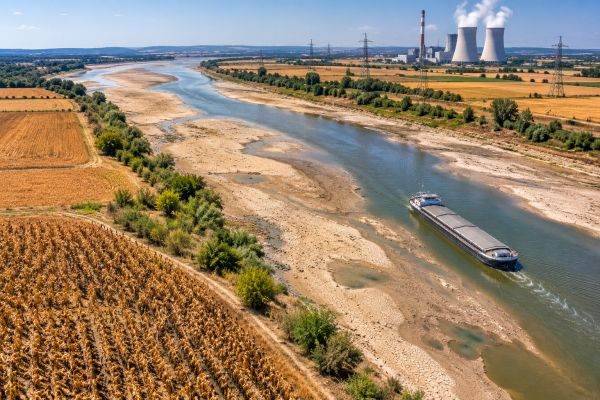
The heatwaves and drought affecting Europe this summer could wipe out almost 1% of the European Union's gross domestic product, the equivalent of around 180 billion euros, according to an analysis by the Dutch bank Triodos. The effects are not limited to agriculture, the reduction in labor productivity, disruption of river transport, pressure on energy systems and increased costs for companies and administrations turn the meteorological phenomenon into an economic risk with implications for the entire European economy. Triodos' estimate comes at a time when much of Europe is facing extreme temperatures, a deficit of precipitation and very low levels of major rivers. In some regions, the problems have already begun to affect agriculture, energy production and logistics chains. The analysis describes not only the direct costs of drought and high temperatures, but also the indirect effects of slowing economic activity. When employees work less efficiently, crops fail, transport is restricted and power plants struggle to produce energy, losses spread from one sector to another.
• Labour productivity, the first channel through which heat hits the economy
One of the most important economic effects of extreme temperatures is reduced labour productivity. Triodos estimates that the reduction in economic activity caused by heat is the main component of the estimated euro180 billion expected to be lost to the European economy this year. Very high temperatures affect both outdoor activities and work in industrial or commercial spaces. Concentration and physical exertion decrease, and employers are forced, in some cases, to reduce working hours or reorganise activities.
A report cited by Euronews shows that, after exceeding the 30 degrees Celsius threshold, labor productivity can fall by about 3% for every additional degree, while energy demand can increase by about 1.2% for every degree, due to the use of cooling facilities. The phenomenon is important for Europe because its economies are heavily dependent on sectors in which physical activity, transport and industrial processes have a significant share.
• Agriculture - drought, lower harvests and higher prices
Agriculture is one of the sectors most exposed to the combination of high temperatures and lack of precipitation. Drought reduces the availability of water for irrigation, while extreme temperatures affect crop development and can accelerate their maturation. The European Commission has already revised downwards some estimates of agricultural production. According to the European Commission's Joint Research Centre, repeated heat waves have shortened the grain filling period of winter crops and hastened the harvest. Winter crop yields have been cut by 1%-4%, and the outlook for total cereal production is now around 1% below the five-year average.
• In some regions, the effects are much more severe.
Italy, one of Europe's leading agricultural producers, is facing a difficult situation in the Po Valley, where drought has drastically reduced the availability of water for rice crops. Reuters reports that some farmers have been forced to abandon part of their cultivated areas in order to save the rest of their production. Financial losses in the province of Pavia could exceed 100 million euros, amid higher production costs and reduced harvests. The problem does not stop with farmers. Lower harvests can mean higher food prices, additional imports and inflationary pressures. In this way, a local climate shock can turn into a macroeconomic problem.
• Europe's rivers are becoming a problem for industry
The drought is also having a less visible but important effect on the European economy: it is affecting river transport. Extremely low levels on the Rhine have begun to disrupt freight transport in Germany, and companies are being forced to look for alternatives to supply raw materials. According to the Financial Times, the water level at Kaub, one of the important monitoring points on the Rhine, has dropped to a level that is about a third below the previous record in 2018. Under these conditions, the transport of raw materials such as coal, oil and other industrial products is becoming increasingly difficult. Several German states have temporarily suspended the traditional ban on truck traffic on Sundays to allow road transport to take over some of the burden. The Rhine is no longer able to carry the goods efficiently. ING estimates that the disruption to transport could reduce Germany's economic growth by around 0.3 percentage points in 2026. This is relevant for the entire European economy because the Rhine is one of the main logistical arteries for German and European industry.
• Energy under pressure
High temperatures increase electricity consumption, especially for cooling buildings and industrial sites. At the same time, drought can limit the ability of some power plants to operate at normal parameters. The problem is related to the availability of water needed to cool certain power plants. When river levels drop too much or the water temperature rises excessively, power plants can be forced to reduce production. Reuters reported that this summer's heatwave has already caused several European nuclear power plants to reduce production, as high temperatures and low river levels affect access to water for cooling. At the same time, demand for electricity for air conditioning and other cooling systems is increasing. The result is an unfavorable combination: higher consumption at a time when the production of certain power plants is constrained.
• Romania enters the risk zone
Romania is not spared by this combination of risks. The very low level of the Danube has already begun to create problems for the energy system. According to Reuters, Romania is facing difficulties in maintaining the operation of the Cernavoda nuclear power plant, due to the decrease in the level of the Danube. One of the plant's two reactors has already been shut down, and the authorities have adopted emergency measures to maintain the water needed to cool the remaining reactor. Forecasts indicated that the Danube level would continue to decrease at least until August 16. The situation is all the more important as the Cernavoda power plant makes a significant contribution to Romania's electricity production. A reduction in nuclear production may force the energy system to turn to other sources of production or imports to a greater extent.
The authorities have also declared a state of energy emergency for August and have called for a voluntary reduction in electricity consumption, according to Reuters.
• Romanian agriculture vulnerable to drought
Romania is, in turn, one of the European economies exposed to climate risks, especially through agriculture. The OECD shows that our country is vulnerable to rising temperatures and drought risks, with effects on agriculture, energy systems, transport, water management and infrastructure. In a recently published analysis, the Dutch authorities note that Romania, one of the main agricultural producers in the European Union, is facing increasing pressure on water resources, reduced soil moisture and less predictable rainfall in several regions. The risk for Romania is an economic one in general, not just agricultural. Lower production means reduced income for farmers, higher costs for processors and, in certain situations, higher prices for consumers. Romania is also a major exporter of cereals, which means that the evolution of agricultural production has implications for the trade balance and export revenues.
• Drought begins to affect supply chains
A particularity of the current crisis is that the effects can no longer be viewed separately by sector. A poor harvest can cause food prices to rise. A low river level can make transport more expensive. Reducing the production of a power plant can increase the need for energy imports. High temperatures can reduce employee productivity and, at the same time, increase companies' energy bills. Thus, the total economic cost is greater than the sum of the losses directly caused by drought or heatwave. A European study analyzed by researchers from the European Central Bank shows that the effects of heatwaves do not disappear immediately after temperatures return to normal. Research indicates a reduction in economic activity in the first year of approximately 1%, with effects that may remain visible later. This perspective is important for economic policy because it suggests that extreme weather events should not be treated exclusively as temporary events.
• Costs can be passed on to inflation
One of the main secondary economic consequences of drought and heat waves is pressure on prices. When agricultural production falls, food supplies are reduced. At the same time, production costs can increase due to additional irrigation, energy, feed or transport needs. On the energy side, intensive use of air conditioning increases electricity demand, and production problems power plant closures can limit supply. In the case of transport, river restrictions can shift goods to more expensive and energy-intensive road transport. All of these mechanisms can fuel inflationary pressures, at a time when the European economy is already facing other sources of uncertainty.
• From weather phenomenon to structural economic risk
What distinguishes the current situation from a regular drought is the scale of the simultaneous effects. Europe is facing problems in agriculture, transport, energy and public health at the same time. Reuters has shown that heat waves, drought and fires have already had effects on agricultural production, river transport and energy systems. In some regions, extreme temperatures have also put additional pressure on health systems. In this context, Triodos' estimate of the loss of around 1% of European Union GDP should be seen not only as an estimate of the damage caused by the summer of 2026, but also as a signal of the economic cost of not adapting European infrastructure to more severe temperatures and droughts.
The European Environment Agency stresses that adaptation to climate change is becoming essential to reduce risks to infrastructure, the economy and people. Among the necessary measures are more resilient infrastructure to extreme events, more efficient water management and the development of solutions that reduce the vulnerability of cities and regional economies.
• Investing in adaptation becomes an economic issue
For governments, the issue thus shifts from managing damage to financing adaptation. Investments in water networks, irrigation systems, energy infrastructure, electricity grids, transport and more energy-efficient buildings entail significant costs in the short term. However, the lack of such investments can generate much greater losses when extreme weather episodes occur. Experience this summer shows that European infrastructure was designed in a period when such phenomena were rarer or less intense. Current river levels and recorded temperatures are testing essential logistics and energy systems. For Romania, the problem is even more sensitive. The OECD estimates that the country is insufficiently prepared for some of the climate pressures, given its aging infrastructure, existing pressures on water systems and the low energy efficiency of a significant part of its buildings.
• Europe pays the bill for climate change
The estimate of euro180 billion is not just an accounting of lost crops or damage caused by drought. It includes the broader effect of a climate shock on economic activity: less effective work, lower agricultural production, more expensive transport, pressure on energy and additional expenses for companies and authorities. Given that Europe is warming faster than other regions of the world, such episodes could become more frequent and more expensive. For the European economy, the question is no longer just how much this summer's heatwave will cost, but how much it will cost to maintain an infrastructure and economic models insufficiently adapted to new climate conditions.






















 Euro
Euro Dolar SUA
 Franc elveţian
 Liră sterlină
 Gram de aur