 English
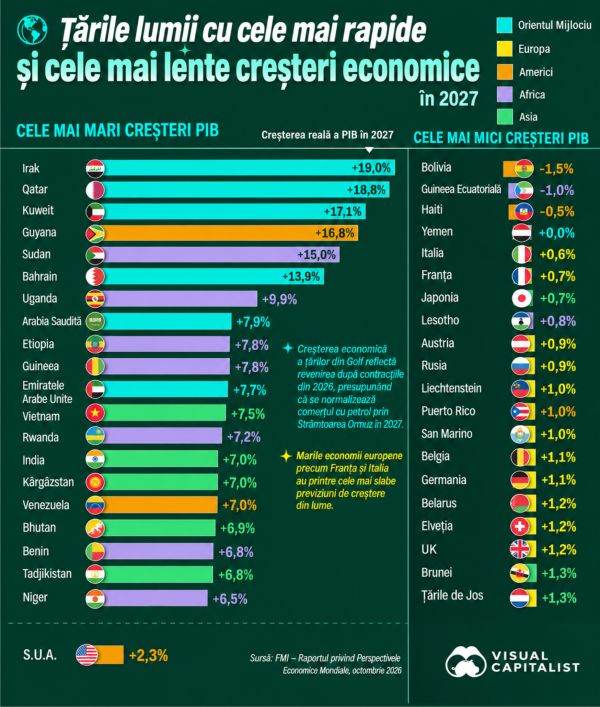
The Middle East is expected to lead global economic growth in 2027, as an anticipated post-war recovery supports a rebound in energy production and exports. However, this forecast hinges on maritime traffic through the Strait of Hormuz returning to pre-war levels, according to visualcapitalist.com.
The source presents a ranking of the world's fastest- and slowest-growing economies for 2027, based on projections from the IMF's "World Economic Outlook" report, released this month.
• Where the fastest economic growth will occur in 2027
Iraq, Qatar, and Kuwait top the global ranking, with each of these economies projected to grow by more than 17% next year. These growth forecasts follow severe contractions in 2026, including declines of 16% in Iraq, 15.6% in Qatar, and 16.7% in Kuwait. The IMF estimates that maritime shipping through the Strait of Hormuz will gradually resume starting in March 2027, returning largely to pre-war conditions by October.
Outside the Middle East, Guyana ranks fourth, with a growth rate of +16.8%, maintaining its rapid expansion as offshore oil production grows. Vietnam (+7.5%) and India (+7%) are also among the fastest-growing economies, bolstered by manufacturing exports and domestic consumption.
• Countries with the slowest economic growth
Bolivia (-1.5%), Equatorial Guinea (-1%), and Haiti (-0.5%) are the only economies projected to contract in 2027. Several major advanced economies also appear toward the bottom of the list. Italy, France, and Japan are expected to see growth of less than 1%, while Germany and the United Kingdom are forecast to expand by only 1.1% and 1.2%, respectively.
In Europe, high energy costs are weighing on consumption and industrial activity, the source notes. Furthermore, intensifying competition from Chinese exporters is expected to dampen economic growth in the EU through 2028, as European producers face mounting pressure in both domestic and foreign markets. Overall, economic growth in the eurozone is projected at just 1.2% in 2027, compared to 2.3% in the United States. For European governments, these modest prospects emerge against a backdrop where mounting commitments in defense and infrastructure are placing additional strain on already constrained public finances.
• IMF: Europe Must Accelerate Growth and Reduce Borrowing
European economies need to achieve a faster pace of growth or borrow less in order to keep debt on a sustainable path, according to the IMF, which warns that countries in the region must take action.
The Eurozone is projected to grow by 1.1% this year and 1.2% next year-figures similar to those estimated in April-the IMF forecasts, as reported by Reuters and Agerpres.
"About three-quarters of European countries will need a combination of structural reforms-to boost growth and ease spending pressures-and deficit-reduction measures averaging around 3.5% of GDP over the medium term to keep debt sustainable," the IMF indicated this month.
Fiscal consolidation, as outlined in the EU's medium-term structural fiscal plans-which each member state must agree upon with the European Commission-averages about 2% of GDP; the IMF argues that this falls short of what is required in some countries.
"Even these consolidation measures could prove challenging, given the IMF's assessment that the necessary fiscal consolidation efforts are underestimated in most countries," the international financial institution notes. "Approximately a quarter of European states will require consolidation measures exceeding 5% of their GDP to keep public debt sustainable-a level generally higher than what has proven feasible in the past. Consequently, the scope of government activity must be re-evaluated, and the role of the private sector expanded to bridge the gap," the IMF suggests.
In May, the European Commission projected that the EU's debt-to-GDP ratio would rise from 82.8% in 2025 to 84.2% in 2026, and further to 85.3% in 2027. Within the Eurozone, debt is expected to climb from 88.7% in 2025 to 90.2% in 2026, reaching 91.2% by 2027.
"Given the long-term spending challenges facing most European countries-linked to an aging population, increased defense expenditure, and the ongoing energy transition-public debt could rise substantially absent changes to economic policies," Mateusz Szczurek, head of the IMF's European Department, told Reuters. He warned: "In some Central European states, which are experiencing faster growth, the pace at which this debt accumulates could be even higher."
According to the IMF, the primary obstacle to accelerating growth in Europe is weak productivity. The Fund urges governments to remove barriers within the EU's internal market and to invest in innovation and the expansion of companies.


























 Euro
 Dolar SUA
 Franc elveţian
 Liră sterlină
 Gram de aur






























Reader's Opinion