English


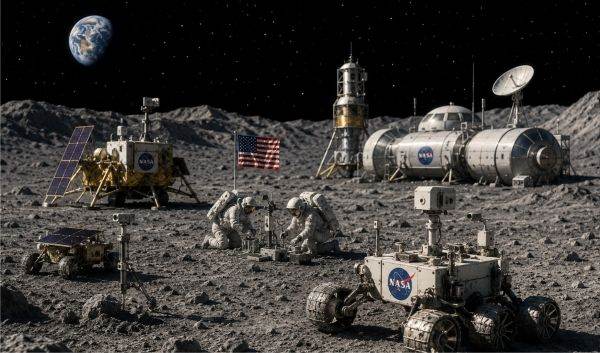
NASA has announced the launch of four new lunar missions, part of a larger program aimed at building a future base on the surface of the Moon. The projects, developed together with three American companies specializing in lunar robots, have a cumulative budget of approximately 600 million dollars and are part of the long-term strategy of the American space agency, AFP reports.
• Robots and experiments for the lunar "construction site"
The new missions will have the role of transporting scientific instruments and experimental technologies to the Moon, intended to prepare the infrastructure of the future base. Among the priorities are testing robotic systems and assessing ground conditions, in an area considered essential for future lunar landings. The project complements other missions announced by NASA in May, part of a visible acceleration of the American lunar program.
• Plans hit by setbacks and technological adjustments
The announcement comes amid a complicated context for the US lunar program, which was recently hit by the explosion of the New Glenn rocket, developed by billionaire Jeff Bezos' Blue Origin company. The incident delayed some components of the transportation plan to the moon. However, NASA officials said they were analyzing "other options" for launching the lunar module developed by Blue Origin, in case the rocket is not available on time. The agency is also considering the involvement of other private companies to meet the mission schedule. "We intend to carry out at least one mission in 2026," said Carlos Garcia-Galan, NASA's head of the lunar base program.
• Possible mission reconfiguration and new technologies
To compensate for the delays, NASA is also exploring reorienting robotic vehicles originally designed for Mars, adapting them for use on the surface of the moon.
This technological flexibility reflects the increasing pressure to meet the agency's ambitious schedule, which includes the development of complex exploration systems and infrastructure.
After years of focusing on the Gateway orbital station, NASA announced a shift in strategy in March: the focus is shifting to building a ground base, for which it has allocated about $20 billion. The future base is planned near the lunar south pole, a region considered strategic due to the existence of water ice in the ground - an essential resource for supporting life and producing fuel.
• A new space race: US vs. China
The American project is part of a direct competition with China, which also aims to send human crews and build a base on the Moon. In this context, NASA is gradually developing its technological vision, which includes lunar modules, exploration vehicles, drones and, in the long term, infrastructure such as electrical grids and pressurized habitats. Although the plan remains in the development phase, the direction is clear: returning to the Moon is no longer an exercise in exploration, but the beginning of a possible permanent colonization.






















 Euro
Euro Dolar SUA
 Franc elveţian
 Liră sterlină
 Gram de aur