English

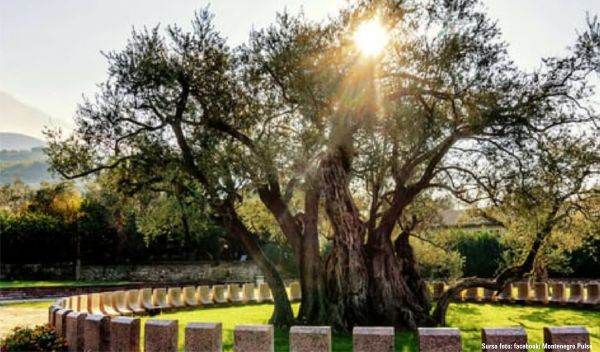
One of Europe's oldest olive trees, located in the village of Mirovica in Montenegro, is producing fruit again after several years in which specialists feared that the tree would die due to changes caused by urbanization. Considered a symbol of peace and longevity, the tree, which researchers attribute to an age of about 2,250 years, continues to be one of the country's most important tourist attractions, AFP reports.
• A legendary tree, saved by drainage works
Located between the Montenegrin Mountains and the Adriatic coast, the olive tree in the village of Mirovica has been, for centuries, a landmark for the local community. The tree, with an impressive trunk and branches twisted by the passage of time, has survived even the two major fires that affected the area in the last century. Four years ago, however, locals noticed that the tree was starting to dry up and gradually lose its vitality.
"It had started to degrade, to dry up,” said Marija Markoc, director of the Olive House, the institution responsible for preserving the region's olive heritage.
According to her, the main cause of the degradation was the rise in the water table, a phenomenon that local authorities blamed on accelerated urbanization and the sealing of land in the area. "The olive tree loves the sun, drought and stone,” explained Marija Markoc, emphasizing that excess moisture is one of the species' greatest enemies. Following drainage work carried out around the roots, the tree gradually recovered, and in October 2025 it produced olives again.
The tree's comeback coincides with the period in which it was officially assessed at approximately 2,250 years old. The estimate was made in 2015 by an international research team coordinated by a scientific laboratory in Turkey, which analyzed the biological characteristics of the tree. However, experts point out that determining the exact age of very old olive trees remains difficult. The growth characteristics of these trees make it almost impossible to identify the original trunk with certainty, which means that any dating involves a certain degree of interpretation. According to local tradition, the olive tree was brought to this area by Greek colonists in Antiquity, many centuries before the formation of the Montenegrin state.
• Symbol of peace and reconciliation
For the inhabitants of the village of Mirovica, whose name derives from the Slavic word "mir" ("peace"), the tree has a value that goes beyond its botanical importance. Legend has it that for generations, clans in conflict met under the shade of this olive tree to make peace and end disputes, transforming the tree into a symbol of reconciliation.
"We have managed to bring this place back to life and give this tree a sustainable existence,” said Marija Markoc. She described the conservation mission as a privilege, but also a huge responsibility, confessing that she is grateful that she is not part of the generation that would have witnessed the disappearance of one of Montenegro's most valuable natural monuments.
• Tourist attraction and object of local traditions
The thousand-year-old olive tree attracts tens of thousands of tourists from all over the world every year. Visitors follow an old local ritual, which involves circling the tree three times. Tradition says that the first circumambulation brings health, the second love, and the third is associated, depending on the version of the legend, with either luck or material prosperity. In early June, small green olives appeared again on its branches, confirming the second consecutive harvest after the rescue interventions and providing new reason for optimism for those responsible for the conservation of this exceptional tree. The recovery of the Mirovica olive tree is considered by specialists as an example of how restoration interventions and adaptation to the effects of environmental changes can contribute to the salvation of natural monuments with inestimable historical and cultural value.






















 Euro
Euro Dolar SUA
 Franc elveţian
 Liră sterlină
 Gram de aur