English


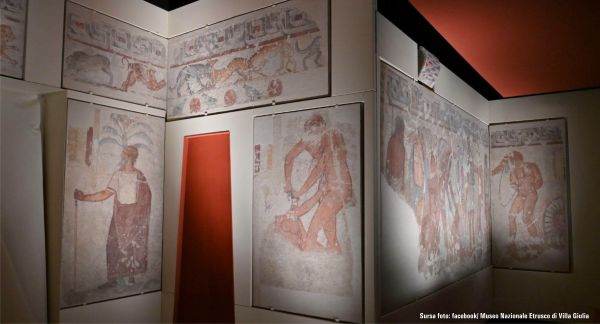
One of the most important artistic testimonies of Etruscan civilization has entered the Italian public heritage and is permanently exhibited at the National Etruscan Museum "Villa Giulia" in Rome. The Italian state has acquired the famous frescoes of the Tomb of Francis for 15 million euros, in an operation considered essential for the recovery of national heritage, Reuters reports.
• A masterpiece over 2,300 years old
Discovered in 1857 by archaeologist Alessandro François, the tomb is located in the ancient Etruscan city of Vulci, one of the most important centers of this civilization in central Italy, located north of Rome. The burial chamber is famous for its frescoes painted between 340 and 320 BC, which combine scenes inspired by Greek mythology with episodes from Etruscan history and traditions. "The Tomb of Francis is one of the greatest treasures of Etruscan archaeology and culture. It tells the story of families, gods and warriors from the Etruscan world,” said Luana Toniolo, director of the National Etruscan Museum "Villa Giulia”. According to her, the artistic value is amplified by the reinterpretation of Greek myths from the perspective of Etruscan culture, offering a rare insight into how this civilization built its own cultural identity.
• A window into the rivalries before the rise of Rome
The Etruscans dominated large territories in central Italy before the rise of Rome and decisively influenced the development of Roman religion, urbanism and institutions. The frescoes in the Tomb of Francis also offer an exceptional perspective on the conflicts between the city-states of the era. One of the scenes depicts Etruscan warriors defeating opponents identified by inscriptions as inhabitants of Rome and other rival cities. Among the most famous representations are the sacrifice of Trojan prisoners by Achilles, but also the liberation of an Etruscan nobleman by the warrior Mastarna, a character that the Roman emperor Claudius later identified with Servius Tullius, the sixth king of Rome.
"This is the only portrait of a king of Rome that has survived to this day,” Luana Toniolo emphasized.
• From private collection to national heritage
After its discovery, the tomb was located on the grounds of the aristocratic Torlonia family, and the frescoes remained in their private collection for over a century and a half, rarely accessible to the public. "This is our cultural heritage. It is very important for the origins and identity of our country and must belong to the state,” said the museum director. Many of the objects discovered in the tomb - Greek vessels, jewelry and bronze statuettes - were offered in the 19th century as payment to archaeologists and funders of the excavations. Over time, they have ended up in the collections of prestigious institutions, including the Louvre Museum in Paris and the British Museum in London.
• Symbolic reunion after more than 160 years
On the occasion of the inauguration of the new permanent exhibition, several European museums have lent the artifacts from the Tomb of François, so that they can be exhibited again together with the original frescoes, for the first time in more than 160 years. "When we announced that we would buy the Tomb of François, all the museums were delighted to participate in this project. It was an extraordinary international collaboration," said Luana Toniolo. The acquisition represents one of the most important recent steps by the Italian authorities to recover and valorize the national archaeological heritage, offering the public permanent access to one of the most spectacular creations of the Etruscan civilization.





















 Euro
Euro Dolar SUA
 Franc elveţian
 Liră sterlină
 Gram de aur