English

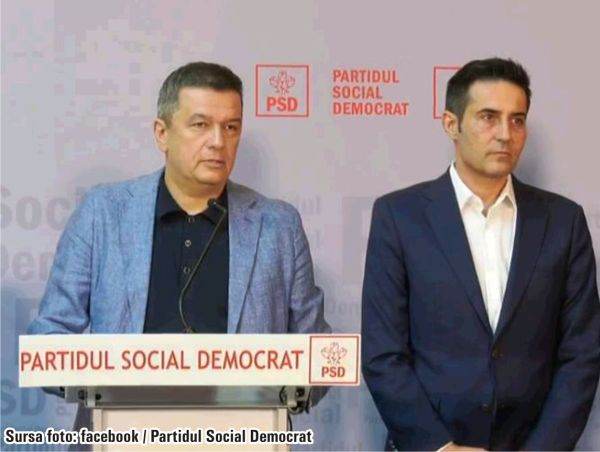
Ahead of today's consultations at the Cotroceni Palace, PSD announced yesterday, from Sinaia, through the voice of President Sorin Grindeanu, its willingness to return to government. Moreover, the Social Democrats also put on the table of the parliamentary parties a "decale" of national priorities, which would be included in the governing program for the future Executive that will lead the country in the next two years.
The Social Democratic leaders, gathered yesterday in the meeting of the National Political Council, adopted the respective agreement on the ten national priorities, after which Sorin Grindeanu declared to the press that PSD proposes two variants of government: one built around PSD and another minority, but which it is ready to support only on the basis of a clear program.
PSD proposes that the future Government receive a 24-month mandate and be evaluated according to the achievement of the ten priorities, not the political formula of which it is composed. Moreover, the Social Democrats demand that the program be established before the negotiation of ministerial positions and portfolios. Each priority must have identified funding, a deadline, a responsible person and a public indicator, and the Prime Minister and the ministers must accept the public evaluation of the results.
The ten priorities are the restoration of the energy system and the valorization of resources, national security and the development of the defense industry, the reindustrialization and financing of productive capital, the increase in collection and the fight against fraud, the reform of the state and public services, labor, income and demography, education, health and research, agriculture and rural development, infrastructure and strategic investments and the consolidation of Romania's European and Euro-Atlantic position.
In the field of energy, the Social Democrats demand a public audit of energy projects and a national calendar for the introduction of new production capacities, the modernization of networks, the development of storage and interconnections. The PSD also proposes a program for the production of energy equipment and services in Romania, as well as an updated inventory of mineral resources and critical raw materials.
In the field of defense, the PSD proposes the development of a national industry for ammunition, powders, vehicles, communications, software and dual-use technologies, as well as a national program for drones and interception systems, with the production in Romania of platforms, critical components and command software. Military procurement should include, where possible, technology transfer and the participation of Romanian industry.
Reindustrialization is another major component of the social-democratic plan that identifies energy, defense, agri-food processing, materials, technology, the pharmaceutical industry, digital infrastructure and the circular economy as areas around which the productive core of the economy could be rebuilt. The Investment and Development Bank would become the main public instrument for financing development, and SMEs and companies with export potential would benefit from stable guarantee and capitalization instruments.
In the fiscal field, the social-democrats argue that before introducing new burdens on taxpayers, fraud, evasion and waste must be attacked. The PSD proposes integrating tax, customs, commercial and patrimonial data into a single risk analysis system and focusing controls on large frauds and organized networks. The document also introduces a budgetary rule: permanent expenses must be financed from recurring revenues, and loans must be used for investments with a verifiable economic or social effect.
The state reform would include an audit of the central administration, state agencies and companies, a single public portal, a single digital account and a single electronic file for the relationship of citizens and companies with institutions. The Social Democrats also demand the elimination of redundant certificates and documents that the state currently requires although the information already exists in its databases.
On the social front, the PSD proposes a transparent mechanism through which the minimum wage would be correlated with productivity, the median wage and the cost of living, the expansion of collective bargaining and a "family package” that would include nurseries, kindergartens, affordable housing, flexibility at work and support for care.
Agriculture, in turn, enters the decalogue through a program for irrigation, water retention and soil restoration, the development of storage and processing capacities and support for cooperatives and voluntary associations.
An important element of the agreement is the control mechanism of the future Executive. PSD proposes the creation of a "public scoreboard", updated monthly by the Government, through which installed energy capacities, completed projects, collective incomes can be tracked, jobs, access to services and other assumed results.
The agreement also contains termination clauses. Violation of the constitutional, European and Euro-Atlantic orientation, unilateral modification of one of the ten priorities, repeated failure to comply with the budget, political protection of corruption, refusal to publish indicators or secret agreements regarding positions, contracts and budgetary allocations may determine the exit of any of the signatory parliamentary parties from the agreement.

















 Euro
Euro Dolar SUA
 Franc elveţian
 Liră sterlină
 Gram de aur