English


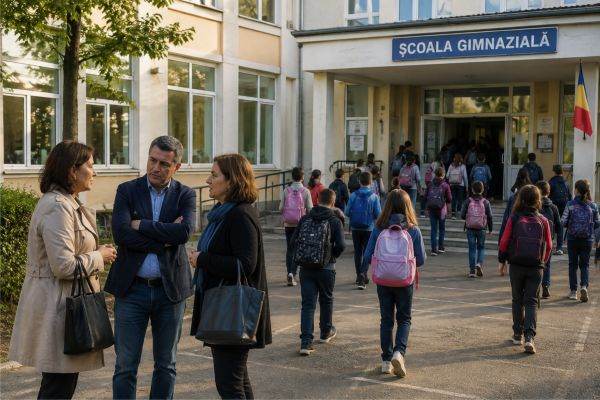
The 2026-2027 school year begins on Monday, September 7, in an education system that is entering a new phase of budgetary and administrative adjustments. Teachers continue to work with increased teaching hours, salaries remain one of the main sources of tension between the Government and unions, and the rules regarding student scholarships are still in the process of being modified. In parallel, Romania continues to have the highest rate of early school leaving in the European Union (according to Eurostat data), while the differences between urban and rural schools remain important.
The new school year begins with a series of changes already made to the system, but also with several decisions that have not yet been closed. If in previous years public discussions have focused mainly on the financing of education, infrastructure or exam results, in 2026 the pressure is increasingly shifting towards the cost of the system and the efficiency of spending public money. According to the Ministry of Education and Research, the 2026-2027 school year will begin on September 7 and end on June 18, 2027, with the school year lasting 36 weeks. For students in the 8th grade, the courses will end on June 11, 2027, and for students in the 12th and 13th grades, the courses will end on June 4, 2027, in the evening and with reduced attendance. The calendar is clear. However, the problems of the system are less simple.
• Teachers enter second year with increased teaching hours
One of the most important changes affecting teachers is the increase in the teaching hours, a measure introduced by legislation adopted in 2025 and also applicable in the 2026-2027 school year. For teachers in middle school, high school and post-secondary education, the teaching hours are set, during the period provided for by law, at 20 hours per week. For teachers with a teaching degree I or the title of emeritus professor who carry out mentoring activities, the hours are 18 hours. For practical training teachers and foremen-instructors, the hours are 26 and 22 hours, respectively, in the situations provided for by law. The regulations are also reflected in the methodology for the mobility of teaching staff for the 2026-2027 school year. The increase in the hours was one of the measures through which the authorities sought to reduce hourly pay expenses and use existing staff more efficiently. The Ministry of Education claimed that the measures introduced by Law no. 141/2025, including the increase in the teaching norm, the reorganization of the school network and the modification of the number of students per class, aimed to streamline expenses. However, education unions had a critical position towards these changes, considering that they increased the pressure on teachers. The problem is not only the number of teaching hours. For teachers, the increase in the norm comes in a context in which the teaching activity also involves preparing lessons, assessing students, administrative activities, communicating with parents and participating in various school activities.
• Salary, at the center of dissatisfaction
The discussion regarding teachers' incomes remains one of the most sensitive topics of the beginning of the school year. Education unions have challenged in recent months the way in which the new salary law is constructed and have demanded that education staff have an appropriate positioning in the salary scale. The dissatisfaction does not only refer to the level of salaries, but also to the relationship between income, responsibilities and working conditions. Union leaders have even warned of the possibility of some forms of protest at the beginning of the school year, in the context of negotiations on salaries. At the same time, the authorities must balance salary demands with the objective of reducing and controlling public spending. Education is one of the areas in which any salary increase has a significant impact on the budget, given the large number of employees in the system. However, there are also support measures distinct from salary for teachers. For example, in 2026, a teaching career bonus of 1,500 lei is foreseen (according to the Ministry of Education), intended for professional development and certain categories of expenses related to teaching activity. The Ministry has also recently modified the procedure for its use, including the deadline until which certain amounts can be used by teachers who remain in the system. However, the career bonus does not replace the discussion about the basic salary. For teachers, this represents a distinct benefit, while the issue of salary is about permanent income and the prospect of a career in education.
• Student scholarships, changed even before the start of classes
Another sensitive issue is that of bur selor. For the 2025-2026 school year, the methodology approved by Government Decision no. 732/2025 established an amount of 450 lei per month for the merit scholarship and 300 lei per month for the social and technological scholarships. However, these values represent the framework for the 2025-2026 school year and should not be confused with the final form of the rules for 2026-2027. For the new school year, the Ministry of Education discussed changing the way social scholarships are awarded, including the award period and the monthly amount. The Minister of Education and Research, Mihai Dimian, stated at the end of August that the total amount that will be allocated annually for a beneficiary and the way it will be distributed during the year must first be established. According to the minister, both the award period and the monthly amount were under public debate. The initial proposal to grant social scholarships only during the school year provoked public reactions. Later, Minister Mihai Dimian announced that he would not propose to the Government to reduce the annual support granted to beneficiary students and that the income threshold for eligibility would be increased, which could allow a larger number of children to access this type of support. Therefore, at the beginning of the school year, the issue of scholarships must be viewed with an important clarification: not all the elements discussed in the projects under debate represent definitive rules. For low-income families, however, the stakes are significant. The social scholarship is designed as an instrument to support participation in education and reduce the risk of dropout, and any change in the payment method can have direct effects on family budgets.
• Romania continues to have the highest rate of early school leaving in the EU
The issue of scholarships must be viewed in the context of an older vulnerability of the Romanian system. The latest Eurostat data show that the rate of young people aged 18 to 24 who left education and training early in Romania fell to 15.5% in 2025, from 16.8% in 2024. However, Romania remained in first place in the European Union, while the EU average was around 9.1%. The decrease is significant, but the gap with the European average remains large. In other words, Romania has taken a step in the right direction, but the problem is not solved. In addition, early school leaving and early leaving are not evenly distributed across the territory. Children in rural areas are much more at risk of dropping out of the system than those in cities, and access to teachers, support services, transport and other educational resources is more difficult in many rural communities.
• Rural school remains one of the great vulnerabilities
The differences between rural and urban areas represent one of the structural problems of Romanian education. In rural areas, schools face a combination of difficulties: smaller school populations, limited administrative resources, difficulties in recruiting teachers and reduced access to complementary services. The human resource issue is especially important for scarce subjects and for localities where commuting or working conditions make it more difficult to fill positions. In these conditions, increasing salaries is only one of the possible solutions. Housing conditions, transportation, job stability, access to professional training and the possibility of working in a school with sufficient resources are also relevant for attracting teachers to scarce areas.
• The reform of the school network also brings a social problem
The reduction of expenses has also led to reorganizations of the school network. The merging of some educational units and the modification of the number of students per class were presented by the authorities as necessary measures to make the use of resources more efficient. The Ministry of Education claimed that the effects of the reorganizations did not generate a major negative impact on the system. For small communities, however, closing or reorganizing a school can have effects that go beyond the administrative problem. The distance to the destination school can mean additional costs for the family and lost time for students.
Therefore, budgetary efficiency must be evaluated together with the social effects. A school may be more expensive in relation to the number of students, but maintaining it can have an important value for an isolated community.
• "Healthy Meals”, one of the programs with a social stake
In parallel with the measures to reduce expenses, the state continues to finance programs aimed at vulnerable children. The National "Healthy Meals” Program is one of these measures. For 2026, the program benefits from a funding of approximately 1.531 billion lei, and the estimated number of beneficiaries exceeds 540,000 children and students, according to data from the Ministry of Education. The program has a function that goes beyond The food component. For students from low-income families, providing a meal at school can contribute to attendance and reduce costs borne directly by the family. Such programs also show the difficulty facing education policy: the state must simultaneously reduce certain expenses and increase or maintain funding for social programs that prevent the increase in dropout.
• School results lag behind European objectives
The problem of education cannot be reduced to the number of teachers, salaries or scholarships. Ultimately, the essential indicator is what students manage to learn. Romania continues to have poor results in basic skills compared to European objectives, and the differences between advantaged students and those from vulnerable backgrounds are significant. These results are influenced by several factors: the training and stability of teaching staff, the socioeconomic conditions of families, access to early education, the quality of school management and the system's capacity to intervene quickly when a student begins to accumulate delays. In this sense, the problem of Romanian education is not only how much the state spends, but also where the money is directed and what results it produces.
The 2026-2027 school year thus begins at a time when Romania is trying to find a balance between austerity and investment in education.














 Euro
Euro Dolar SUA
 Franc elveţian
 Liră sterlină
 Gram de aur