 English



• Why Was the August Forecast Wrong?
September inflation, at 6.61%, exceeded the level forecast by the NBR in August by 0.73 percentage points, according to the November Inflation Report. The NBR writes that the deviation was mainly due to energy prices rising more than expected, following the renewed escalation of the conflict in the Middle East and the heatwave and drought in Europe.
The NBR revised its December 2026 forecast upwards in each of the four reports published this year. In February, the NBR forecast inflation of 3.9%, according to the Governor's February presentation. Three months later, it forecast 5.5%, according to the May presentation, and in August, 6.1%, as reported by BURSA. The forecast for December 2027 has risen from 2.9% in February to 3.7% now.
In each of the three reports, the NBR assumed that oil would be cheaper than it actually was. The NBR now estimates the average Brent oil price in 2026 at $94.9 per barrel, when three of the four quarters have already ended. In February, the NBR assumed an average of $61.7, or $33.2 less. In May, following the outbreak of the conflict in the Middle East, it estimated $84.8, or $10.1 less.
In August, the NBR assumed a Brent price of $76.87 per barrel in the third quarter of 2026, according to the data series published by the NBR for the November report. Oil cost $96.33 in the third quarter, or $19.46 more. For the fourth quarter, the NBR raised its assumption from $75.77 to $99.62.
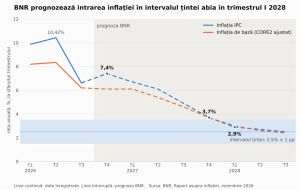
Governor Mugur Isărescu explained the November revision by citing a "substantial upward reassessment of energy prices". The table in the Governor's presentation breaks down the 1.3 percentage-point increase in the December forecast as follows:
Fuels: plus 0.8 percentage points
Electricity and natural gas: plus 0.3 percentage points
Core inflation: plus 0.5 percentage points
Vegetables, fruit and eggs: minus 0.2 percentage points
The NBR rounds the figures to one decimal place, so their sum differs slightly from the total revision. Fuels account for the largest share of the revision because, according to the NBR, oil prices have increased, supplies of refined products, particularly diesel, have been disrupted, and the dollar has appreciated.
Core inflation contributes 0.5 percentage points. The NBR writes that its forecast has also increased due to the depreciation of the leu and certain temporary price increases, not only because of energy costs. The Governor linked the exchange rate corrections this year to the political crisis, meaning that part of the revision has a domestic cause. The NBR does not separately disclose how much of the 0.5 percentage points is attributable to the leu exchange rate.
The depreciation also had a favourable effect. The NBR writes that it corrected the leu's overvaluation, while the Governor said that, according to the NBR's calculations, the price competitiveness of Romanian products had not deteriorated.
• What Assumptions Underpin the New Forecast?
The NBR's new scenario lowers the Brent oil price to $93 in the first quarter of 2027, $89 in the second quarter, $85 in the third quarter, $82 in the fourth quarter, and eventually to $76.64 in the third quarter of 2028. The NBR constructed this trajectory based on futures quotations collected on October 12.
The report states that approximately one quarter of the inflation forecast for December 2026 comes directly from higher oil and refined product prices, to which indirect effects on production, transport and distribution costs are added.
The Governor said that, since the forecast date, oil prices had fallen to $90 and that, if this price were maintained, the forecast would change. However, the change would not be exclusively downward. The $90 price is below the NBR's scenario for the fourth quarter of 2026 and the first quarter of 2027, and would therefore lower inflation in the short term. From the third quarter of 2027 onwards, the NBR's scenario falls below $90, to $85 and then $82. If oil remains at $90, the pressure exerted by fuel prices on inflation in the second half of 2027 will be greater than assumed in the forecast.
The second assumption concerns gas. The mechanism protecting household natural gas consumers expires on March 31, 2027. The report states that there is no official decision for the period thereafter, and the forecast assumes that household gas prices will remain throughout 2027 at the level projected for the end of 2026. However, the NBR has revised this level significantly upwards compared with August, meaning that gas prices have already increased in the forecast, and the assumption is merely that they will not rise further after April.
The NBR warns that market liberalisation would push inflation higher. The increase would depend on the reference price: the pre-emption price of gas from the Neptun Deep field, whose production could begin in the first quarter of 2027, or futures quotations for April 2027, which are higher.
The forecast is therefore based on two favourable assumptions, cheaper oil and no further increases in gas prices after April 2027, neither of which is within the NBR's control.
• Why Isn't the NBR Raising Interest Rates?
The Governor explained the unchanged interest rate by pointing to the GDP gap, which he described as strongly negative. With demand already low, he said, the NBR would need very strong arguments to reduce it even further.
The decline in households' real incomes supports the NBR's assessment that demand is weak, although it does not measure the GDP gap, which compares the output of the entire economy with its potential level.
Households' real incomes fell by approximately 3% between the second quarter of 2025 and the second quarter of 2026, according to BURSA's calculations based on the INS household budget survey: incomes increased by 7.4%, while prices rose by approximately 10.7%. Employee households lost around 6% in real terms.
However, the negative output gap is smaller than the NBR estimated in August. The report estimates the GDP gap at an average of below -3% in 2026, with a low of -3.2% in the third and fourth quarters, and has revised it towards less negative values, mainly because the INS revised its GDP series for the 2018-2025 period. The NBR writes that the negative output gap continues to bring inflation down, but less strongly than previously estimated.
The monetary policy rate, at 6.50%, is below October inflation of 6.94% and below the inflation forecast for December. Relative to these figures, the real interest rate is negative. The NBR writes that real interest rates on new loans and deposits have a stimulative influence and that, in the fourth quarter of 2026, monetary conditions are more stimulative than it estimated in August. The NBR expects them to become restrictive again only from the first quarter of 2027.
Companies continue to expect price increases over the next three months, and the NBR has revised inflation expectations upwards. Over the medium term, the NBR considers that inflation risks are tilted to the upside.
• Who Pays If the Assumptions Do Not Materialise?
Households are spending an increasingly large share of their consumption on housing, water, energy and gas: 16.5% in the second quarter of 2026, compared with 13.7% a year earlier, according to the same INS survey. Among pensioners, this share rose from 15% to 17.9%.
Oil prices that do not fall and gas prices that increase after March 31, 2027, also raise companies' costs, while protection schemes increase budget expenditure. The most exposed, however, are households whose real incomes are already declining. The NBR report states that inflation also erodes the purchasing power of savings held in bank deposits, which the population has used to cushion the impact of fiscal consolidation.
The NBR's forecast therefore depends on two prices that it does not control: oil and gas. However, the NBR does control the monetary policy rate, through which it can influence demand and limit the transmission of energy price increases to other prices, and the NBR expects monetary conditions to become restrictive only in the first quarter of 2027, following its current decision. If oil remains at $90 or gas prices increase after March 31, 2027, the risk that inflation will return to the target range, currently projected for the first quarter of 2028, will once again be delayed, and households that have already lost real income will be the most exposed.
























 Euro
 Dolar SUA
 Franc elveţian
 Liră sterlină
 Gram de aur


























Reader's Opinion