 English
• Can a Democratic Congress Stop the War with Iran?
Trump started the war with Iran on February 28, 2026, together with Israel, without congressional approval. On June 23, 2026, both chambers voted on a concurrent resolution calling on the president to withdraw US forces. It was the first time since 1973 that both chambers had voted on such a resolution. Congress does not send a concurrent resolution to the president for signature. According to the Supreme Court's 1983 ruling in INS v. Chadha, Congress can impose obligations on the president only through acts sent to him for signature. Therefore, the concurrent resolution does not, by itself, bind the president. The authors of the resolution argue that the obligation to withdraw stems from the 1973 War Powers Act.
The war has not ended. On July 8, Trump declared the ceasefire signed in June over, and the US military resumed attacks, according to US media. On November 2, Iranian forces attempted to shoot down a US aircraft near Qeshm Island, in the Strait of Hormuz, according to the Institute for the Study of War. On November 3, Iranian Deputy Foreign Minister Kazem Gharibabadi declared that Iran was still in a state of war, reported bne IntelliNews. Messages between Tehran and Washington are being conveyed through mediators from Qatar. Trump said that Iran would either make a deal or the United States would finish it off, and he repeatedly suggested attacks after the November 3 elections, reported Al Jazeera.
The Democrats can stop the war against Trump's wishes in only two ways: if they secure two-thirds of the votes to override his veto, or if they refuse to provide funding for the war. In June 2026, the Pentagon asked senators for approximately 80 billion dollars, most of it to cover the cost of the war, reported the Associated Press. From January 3, 2027, the Democrats will decide whether to approve such sums. Trump can continue to use the budget the Pentagon already has. If Trump attacks Iran after the elections, the attacks will take place before January 3, 2027, while Congress is still under Republican control.
For Romania, the war with Iran matters because of the price of oil and gas. It also matters because of the weapons the United States sends to the Middle East instead of keeping them in Europe.
• What Changes for the Alliance with Israel?
Israel is waging war with a government that has no majority. In the October 27 elections, Prime Minister Benjamin Netanyahu's bloc obtained 53 of the 120 seats in the Knesset, while the opposition led by Gadi Eisenkot obtained 48, according to ABC News. Arab parties won 19 seats. No coalition has the 61 seats required for a majority. Netanyahu and Eisenkot have ruled out a coalition with the Arab parties. Until a new government is formed, Netanyahu remains caretaker prime minister. If Trump attacks Iran before January 3, Netanyahu will be caretaker prime minister, and the US Congress will still be Republican.
In Washington, Democrats are increasingly voting against arms sales to Israel. In April 2026, 36 Democratic senators voted to block a transfer of bombs, and 40 voted to block the sale of military bulldozers, according to the Washington Examiner. In the previous vote of the same kind, 27 Democrats had supported blocking the sale. Before that, only 19. Some senators justified their votes by opposing the war with Iran, which Congress had not authorized. Apart from Bernie Sanders, however, no Democratic senator is calling for an end to military aid to Israel, according to Arab Center Washington DC.
From January 3, 2027, a resolution blocking an arms sale can pass both chambers. Trump can reject it through a veto, and deliveries will continue. The Democrats can impose conditions on military aid through annual appropriations laws.
The United States provides Israel with 3.8 billion dollars a year in military aid under an agreement signed in 2016 that expires in 2028, according to Jewish Insider. Negotiations for a new agreement began in June 2026. US Ambassador to Israel Mike Huckabee presented replacing aid with sales as the direction of the new agreement, according to Ynet. A Democratic Congress will control funding for aid until 2028 and vote on arms sales.
• Has Putin Lost America?
After the elections, some jokingly say that Putin has lost America. The facts show something else. Putin can no longer count on a Republican-led Congress that did not oppose the exemptions granted by Trump. The White House, however, remains under Trump until January 2029. The advantages Putin obtained from Washington during these months, namely the sanctions waiver and the diesel agreement, came from the president, not from Congress.
Congress passed the Lindsey O. Graham Sanctioning Russia and Iran Act of 2026 with votes from both parties, under a Republican majority. Trump signed it on September 18, according to Newsweek. The law provides for tariffs of up to 100% on countries that purchase Russian energy. On October 9, Trump announced an agreement with Putin for Russian diesel deliveries. On the same day, the Treasury issued General License 135, which allows Russian diesel imports into the United States until April 7, 2027, according to law firm Clyde & Co. On October 16, Trump waived the tariffs and most of the sanctions under Executive Order 14436, according to law firm King & Spalding. He used a waiver written into the law itself, which allows him to waive sanctions if he determines that doing so serves the national interest. The White House had opposed earlier versions of the law that did not include this broad waiver authority, according to law firm Steptoe. Twelve senators, including six Republicans, asked Trump to cancel the agreement with Russia, Reuters reported.
Congress granted Trump the waiver authority, so only Congress can take it back. A law without a waiver can override Trump's veto only with two-thirds of the votes. Sanctions against Russia, however, are the area in which Congress has secured the largest majorities from both parties. Here, the two-thirds majority may exist, although the outcome of a vote is uncertain. For Romania, sanctions matter because the money Russia earns from energy finances the war on Romania's border.
The global position of the United States rests on alliances, the dollar and its technological lead over China. Congress defended alliances even under Republicans, through the threshold of 76,000 US troops in Europe, and Democrats support NATO at least as strongly. Technology restrictions on China have support in both parties. Budget disputes, which may become more intense with an opposition-controlled Congress, could raise interest rates on US government bonds. The facts known now, however, do not show that the dollar's global role is weakening because of the elections.
• What Changes for Taiwan?
US policy toward Taiwan has the support of both parties, so the elections do not change it. What changes is the pressure on Trump, who uses weapons for Taiwan in negotiations with Chinese leader Xi Jinping.
In December 2025, the Trump administration approved the largest arms package for Taiwan in history, worth 11.15 billion dollars, according to Taiwan's Ministry of Defense, cited by Fortune. A second package, worth approximately 14 billion dollars, was not approved. Before his meeting with Xi in Beijing in May 2026, Trump said he would discuss arms sales with the Chinese leader, reported CNN. Until then, US administrations, including Trump's, had refused to consult Beijing about weapons for Taiwan. After the meeting, Trump called the delay in the sale "a good bargaining chip," reported Defense News. Congress, still Republican, then approved 500 million dollars to fund weapons for Taiwan. Trump and Xi met twice in 2026, and the 14-billion-dollar package remained unapproved, according to Al Jazeera.
From January 3, 2027, the Democrats can provide Taiwan with more funding through appropriations laws. They cannot, however, force the administration to approve the 14-billion-dollar package. An arms sale begins only after the administration notifies Congress. Congress can block a sale, but it cannot initiate one. The Democrats can hold hearings on Trump's negotiations with Xi.
Analysts cited by Al Jazeera point to a risk. Constrained at home by a Democratic Congress, Trump could focus more on foreign policy, where Congress limits him the least. An agreement with Xi falls within this area.
For Romania, the Taiwan case raises a question. The US Defense Strategy, published by the Pentagon on January 23, 2026, places the defense of US territory and the deterrence of China first. The same strategy asks European allies to assume primary responsibility for Europe's conventional defense. The strategy therefore places deterring China ahead of defending Europe. Does giving priority to China help deter Beijing if Trump uses weapons for Taiwan as a bargaining chip in negotiations with Xi Jinping? Bucharest can raise this question with the committees of the Democratic Congress.
• What Negotiating Power Does Trump Still Have for a Meeting with Xi and Putin?
Putin, Trump and Xi could meet together at the Asia-Pacific Economic Cooperation summit in Shenzhen on November 18-19. Yuri Ushakov, Putin's foreign policy adviser, announced on October 25 that preparations had begun, according to Kyiv Post. Trump declared himself open to such a meeting and said it would focus mainly on nuclear weapons, as reported by the media. The White House has not officially confirmed the meeting. The Wall Street Journal reported, citing a former Russian intelligence officer, that Putin sees the meeting as an opportunity to divide the world into spheres of influence. Ukrainian President Volodymyr Zelenskyy said he did not want the meeting to become "Yalta 2, 3, 4," according to Euromaidan Press. At Yalta, in February 1945, Stalin, Roosevelt and Churchill negotiated the organization of postwar Europe without the participation of the countries whose destinies were being discussed.
The meeting would take place before January 3, 2027, while Congress is still Republican. Trump can do several things on his own, even in Shenzhen: he can delay weapons for Taiwan, grant waivers from sanctions against Russia, make statements about borders and move US troops between European countries. However, he cannot promise on his own what requires Congress: a treaty, which needs two-thirds of the Senate, new funding and the withdrawal of troops from Europe below the threshold of 76,000 troops without justification before Congress.
For some sanctions against Russia, Congress also has a review right. A 2017 law, the Countering America's Adversaries Through Sanctions Act, requires the president to submit to Congress any lifting of sanctions covered by the law and wait 30 days. During this period, Congress can vote to reject it, but the rejection is subject to a veto. The law covers sanctions imposed under executive orders and laws listed in it, all predating 2017. Sanctions imposed after the 2022 invasion of Ukraine have a different legal basis and are not subject to this review, according to Democratic Senator Tim Kaine.
Therefore, Trump's power to act alone remains unchanged after the elections. The value of Trump's promises that require funding, laws or Senate approval decreases. Xi and Putin know that any such commitment will pass through an opposition-led Congress after January 3. Trump's executive decisions have immediate effects, but Trump leaves the White House in January 2029, and the next president can reverse them. If an understanding on spheres of influence were reached in Shenzhen, Trump could make political and executive commitments. However, implementing commitments that require funding, laws or treaties would depend on Congress.
For Romania, the threshold of 76,000 US troops in Europe is the legal limit Trump cannot bypass without justification before Congress if he were to accept a US withdrawal from Eastern Europe in Shenzhen. The threshold does not, however, prevent troops from being moved from Romania to other European countries.
• What Remains at the White House
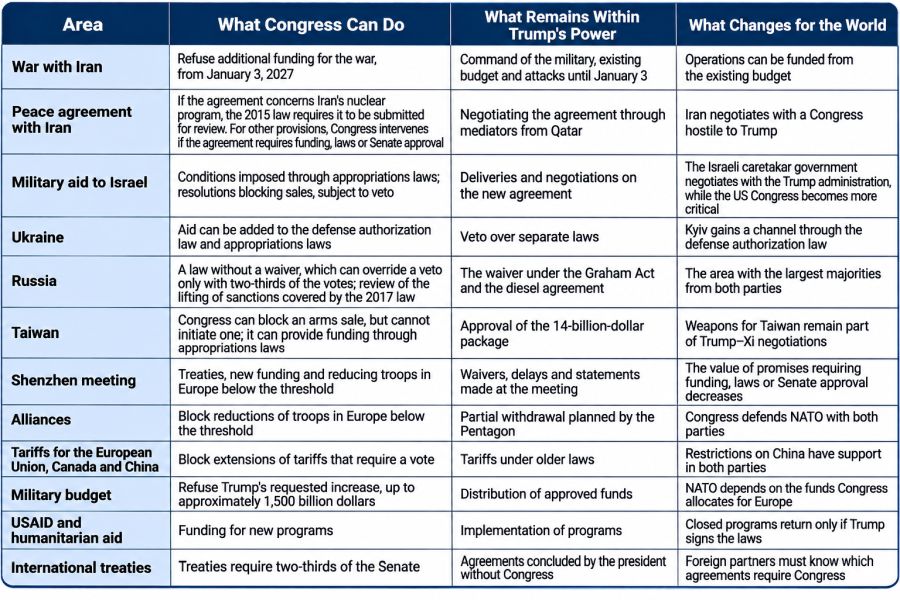
The Republicans' defeat does not immediately change the military forces, weapons and strategic capabilities of the United States, China and Russia. What changes are the financial and political conditions under which Trump exercises his foreign policy power: from January 3, 2027, additional funding for wars and allies that requires a new law will depend on the Democrats' vote.
In foreign policy, a Democratic Congress can refuse funding, block arms sales and hold hearings. Congress cannot immediately prevent an attack ordered by the president, but it can limit operations through laws and funding. It cannot cancel an agreement with Putin and cannot initiate an arms sale to Taiwan. Trump alone decides on Iran at least until January 3, 2027. The only area in which Congress has secured large majorities from both parties against Trump's policy is sanctions against Russia. For Romania, this is also the area that matters most, because Russia's energy revenues finance the war on its border. Trump can continue negotiating with Putin and Xi Jinping, but commitments requiring funding, laws or Senate approval will depend, from January 3, 2027, on an opposition-led Congress.


Editor's Note
The text was prepared with the assistance of artificial intelligence; responsibility for the analysis rests entirely with the author.




















 Euro
 Dolar SUA
 Franc elveţian
 Liră sterlină
 Gram de aur






























Opinia Cititorului