 English
• What Does Romania Gain Regarding US Troops?
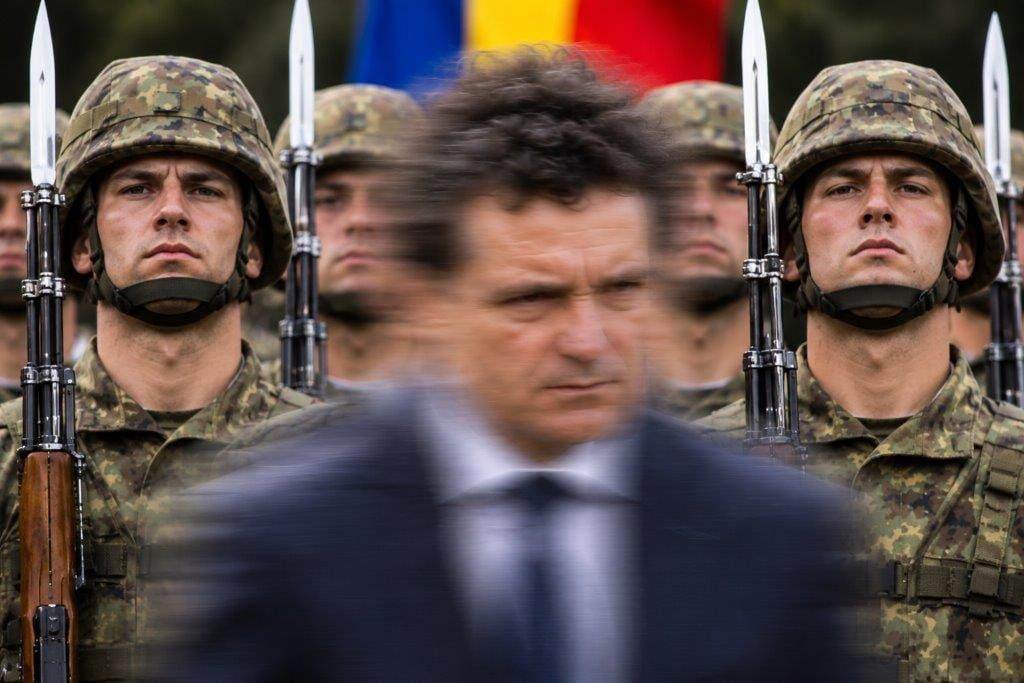
In October 2025, the Pentagon completed the rotation of a US brigade stationed largely in Romania. The Ministry of Defense announced at the time that approximately 1,000 US troops would remain in the country. Democratic Senator Jeanne Shaheen calculated that the Pentagon had reduced US troop numbers in Romania by almost half.
Congress responded in December 2025 through the annual defense authorization law. This is the law through which Congress establishes the rules and limits governing the Pentagon's activities. Funding is provided through annual appropriations laws. Through the defense authorization law, Congress prohibits the Pentagon from keeping fewer than 76,000 troops in Europe for more than 45 days unless it justifies the reduction before Congress. Both parties voted for the law, and the majority in Congress was Republican. Two Republicans, the chairs of the defense committees, Roger Wicker and Mike Rogers, publicly criticized the withdrawal of the brigade from Romania.
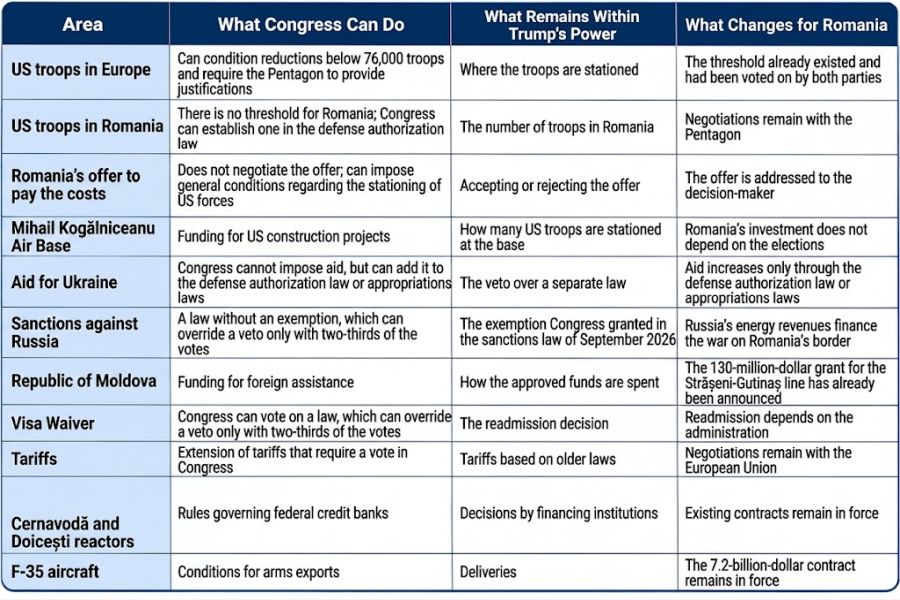
The Democrats' victory changes the outlook for troops in Romania only slightly, for two reasons. First, the threshold of 76,000 troops already existed and had been voted on by both parties. Second, the threshold applies to Europe as a whole, not to Romania. In December 2025, approximately 85,000 US troops were stationed in Europe. Based on the troop numbers reported in December 2025, the difference from the legal threshold was approximately 9,000 troops. The threshold concerns the total number of troops in Europe, not their distribution among countries. The drafts of the new defense authorization laws, H.R. 8800 and S. 4784, extend the threshold into 2027 as well.
The real change concerns congressional committees. The Democrats will chair them and decide what hearings to request from the Pentagon and what documents to demand.
• What Value Does Romania's Offer to Pay Part of the Costs of US Troops Still Have?
Romania offered to share with the United States the costs of US military operations on its territory, as reported by the media. President Nicuşor Dan and Foreign Minister Dan Neculăescu confirmed the offer, but did not disclose its value. Elbridge Colby, the Pentagon's Under Secretary of Defense for Policy, prepared the plan to reduce US troops in Europe. He is visiting Bucharest on November 4, as announced by Defense Minister Radu Oprea.
One might think that Romania is paying for something that Congress already protects. That is not the case. Congress protects the total number of troops in Europe. The Pentagon, meaning the Trump administration, decides where those troops are stationed. Romania's offer is addressed to the decision-maker, and the elections have not changed who that decision-maker is.
The approximately four-billion-euro investment in Mihail Kogălniceanu Air Base is a separate project from this offer. The Pentagon decides how many US troops will be stationed there. Congress decides whether to provide funding for US construction projects at the base.
• What Changes for Ukraine and the Black Sea?
For Romania, US support for Ukraine matters because Russia is waging war on Romania's border and in the Black Sea. The United States purchases weapons for Ukraine through a program called the Ukraine Security Assistance Initiative. The December 2025 defense authorization law provides 400 million dollars a year for this program. The package passed in 2024 included almost 14 billion dollars for the same program.
The Democrats want to increase aid. A separate law for Ukraine can enter into force against Trump's wishes only if two-thirds of each chamber votes for it. In the House of Representatives, this would require the votes of several dozen Republicans. In June 2026, only 18 Republicans in the House of Representatives voted for a Ukraine aid bill.
The Democrats' main route is different. They can include aid in the annual defense authorization law, which authorizes Pentagon programs, or in annual appropriations laws, which provide the funding. Trump can veto these as well. If he vetoes the defense authorization law, he rejects all the Pentagon's annual rules. If he vetoes an appropriations law, he stops funding for the institutions financed by that law. Through the same route, the Democrats can also introduce new sanctions against Russia.
• What Will Not Change: Visa Waiver and Tariffs
The Department of Homeland Security removed Romania from the Visa Waiver Program on May 2, 2025. Visa Waiver is the program through which citizens of certain countries enter the United States without a visa. The decision was administrative. Congress can vote on a law that includes Romania in the program. Senators Durbin, Shaheen and Wicker proposed such a law as early as 2023. However, the law would enter into force against Trump's wishes only with two-thirds of the votes, which the Democrats do not have. Without such a law, Romania's readmission depends on the Trump administration.
Customs tariffs on Romanian exports will not change as a result of the elections either. The European Union negotiates with Washington on Romania's behalf. On February 20, 2026, the Supreme Court overturned the tariffs imposed by Trump under the law concerning economic emergencies, in the case of Learning Resources v. Trump. The remaining tariffs are based on older laws through which Congress granted the president the power to impose tariffs. Congress can withdraw this power only through a new law, which can override Trump's veto only with two-thirds of the votes.
• What Does the Result Mean for Bucharest?
From January 3, 2027, Trump retains command of the military and leadership of diplomacy, but loses control over funding, appointments and new laws. The decisions that matter most for Romania remain with the White House and the Pentagon: how many US troops are stationed in the country, readmission to Visa Waiver and tariffs. Through Congress, Romania gains a channel for aid to Ukraine, a chance for tougher sanctions against Russia and stricter oversight of the Pentagon. The threshold for US troops in Europe had already been secured before the elections. Bucharest continues to negotiate with the Trump administration. A Democratic Congress becomes Romania's second interlocutor in Washington, but does not replace the first.


Editor's Note
The text was prepared with the assistance of artificial intelligence; responsibility for the analysis rests entirely with the author.


















 Euro
 Dolar SUA
 Franc elveţian
 Liră sterlină
 Gram de aur






























Opinia Cititorului