 English


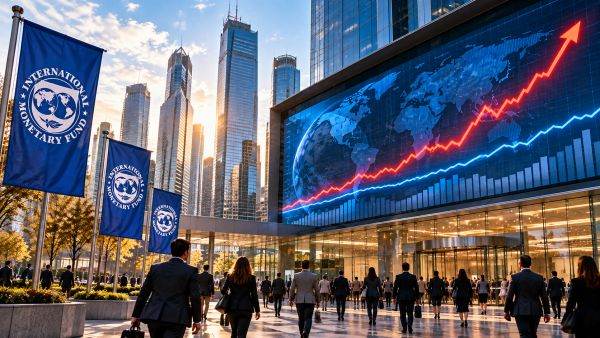
The IMF and the World Bank are meeting in Bangkok in a world where, over five decades, debt has grown faster than output, and the global economy needs increasingly more investment for every additional dollar of output. The IMF Managing Director says governments can no longer rely solely on economic growth to solve their fiscal problems and calls for fiscal consolidation. BURSA believes that the integration phase of globalization has come to an end: trade and capital flows continue, but along routes divided between blocs, while poor countries bear the highest cost relative to the size of their economies.
• Over five decades, debt has grown faster than output
In 1974, the world's total debt, public and private, excluding the financial sector, stood at 108% of global GDP: 80% private debt and 28% public debt. By 2024, it had reached 235% of GDP, comprising 143% private debt and 93% public debt, following a peak of 258% in 2020, according to the IMF's Global Debt Database. Including the financial sector, global debt reached $365.5 trillion in the first half of 2026, approximately 310% of GDP, according to the Institute of International Finance (IIF).
The debt-to-GDP ratio has fallen by approximately 25 percentage points since 2021. The IIF says the decline stems from nominal GDP growth driven by inflation, "not from a real reduction in debt or from fiscal consolidation.”
At the level of the economy as a whole, credit expansion is sustainable only if output grows sufficiently to cover the principal, interest and a profit, while rolling over debt that does not meet this condition increases it, as BURSA noted back in March 2014. Kristalina Georgieva, the IMF Managing Director, now says that governments "can no longer rely solely on higher growth rates to solve fiscal problems,” according to Euronews.
• More investment is needed for every additional dollar of output
In 2000-2007, the world invested an average of 23.7% of GDP, while the global economy grew by 3.7% a year, according to World Bank data on investment and economic growth. In 2022-2024, the world invested 25.9% of GDP, while the economy grew by 3.1% a year. The ratio of annual investment to output growth thus rose from approximately 6.4 to 8.4: around $6.4 in investment was needed for every additional dollar of annual output in the first period, compared with approximately $8.4 in the second.
This calculation is an approximation for the global economy as a whole. It does not measure investors' returns, includes investment that merely replaces worn-out equipment, and depends on the stage of the economic cycle in each period. However, it indicates an apparently lower level of investment efficiency: the world needed more investment for every additional dollar of output than it did two decades ago. Separately, in its September report, the IIF observes that "the marginal utility of additional debt is declining.”
• Credit is increasingly being used to pay off old debt
When economic integration reduces yield differentials between markets, credit ceases to finance primarily new production and increasingly goes towards refinancing existing debt, supporting demand and sustaining asset values, according to The Theory of Interest (BURSA Publishing House, 2026). Some credit continues to finance productive investment, but current facts are consistent with this explanation. The average borrowing cost for G7 countries is at its highest level since mid-2008, while annual interest expenses are almost 85% higher, according to the IIF. The interest paid by advanced-economy governments exceeds estimated global spending on artificial intelligence ($2.6 trillion) and defence ($3.1 trillion). Developing countries owe external creditors approximately $400 billion in 2026, one-third of which represents interest, according to the World Bank, as cited by BURSA. Romania needs to refinance approximately euro83.9 billion in public-debt principal over 2027-2030, according to BURSA, meaning new borrowing to cover old maturities.
• How can the debt burden still be reduced?
If economic growth is not enough, the debt burden can be reduced in four other ways, all of which have been used throughout history. Some reduce the amount owed, while others reduce its real value or its ratio to GDP, and each has a cost that someone must bear.
The first is a primary budget surplus maintained for years: the state collects more than it spends, excluding interest payments. The cost is borne by taxpayers and those who receive money from the budget. The IMF is calling for this approach, but Georgieva says that "we are not seeing decisive action in highly indebted advanced economies,” according to BURSA.
The second is inflation, which reduces the real value of debt. The cost is borne by savers and people on fixed incomes. According to the IIF, this is the mechanism through which the global debt-to-GDP ratio has declined since 2021.
The third is keeping interest rates below inflation. After the Second World War, when public debt was at a level comparable to today's, this approach reduced US and UK debt by an average of 3-4% of GDP a year, according to a study by economists Carmen Reinhart and Belen Sbrancia. Savers bore the cost. Today, central banks are doing the opposite: Georgieva described the recent interest-rate increases by the US Federal Reserve, the European Central Bank and the Bank of Japan as "extremely appropriate.”
The fourth is debt restructuring or a suspension of payments. Creditors bear the cost. This is the issue currently being discussed at the Bangkok meeting.
• The world is splitting into blocs
The Theory of Interest interprets the fragmentation of the global economy as the way in which the credit system restores yield differentials after integration has reduced them: through trade barriers, diverging regulatory regimes, sanctions and economic blocs. The data show that fragmentation exists and is also taking place within blocs; on their own, however, they do not prove the cause proposed by the theory.
In March 2025, the United States imposed tariffs on Canada and Mexico, its partners in the North American trade agreement, according to Agerpres. Fragmentation is also evident in the position taken by the largest shareholder in multilateral institutions: the US Treasury announced that its participation in Bangkok aims to ensure that international financial institutions and the international economic system as a whole promote US economic and national security interests, according to Reuters.
Artificial intelligence is creating new disparities between countries. Investment in artificial intelligence is distributed unevenly, and its benefits are concentrated in a handful of economies, Georgieva said, according to BURSA.
The IMF estimated the long-term cost of fragmentation in global trade at up to 7% of global GDP, Georgieva said in April 2023, according to the IMF.
• Poor countries bear the highest cost relative to the size of their economies
"Poorer member countries of the IMF and the World Bank are in distress because of the effects of the war in Iran,” compounded by rising interest rates in the West and a climate crisis worsened by El Niño, said Kevin Gallagher, director of the Boston University Global Development Policy Center, according to AFP.
Welfare losses caused by the closure of the Strait of Hormuz are estimated to be 10 to 20 times greater in South Asia, Sub-Saharan Africa and parts of the Middle East than in advanced economies, excluding oil-exporting countries, according to the Kiel Institute for the World Economy. Developing economies are paying more for diesel and fertilisers and borrowing at high interest rates, World Bank President Ajay Banga said. The IMF's largest downward forecast revisions will affect countries hit by the war, Georgieva announced. Of the 119 low- and middle-income countries with credit ratings, 75 were experiencing debt distress or faced a significant risk of it in March 2026, according to the Center for Economic and Policy Research (CEPR).
• What can the Bangkok meeting achieve?
The meeting's instruments are well known: World Bank crisis assistance of $50-60 billion, rising to as much as $100 billion if the situation deteriorates; operations to replace expensive debt with cheaper financing; sovereign debt restructuring; and IMF recommendations for fiscal consolidation. All concern how losses are distributed. "The IMF and the World Bank are not responding to current needs,” Gallagher says, according to AFP. Debt restructuring determines who bears the loss: private creditors, multilateral institutions or creditor states. Can multilateral institutions still distribute losses through cooperation if their largest shareholder declares that it is primarily pursuing its own national interest?
The meeting cannot restore the world to its previous level of integration. The Theory of Interest argues that, during a phase of fragmentation, global cooperation tends to become formal, and the events in Bangkok fit this description: the Treasury of the largest shareholder explicitly states that its participation is intended to promote US interests. At most, the meeting can decide how much of the losses remain with creditors and how much is transferred to poor countries.
• The questions the IMF does not answer
The IMF assesses each country's debt sustainability, but it does not say how long the world can continue to function with debt growing faster than output. Japan shows that very high public debt, at around 230% of GDP, according to BURSA, can be sustained for decades under two conditions: interest rates close to zero and creditors located largely within the country itself. The first condition is no longer met even in Japan: the Bank of Japan is raising interest rates, and the yield on Japanese 10-year bonds is at its highest level since 1996, according to Georgieva, as quoted by Euronews.
Artificial intelligence could change the answer in either direction. If it delivers the productivity growth markets expect, economic growth could once again cover a larger share of the debt burden. Georgieva warns, however, that market disappointment over artificial intelligence results could become a "major shock,” according to BURSA. If economic growth can no longer cover the debt burden and interest rates can no longer be kept low, how much longer can the world function under its current system?
The Theory of Interest does not assume that the credit system can restore itself indefinitely through fragmentation. It identifies three situations in which this process fails: when even maximum fragmentation no longer creates yield differentials sufficient to cover the cost of capital; when fragmentation raises financing costs at least as quickly as it creates opportunities; and when debt repayments exceed the capacity of income to support new credit. The facts presented here relate to all three situations. G7 borrowing costs are at their highest level since 2008, and more investment is needed for every additional dollar of output than two decades ago. The IMF estimates the cost of trade fragmentation at up to 7% of global GDP. The interest paid by advanced-economy governments exceeds global spending on artificial intelligence, while 75 of 119 low- and middle-income countries are experiencing debt-payment difficulties. Today's data are consistent with the world approaching these limits, but they do not yet make it possible to measure how far away the system is from the thresholds at which it could become blocked.
A decisive element in the answer, in the interpretation offered by The Theory of Interest, is where the credit system can still find returns sufficient to pay interest. Fragmentation has moved from the global scale to the scale of blocs and has begun to extend within blocs, towards the national scale. When it reaches the national scale, where will the interest-bearing credit system find the yield differentials it needs in order to function?


























 Euro
Euro Dolar SUA
 Franc elveţian
 Liră sterlină
 Gram de aur































Reader's Opinion