English
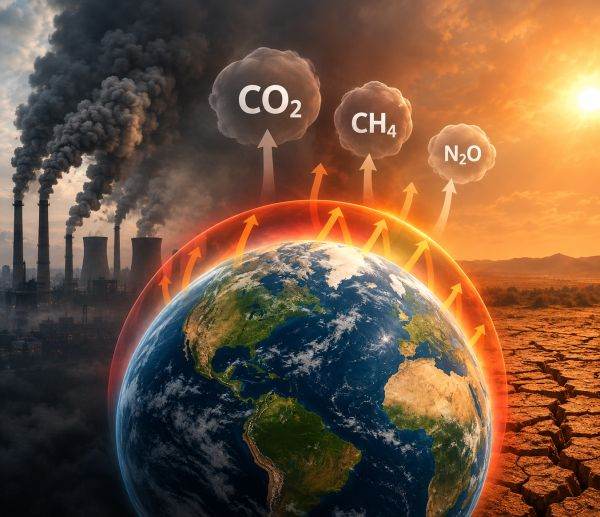
Atmospheric concentrations of the primary greenhouse gases reached record levels in 2025 and continue to rise this year, exacerbating global warming and the risks associated with extreme weather events, the World Meteorological Organization (WMO) warns in a report. Data show record increases for carbon dioxide (CO2), methane (CH4), and nitrous oxide (N2O) - the main long-lived greenhouse gases linked to human activity. According to the WMO, their accumulation in the atmosphere leads to the trapping of increasing amounts of heat, with consequences for the climate, economies, and societies. "Another year, another record. Greenhouse gases are trapping an unprecedented amount of heat in the atmosphere, fueling the intensification of extreme weather events and the risks they pose to our economies and societies," stated Ko Barrett, Deputy Secretary-General of the WMO.
The official warned that the last 11 years have been the warmest ever recorded, and this trend is set to continue. In the case of carbon dioxide, the effects persist for decades or even centuries, due to its long atmospheric lifetime. In 2025, the global average concentration of carbon dioxide reached 426.8 parts per million (ppm)-equivalent to 153% of the pre-industrial level from 1750. According to the WMO, this increase continued into 2026. Approximately half of the carbon dioxide emitted annually remains in the atmosphere, while the remainder is absorbed by terrestrial ecosystems and the oceans.
Accounting for about 66% of the warming caused by long-lived greenhouse gases, CO2 is currently increasing at a rate three times higher than that observed in the 1960s.
Between 2024 and 2025, its global average concentration rose by 2.8 ppm-a figure above the average for the last decade, though lower than the exceptional surge recorded between 2023 and 2024.
The WMO attributes this more moderate pace in 2025 to a reduction in carbon emissions from wildfires, as well as the effects of the strong El Niño event of 2023-2024. Nevertheless, an increase of 2.8 ppm still represents a significant addition of carbon resulting from the burning of fossil fuels. "Every additional ppm matters, because it traps more heat. In short, we are on the path to overloading the ocean and the atmosphere," stated Ko Barrett.
• El Niño can reduce carbon absorption
The progression of the El Niño phenomenon introduces an additional layer of uncertainty regarding CO2 concentrations. Droughts and wildfires associated with such events can diminish the capacity of terrestrial ecosystems to absorb carbon. Oksana Tarasova, a senior scientific officer at the WMO, has warned that the current El Niño episode will almost certainly impact atmospheric carbon dioxide concentrations. The report highlights that greenhouse gas levels depend not only on emissions directly generated by human activity but also on the capacity of oceans and terrestrial ecosystems to absorb a portion of the released carbon. In 2025, the global average methane concentration reached 1,948 parts per billion (ppb)-267% of the level recorded in 1750. This gas contributes approximately 16% to climate warming and has a shorter atmospheric lifespan than carbon dioxide. According to the WMO, about 35% of methane emissions originate from natural sources, such as wetlands, which are sensitive to climate change. The remaining 65% is linked to human activities, including livestock farming, rice cultivation, fossil fuel extraction, landfills, and biomass burning.
The WMO bulletin also notes an increase in the concentrations of other greenhouse gases-less abundant, yet possessing a high warming potential. These include molecular hydrogen (H2) and sulfur hexafluoride (SF6), the latter of which is associated with, among other things, the production and distribution of electricity. The WMO's annual report was released in the lead-up to COP31-the UN climate change conference scheduled to take place from November 9 to 20 in Antalya, Turkey. The document highlights the difference between emissions generated in a given year and the concentrations accumulated in the atmosphere: even if emissions were to decrease, the persistent gases already accumulated would continue to influence the climate for long periods.

























 Euro
 Dolar SUA
 Franc elveţian
 Liră sterlină
 Gram de aur