English



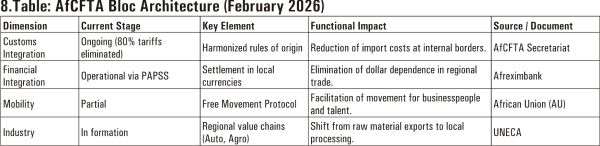
After analyzing the consolidated blocs in the Americas, Europe, and Asia, this ninth episode focuses on AfCFTA (African Continental Free Trade Area). As of February 2026, it represents the largest free trade area in the world by number of participating states (54), being a project born not only out of political ambition but also out of a biological necessity: Africa must feed and employ a population that will reach 2.5 billion people by 2050.
The AfCFTA architecture does not aim solely at eliminating tariffs, but at creating a single continental market for goods and services, supported by:
-The Protocol on Free Movement of Persons;
-The Pan-African Payment and Settlement System (PAPSS) - designed to eliminate dependence on the dollar in intra-African trade.
• 1. Current Status: From Agreement to Operationalization
Officially launched for trade in 2021, AfCFTA reached a critical implementation phase in 2026. Trade under the new rules of origin is now a reality in key sectors such as automotive, agriculture, and pharmaceuticals.

• 2. Financial Pillar: The PAPSS System
One of the biggest barriers in Africa has been the need to convert local currencies into dollars or euros to conduct trade between neighboring countries.
Pan-African Payment and Settlement System (PAPSS): In 2026, this system allows a company in Nigeria to pay a supplier in Kenya in Naira, with the latter receiving the equivalent in Shillings instantly.
Impact: Savings of over USD 5 billion annually in currency conversion costs. (Source: Afreximbank Report 2025)
• 3. Demographic Pressure: Engine and Risk
Unlike the EU or China, which face population aging, Africa has a median age of 19.
Engine: A massive workforce and a rapidly expanding consumer market.
Risk: If AfCFTA does not accelerate industrialization, demographic pressure will translate into social instability and massive migration flows.
• 4. Implications for Romania
Opportunities:
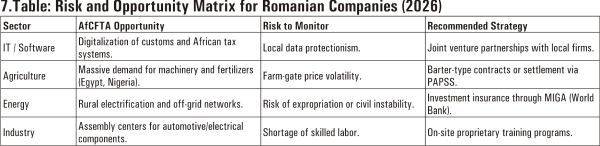
Agricultural Exports and Technology: Romania has a competitive advantage in providing agricultural expertise, fertilizers, and machinery for Africa's food security (e.g., Egypt, Nigeria, Algeria).
IT Sector and Digitalization: Romania's experience in e-government and fintech can be exported to African states that are "leapfrogging” technological stages.
Risks:
Global Competition: China, Turkey, and Gulf states are already deeply anchored in African infrastructure, offering credit lines that are difficult for Romanian companies to match.
• 5. Case Study: Antibiotice SA and Expansion into the African Market
Context: The acute need for affordable medicines in AfCFTA signatory states.
Challenge: Different regulatory barriers among regional economic communities (ECOWAS, EAC, SADC).
Solution: Antibiotice SA has begun using logistics hubs in North Africa (Morocco/Egypt) to access the AfCFTA market under the new simplified rules of origin. The collaboration targets the export of essential anti-infective products.
Result: In 2025, the presence in African markets significantly contributed to export turnover growth, benefiting from the harmonization of pharmaceutical standards at the continental level.
(Source: Antibiotice SA Annual Report; African Medicines Agency (AMA) Updates).
• 6. Practical Recommendations for Romanian Managers and Investors
If in the 1990s Africa was viewed through the lens of political risk, in 2026 it must be approached through the lens of "infrastructure arbitrage.” Romanian managers must understand that AfCFTA transforms 54 small markets into a single "ocean” of consumption.
A. For Managers: Operational Adaptation
"Local sourcing” through AfCFTA: If you produce in Egypt or Morocco, you can export to the rest of the continent with zero tariffs. Do not view Africa as an export destination from Romania, but as a place to establish final assembly points.
Use of PAPSS: Ask financial departments to test the Pan-African Payment System. Eliminating the need to source dollars for transactions in Nigeria or Kenya reduces the risk of payment blockages (currency crunch).
African Standardization: Monitor PAO (Pan-African Organisation for Standardisation) regulations. A certification obtained in one hub (e.g., South Africa) becomes your technological passport for the entire continent.
B. For Investors: Where Are the Returns in 2026?
Agro-Tech and Food Security: Africa imports over USD 50 billion worth of food. Investing in Romanian companies that export irrigation systems, smart silos, or agricultural genetics to Africa under the AfCFTA umbrella offers higher returns than mature markets.
"Last Mile” Logistics: AfCFTA eliminates customs, but not potholes. Investing in logistics operators with hubs in special economic zones (SEZs) in African ports is the winning bet of the decade.
Cross-Border Fintech: Companies that facilitate interoperability between European payment systems and PAPSS will be tomorrow's financial "pipelines.”
The successful Romanian manager no longer asks "How do I sell in Africa?”, but "How do I integrate into the AfCFTA value chain?”. Africa is no longer a dumping market for Europe's old inventories, but a laboratory of the future where new payment systems and demographic models are tested.
Romania has a window of opportunity of maximum 3-5 years to secure a position as a "preferred supplier” before giants from Asia and the Persian Gulf fully saturate AfCFTA infrastructure.
• The Final Frontier of Globalization
AfCFTA is not just a trade agreement, but the only solution for the continent's economic survival. For Romania, Africa should no longer be seen as an aid destination, but as an emerging market of gigantic scale. The success of Romanian companies depends on their ability to navigate the new PAPSS payment system and to leverage the new African logistics hubs.






















 Euro
Euro Dolar SUA
 Franc elveţian
 Liră sterlină
 Gram de aur