 English


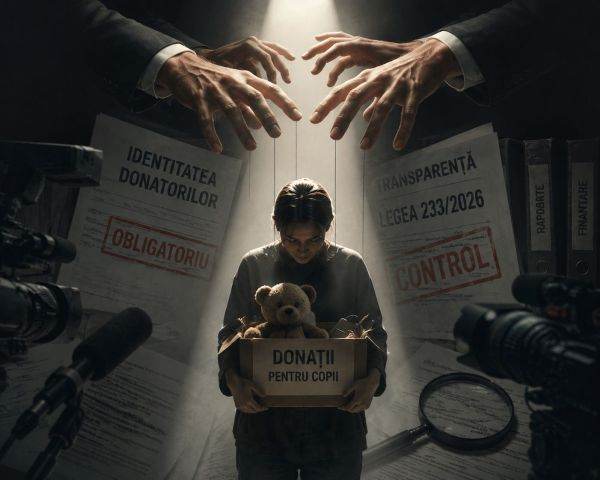
Save the Children Romania warns that the legislative project that obliges associations and foundations to publish the identity of all funders would not bring a real increase in fiscal transparency, since control and reporting mechanisms already exist, but would have as its main effect the discouragement of donations, the intimidation of donors and the stigmatization of the entire non-governmental sector. The organization claims that the legislative proposal L233/2026, registered with the Senate and which aims to supplement the Romanian Senate by amending Government Ordinance no. 26/2000 on associations and foundations, would establish a mechanism of "unjustified collective surveillance", applicable to all NGOs, regardless of whether or not there are concrete suspicions of irregularities.
• Risk of infringement and European precedent
According to the organization, the project is incompatible with European standards on freedom of association and protection of personal data. Save the Children representatives invoke the judgment of the Court of Justice of the European Union of June 18, 2020 in case C-78/18, by which Hungary was sanctioned for a similar law that required civic organizations to declare and publish funding from abroad. The European court then determined that such obligations represent discriminatory and unjustified restrictions, contrary to the free movement of capital and Articles 7, 8 and 12 of the Charter of Fundamental Rights of the European Union, relating to respect for private life, protection of personal data and freedom of association. "We warn that the adoption of similar legislation would expose Romania to a real risk of infringement proceedings,” the organization emphasizes.
• Donors could be publicly exposed
Save the Children points out that publishing the identity of individuals who donate to NGOs constitutes processing of personal data regulated by the European Union (GDPR) and Law no. 190/2018. In the organization's opinion, such information may indirectly reveal political opinions, religious beliefs or support for social causes, categories of data that benefit from a special protection regime under Article 9 of the GDPR. "By establishing generalized obligations of forced transparency, which are unnecessary and impossible to put into practice, the draft law intends to create a mechanism of unjustified collective surveillance,” the organization states.
• NGOs are already subject to rigorous controls
The organization emphasizes that the nonprofit sector in Romania is already subject to extensive reporting and control obligations. These include: filing tax returns and annual financial statements with the National Agency for Fiscal Administration; registration in the Register of entities for which tax deductions are granted; reporting of beneficial owners according to Law no. 129/2019 on the prevention of money laundering; independent audits and controls carried out by national and European authorities;
publication of activity reports and balance sheets in the Official Gazette of Romania.
In addition, projects financed from European or national funds are verified by institutions such as the Court of Auditors of Romania, the European Commission and the European Anti-Fraud Office.
• Direct impact on vulnerable children
Save the Children representatives state that the most serious effect of the new obligations would be to affect the ability of organizations to provide essential services to vulnerable children and families. "They would directly affect the ability to provide essential services to vulnerable children, families in difficulty and disadvantaged communities, in conditions where socio-educational or medical services cannot fully cover their needs," the statement reads. The organization believes that the legislative initiative starts from a wrong premise, according to which the entire nonprofit sector should be treated as a suspect, in the absence of concrete indications of a violation of the law.
• Dialogue, but firm opposition
Save the Children Romania expresses its firm opposition to the draft law, but says that it remains open to a constructive dialogue with the initiators and legislative authorities. According to the organization, legitimate concerns regarding the transparency of NGO funding can be resolved through existing instruments, without introducing measures that could violate European law and affect freedom of association. Legislative initiative L233/2026 proposes that all associations and foundations in Romania must publicly declare the identity of the natural and legal persons who fund them. Failure to comply with this obligation could lead to the suspension of the organization's activity. Critics of the project argue that the measure is not proportionate to the intended purpose and that it risks discouraging private donations, in a sector that provides essential social, educational and medical services to tens of thousands of beneficiaries in Romania.























 Euro
Euro Dolar SUA
 Franc elveţian
 Liră sterlină
 Gram de aur





























