English


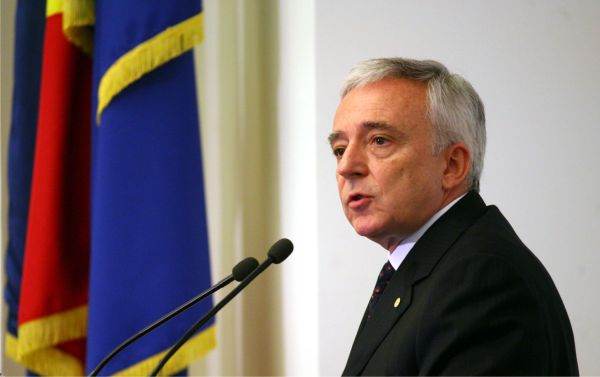
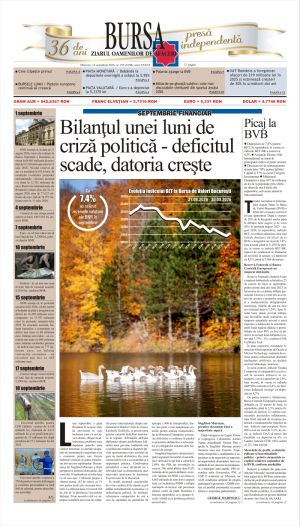
We need to have a government with full powers "as soon as possible", says the governor of the National Bank of Romania (BNR), Mugur Isărescu, emphasizing that the current political crisis is affecting investments. He declared yesterday, in the press conference where he presented the inflation report: "We need a government, clearly, as soon as possible. Romania must be politically stable. It will not be good if the formation of the new government takes a long time. A technocratic prime minister would not necessarily be a solution. I was such a prime minister, but people forget that I was participating in government meetings even before that, because there was no money and I was negotiating all the agreements with the IMF alongside them. I don't know how easy it would be for a technocrat, coming from outside, to quickly get into problems and especially to influence all the members of the government. You have to have a certain credibility, to know them, and for them to know you. Otherwise, you are talking nonsense."
The NBR Governor mentioned that fiscal correction must be continued, stating: "Fiscal correction is a necessity because, otherwise, the markets will penalize us and we will have to tighten our belts much more. We do not need new tax increases, but there can be no question of decreases in the coming period either. For a healthy fiscal policy, VAT or other taxes should not decrease, under any circumstances."
• "We hope to no longer be inflation champions in the fall"
Mugur Isărescu stated that inflation in our country will increase until July, after which it will decrease, and at the end of the year it is estimated at approximately 5%. The Governor of the National Bank of Romania said: "The outbreak of the conflict in the Middle East and the blockade of the Strait of Hormuz have generated a major shock on the international oil and gas markets, with knock-on effects on several economic sectors. This phenomenon, called in Europe "Ormuz inflation", will push inflation in Romania in the coming period. Inflation will increase until July. We don't know exactly how much either. There are many factors. It will probably go up to 11%. The increases will be small. Then, in September, we will already have an inflation of 6%, and towards the end of the year - of 5 or so percent. We may no longer be inflation champions in the fall."
Currently, the inflation rate in Romania is 10.7%, and the NBR governor stated that the future forecast depends both on the evolution of the conflict in the Middle East and on the return of domestic political stability: "The projections are strictly conditioned by assumptions regarding the implications of the conflict in the Middle East. We must also add the return to a minimum of political and governmental stability, that is, to have a government."
• "We did not keep the exchange rate artificially"
The NBR Governor also referred to the dynamics of the exchange rate in the last month, in the context of internal political tensions, stating: "I read all kinds of "interesting" things, such as that the exchange rate is being kept artificially. We did not keep the exchange rate artificially and this is evident from the evolution of foreign exchange reserves. We had to sell large quantities of foreign exchange to have kept the exchange rate artificially low. And then how did international reserves grow? They have grown by 40 billion euros in the last five years, meaning they have doubled. We intervened in the market, but we intervened mainly by buying foreign exchange and avoiding the leu from appreciating. We did not make the bulk of the purchases directly from the market, but from the Ministry of Finance. In other words, the Ministry of Finance, instead of selling foreign exchange receipts from European funds or foreign loans directly in the market, with very large variations in the exchange rate, sold them to the National Bank. When it needs of lei, the Ministry does not sell 20 million euros. It sells us one, two billion euros. And, in a rather "thin" market like our foreign exchange market, what does it mean to sell a billion euros in one day? It means a strong appreciation of the exchange rate, and then a depreciation".
Mugur Isărescu also said: "It seems that, at the current level, we can afford greater exchange rate flexibility, because the reserves are at an adequate level. The exchange rate seems to be balanced on the market. The leu is not overvalued. However, it depends on the continuation of the fiscal correction and political stability. The markets are very sensitive to both factors".
The BNR Governor also stated that capital outflows from Romania were much lower this spring compared to April-May last year, when Prime Minister Marcel Ciolacu resigned.
• "Investments can bring us sustainable, long-term and non-inflationary economic growth"
Mugur Isărescu believes that Romania must continue the current economic program, stating: "Investments increased in the third and fourth quarters of 2025, possibly in the first three months of 2026, but future developments depend on financing from external sources and require political continuity. Investments can bring us sustainable, long-term and non-inflationary economic growth. Investments still have a low share in GDP, and this must increase significantly to compensate for the decrease in consumption."
Mugur Isărescu: "The government must continue what it is currently. Not necessarily to cut, not necessarily to increase taxes, to continue. Continuing means not reducing, for example, VAT. Not even discussing starting to reduce VAT, which is not easy. Some are betting on this. Continuing may also mean maintaining a certain line of austerity in terms of future wage increases. Although I have reservations here. No correction, no reform without social support works. (...) We do not want, under any circumstances, to ignore the difficulties that any fiscal correction entails. But, our duty is to say that no country that had such a deficit has found another way".










 Euro
Euro Dolar SUA
 Franc elveţian
 Liră sterlină
 Gram de aur