 English

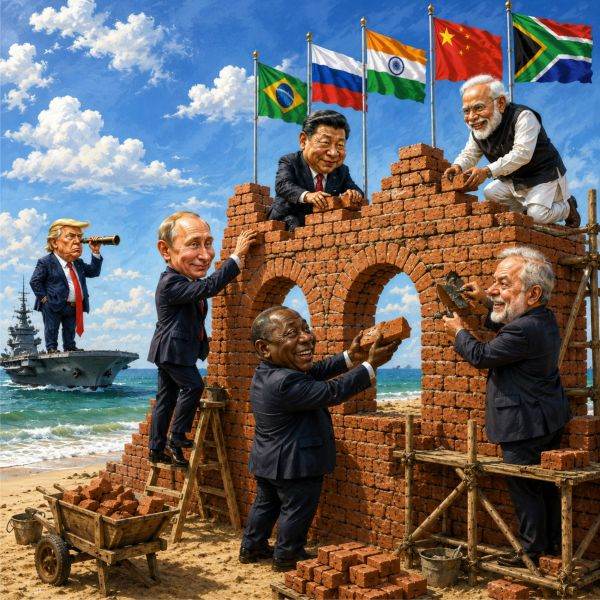
Secretary of State Marco Rubio's visit to India, the other day, was presented by the US Presidential Administration and the media favorable to President Donald Trump as a real success because it ended with the signing of an agreement on rare earths and critical raw materials. The situation presented by the American press is completely different, if we analyze what happened in New Delhi, before Marco Rubio's official visit.
None of the overseas political experts talked about the fact that in mid-May, India, as the chair, organized the BRICS foreign ministers' summit in New Delhi, which ended with a joint declaration, signed by all members of the organization, through which the participants sent one of the harshest and most ambitious geopolitical signals in recent years against the Western-dominated world order: the major emerging economies no longer accept the status of secondary actors in a system perceived as unbalanced, politicized, and controlled by the West.
The foreign ministers of the BRICS member states openly discussed the radical reform of the IMF and the World Bank, the reduction of dependence on the dollar, the development of alternative cross-border payment mechanisms, the expansion of the role of the New Development Bank in the Global South, the construction of their own digital infrastructure, cooperation in artificial intelligence, and the consolidation of a "multipolar” global system that would diminish the influence of the United States and its Western allies on the world economy and international institutions.
The final declaration adopted in New Delhi and published on the website of the Ministry of External Affairs of India is, in essence, a direct strategic challenge to the global architecture built after the Second World War.
"The Ministers reiterated the urgent need to reform the Bretton Woods institutions to make them more agile, efficient, inclusive, impartial, accountable and representative, with a view to strengthening their legitimacy and credibility. They called for reforms in their governance to reflect the transformation of the global economy since their inception, improved management procedures, including through a merit-based and inclusive selection process, and increased representation of emerging and developing economies in the leadership of the IMF and the World Bank,” the statement said. Practically, two decades after its establishment, BRICS is no longer just an alternative economic alliance to the West, but is beginning to emerge as a geopolitical pole that directly challenges the world order built around the dollar, the IMF, the World Bank, the UN Security Council and multilateral institutions dominated, directly or indirectly, by the United States and its allies.
• The New Development Bank, encouraged to lend to the entire Global South
The New Delhi document is not a simple diplomatic exercise loaded with bureaucratic formulas, but a strategic manifesto of the Global South against Western hegemony, against unilateral sanctions, against selective protectionism and against the Western monopoly on the rules of globalization.
The text of the Final Declaration from New Delhi also says: "The Ministers stressed the importance of efforts to facilitate fast, low-cost, more accessible, efficient, transparent and secure cross-border payments between BRICS countries and other states, which can support greater trade and investment flows. In this regard, they encouraged further discussions on the BRICS initiative for cross-border payments and strengthening the BRICS reinsurance capacity.” In geopolitical translation, this is the cautious language through which the BRICS announces that it wants to reduce dependence on the financial infrastructure controlled by the West. It is not yet a total break with the dollar, but it is the beginning of the construction of a parallel infrastructure: alternative payments, financing in local currencies, the expansion of the New Development Bank and the strengthening of its own financial protection mechanisms. And this is stated in the respective statement: "As the New Development Bank begins its second golden decade of high-quality development, the ministers recognized and supported its increasingly important role as a robust and strategic agent of development and modernization in the Global South,” encouraging the bank "to steadily expand its capacity to mobilize resources, promote innovation, expand local currency financing, diversify funding sources, and support impactful projects.” In other words, BRICS is no longer just asking for reform of the existing system, but is trying to build the economic levers of a post-Western world.
• BRIC Foreign Ministers : AI, essential for a just, equitable and prosperous future for all states, especially those in the Global South
This offensive is not limited to finance. It also goes straight to the most sensitive area of the 21st century: technology, artificial intelligence, digital infrastructure and the control of data flows.
"The Ministers recognized that Artificial Intelligence presents immense opportunities for stimulating economic growth and sustainable development for all. They further noted that international cooperation to improve the accessibility of artificial intelligence resources, while ensuring their safety, security, inclusiveness and reliability, to promote the energy efficiency of AI systems, to stimulate science and innovation in the field of AI, to develop trustworthy AI technologies, to harness AI for economic growth and social good and to reduce potential risks, will be essential for promoting a just, equitable and prosperous future for all states, especially those in the Global South,” the text of the final declaration in New Delhi states. This is one of the most important passages in the declaration, because it shows that BRICS is no longer just talking about oil, infrastructure, trade and market access, but about the future technological command of the world. Whoever controls artificial intelligence, digital infrastructure, submarine cables, ICT standards, data security and interoperable systems controls, in fact, the global economy of the coming decades.
This is where the major ambiguity of the BRICS project appears. On the one hand, the group presents itself as a defender of sovereignty, equity and the right of emerging states to no longer depend on Western monopolies. On the other hand, the same document talks about "common interoperable rules and standards at the global level”, about combating disinformation, hate speech, information manipulation and deepfakes, about the security of digital supply chains and about the expansion of digital public infrastructure. "The Ministers recognized the transformative impact of Information and Communications Technologies (ICT) as a key driver of socio-economic growth and digital transformation in the BRICS countries and reaffirmed their commitment to further strengthen collaboration in this area,” the statement says, adding support for "an open, safe, secure, stable, accessible, peaceful and interoperable ICT environment, while respecting the sovereignty and national security of each country.” The formula is seductive, but it contains an obvious tension: how can a system be simultaneously nationally sovereign and globally interoperable, open and controlled, accessible and supervised, politically decentralized and technologically standardized?
This is precisely where the two sides of BRICS multipolarity meet. The first is the attractive side for the Global South: the promise of a more equitable world, in which Asia, Africa, Latin America and emerging economies are no longer mere peripheries of decisions made in Washington, Brussels, London or Frankfurt. The second is the darker side, critically suggested by an analysis published yesterday in Zerohedge by Iain Davis: the replacement of a Western-dominated global order with another form of global governance, perhaps more diverse in appearance but equally centralizing in practice. If the BRICS criticize Western hegemony only to build another global architecture of financial, technological and informational control, then multipolarity risks becoming not a liberation but a redistribution of power among elites.
• BRICS Build Their Own Communications Infrastructure
The New Delhi document thus contains both the promise and the danger of the new multipolar order. The promise is obvious: reforming the IMF and the World Bank, increasing the representation of emerging states, developing financing in local currencies, expanding the New Development Bank, strengthening cooperation in the Global South, creating their own payment mechanisms, reducing vulnerability to sanctions and challenging a global system perceived as unfair. The danger is equally clear: in the name of equity, digital security, resilience, inclusion and combating disinformation, BRICS is proposing its own mechanisms for standardization, monitoring and control. It is no coincidence that the declaration calls for "a comprehensive, balanced and objective approach to the development and security of ICT products and systems, as well as the development and implementation of common, globally interoperable rules and standards for the security of supply chains”. In a digital economy, global standards are not simply technical norms, but instruments of power.
The infrastructural dimension reinforces this direction. "The ministers welcomed the progress of discussions on the technical and economic feasibility study for the creation of a high-speed communications network through submarine cables between BRICS countries, to promote digital infrastructure connectivity, capacity building and common development. In this context, they welcomed the establishment of the BRICS Working Group on Submarine Cables to advance the discussions,” the New Delhi declaration says, a crucial passage that shows that BRICS no longer just want access to existing global infrastructure, but want to build their own. Submarine cables, payment systems, development banks, local currencies, digital platforms and cooperation in artificial intelligence are all part of the same project: reducing structural dependence on the West and creating real strategic autonomy.
• Divergences on Middle East policy
Geopolitically, the declaration seeks to transform BRICS into the political voice of the Global South. Criticisms of "unilateral coercive measures”, sanctions, protectionism and the politicization of multilateral institutions are a direct attack on the instruments through which the West has exerted its influence in recent decades. In Asia, Africa and Latin America, this message is catching on with citizens. Indebted states, economies vulnerable to dollar shocks, governments affected by sanctions, countries dependent on external financing, and actors marginalized in global institutions see BRICS not just as an alliance, but as a possible path to more advantageous negotiations with the Western world. Herein lies the group's narrative strength: it promises not just development, but geopolitical dignity.
However, BRICS is not a homogeneous bloc. Behind the formulas of solidarity, multipolarity, and win-win cooperation lie divergent national interests, regional rivalries, economic competitions, and major diplomatic sensitivities. The very declaration hints at these limits when it uses cautious formulas regarding the Middle East and admits the existence of "different views among some members.” India, China, Russia, Brazil, South Africa, and the new members of the group do not share the same vision of global security, trade, regional conflicts, or relations with the West. Some states want autonomy from Washington, others want room for negotiation, others want protection, others want influence. BRICS is, for now, more of a convergence of grievances than a disciplined alliance.
The position on Gaza best shows this combination of ambition and caution. The declaration expresses "deep concern,” supports Palestinian rights, invokes UN resolutions, and calls for political solutions, but avoids radicalism that could crack the internal consensus. This ambivalence reduces the moral force of the message, but preserves the minimal cohesion of the group. BRICS wants to be critical enough of the West to attract the Global South, but cautious enough not to turn its internal differences into open crises.
From this perspective, the New Delhi declaration marks an important moment not because it would officially proclaim the end of Western dominance, but because it shows that this dominance is no longer accepted as inevitable. The West no longer has a monopoly on globalization. Terms like reform, equity, representation, inclusion, sustainable development, digital security, artificial intelligence, and international finance are now being reclaimed by the BRICS and repackaged in an anti-hegemonic discourse. This is the big change: the fight is no longer just for resources, markets, and institutions, but also for the vocabulary of the world order.
But the crucial question remains whether the BRICS can turn this rhetoric into real power. Building an alternative to the Western system is not just about criticizing the dollar, the IMF, the World Bank, or US sanctions. It means creating liquidity, trust, predictable rules, clearing mechanisms, credible institutions, secure infrastructure, and markets deep enough to support global flows. It also means overcoming the internal contradictions among the group's members. Without these elements, multipolarity risks remaining more of a geopolitical slogan than a functional order.
Yet the signal sent to New Delhi is impossible to ignore. BRICS is no longer a decorative forum for emerging economies, but is trying to become the architect of a new distribution of global power. It wants a different financial order, a different digital infrastructure, a different institutional representation, a different governance of artificial intelligence and a different logic of international trade. This is the real stakes: building a world in which the West no longer sets the rules alone.
The new multipolar world order promised by BRICS may be the beginning of a historical correction or the beginning of a new form of global centralization. What is certain is that the world is entering a phase in which the old rules are no longer accepted without question, and the major emerging economies no longer just demand a seat at the table, they want to redesign the table itself.




















 Euro
Euro Dolar SUA
 Franc elveţian
 Liră sterlină
 Gram de aur





























