 English


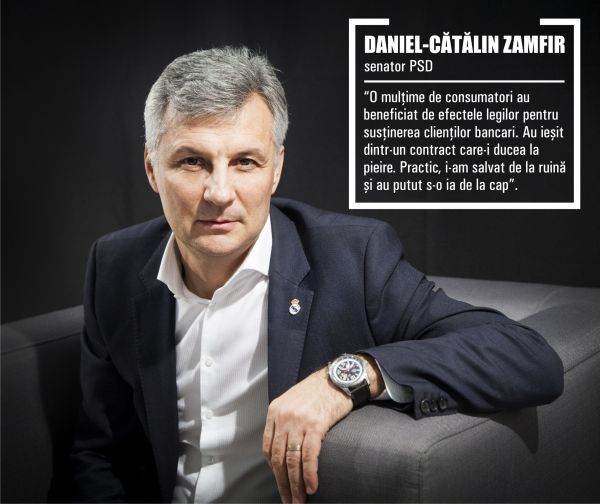
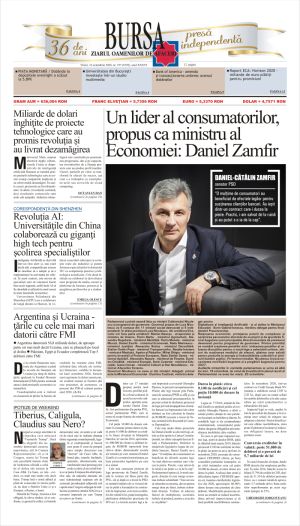
Regarding the composition of the new Cabinet, it is worth noting that, among the 17 proposed ministers, the individual with the most clearly defined political profile-one well-aligned with the needs of the citizens-is Senator Daniel Zamfir. A former PNL lawmaker and current PSD parliamentarian, he is slated to serve as Minister of the Economy. At least 10,000 cases estimated to be in court regarding "payment in lieu of debt" (darea în plată), over 51,000 debtors with Swiss franc-denominated loans on bank balance sheets as of the summer of 2016, and approximately 400,000 clients with interest rates pegged to the ROBOR index-these are just a few of the social dimensions of the issues upon which Senator Daniel Zamfir has built his reputation, through legislative proposals that were enacted by Parliament to support citizens.
Behind Daniel Zamfir's legislative track record lie people who saw their loan installments rise, lost assets without being relieved of their debts, or discovered that a loan of a few thousand lei required a repayment amount many times larger than the original sum received. Some of these initiatives became law, others were halted by the Constitutional Court, while some still await a final decision from Parliament.
Regarding his legislative initiatives concerning bank loans, Daniel Zamfir stated: "A great many consumers have benefited from the effects of these laws. They were able to exit contracts that were leading them to ruin. Essentially, we saved them from financial collapse, allowing them to start over.” The lawmaker asserts that the direction of the economy must definitively be changed: "We need to relaunch the economy, but we cannot rely solely on cuts; the course must be altered. We need to introduce multiplier effects-the economy must be productive so that we have the means to make payments.”
• Debt-for-property settlement (darea în plată): approximately 9,100 notifications and at least 10,000 court cases
Law no. 77/2016, initiated by Daniel Zamfir with legal support from attorney Gheorghe Piperea, provided a solution for situations where the loss of one's home did not also extinguish the associated debt. Under the terms of the law and constitutional jurisprudence, a consumer can secure the discharge of their obligations by transferring the real estate property to the creditor.
Regarding the impact of this law, according to data from the National Bank of Romania (BNR), by the end of March 2019, banks had received 9,100 notifications for debt-for-property settlements. A year and eight months later, in November 2020, the consumer association CREDERE-based on a review of the court portal-stated that there were at least 10,000 active court cases concerning such settlements. These same figures also highlight the arduous nature of this struggle. CREDERE estimated that, prior to the legislative clarifications introduced in 2020, approximatelly 80-90% of the cases were lost by the debtors. Subsequent amendments aimed to reduce uncertainty regarding the doctrine of unforeseen circumstances (impreviziune) and to enable the rebalancing of contracts. In November 2020, in a case involving Credit Europe Bank NV, the court fixed the CHF exchange rate at 2.41 lei; this was followed by rulings favorable to debtors in other cases pending before courts across the country.
The impact of the law is thus evident in the thousands of proceedings initiated and in the emergence of solutions for the discharge or adjustment of debt. For a borrower who secures a rebalancing, the outcome can mean retaining their home and reducing their monthly payment obligation, rather than simply having to surrender the property.
• Conversion of foreign currency loans: over 51,000 debtors and a 5.7 billion lei burden
Regarding the Swiss franc, data from the National Bank of Romania (BNR) clearly illustrate the scale of the issue. In July 2016, banks held 53,794 CHF-denominated loans on their balance sheets, involving 51,334 individual borrowers, with a total value of approximately 5.7 billion lei. The non-performing loan (NPL) ratio for this segment reached 33%. This group was among those directly targeted by the proposal-championed by Senator Daniel Zamfir-to convert loans at the historical exchange rate. At the time, the BNR estimated a gross impact on the banking sector of 2.38 billion lei, or 1.67 billion lei after accounting for impairment adjustments already recognized. These figures represented estimates of banking losses under a conversion scenario, rather than actual funds returned to consumers. Nevertheless, they illustrate the financial scale of the currency-risk burden redistribution intended by the legislation.
The law adopted in 2016 was declared unconstitutional in its entirety by the Constitutional Court of Romania (CCR) Decision no. 62/2017. According to data from the National Bank of Romania (BNR) published in 2017, between January 2015 and January 2017-following conversions negotiated individually with banks-37,366 requests were resolved: 24,853 through conversion and 12,513 through restructuring.
Daniel Zamfir pursued the matter further with a draft law on protection against currency risk. Although this bill did not ultimately become law, the senator's efforts did lead to banks adjusting their contracts, thereby limiting the burden caused by currency appreciation.
• Leasing: The value of a repossessed vehicle must be deducted from the consumer's debt
Law no. 83/2021, another initiative by Daniel Zamfir, addresses a different type of vulnerability: a consumer may lose the financed asset while remaining burdened by significant payment obligations. The explanatory memorandum outlines the imbalance between the financier and the user, justifying the provision of additional protections.
The law removes the status of "enforceable title" (an instrument that allows for immediate enforcement without a court judgment) from contracts and related guarantees in dealings with consumers. If the asset is returned as scheduled, any compensation owed must be calculated by taking into account the value realized from the asset's sale or its appraised value. The consumer-or a buyer proposed by them-also enjoys a priority right of purchase, in accordance with the law.
The impact can be illustrated by the following example: given eligible obligations of 50,000 lei and a recovered asset value of 35,000 lei, the difference amounts to 15,000 lei. This example serves to illustrate the mechanism rather than representing an actual case. The law does not automatically extinguish the entire debt upon the surrender of the vehicle. Unfortunately, there is no verifiable public record of the beneficiaries of this law or the total savings realized following its implementation; however, initial estimates suggested there could be "hundreds of thousands of beneficiaries."
• The origins of the IRCC
Daniel Zamfir publicly advocated for a shift toward a benchmark based on actual transactions and claims credit for the political initiative, although the IRCC was legally introduced via Emergency Government Ordinance (OUG) no. 19/2019. The intended benefit was to establish a benchmark that more closely reflects actual market operations. However, this index does not guarantee consistently lower rates than the ROBOR; the financial advantage depends on the specific time period and the individual contract. The legislative documentation also includes an explicit financial assessment. The explanatory memorandum for the draft legislation-which became Law no. 243/2024-argues that reducing the reference cost for retail loans by one percentage point, through the replacement of the ROBOR with a transaction-based index, would leave approximately one billion lei annually in the hands of consumers.
• The Setting of the ROBOR Index - An Issue Affecting Hundreds of Thousands of Banking System Customers
In October 2022, Florin Dănescu, Executive President of the Romanian Banking Association, stated that approximately 400,000 borrowers had interest rates linked to the ROBOR index. This figure represents the number of people exposed to the index at that time, not the number of individuals who would receive compensation under the draft legislation promoted in 2026 by Senator Daniel Zamfir. Following a parliamentary inquiry led by the senator in 2019, the Competition Council-acting on its own initiative-launched a separate investigation in October 2022 into the ten banks involved in determining the ROBOR index. In early June 2026, the competition authority announced sanctions totaling 3.73 billion lei, a decision the banks have contested. Draft law L447/2026, initiated by Daniel Zamfir to provide compensation to consumers, was adopted by the Senate on October 14 and sent to the Chamber of Deputies. The explanatory memorandum aims to facilitate the recovery of damages through an accessible mechanism, thereby reducing the need for costly individual litigation. Compensation will be calculated on a case-by-case basis, contingent upon a final determination that competition law has been violated.
Following these various legislative packages, Daniel Zamfir came to be seen by the public as their primary ally in the struggle against the banking system. Representatives of that system have frequently accused the Social Democratic senator of using his legislative initiatives to destabilize the country's commercial banks, or of having an indirect personal interest in the adoption of such laws-as was the case with the "dation in payment" (debt discharge by asset surrender) law, which critics claimed would have benefited the senator's own brother, who held such a loan.
• Interest rates charged by non-bank financial institutions (IFN-uri) and loan repayments to these entities
The scale of the costs that the "IFN law"-initiated by Daniel Zamfir-sought to cap is illustrated by documents published by "Snoop" in a July 2024 investigative report. In one repayment schedule analyzed by the outlet, a loan of 4,000 lei resulted in a total repayment amount of 27,660 lei over the course of one year. The investigation also highlighted cases where individuals ended up paying back approximately seven times the amount they had originally received.
Law no. Law 243/2024, initiated by Zamfir and a group of parliamentarians, introduced daily caps and a rule stipulating that, for the categories of credit up to 25,000 lei covered by the legislation, the total amount payable cannot exceed double the loan amount. For a new loan of 4,000 lei subject to these rules, the total limit is, therefore, 8,000 lei. The difference compared to the previously documented example is 19,660 lei.
Inspection data show that the problem persisted even after the law came into effect. In November 2025, the ANPC (National Authority for Consumer Protection) reported that 573 non-bank financial institutions (NBFIs)-including pawn shops-had been inspected; 326 were found to be in violation, resulting in 256 fines totaling 1.47 million lei and 104 supplementary measures. Orders were also issued for the reimbursement of amounts collected unlawfully. Since the inspections covered various consumer protection obligations, not all sanctions can be attributed exclusively to Law 243/2024.
When presenting his legislative package in 2019, Senator Daniel Zamfir spoke of protecting approximately four million families. This was the political estimate for the entire set of draft laws concerning banks, NBFIs, debt collection agencies, and forced execution proceedings.
• Prosumers: a community of over 300,000 users
In March 2026, the leadership of the ANRE (National Energy Regulatory Authority) reported that there were over 300,000 prosumers in Romania. This represents the size of a community for which the compensation and billing rules have direct financial consequences. The figure does not refer to households established under the "Zamfir Law," nor does it represent individuals already confirmed as beneficiaries of these specific provisions.
Daniel Zamfir is a co-initiator of the legislative proposal that became Law no. 160/2026. This law provides for compensation across multiple consumption or production sites-subject to applicable conditions-as well as monthly billing and settlement mechanisms. For private individuals with installations of up to 27 kilowatts, the value of any surplus energy can also be used to cover natural gas bills from the same supplier, provided that legal requirements are met. Electrica Furnizare has stated that the implementation of these provisions requires regulatory action from ANRE (the National Energy Regulatory Authority) and the establishment of operational processes.
The intended impact is to maximize the value of investments in solar panels by using surplus energy to offset household expenses. However, the actual savings will vary depending on production levels, consumption, and the specific terms of the energy contract.
• Completing the construction of existing hydropower projects: a priority for the national energy system
During debates in 2022, proponents of Daniel Zamfir's initiative-which focuses on completing hydropower projects that were initiated decades ago-pointed to the Răstoliţa, Bumbeşti, and Dumitra plants. They estimated that the energy produced by these facilities would be sufficient to meet the consumption needs of over 300,000 households. The law, promulgated in September 2026, allows-under specific conditions-for the modification of the boundaries of certain protected areas to accommodate developments that were approved and initiated prior to June 29, 2007; this includes investments that began even before 1990. The intended benefit is to restore the utility of these investments and generate additional output once the work is completed.
This legislative initiative has been challenged on several occasions by environmental organizations, which also alerted the European Commission; the Brussels-based institution has requested clarifications multiple times.
It remains to be seen whether, following its review of the law-promulgated by President Nicuşor Dan a month ago-the European Commission will release the funds linked to the National Recovery and Resilience Plan (NRRP) milestone concerning protected areas, or whether it will withhold the amount, deeming that the objective has not been touched upon.
• State holdings: protecting future revenues
Daniel Zamfir is a co-initiator of bill PL-x 376/2026, which proposes a freeze on the disposal of state-owned equity stakes until December 31, 2027, subject to specific exceptions outlined in the text. The bill was passed by the Chamber of Deputies-the final decision-making body-with 178 votes in favor, 103 against, and 8 abstentions; it is currently under review by the Constitutional Court following a challenge filed by [Bucharest Mayor] Nicuşor Dan.
The proponents argue that this measure prevents disadvantageous sales and secures the state's future revenue streams from profitable companies.
Another initiative championed by the prospective Minister of Economy concerns mandatory school uniforms; this bill has been passed by the Senate and is now before the Chamber of Deputies. As proposed, the bill allows individual schools to determine the design of the uniforms and provides for free-of-charge provision or subsidies, depending on the families' financial circumstances. Supporters argue that this reduces the social pressure stemming from disparities in clothing, while opponents question the measure's effectiveness and its associated costs. During parliamentary debates, Senator Ştefan Pălărie cited a projection of over 1.2 billion lei for the support scheme-though this figure does not represent a finalized or validated cost.
Following consultations with students and parents, Daniel Zamfir supported an amendment to ensure students are involved in selecting the design of their uniforms.
• A track record built on tangible results for the benefit of citizens
Thousands of "dation in payment" (debt settlement by asset transfer) procedures, tens of thousands of debtors affected by currency risk, and hundreds of thousands of clients exposed to the fluctuations of financial indices explain why these issues gained prominence well beyond the base of any single political party. Daniel Zamfir championed debt settlement and the conversion of loans while serving as a PNL (National Liberal Party) MP, and he successfully enacted these measures into law after becoming a PSD (Social Democratic Party) MP. Consequently, through his work, Daniel Zamfir has cultivated a personal following that transcends party lines.
His collaboration with experts-most notably the lawyer Gheorghe Piperea, now a Member of the European Parliament-demonstrates that the prospective Minister of Economy possesses the ability to attract expertise, grasp complex issues, and take decisive action in the interest of consumers. The tangible outcomes are reflected in rebalanced contracts, reduced financial obligations, and the effective exercise of consumer rights.
His nomination as Minister of Economy has also brought renewed attention to a controversy involving a written pledge Daniel Zamfir made during a talk show on "România TV", in which he promised not to vote for a government led by Luca Niculescu. However, being nominated for a cabinet portfolio and the subsequent vote of investiture are two distinct actions; the nomination alone does not constitute a breach of his commitment regarding the vote. From a political standpoint, accepting the position nonetheless requires an explanation as to how his initial stance has evolved. In response, Mr. Zamfir clarified that he had simply "forgotten" to specify on that document that he would not grant a "blank check" vote to such a government. Based on the above, it can be stated that Daniel Zamfir's parliamentary track record is rooted in a clear social constituency, with legislative interventions that have altered the tools available to consumers. A potential tenure at the helm of the Ministry of Economy should translate this experience-moving beyond mere public confrontation-into tangible, verifiable results that citizens can actually perceive in their monthly loan installments, utility bills, and the funds remaining for their daily living expenses.
What is certain is that, once appointed as Minister, Daniel Zamfir will have more than just his own legislative initiatives at his disposal; he will also have the backing of the institution tasked with consumer protection-the National Authority for Consumer Protection (ANPC)-which operates under the Romanian Government and is coordinated by the Ministry of Economy.






















 Euro
Euro Dolar SUA
 Franc elveţian
 Liră sterlină
 Gram de aur






























Reader's Opinion