 English


The Yashar party of former military chief Gadi Eisenkot is leading in almost all polls ahead of the 27 October parliamentary elections, with Likud, Prime Minister Benjamin Netanyahu's party, in second place. First place, however, does not determine who forms the government. In the 120-seat Knesset, a government needs 61 votes, and the electoral threshold is 3.25%. The president of Israel designates the politician with the best chance of securing a majority, not necessarily the leader of the largest party. Why could Netanyahu lose the election and still remain prime minister?
• What the polls show
Four polls conducted between 14 and 21 October give the same ranking and the same conclusion: neither bloc reaches 61 seats. The N12 and Channel 13 polls were reported by the Jerusalem Post and Haaretz, the Walla poll was also reported by the Jerusalem Post, while the final poll by Zman Yisrael was reported by the Times of Israel.
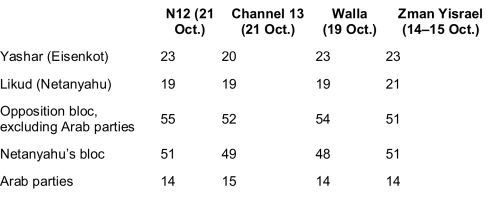
The exception is Channel 14, a television station that openly supports Netanyahu: its 13 October poll, reported by Agenzia Nova, gave Likud 29 seats and the prime minister's bloc exactly 61. Benny Gantz withdrew from the race, and Yashar received some of his votes.
The result may depend on two small parties hovering around the electoral threshold: People of Israel, led by former general Ofer Winter, who is close to Netanyahu's camp, and Yoaz Hendel's Reservists alliance with Yaron Zelekha's Economic Party. In the Walla and Zman Yisrael polls, the Reservists clear the threshold with four seats, without joining either bloc, while People of Israel remains below the threshold. Votes cast for a party that fails to cross the threshold are lost, and the seats are distributed among the others.
• Netanyahu's coalition has fallen apart before the vote
The prime minister's camp comprises Likud and the radical right represented by ministers Itamar Ben-Gvir and Bezalel Smotrich. The ultra-Orthodox parties, Netanyahu's traditional allies, have broken with him over the conscription law: United Torah Judaism left the coalition, while Shas left the government but remained in the coalition and boycotted its legislative initiatives. If Netanyahu needs them again, he will have to negotiate with them over the conscription arrangements, a subject covered in Article 2 of the dossier, "Israelis Demand an Inquiry into 7 October That Netanyahu Has Refused for Three Years”.
• The opposition: several leaders, one goal
Alongside Yashar, the opposition includes Naftali Bennett and Yair Lapid's B'Yachad alliance, Avigdor Lieberman's Yisrael Beiteinu and Yair Golan's Democrats. Its leaders have signed a cooperation agreement to replace Netanyahu. Eisenkot has rejected a government with a rotating premiership.
• The Arab parties: excluded, then readmitted
At the request of Likud and Ben-Gvir's party, the Central Elections Committee voted on 24 September, by 18 votes to five, to disqualify the two Arab lists, Ra'am and the Joint List, from the election. On 2 October, the Supreme Court unanimously overturned the decision, finding that the evidence did not meet the legal requirements; Sami Abu Shehadeh, leader of the Balad party, withdrew from the race.
The two lists would win a combined 14 seats in the N12 poll. Without them, the opposition is six seats short of a majority; with them, it would have a numerical majority. But Eisenkot says Ra'am and the Joint List cannot be coalition partners, arguing that some of their members do not regard Hamas as a terrorist organisation. As Article 1 of the dossier, "The World Judges Netanyahu over Gaza, Israelis Judge Him over 7 October”, shows, voters for these parties are those who judge the war in Gaza most closely in line with how the rest of the world judges it. Likud is campaigning precisely on the opposition's dependence on them, arguing that Eisenkot cannot form a government without Ra'am.
One possibility remains, as described by The Economist: the Arab parties could support an Eisenkot-led minority government from outside, without joining it. Would opposition voters accept a government that relies on votes its leader has rejected?
• Netanyahu's trial and Qatargate
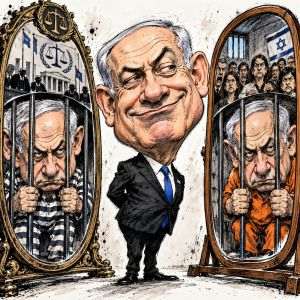
Netanyahu is the first Israeli prime minister to stand trial while in office. He is accused of bribery, fraud and breach of trust in three cases, known as Cases 1000, 2000 and 4000, and completed his testimony on 24 June 2026 after 98 hearings; no verdict has been delivered. Netanyahu calls the trial political and denies the charges.
In the Qatargate affair, advisers to the prime minister are suspected of having been paid by Qatari lobbyists to promote Qatar's image during the war. Police completed their investigation in January 2026, and the case is awaiting a decision by prosecutors. Netanyahu has given statements but is not a suspect.
As prime minister, Netanyahu is preferred by fewer Israelis than Eisenkot. In a public broadcaster KAN poll conducted on 12 October and reported by Anadolu, 43% preferred Eisenkot and 38% Netanyahu; in a Maariv poll conducted on 14-15 October and reported by the Jerusalem Post, the figures were 48% and 41%, respectively.
• Three possible outcomes
Netanyahu forms a government again if his bloc reaches 61 seats or he attracts parties from outside it. Eisenkot forms a government with his own majority or with the Arab parties' external support. Alternatively, neither succeeds, and Israel goes to another election, with Netanyahu remaining caretaker prime minister in the meantime. Only the first and last scenarios would keep him in office.



















 Euro
 Dolar SUA
 Franc elveţian
 Liră sterlină
 Gram de aur































Reader's Opinion