English

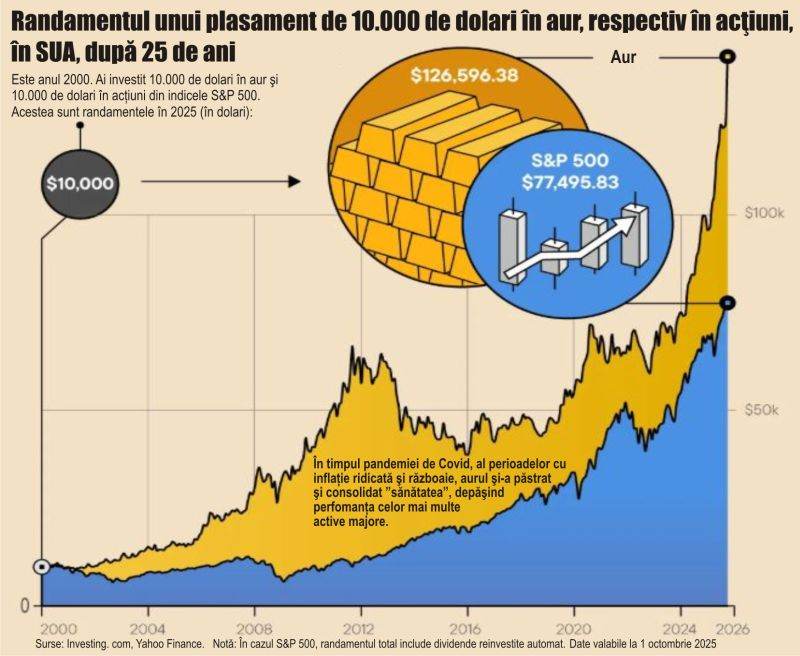
Investors keep asking the same question about investments: gold or stocks? Since 2000, a series of crises, inflation spikes and policy changes have tested both assets, according to an analysis by visualcapitalist.com, conducted in partnership with BullionVault, which shows how a $10,000 investment in gold, or the same amount in stocks from the S&P 500 stock index, has grown over the past 25 years. The analysis covers the period from January 2000 to October 2025, using data provided by investing.com and Yahoo Finance.
• How the return on a $10,000 investment has increased over cycles
According to the most recent data, the value of $10,000 in gold has reached $126,596.38 this year, while $10,000 in S&P 500 stocks has reached $77,495.83. As a result, gold has increased by 10.4% annually, compared to 8.3% for stocks over the same period. The difference in value of the gold investment on October 1, 2025, is $49,100.54, or 63.4% higher than the S&P 500 in percentage terms, according to the cited source.
In December 2020, the year of the Covid pandemic, the investment in gold was worth $64,710.55, and the investment in stocks - $40,416.65. On December 1, 2022, the investment in gold was worth $64,398.47, and the investment in stocks - $42,597.40.
• Why gold outperformed stocks
Stocks suffered major declines in 2001-2002, 2008-2009, and 2022, which slowed the growth of company capitalization, even with dividends. At the same time, gold benefited from rising inflation, exchange rate volatility, and continued purchases by central banks and other public institutions. Thus, inflation increases and political uncertainty have increased gold's role as a store of value.
Gold in particular reached record highs in 2024-2025 as macroeconomic risks remained elevated.
Recall that last month, the price of gold reached the $4,000 mark for the first time as investors sought a safe haven from a weaker dollar, geopolitical volatility and economic uncertainty.
At the same time, China and other countries have diversified their investments in gold, moving away from US Treasury bonds and towards gold, respectively, following the harsh sanctions imposed by Washington on Russia after the invasion of Ukraine in 2022. Individual investors have also made investments in gold as protection against persistent inflation.
In such conditions, the gold price has risen by more than 50% this year.
• The yellow metal won when the question arose: "gold or stocks?"
For more than 25 years, gold has delivered higher returns and fewer notable failures. As a result, it has maintained its purchasing power when shocks have occurred and strengthened when stability has returned.
For long-term savers who value resilience and liquidity, the data shows that since the turn of the millennium, the yellow metal has won when the question of "gold or stocks” has arisen.
For investors looking to buy gold, there are several ways to own bullion. However, costs have mattered over the decades. Even small annual fees increase the gap between metals and ETFs (exchange-traded funds), according to the cited source.
As a result, many investors prefer physical gold, stored in a vault, held in direct ownership and transparent storage.
• WGC: Central banks prefer gold as reserves
Central banks around the world expect the share of gold holdings in their reserves to increase over the next five years, while the share of the dollar is expected to decrease, according to a study published this summer by the World Gold Council (WGC), cited by Reuters.
Of the 73 central banks surveyed, 76% expect their gold holdings to increase over the next five years, compared to 69% last year. Almost three-quarters of respondents expect central bank reserves denominated in dollars to decrease over the next five years, compared to 62% last year.
According to the WCG, 95% of respondents believe that central bank gold reserves will increase over the next 12 months, compared to 81% last year, while the Bank of England (BoE) remains the preferred place for central bank gold reserves.
"Gold's performance during times of crisis, portfolio diversification and inflation hedging are reasons for the increase in gold reserves in the future,” the WGC said.
According to the WGC, global demand for gold has remained robust over the past decade, fueled by central bank reserves, investment and jewellery demand.
According to the WGC, global demand for gold has remained robust over the past decade, fueled by central bank reserves, investment and jewelry demand. China has been the world's top gold producer for more than a decade, the source said. It noted that in 2024, the Asian country produced 380 tonnes of gold, up just 8% from 351 tonnes in 2010. Despite the modest growth, its dominance reflects long-term investment in domestic mining and refining infrastructure. China's state-backed mining industry also helps insulate it from global volatility. Russia, in second place, has increased its gold production by 63% since 2010, reaching 330 tonnes in 2024. This growth is driven by large investments in mining projects and a strategic focus on strengthening national reserves. Australia is next, with 284 tonnes in 2024, an 11% increase from the 257 tonnes extracted in 2010. Canada, in fourth place, has the largest increase among the top five producing countries, at 98% - from just 102 tonnes in 2010 to 202 tonnes in 2024.


























 Euro
Euro Dolar SUA
 Franc elveţian
 Liră sterlină
 Gram de aur