English


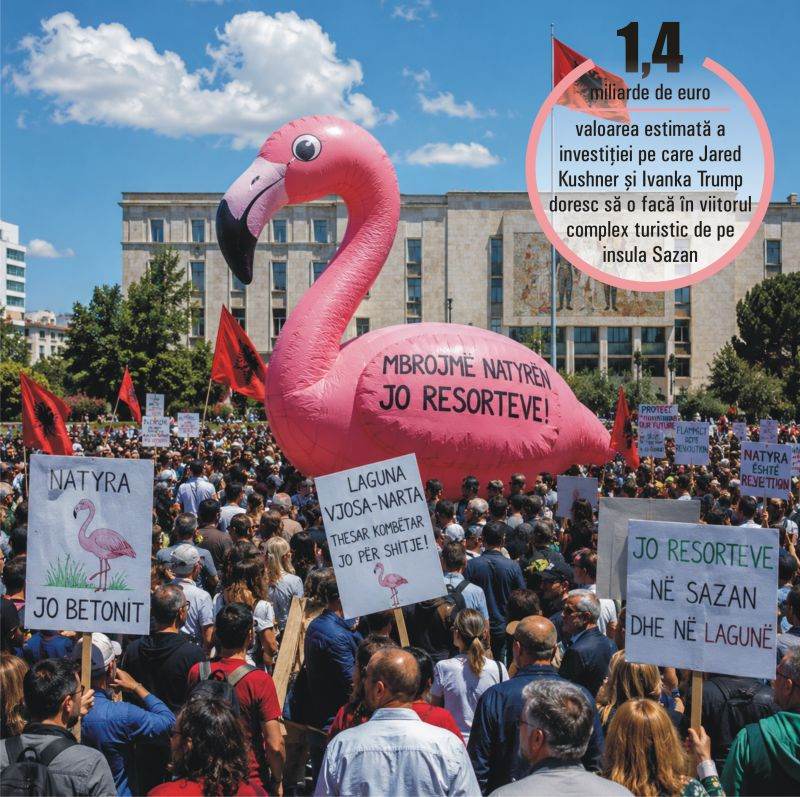
Few protest movements in Europe in recent years have experienced such a spectacular transformation as what Albanians now call the "Flamingo Revolution.” What began near a lagoon populated by flamingos, pelicans, and hundreds of other protected species has transformed, in just a few weeks, into a direct challenge to the entire Albanian political class, the way public resources are managed, the relationship between the state and major investors, and even the direction Albania is heading in its European integration process. After entering the second month of consecutive, uninterrupted protests last week, the movement can no longer be considered just one that concerns a few hundred hectares of land, but one that refers to the protection of public property, but also to the lack of trust of citizens in state institutions and in the political class in Tirana, which seems to make decisions contrary to the will of civil society.

Today's conflict has its roots in 2023, when Albania was presented as a European model in nature protection after declaring the Vjosa River as the first Wild River National Park in Europe. The government of Prime Minister Edi Rama transformed this decision into a symbol of its commitment to the preservation of natural heritage and received international praise for protecting one of the last unspoiled river ecosystems on the continent. However, in February 2024, the Albanian Parliament adopted important changes to the legislation on protected areas. At first glance, the changes seemed like simple legislative adjustments, but in reality they changed the philosophy of the entire environmental protection system. Areas where there were previously severe restrictions on construction became accessible to tourism, energy or infrastructure developments, and the boundaries of protected areas could be revised depending on the projects declared of interest for development. For environmental organizations, this was the moment when the door opened, from a legal point of view, to what was to become the most controversial real estate project in Albania in recent decades. It was not long before the legislative changes began to produce concrete effects.

• Donald Trump's son-in-law, investment plans on Sazan Island and the Vjosa-Narta Lagoon
Between March and June 2024, Jared Kushner, son-in-law of US President Donald Trump, made public his plans for large-scale tourism investments in Albania. Moreover, on June 20, 2024, Ivanka Trump was in Albania to visit the two locations where the respective tourism investments were to be made. The projects targeted two of the country's most spectacular natural areas: Sazan Island and the Zvërnec-Narta region, located near the Vjosa-Narta lagoon. The value of the investments was estimated at billions of euros, and the Albanian authorities presented the initiative as one of the most important economic opportunities in the country's recent history. At the same time, however, international publications and environmental organizations warned that the development of luxury resorts in a unique ecosystem risks affecting one of the last intact natural deltas in Europe, and the coincidence between the change in the law and the announcement of the projects raised many questions.
At the end of 2024, the project took another decisive step. The Albanian government has granted "strategic investor” status to Atlantic Incubation Partners LLC, associated with Jared Kushner, for the development of the tourist complex on Sazan Island, an investment estimated at around 1.4 billion euros. In parallel, documents obtained by BIRN showed that the authorities were preparing to transfer the administration of over 90% of the surface of Sazan Island from the Ministry of Defense to the Ministry of Economy, a step considered essential for the implementation of the project. This is because Sazan Island was the place where the USSR established a military base before 1990, which later came under the tutelage of Albania, which maintains a functional military radar. Investigations by the Albanian press - Exit.al and BIRN - also showed that special legislative facilities were being considered for the investor, including accelerated procedures and the involvement of state institutions in preparing the land for tourism development.
All the while, tensions were growing almost imperceptibly. On one side were the authorities, who talked about historic investments, jobs and transforming Albania into a premium destination for international tourism. On the other side were local communities, environmental organizations and a growing number of specialists who warned that the development of huge tourist complexes in an area inhabited by over two hundred of bird species, pelicans, flamingos, sea turtles and other protected animals could produce irreversible effects on biodiversity. At the same time, accusations of lack of transparency, property conflicts, legislative changes considered favorable to investors and connections between authorities and influential economic groups were emerging around the projects.
• Construction site organization, the trigger for the conflict
The moment that definitively changed the course of events occurred in the spring of 2026. At the end of April and the beginning of May, heavy machinery, metal fences and barbed wire began to appear on the ground in the Pishë Poro and Zvërnec areas. For the authorities, these represented simple preparatory work. For the residents of the area, however, the image of the fences erected between the community and the beaches they had used for generations had a huge symbolic charge. Many saw the fences as evidence that the state had already begun to cede control over a space considered a common heritage. Investigations in the Albanian press show that the barbed wire fences were precisely the moment when the conflict left the online environment and moved to the streets.
On May 23, 2026, dozens of residents of Zvërnec and environmental activists organized the first protest near the construction site. They demanded a halt to the works and free access to the lands and beaches that had been considered public domain until then. The banners carried during the demonstration already spoke not only about nature, but also about corruption, oligarchy and the defense of the property of local communities. The conflict was no longer presented as just an ecological one, but also as one regarding the way public decisions are made and citizens' rights in relation to large investments.
For several days, the protest remained a local one. But everything changed on May 30, when protesters clashed with security guards at the construction site. Images of the altercations quickly circulated on social media and sparked a wave of outrage across Albania. What had previously seemed like an isolated environmental conflict had become a national issue overnight. Many Albanians began to see the images of the fences and physical confrontations as an expression of a broader phenomenon: the feeling that the interests of some investors were being given greater protection than the rights of their own citizens.
• The Uprising Moves to Tirana
In the early days of June, the movement reached the capital, Tirana. Thousands of people began to gather daily in front of the government headquarters. The pink flamingo, one of the most famous birds of the Narta Lagoon, became the symbol of the protest and would give the name to the entire movement. The initial slogans aimed to stop the project and protect nature, but very quickly the demands expanded. Among the most common messages were "Albania is not for sale”, "Edi Rama resign”, "Don't take our country” and calls to defend the natural and national heritage. The international press was already noticing that the protests had gone beyond a simple dispute over a tourist resort and had become a major political challenge to the Albanian government. As the number of participants grew from day to day, it became increasingly clear that the demonstrations could no longer be explained solely by opposition to the construction of luxury resorts near the Narta Lagoon or on Sazan Island. Within a few days, protesters began to turn each march into a public indictment of the way Albania was being run. If in the first demonstrations there were visible banners dedicated to the protection of flamingos, pelicans and the Vjosa-Narta ecosystem, very soon they were accompanied by messages denouncing corruption, the capture of state institutions, the favoring of oligarchs and the lack of transparency in large economic projects. The movement changed its nature right under the eyes of the authorities, and the flamingo symbol gradually became the emblem of a civic revolt against a political system that many Albanians considered exhausted.
At the same time, the journalistic investigations of the cited sources described complicated structures of offshore companies, companies registered in the Netherlands, contracts for land disputed in court and people previously involved in property disputes or criminal cases. Even if these elements did not automatically prove the existence of illegalities in the project itself, they fueled the public perception that behind the investment there was an opaque mechanism, inaccessible to the average citizen and protected by political power.
In just a few days, the protests took on an almost permanent character. Every evening, hundreds and then tens of thousands of people gathered in the center of Tirana. The pink flamingo appeared on banners, T-shirts and posters, transformed into a symbol of civic resistance. The atmosphere was increasingly reminiscent of the great European protest movements of the last decade: music, satirical banners, improvised speeches and a massive participation of young people, who saw in this uprising an opportunity to protest against a political model that they considered incapable of responding to the interests of society. Slogans such as "Rama in prison”, "Berisha in prison”, "Albania wants revolution” and "Resignation” echoed in the crowd. The fact that the protesters simultaneously attacked both Prime Minister Edi Rama and opposition leader Sali Berisha was interpreted by analysts as evidence that the movement rejected the entire political class formed after the fall of communism. For the first time in many years, a demonstration of such magnitude could not be claimed by either the government or the traditional opposition.
As the protests continued, they also began to attract the support of the Albanian diaspora. Communities in London, New York, Athens and other major European and American cities organized solidarity actions and sent messages of support for the demonstrators in Tirana. Images broadcast by the Albanian press showed banners that read that Albania should not be sold and that the natural heritage belongs to future generations, not to momentary economic interests.
• European Parliament, dissatisfied with projects in protected areas
On June 17, the demonstrations received what many protesters considered an indirect confirmation from the European institutions. The European Parliament adopted an amendment calling on the Albanian authorities to establish a moratorium on new permits and on works in protected areas until the legislative changes of 2024 are reviewed and fully aligned with European Union standards on nature protection. Although the text did not represent a direct condemnation of the Rama Government, the mere fact that one of the fundamental institutions of the European Union considered such an intervention necessary was interpreted as a strong political signal. For the protesters, the decision demonstrated that their concerns were not mere exaggerations, but reflected real issues regarding the compatibility of the projects with European standards.
In early July, after more than a month of daily demonstrations, the Flamingo Revolution entered a new phase. It was no longer a spontaneous protest by locals outraged by the appearance of barbed wire fences near a beach or the opposition of environmental organizations to a controversial real estate project. The movement had become an unprecedented political challenge for the government led by Edi Rama, and the scale of the protests was beginning to attract the attention of the international press, European institutions and observers concerned about the evolution of Albanian democracy.
As the demonstrations continued, the government chose not to back down. Prime Minister Edi Rama continued to argue that the investments represented a historic opportunity for Albania's development and that the tourism projects would comply with environmental protection standards. In his public interventions, he rejected accusations of favoring investors and insisted that opposition to the projects was fueled either by political manipulation or by foreign interests. In several statements, the prime minister went even further, suggesting that the demonstrations were part of a veritable "hybrid war” directed against Albania and that Jared Kushner's name was being used to provoke disproportionate emotions and reactions in society. The government also tried to convey the idea that the protests were infiltrated by the opposition or by groups interested in destabilizing the country, but this explanation did not convince a large part of the public opinion.
In the protestor camp, on the contrary, the discourse became increasingly radical. Participants stated that the problem was not the existence of foreign investments per se, but the way in which they were approved, the lack of public consultation, the legislative changes considered favorable to privileged investors and the perception that the state treated natural heritage as a negotiable commodity. Many of those interviewed by the Albanian press said that they did not dispute economic development, but that it seemed to be achieved by sacrificing protected areas and ignoring local communities.
In this extremely tense climate, one of the most important external warnings also came. On July 1, the international press reported that the tourism projects associated with Jared Kushner risked affecting Albania's European path. The signal was clear: economic development cannot take place at the cost of violating European standards regarding nature protection and administrative transparency. For a state in the midst of negotiating accession to the European Union, such an observation had a special political weight and showed that the dispute had already crossed the borders of Albania.
The most serious escalation, however, would occur on July 2. After more than thirty days of almost uninterrupted demonstrations, the tension built up in the streets degenerated into violent confrontations between protesters and the police. According to the reports included in the analyzed documents, the police used tear gas, pepper spray and water cannons to disperse the crowd, while some of the demonstrators responded by throwing stones and eggs at the public order apparatus. Several police officers were injured in the clashes and numerous arrests took place. For the first time since the start of the Flamingo Revolution, the images circulating in the international press no longer only showed flamingos, colorful banners and young people peacefully protesting, but also violent confrontations in the center of the Albanian capital.
However, the most suggestive image of the entire uprising remains the barbed wire fence erected in Zvërnec. For the authorities, the fence demarcated a construction site. For the protesters, it became a symbol of a much deeper rift between the state and the citizen.
















 Euro
Euro Dolar SUA
 Franc elveţian
 Liră sterlină
 Gram de aur