English


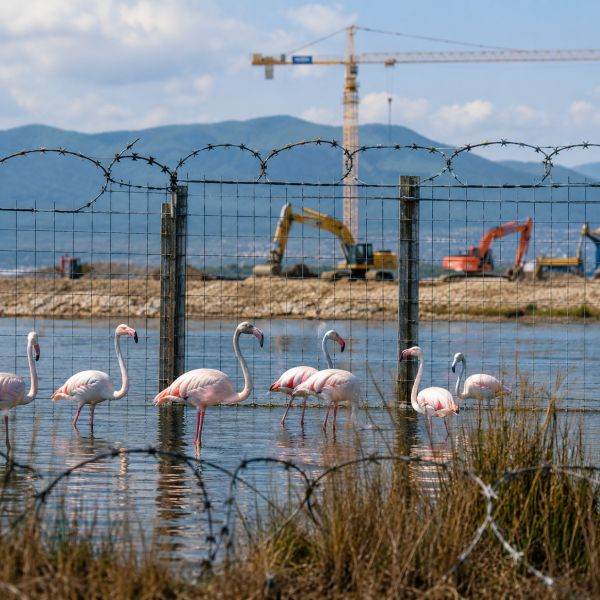
At first glance, the Flamingo Revolution seems to have erupted for a simple and understandable reason: the construction of luxury tourist resorts in one of Albania's most valuable natural areas. A careful analysis of the investigations published by the Albanian press, official documents, the chronology of events and the reactions of the actors involved shows, however, that this explanation is only the superficial layer of a much deeper crisis. In reality, the real estate project associated with Jared Kushner did not create discontent, but only brought to the surface frustrations accumulated over years, related to the functioning of the state, the lack of transparency of public decisions, the influence of economic groups on political power, the management of natural heritage and the increasingly widespread belief that institutions no longer work in the interests of the citizen.

The first, most visible cause and the one that actually triggered the revolt is represented by the huge tourist projects developed around the island of Sazan and the Zvërnec-Narta area, projects associated with the company Affinity Partners, founded by Jared Kushner, son-in-law of US President Donald Trump. The value of the investments, estimated at several billion dollars or euros, depending on the various official assessments, was not seen by most Albanians as a problem in itself. Albania has been trying for years to attract foreign investment and transform the coast into a luxury destination for Mediterranean tourism. Dissatisfaction, however, arose when many citizens began to believe that the projects were receiving privileged treatment and that the state was willing to change old environmental protection rules to facilitate their implementation. In public perception, the main problem was not the investor, but the willingness of the authorities to adapt the legislation according to his interests. Moreover, journalistic investigations by Albanian publications presented an extremely complicated picture, in which rapid legislative changes appeared, companies registered through offshore structures, unresolved property disputes, documents that were difficult for the public to access, and accelerated administrative procedures. For many Albanians, all these elements created the impression that the state no longer acted as an impartial arbiter between public and private interests, but as a partner of privileged investors. The lack of transparency thus became one of the most important causes of the uprising. People were not protesting just because a resort was being built, but because they felt that fundamental decisions regarding the country's heritage were being taken without consulting society and without sufficient explanations.
In this equation, the amendment to the Law on Protected Areas in 2024 was of decisive importance. Many activists and lawyers have noted that the legislative changes were followed almost immediately by the announcement of Jared Kushner's investments, fueling suspicions that the law had been adapted to allow the development of projects that, in the previous form of the legislation, would have faced much greater obstacles.
Another key cause is the conflict over land ownership. BIRN investigations describe the existence of disputes lasting more than two decades, competing claims, contradictory court decisions, accusations of document falsification and individuals involved in civil and criminal trials over the lands included in the project. In this context, the start of work before all disputes were clarified was perceived by many residents as an attempt to turn an uncertain legal situation into a fait accompli. For local communities, the fences erected around still disputed lands symbolized the definitive loss of control over a space they considered part of their own family history.
But there is also a symbolic dimension to the protest that cannot be ignored. During a public intervention, Ivanka Trump, Donald Trump's daughter, described the Sazan project using the phrase "our private island". Even if the wording was probably intended to illustrate the scale of the investment, in Albania it was received completely differently. For many citizens, Sazan Island represents a symbol of national history and sovereignty, and the expression was interpreted as evidence of a mentality in which public heritage is treated as negotiable property. Social networks were filled with messages such as "Sazan was not discovered by Ivanka Trump", and the debate quickly went beyond the ecological area, becoming one about national identity and collective dignity. Equally important was the perception of the closeness between political power and large economic groups. Investigations described meetings, negotiations, administrative transfers, accelerated procedures and the presence of influential businessmen around tourism projects. Even if each of these elements may have administrative or commercial explanations, together they have fueled the belief that in Albania access to public resources depends more on relationships with power than on general rules applicable to everyone. It is precisely this perception that explains why the slogans on the streets began to talk about oligarchy and state capture, not just about protecting nature.
Perhaps the most profound explanation of the Flamingo Revolution, however, is that formulated by the Albanian political scientist Blendi Kajsiu, who believes that the conflict is not a confrontation between supporters and opponents of economic development, nor even a dispute over environmental protection, but reflects a crisis of representation. The people who took to the streets do not share the same ideology and come from very different backgrounds, but they are united by the belief that the current political system no longer represents them. The image of the fence erected in Zvërnec is, in his interpretation, the perfect metaphor for how citizens perceive the functioning of state institutions: just as the fence separates the community from nature, institutions seem separated from society by an invisible barrier, behind which decisions are made by a narrow circle of political and economic interests.
In the same direction goes the observation made by Bloomberg, according to which the Flamingo Revolution is probably the first major civic movement in post-communist Albania that cannot be claimed by any political party. The protesters simultaneously chanted against Edi Rama and the opposition leader, Sali Berisha, demonstrating that they reject not only the current government, but the entire political model built after 1991. This detail explains why the movement continued to grow, instead of being absorbed by the traditional competition between power and opposition.
Ultimately, the Flamingo Revolution cannot be explained by a single cause. It is the result of several overlapping crises: an ecological crisis, generated by the fear of destroying one of Albania's most valuable ecosystems; a legal crisis, fueled by legislative changes and property conflicts; an administrative crisis, caused by the lack of transparency and suspicions of favoritism towards certain investors; a political crisis, born of distrust in institutions and traditional parties; and, perhaps most important of all, a crisis of representation, in which a significant part of society no longer believes that the state belongs to it.
The tourist resorts and flamingos were just the spark. The fuel had been accumulating in Albanian society for many years. That is why, even if the projects were suspended or modified, the root causes of the Flamingo Revolution will continue to exist as long as citizens feel that the big decisions regarding the country's future are being made without them and, sometimes, against them.

















 Euro
Euro Dolar SUA
 Franc elveţian
 Liră sterlină
 Gram de aur