English

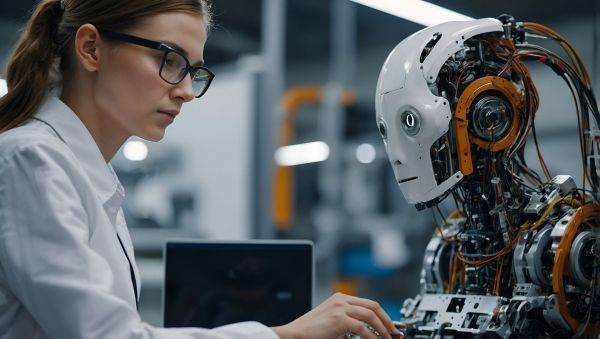
The humanoid robot industry is approaching a moment of transformation that the CEO of Chinese company Unitree likens to the emergence of ChatGPT. Companies in the field are trying to move from spectacular demonstrations to machines capable of performing useful tasks in the real world, amid accelerating investment in artificial intelligence and robotics, Reuters reports. The change of direction is visible in China's robotics industry, where manufacturers are increasingly focusing their efforts on concrete applications in logistics, manufacturing and services. At the World Robot Conference in Beijing, more than 300 companies presented more than 2,000 exhibits, including humanoid robots capable of sorting packages, wrapping phones and assisting with household chores. The challenge for the industry is no longer just to demonstrate technical capabilities, but to prove commercial utility. According to Reuters, the focus of investors and companies is shifting to productivity, autonomy and profitability of using robots.
• Unitree, at the center of industry expansion
The statements by the CEO of Unitree come at an important moment for the Chinese company. Unitree recently debuted on the STAR market in Shanghai, and its shares have recorded a spectacular increase, with the company being valued at about $50 billion after the debut. The initial public offering attracted about $900 million. Unitree is one of the main Chinese manufacturers of humanoid robots, and the company's development reflects China's ambition to occupy an important position in the next stage of artificial intelligence, in which software is integrated into systems capable of physically interacting with the environment.
• AI is starting to take physical form
While the first waves of artificial intelligence were mainly associated with conversational models and software, humanoid robots represent a stage in which these technologies are integrated into machines capable of moving and working in spaces designed for humans. In this model, artificial intelligence is no longer limited to generating text, images or code, but must interpret the environment, make decisions and execute physical actions. Reuters notes that the industry is still at the stage where it must demonstrate that these systems can generate enough value to justify their widespread adoption. Cost remains one of the main barriers. Reuters estimates that the price of some humanoid robots is between 300,000 and 500,000 yuan ($45,000 - $75,000), and the expansion of commercial use depends on their ability to reach productivity levels that justify the investment.
• China strengthens its position in robotics
Unitree's evolution is part of a broader development of China's robotics industry. Chinese companies accounted for 97% of global shipments of humanoid robots in the first half of 2026, according to data cited by Reuters. For the industry, the next stage will be the transition from technology demonstrations to repeated and effective use in commercial activities. If this transition is achieved, humanoid robots could represent one of the main ways in which artificial intelligence will exit the digital environment and enter directly into the real economy.
























 Euro
Euro Dolar SUA
 Franc elveţian
 Liră sterlină
 Gram de aur