English

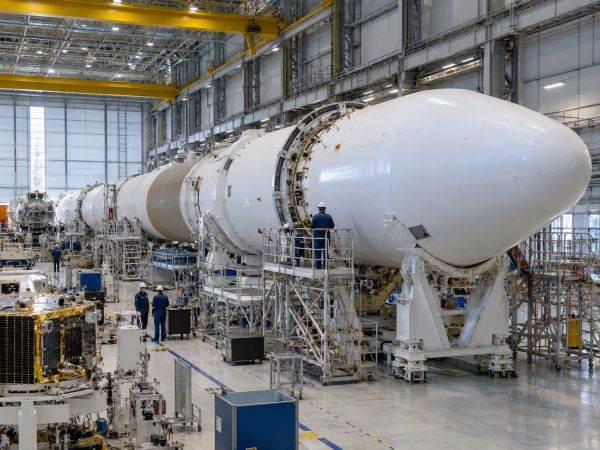
Europe is trying to consolidate its space industry at a time when SpaceX dominates the launch market and China is accelerating the development of its own technologies. However, the divergences between France and Germany are complicating the construction of a common European strategy, despite the investments of tens of billions of euros announced for the coming years, informs Le Monde. The issue of Europe's competitiveness in the space field is back at the center of discussions with the International Space Summit, organized in Paris these days. The situation is all the more important as Europe is trying to reduce its dependence on American launch capabilities and ensure its autonomous access to space.
• SpaceX raises the standard of competition
SpaceX's dominance is rapidly changing the rules of the industry. The American company has turned the reuse of rockets into a major competitive advantage, while Europe is trying to strengthen its own launch capacity. According to Le Monde, delays in the Ariane 6 program have left Europe without autonomous access to space for about nine months. The European rocket was successfully launched in July 2024, but the period of unavailability has increased Europe's dependence on Elon Musk's American launcher.
Ariane 6 is set to reach a rate of around nine to ten launches per year by 2027. According to ESA, however, the pace of development of the global space industry requires Europe to move faster. "The space economy is evolving at an extremely fast pace all over the world," said Josef Aschbacher, ESA Director General, in early September, acknowledging that the progress made by Europe is not yet fast enough and ambitious enough.
• Germany accelerates its investments
While France continues to support a European approach centered on large joint programs, Germany is developing its own capabilities and companies. Berlin announced in 2025 a budget of around 35 billion euros for the space sector until 2030. An example of the new German strategy is the company Isar Aerospace, whose Spectrum rocket managed to reach orbit on September 5 and place five satellites. The success is considered an important step for the German space industry and for the emergence of European alternatives to Ariane 6. ESA, in turn, is trying to stimulate the emergence of new European launch service providers. The agency launched the European Launcher Challenge, a program aimed at expanding the European offer and increasing the robustness of Europe's access to space. The first contracts of the program were signed in August. Among the companies selected under the program are Isar Aerospace, MaiaSpace, Orbital Express Launch, PLD Space and Rocket Factory Augsburg.
• Risk of a launcher shortage by 2030
One of the problems identified by ESA is the possibility that Europe will not have enough launch capabilities by the end of the decade. While SpaceX is rapidly expanding its capacity and China is developing reusable launchers, Europe needs to diversify its offer. According to Le Monde, ESA believes that the European model should be based more on competition and the emergence of new companies, which can complement the capabilities of Ariane 6. The pressure is also amplified by developments in China. In August, the Chinese company LandSpace managed to bring back to Earth the first stage of the Zhuque-3 rocket, a technology that SpaceX already uses with the Falcon 9 and that Europe does not yet have operational at the same level.
• 60 billion euros for the next European budget
However, Europe has greater financial resources to develop the sector. According to Le Monde, the next multiannual financial framework of the European Union, for the period 2028-2034, could include around 60 billion euros for the space sector, compared to around 17 billion euros in the previous financial framework. The amount must be seen in the broader context of the European Commission's proposal for the EU budget 2028-2034, estimated at almost 2,000 billion euros. The problem, however, is not only the volume of investments, but also how they are used. France wants European funding to be accompanied by a preference for European companies, while Germany supports an approach that gives start-ups more freedom and autonomy.
The differences between the states are also reflected in the IRIS² (Infrastructure for Resilience, Interconnectivity and Security by Satellite) project, the European constellation for secure communications. In August, the European Commission and the SpaceRISE consortium signed the agreement to implement the program. The new architecture will reach 348 satellites, and the first launches are scheduled for 2029. The system will provide secure communications for European institutions and for the defense and security sector.
The program is, however, affected by the development of parallel national projects. Germany is seeking to build its own space infrastructure for defense needs, and other states are also analyzing similar projects. In this context, there is a risk that European resources and capabilities will be fragmented between national initiatives and joint EU projects.
The European Commission is trying, instead, to transform IRIS² into an instrument for increasing European strategic autonomy. According to the Commission, the system would reduce the EU's dependence on space infrastructures outside the Union and provide resilient communications for authorities, defense and crisis management.
• Europe has money, but lacks speed
Europe's problem does not seem to be exclusively financial. The announced investments are considerable, and joint programs benefit from significant budgets. The difficulty is to transform these resources into an industrial capacity capable of keeping up with the pace imposed by the United States and China. The recent success of Isar Aerospace shows that Europe can produce new players in the launch industry. At the same time, the development of Ariane 6, the European Launcher Challenge and IRIS² indicate the existence of projects that can strengthen European autonomy. According to ESA, however, the pace must be accelerated. The competition is no longer limited to launchers, but involves the entire space ecosystem: reusable rockets, satellite constellations, communications, commercial services and defense applications.
For Europe, the stakes in the coming years are thus higher than catching up with SpaceX. It is about the continent's ability to remain an autonomous player in an industry in which the United States and China are rapidly expanding their technological and commercial advantages.















 Euro
Euro Dolar SUA
 Franc elveţian
 Liră sterlină
 Gram de aur