 English


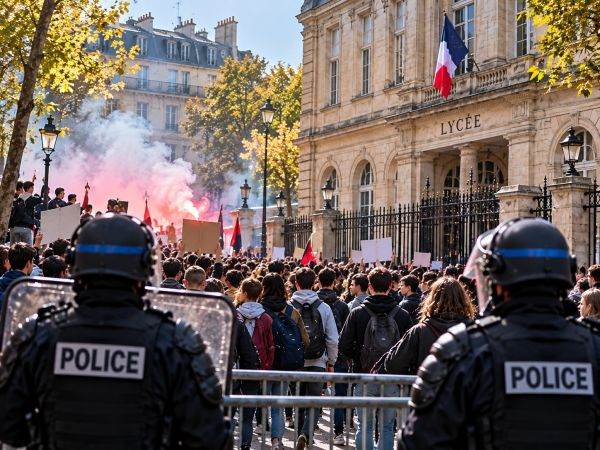
Schools across several parts of Europe are facing a literal, violent assault. From grievances regarding the education system to clashes with police and attacks committed within school grounds, several European nations are confronting episodes of youth violence. Authorities in two areas have been placed on high alert. Student protests in France and recent attacks in Polish schools have once again highlighted an issue that transcends national borders: the increasingly strained relationship between a segment of the younger generation and the institutions, authority figures, and social environments that shape them.
In France, demonstrations were sparked by dissatisfaction with educational conditions, teacher shortages, and the state of school infrastructure, Reuters reports. In some cities, protests escalated into arson, vandalism, and clashes with law enforcement. Meanwhile, in Poland, three attacks within educational institutions over the span of four days resulted in one death and injuries to several people-including children-according to the AP.
The two situations are not equivalent. France is witnessing a protest movement driven by educational and social demands, whereas in Poland, authorities are investigating acts of individual aggression-incidents Prime Minister Donald Tusk suggests were influenced by the online glorification of violence. Nevertheless, both cases illustrate the challenges institutions face in managing tensions involving young people and minors.
• France: School-related grievances spill onto the streets
According to Reuters, protests by French students intensified; on October 8, the Ministry of the Interior estimated nationwide turnout at 71,500 people, with 24,500 in Paris alone. Now in its third week, the movement was sparked by dissatisfaction with educational conditions and has spread from the capital region to other urban centers. Demands include smaller class sizes, the filling of vacant teaching positions, improvements to school facilities, and changes to the curriculum. Students have also denounced inequalities within the education system and police violence. Reuters reports that while demonstrations in Paris were largely peaceful, serious incidents occurred elsewhere. In Bordeaux, rioters attacked a police station; a school in Saint-Étienne was trashed; and teachers in Toulouse and Marseille were assaulted during the protests. French authorities thus face a dual challenge: they must address grievances regarding the functioning of the education system while also preventing the demonstrations from escalating into street violence. French media reports indicate that the large-scale mobilization was accompanied by police interventions, arrests, and injuries among participants. In some instances, the police response itself became a focal point of the protests, fueling tensions between demonstrators and the authorities.
• Poland: Three Attacks in Four Days
In Poland, the situation has taken a much more serious turn due to attacks carried out at educational institutions. According to the Associated Press (AP), three incidents occurred in the central province of Mazovia over the course of four days. A 19-year-old vocational school student injured nine people with a sharp object. In another case, a 15-year-old attacked staff at his former primary school, killing a caretaker and injuring two others. On Saturday, a 21-year-old woman injured three people at a post-secondary educational institution in Warsaw. Following these incidents, authorities stepped up security checks. By Sunday morning, police had detained 117 individuals for possessing knives or other dangerous objects, or for making threats regarding attacks on schools and fellow students. Approximately 64,000 schools were inspected, according to data provided by the AP. Prime Minister Donald Tusk stated that the attacks do not appear to be part of a large-scale organized operation, but rather spontaneous acts inspired by online content. The Polish leader warned of a growing fascination with violence and an interest among some young people in extremist ideologies, Nazi symbols, and individuals who have committed mass attacks and subsequently been glorified on the internet.
• Social Media and the Risk of Copycat Attacks
One of the main concerns of Polish authorities is the possibility that acts of aggression might be imitated by other young people who follow reports on the attacks or consume online content portraying the perpetrators as role models. The AP quotes Kacper Rekawek, a senior researcher at the International Center. Counter-Terrorism [center] in The Hague, which drew attention to the similarities between symbols used by one of the Polish suspects and those associated with Brenton Tarrant-the perpetrator of the 2019 attacks on two mosques in Christchurch, New Zealand, that left 51 people dead. While these similarities do not in themselves prove the existence of an organized network, they raise the issue of how extremist symbols circulate and how certain criminals are transformed into figures admired within specific online communities. Donald Tusk described the situation as a phenomenon with broader social and cultural implications. He urged parents and teachers to discuss online activity with young people and to address the consequences of participating in communities that glorify aggression. The Polish government also announced plans to renew efforts to restrict access to online content deemed harmful to minors. According to the AP, Tusk argued that authorities currently lack all the legal tools they consider necessary to block such material.
• Two different crises, a shared challenge regarding prevention
Any comparison between France and Poland must be made without conflating social protest with criminal violence. French students demanding teachers, decent learning conditions, and a more equitable education system cannot be equated with those who commit attacks against classmates or teachers. Nor do violent incidents occurring during demonstrations justify attributing extreme behaviors to the protest movement as a whole.
However, a common question faces the authorities: how can tensions be identified and managed before they escalate into acts of aggression? In France, protests have brought to light long-standing grievances within schools and the challenges facing the education system. In Poland, attacks have highlighted the risks associated with online threats, the spread of extremist symbols, and the potential for copycat behavior. In both instances, the institutional response cannot be limited to police intervention and security measures, however necessary these may be in situations of immediate danger. Schools play a vital role not only in imparting knowledge but also in shaping social behavior. When students feel their concerns are not being heard, tensions can escalate. At the same time, exposure to violent and extremist content creates risks that require specific interventions-not only from families and teachers but also from the institutions responsible for public safety.
Events in both countries demonstrate the limitations of a purely punitive approach. While security measures can prevent certain incidents and investigations can identify those responsible, long-term prevention requires an understanding of the root causes that foster violence.
In France, authorities must address the specific issues raised by students without allowing demonstrations to become a pretext for aggression and destruction. In Poland, the immediate priority is to protect students and school staff while simultaneously investigating the attacks and any potential links to online extremist circles. There also remains the issue of the responsibility of digital platforms, through which violent imagery, threats, and extremist symbols can spread rapidly. However, combating this phenomenon requires well-founded measures that protect minors without turning any nonconformist behavior or protest into grounds for suspicion.
























 Euro
Euro Dolar SUA
 Franc elveţian
 Liră sterlină
 Gram de aur































Reader's Opinion