English

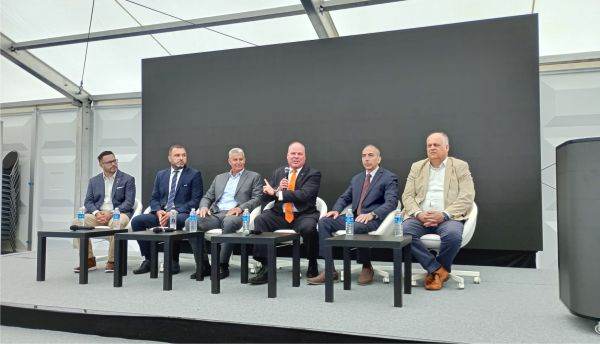
The European F-16 Training Center (EFTC) at the 86th Air Base in Borcea is not just a pilot school, but a regional core of Western military doctrine and expertise, a place where future air warfare operators on NATO's eastern flank are trained, said Lockheed Martin representatives in a press briefing held last week as part of the international exhibition of armaments, technology and military equipment Black Sea Defence & Aerospace 2026, which took place in Bucharest, on the Romexpo platform. They recalled that, at a time when the war in Ukraine is radically changing the security architecture of Europe, and NATO states are accelerating the reconstruction of military capabilities on the eastern flank at an unprecedented pace, our country has become the host of this training center, where future Romanian, Ukrainian and other partner state pilots are transformed, at an accelerated pace, into combat operators capable of piloting and using one of the most famous Western multirole aircraft, the F-16, in real war conditions.
The real size of the project is evident even from the statements of the people who lead it. Bill Thomas, the center manager and location manager for Lockheed Martin, a former American fighter pilot known by the call sign "Sluggo", spoke about the speed with which Romania and Western partners built the center.
"The training center has been operational since October 2023. One of the significant aspects is that, in my opinion, we have broken any speed record from concept to actual contract, and Romania's leadership in achieving this has been absolutely phenomenal,” said Bill Thomas.
But behind this statement lies a much broader strategic reality: after the Russian invasion of Ukraine, the West was forced to reduce years of military bureaucracy to a few months, and our country found itself at the center of a critical project for regional defense. Thomas insisted that the EFTC was not built as a cumbersome and oversized military structure, but as a highly efficient mechanism, based on experience and technology.
"When I started in Romania, I had several pilots as instructors from two companies: Draken International, where my experienced US instructors came from, and Airbus GFD, where the European F-16 instructors came from. We also had experienced US maintenance personnel from Draken International and European maintenance from Daedalus. To keep our footprint as small as possible, we used a high-tech system for supporting and monitoring the aircraft and the training program from Ilias Solutions. Another important aspect is the need for dedicated simulator instructors and academic instructors, who came from our partner BGI,” Bill Thomas said. The description made by the American official shows that the Borcea base basically functions as a Western military ecosystem transplanted to our country. Flight instructors come from American and European structures with huge operational experience, maintenance is carried out by specialists who have worked on the F-16 for decades, and all operations are connected through a military software platform that monitors the fleet status and the training process in real time.
Thomas explicitly emphasized that the people at the Borcea center are not military aviation theorists, but veterans of this system: "Our instructors usually have 3,000 hours of flight time on the F-16, and the maintenance staff is very experienced - you see a lot of gray-haired people here who have been working on the F-16 for 20 years and know how to fix things very quickly.”
In essence, Romania now hosts one of the most concentrated accumulations of Western expertise in the operation and maintenance of the F-16 in Eastern Europe. And this is no coincidence. The F-16 is becoming the backbone of combat aviation for NATO states in the region and for Ukraine. That is why the Borcea center was built for regional interoperability. Bill Thomas explained directly that the project was possible thanks to the strategic partnership between Romania and the Netherlands: "We started with 18 Dutch aircraft deployed in Romania; they entrusted them to us for maintenance and training. On December 31, those aircraft were purchased by Romania from the Netherlands. It is the same type of aircraft that Romania had and that Ukraine also has. The training is designed to work for any country that uses the F-16. Even if a country has a different model, such as Slovakia and Bulgaria, the basic course is the same. Later, they can do the specific training for their weapons systems in their country. Currently, everyone asks Romania if they can send students to this center, and we are happy to support anyone who is sent to training here”.
Basically, our country is no longer just a NATO security beneficiary, but is becoming a regional provider of military training and interoperability. The fact that "everyone is asking Romania” if it can send pilots to Borcea shows that EFTC is starting to function as a regional strategic center for standardizing F-16 operations in Eastern Europe.
One of the most sensitive topics addressed during the presentation was the training of Ukrainian pilots. Center officials unequivocally confirmed that their training takes place in Romania, but refused to provide exact figures. Asked directly how many Ukrainian pilots have been trained, Bill Thomas said: "I can't give you that number. It's not classified, but it's a protected number that we're not allowed to communicate. We're actively training and we intend to continue training Ukrainian pilots.”
The refusal to communicate the figures shows the high level of strategic sensitivity of the program. Moscow is closely monitoring every step of Ukraine's acquisition of Western capabilities, and the training of F-16 pilots is one of the most important components of the transformation of the Ukrainian air force.
However, the details provided about the training process demonstrate that EFTC does not just produce pilots capable of flying the aircraft, but operators prepared for modern air warfare.
Regarding the structure of the course, Lenny Dick "Wizard” from Draken International told us that the training program is longer or shorter depending on each country, but the basic course for Romanian pilots lasts about six months.
"The first month (or maximum six weeks) is dedicated exclusively to the academic part, after which they move on to the BGI simulators, where future pilots do almost 20 simulations before their first flight on the F-16. The first simulations focus on general operation and emergency procedures. The flight begins on a two-seater aircraft (student in front, instructor in the back) for about five sorties, after which they begin to fly alone. The basic phase includes instruments, takeoffs and landings, then about three and a half months of air-to-air combat training, and the last two months are for air-to-ground combat training,” said Dick "Wizard”.
Basically, future pilots are gradually introduced to an extremely complex combat system, in which the emphasis is not only on piloting, but also on emergency response, the use of weapons, air combat and integration into a tactical environment dominated by multiple threats.
And the end result is clearly defined: graduates emerge combat-ready. Asked if the pilots are "fully prepared for a combat mission” upon graduation, Lockheed Martin representatives said that they are fully mission-capable and go to their squadron.
Another extremely important element is the center's flexibility. Unlike classic, rigid, and overly standardized military systems, EFTC constantly adapts its programs based on combat experience and the requirements of each country. This flexibility is crucial in a context where the war in Ukraine is changing air combat tactics and methods almost monthly. In reality, the Borcea base already functions as a center for rapid adaptation to the real lessons of war.
Bill Thomas spoke about the exchange of experience between pilots and stated: "One of our strengths is that we adapt the training to the needs of the country, but also the fact that we have several countries in one place. We do the academic courses together, the pilots discuss with each other, including about the drone engagements that are taking place in the vicinity. Some of our graduate students are from the Romanian Air Force and perform border interception missions. It is crucial to share tactics and procedures with our students”.
In parallel, the center also develops advanced programs for formation leaders and instructors.
"We also have other courses: a two-aircraft leader program, a four-aircraft leader program and occasionally upgrade courses for instructor pilots, as we have done quite a lot for Romania. We can also do specialized training for night vision or targeting containers, as well as functional check flights for maintenance”, stated Dick "Wizard”.
As can be seen, the training center at Borcea Air Base does not only teach NATO manuals, but also direct operational experience from the proximity of the war. Discussions about drones, interceptions and reaction tactics take place between people operating a few dozen or hundreds of kilometers from the conflict in Ukraine.












 Euro
Euro Dolar SUA
 Franc elveţian
 Liră sterlină
 Gram de aur