English

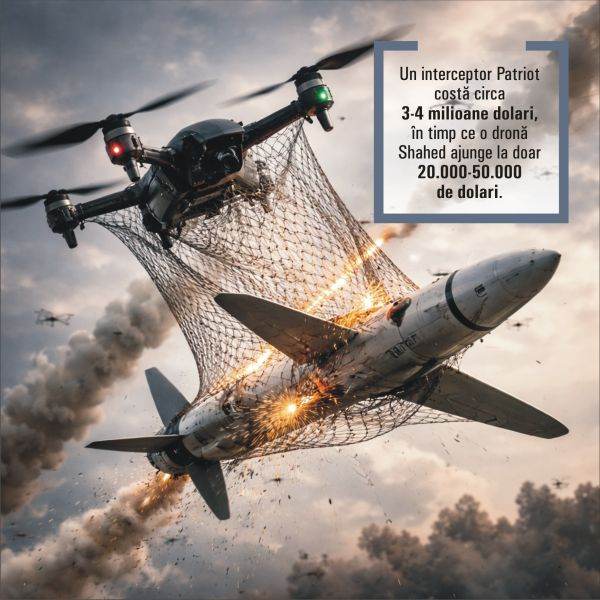
The outbreak of the war in the Middle East, in parallel with the conflict in Ukraine that began on February 24, 2022 with the invasion of Russia, brings to light a major strategic problem that until recently was discussed mainly in military circles: the global crisis of ballistic missile interceptors. Beyond the political rhetoric and the spectacular images of interceptions over cities, modern wars are increasingly turning into a competition of logistics and industrial production. And the mathematics of weapons is starting to look alarming for the West and its allies: interceptors are very expensive, while attack tools are cheap. This creates an unequal situation that no one can cope with. Neither Ukraine, which uses interceptors defensively, against Russian missiles and drones, nor Israel, which uses interceptors defensively, after, together with the US, attacked Iran.
The first alarm signals appeared in the very first days of the war launched against Iran. According to CNN, just a few days after the outbreak of the conflict, at least one US ally in the Gulf had already begun to run out of critical interceptors needed to shoot down Iranian missiles and drones. A regional official described the situation, for the quoted source: "It's not panic yet, but the sooner the interceptors arrive, the better.”
This concern is not isolated. Across the region, including in Israel, there are growing fears about the pace at which interceptor stocks are being consumed, according to the Jerusalem Post. The problem is becoming all the more serious as the Washington administration has suggested that military operations could last weeks or even longer. Under these conditions, each missile launch becomes a resource equation: how many interceptors are available, how quickly more can be produced, and how long this pace of consumption can be maintained.
US Secretary of State Marco Rubio explained that Iran produces "over 100 missiles a month”, while production of comparable interceptors is only "six or seven a month”.
The difference between these two figures shows the scale of the problem: an adversary capable of rapidly producing relatively cheap weapons can deplete stocks of extremely expensive and difficult-to-manufacture defensive systems.
At the same time, the current conflict overlaps with another war that is already massively consuming Western munitions: the war in Ukraine. In recent years, the United States and its European allies have sent Kiev enormous quantities of air defense systems, missiles and ammunition, including Patriot interceptors and other sophisticated systems. It is this reality that led the Pentagon to warn even before the outbreak of the Middle East conflict that a prolonged military campaign could seriously affect the United States' arms stockpiles, especially those supporting the defense of Israel and Ukraine.
The situation becomes even more complicated when we analyze recent experience. During the 12-day war between Israel and Iran in June 2025, the United States launched about 150 THAAD interceptors, or about 25% of the entire American stockpile, as well as 80 SM-3 interceptors, according to the American press.
During the same period, Israel consumed significant quantities of Arrow, David's Sling, and Iron Dome interceptors. At the same time, Israel used about 4,300 munitions in an intense air campaign against Iran, according to data published by the Jerusalem Post and The Times of Israel.
• Interceptors, used in conflict faster than they can be replaced
The fundamental problem is that these weapons cannot be produced quickly. Restocking THAAD interceptors, for example, would require at least a year and a half at the current rate of production, according to CNN, which adds that the US military industry, optimized for decades for low costs in peacetime, is not configured for mass production in the conditions of a high-intensity war or multiple simultaneous conflicts.
At the same time, the West's adversaries have learned to exploit this structural vulnerability. Iran's strategy is based on volume and low cost. Shahed drones, for example, can cost about $20,000, while the Patriot interceptors used to destroy them can cost around $4 million each. The cost difference is huge and turns each interception into an economic victory for the attacker.
This asymmetry has been described by analysts as a deliberate strategy of attrition. Iran could launch waves of relatively cheap drones and missiles precisely to force Western defense systems to consume expensive interceptors at an unsustainable pace.
American analyst Kelly G rieco warned, according to the New Arab website, that interceptors are being "used faster than they can be produced.”
At a tactical level, the problem is amplified by the way missile defense works. In many situations, to guarantee the destruction of a ballistic missile, defense systems launch two or even three interceptors at the same object. Thus, a single attack can quickly consume the resources of a defense battery.
In the Gulf region, the pressure is already visible. In the early days of the current conflict, Iran launched approximately 400 missiles and 1,000 drones in just two days, according to analyses cited by the international press.
Faced with these waves of attacks, defense systems in the United Arab Emirates, Qatar, Bahrain and Saudi Arabia are forced to respond with multiple interceptor launches.
• Air Defense Saturation, the aggressors' method to break the interceptor shield
In parallel, Israel continues to consume huge quantities of Iron Dome interceptors, while Hezbollah and other armed groups launch missiles and drones into Israeli territory. Iron Dome is one of the most effective defensive weapons in the world, but even this system has limits. Each battery has several hundred Tamir interceptors, and maintaining stocks is a permanent challenge, especially in the face of saturation attacks that can include thousands of missiles in a single day.
In fact, the concept of "air defense saturation” is becoming a military doctrine in itself, according to the Modern Diplomacy website. The cited source states that some analyses suggest that the strategy could be amplified by technological cooperation between Iran and China. The idea would be simple: launch waves of cheap drones, primitive missiles or even fake targets to force American and Israeli systems to consume expensive interceptors in attacks on targets with no real value. If this strategy works, the end result could be a logistical exhaustion of the adversary. Basically, a war would no longer be decided only on the battlefield, but in the arms factories. And here the West is faced with an uncomfortable reality: production capacity was not designed for a simultaneous global conflict.
Some studies already warn that in a high-intensity war with a major power like China, the initial stocks of American ammunition could be exhausted in about 25 days.
This perspective becomes even more worrying if Washington has to support the fronts in Eastern Europe, the Middle East and the Indo-Pacific simultaneously, the cited source also shows.
In this context, the current conflicts function as a brutal test for the Western military industry. Patriot, THAAD, SM-3 or Arrow interceptors are highly sophisticated systems, but each launch depletes a stock that cannot be replenished overnight. In contrast, drones, simple missiles and saturation munitions can be produced relatively quickly and in massive quantities.
The result is a fundamental change in the nature of war. Technological supremacy no longer guarantees victory if the adversary can produce cheaper weapons at a faster rate. In this new strategic equation, it is not just generals or technology that decide the final outcome, but also industrial capacity.
























 Euro
Euro Dolar SUA
 Franc elveţian
 Liră sterlină
 Gram de aur