English


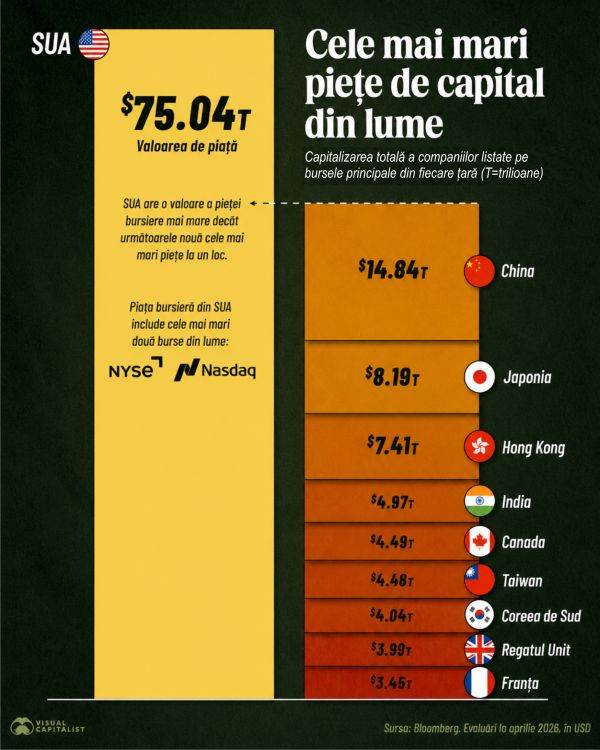
The US stock market has reached a scale unparalleled in financial history, according to an analysis by visualcapitalist.com, which notes that, as of April 2026, the total capitalization of companies listed on the US stock exchange amounted to over $75 trillion, exceeding the combined value of the next nine largest markets in the world.
The cited source ranks the ten largest stock markets in the world using Bloomberg calculations for companies listed on the main exchanges in each country.
• America, global leader
The dominance of US markets has accelerated in the past decade, as US technology giants have captured an increasing share of global investor capital.
Companies like Apple, Microsoft, Nvidia, Amazon and Alphabet are now among the most valuable businesses in history, the source notes. These companies trade on the New York Stock Exchange (NYSE) and the Nasdaq, both based in New York.
In terms of total market capitalization (as of April 2026), China ranks second ($14.84 trillion), with major exchanges in both Shanghai and Shenzhen. Japan ranks third ($8.19 trillion), and among the largest listed companies in the Asian country are Toyota, Mitsubishi and SoftBank, all of which are part of the Nikkei 225 index of the Tokyo Stock Exchange.
In fourth place is Hong Kong ($7.41 trillion), which has long been a financial center for East Asia, especially as a gateway between international investors and mainland Chinese firms. India, in fifth place ($4.97 trillion), relies mainly on the Bombay Stock Exchange and the National Stock Exchange, both based in Mumbai. Canada is next ($4.49 trillion), with the country's market capitalization heavily concentrated on the Toronto Stock Exchange, the third-largest exchange in North America.
Positions 7-10 on the list are: Taiwan ($4.48 trillion), South Korea ($4.04 trillion), the United Kingdom ($3.99 trillion), and France ($3.45 trillion).
Together, the top ten stock markets account for the vast majority of global stock market value, highlighting how concentrated investor capital has become in a small group of countries.
• Stock Rankings Reshaped by Artificial Intelligence
In recent years, the boom in artificial intelligence (AI) and related sectors has solidified the position of countries closely tied to semiconductor manufacturing, particularly Taiwan and South Korea. The presence of local giants TSMC and Samsung has helped these countries attract enormous attention from global investors, leading to higher capital inflows and faster market capitalization growth than competing countries with less exposure to AI infrastructure.
Demand related to AI has reshaped global stock rankings. Taiwan and South Korea have overtaken older financial powers such as the United Kingdom as investors pour capital into chip manufacturing and AI infrastructure.
• Morgan Stanley: "The rally is back in the US, but risks are rising”
After a difficult first quarter, US stock markets have started the second quarter with a significant advance. In just seven weeks, stocks have not only recovered lost ground, but have also reached new highs for the year, with the S&P 500 up more than 8% since the start of 2026, according to Morgan Stanley.
Such a trajectory can make the market seem unstoppable. However, Morgan Stanley's Global Investment Committee believes it is important for investors to consider the factors driving the market's momentum, as well as potential challenges ahead. Morgan Stanley highlights five things investors should be watching as the summer begins:
1. Stocks are rising, but households are under pressure
The U.S. bank's Global Investment Committee is leaning toward stocks, predicting potential upside of about 11% to 12% over the next 9 to 12 months. Morgan Stanley's 12-month target for the S&P 500 is 8,300. However, the underlying economy doesn't look as strong. The surge is largely driven by a surge in spending on AI infrastructure, which has helped semiconductor stocks enjoy historically rare market gains. But U.S. consumers are not keeping up. Adjusted for inflation, household purchasing power has weakened, and signs of stress are becoming harder to ignore: rising credit card debt, more personal bankruptcies, and inflation-driven incomes point to an increasingly fragile consumer.
2. Solid earnings, tight markets
Positive corporate earnings data has supported the market recently: first-quarter results have delivered significant upside surprises, and analysts are raising expectations for profit momentum in the coming years. However, even as earnings forecasts are generally improving, equity price gains have remained concentrated, with just a small group of large companies and sectors, particularly those related to the development of artificial intelligence, driving most of the market's recent advance. This suggests either that more stocks could start to catch up or that earnings optimism is overblown.
3. Prices drive profitability
As investors get excited about higher earnings, the question arises as to whether companies are generating these profits from higher productivity or from pricing power. Productivity-driven gains are generally considered more sustainable because companies are cutting costs without asking customers to pay higher prices. However, much of the recent margin growth appears to be driven by pricing power (i.e., firms charging higher prices) in sectors such as technology, semiconductors, and energy, which may be harder to sustain over the long term. This makes it risky to assume that profit margins will continue to grow at the same pace, which could undermine earnings expectations.
4. The cost of capital is rising
Competition for financing is intensifying around the world. Big tech companies are funding massive AI developments, and developed market governments are borrowing more to pay for public spending and policy programs, which means issuing more bonds. When both governments and large private borrowers are aggressively tapping the markets, long-term interest rates could face persistent upward pressure, which could weigh on asset valuations.
Political uncertainty is another factor to consider. When investors feel less confident about the path of policy, they tend to demand more compensation for holding long-term bonds. This additional yield, or "term premium,” increases again and can put more pressure on asset prices.
5. Non-US stocks outperform
Finally, the US is not the only stock market to have seen such results. Since the beginning of the year, ex-US stocks have outperformed, with Japan and a few emerging markets standing out. As the world becomes more fragmented and technology investment accelerates, strategic resources matter more. Countries with leverage in energy, materials and critical supply chains can gain influence as trading partners and as essential links in global production. For investors, this can translate into a broader set of opportunities than a strategy guide focused solely on the US.























 Euro
Euro Dolar SUA
 Franc elveţian
 Liră sterlină
 Gram de aur