English



• Argument
Reading the essay can be rather agonizing, for it abounds in footnotes, quotations (sometimes repeated two or even three times), textual analyses (some of which presuppose a familiarity with traditional logic), cross-references from one chapter to another, and appendices.
Writing it at an advanced age, I have allowed myself the luxury of not bearing the reader's burden overmuch, but rather of expressing myself as I please and merely ensuring that the text is comprehensible.
It is compatible with several modes of reading - following the order of the pages, with or without the footnotes (assuming, however, that in this way one sometimes loses clarifications or observations that are either useful for understanding or possess a beauty of their own), with or without the appendices - though some of the appendices may be autonomous essays in themselves.
Moreover, I granted the chapters the status of independence (which made them suitable for serialized publication in the BURSA newspaper), producing a construction with a narrative thread reduced to the evolution of the relationship between man and the divine (in Judaism and Christianity).
But the reading can also unfold along the order of the cross-references from one chapter to another, hopping from one place to another.
This latter mode of reading corresponds to the way in which I assaulted the biblical text and the exegesis, choosing from their immensity - which is beyond what a lifetime can encompass (and likewise from among the variants of interpretation) - whatever was necessary to my expression.
The resulting essay is strongly speculative, though I have never permitted myself unargued, undocumented, or hazardous assertions without warning.
I have been asked why I keep invoking the quotation from TB Berakhot 30a: "One who is behind the cover of the Ark should visualize himself as if he were standing in front of the cover of the Ark...” The answer is that, in this way, I emphasize how the speculative character of my own text conforms itself to texts deemed sacred, and that is why I have turned the quotation into a leitmotiv of the essay.
To it is added Rashi's observation that "there is no earlier or later in the Torah,” which overlays upon Scripture a non-categorical aspect, easing my exercise.
I have divided the essay into three books, corresponding to the subjects on which they concentrate:
- The First Book investigates the volatility of the "places of meeting with God” - the Commandments - and human punctuality at the divine "appointments,” as Scripture presents or suggests them.
- The Second Book traces the estrangement from God, the emancipation of man, and the confused balance between these two processes.
- The Third Book is dedicated to the construction of the concept of the "Kingdom of God.”
To the Third Book the reader may come by skipping the first two, but he will then be deprived of the trials to which those subject him and which confer upon him a superior understanding of the concept I propose, clothing it in a dust of gold which the conceptual scheme cannot itself transmit and which may otherwise appear barren; to those who have made the direct leap I point out that the proposal of the Third Book does not displace any other interpretation of the expression "Kingdom of God,” but joins them, completing them.
There is a reason why the essay may be read in reverse order, because in the Third Book I offer a structure that can play an explanatory role for the subjects of the first two books.
And, of course, there is also a reason why the essay should not be read at all. When I say "let each do as he wishes,” this cannot be mistaken for a permission - it is merely an observation. (The Author)
• Preface
• The Circularity of the Pentateuch: Do We Descend Into the Bible or From It?
So long as the Law and the Torah / Pentateuch are accepted as synonyms, the circularity of the biblical text may figure among its valid interpretations:
"12. And the Lord said to Moses: "Come up to Me on the mountain and be there, for I will give you tablets of stone, the Law and the Commandments, which I have written for their instruction.'” (Exodus 24)
If Moses received from God the text that begins with "Bereshit” (in the beginning), then the receiving of the text is recorded within the text received.
The fact that the biblical text is not a mere narration of facts but also refers to itself is suggested by this very word - Bereshit - which not only means "in the beginning” but is also the first word of the text, itself placed at the beginning of the text.
Initiated as a self-referential text, the Law / Torah / Pentateuch culminates on Mount Sinai, where the story of its transfer from God to Moses is itself transferred from God to Moses.
This text, which refers to itself, is read by us ourselves - the concrete medium of its narration and of the story it tells about itself. The circularity of the text opens the infinite space of divine virtuality, in which the reader is drawn along, reading always at another level the narrative transferred by God to Moses about a lower level of the text.
The reading situation absorbs the reader, who discovers that he himself is the creation of God - of whom some Kabbalists maintain that He is the same thing as the Torah and as the Universe created out of the letters of the Torah.
The intensity of the seduction of this bookish occurrence is amplified: on Mount Sinai, Moses received God / Torah / Universe from God, and this is not only what we read in the Bible, but also what we receive when we read it (the fact corresponds to the description of the reading of the Bible as that paradoxical process of transforming discourse into lived experience).
To be sure, this chain of assertions is fragile in some of its articulations, with the exegesis offering alternative interpretations.
Even the initial premise - that the Law and the Torah / Pentateuch are synonymous - is contested, but there are also exegetes (of high authority) who uphold this idea.
The present essay employs a certain logical criterion for selecting the proper interpretation: the Bible is not only a "holy book,” but is also the expression of the wish that it be a holy book (which, in numerous cases, is conflated with piety); consequently, one of its legitimate interpretations is the one in concordance with the principles of a holy book - to which the debate over the historical author of the Bible is improper, this being a subject of history, not of interpretation.
In its unfolding, however, the interpretation may take historical data into account, if these heighten the intensity of the lived experience - accepting that the intensity of the lived experience represents the "truth-value” of the interpreted text.
For example, the opinions that Moses wrote the Torah gradually, in consecutive stages of the forty years of wandering in the desert; or that he wrote it in a single stage at the end of his life, and that the final verses about his death and burial were added by Joshua; or, more recently, that he did not write it at all, but that it consists of texts by different authors, from different historical moments, edited into a single relatively unitary scripture - these opinions are in search of the plausible.
But perfection is a presumed quality of a holy book; the striving around it is the experiencing of its perfection, without which its holiness would not find its human purpose.
From this follows the human responsibility for the perfection of the holy book, which unceasingly generates commentaries / interpretations for the harmonization of Scripture with the new meanings allotted to it (or discovered in it), in step with the needs of the times to come.
This generous type of validation governs (over and beyond argumentation, which, in any case, would have sufficed) the interpretation of the Torah as a circular text.
• A. The Bible Does Not Follow Chronology
In the circular reading, the transfer of the Torah from God to Moses may serve as a preface to Genesis, which, in any case, does not begin by telling us what was in the beginning, but by relating what God did at the beginning of the Creation; "In the beginning God created the heaven and the earth” (Genesis 1:1) is the opening of a chronology which a preface could suspend through circularity, just as logic can suspend history by formalizing events given in succession as articulations of a structure given in concomitance. The preface (concerning the state prior to what God did in the beginning - Bereshit - and concerning the status of the book in the reader's hands) is somehow presupposed, just as the letter Bet (with the numerical value 2, in the Aramaic abjad), of "Bereshit,” is preceded (prefaced) by the first letter Aleph (with the numerical value 1).
An argument in favor of the idea of the Torah's circularity may be derived from the Midrash "Otiot de-Rabbi Akiva,” taken up, in variants with modifications, in Bereshit Rabbah, in Yalkut Shimoni, in the Zohar, and, subsequently, presented here in a very brief form, coherently synthesizing the contradictory variants: the Midrash tells how God chose the letter with which to begin the Torah.
The letters of the alphabet presented themselves before God.
The letter Aleph asserted: "I ought to be used to create the world, since I am the first letter of the alphabet.”
But God answered: "No, I shall create the world with the letter Bet, because it is the first letter of the word "Brachah' (blessing), as though My world were to be for a blessing!” The account of the creation of the world begins with the letter Bet - Bereshit.
Aleph was chosen to begin the Ten Commandments, in the word Anochi: "Anochi Hashem Elokecha” ("I am the Lord your God” - Exodus 20:2).
Whether by intention or not, the Midrash - formulated in the first or second centuries CE (Tradition holds that Rabbi Akiva lived between the years 15 and 135; the third generation of Tannaim, authors of the Mishnah) - suggests that, if we arrange the text of the Torah in the numerical order of the initial letters of its opening words, then Aleph (with the value 1) precedes Bet (with the value 2), so that there is a reason for Genesis to be prefaced by the transfer of the Decalogue, even though the Decalogue is formulated only in Exodus.
Furthermore, in the Talmud (Pesachim 6b) the idea appears that the Bible does not follow the chronology of the events it relates, noting that the events of "the first day of the second month in the second year after the exodus of the Israelites from the land of Egypt” appear in chapter 1 of Numbers, whereas the Commandments which God gives "in the second year after the exodus from Egypt, in the first month,” appear later on, in chapter 9, although chronologically they precede them:
"Rav Menashiya bar Tahlifa said in the name of Rav: That is to say, there is no earlier and no later - that is to say, there is no absolute chronological order - in the Torah, since events that took place later in time may appear earlier in the Torah.” Rashi comments: "There is no earlier and later in the Torah [...]”
It follows that the discursive succession of the Torah is an adaptation to the human understanding laid over the narrative.
• B. Characters in Their Own Book
The transfer of the Torah from God to Moses, recorded in a self-referential text that is to stand as a preface about itself, would highlight the concomitance of Scripture and of God, confirmed by John: "1. In the beginning was the Word, and the Word was with God, and God was the Word” (a formulation that strives to overcome the succession inherent to discourse).
In the field of this divine virtuality there is manifested the creative make-up of the word, the heavenly origin of the Torah, and its distinction from mere reproducible information.
This could be a partial - and not entirely convincing - explanation for the fact, quoted in the Talmud from rabbinic sources, that Joshua cannot receive it once more, since the Torah has already been transferred to Moses and would no longer be found in heaven [author's note: in fact, the biblical quotation upon which the opinion rests - "it is not in heaven” (Deuteronomy 30:12) - does not have the meaning that has been attributed to it (see First Book, Chapter 2 - "Stepping Out from Under God's Tutelage,” and Third Book, Chapter 3 - "The Triumph of Man / D. The Coup for the Ousting of God”)].
Such an interpretation draws a subtle distinction between the text of Scripture - which can be duplicated - and its ineffable texture, which is born in the soul, is held sacred, and cannot be copied (see Third Book, Appendix 3 - "I Am the Lord Your God”). The danger of the idolization of the text written by God with His finger may stand as the motivation for Moses' breaking of the Tablets of the Law (see First Book, Chapter 1 - "The Halting of the First Attempt to Transfer the Commandments / d. Does God not allow Himself to be idolized?”). Which lends support to the idea that "servant of God” means, in fact, "servant of liberty,” and this is the sense of the numerous repetitions of the expression "I am the Lord” and the frequent reminder of His saving role from Egyptian slavery, which may be taken as a symbol of slavery in general (see Third Book, Chapter 2, Appendix 3 - "I Am the Lord Your God / Yahweh Yasha / God the Saviour”).
On the other hand, the observation that the self-referential text has a dual quality supports the idea that Moses received two Torahs (with different functions), in which the first - the Written Torah / the Law - has the second as its shadow - the Oral Torah / the Commandments, which refers back to the first.
The idea gratifies the (relatively arbitrary) opinion promoted by some exegetes, who note that the gematria of the letter Bet, with which the word Bereshit begins - whose value is two - suggests the doubling of the transferred Torah. Rashi affirms that, in the deprecatio of Exodus 32:32 ("I pray now, if You will forgive their sin, forgive them; but if not, blot me out also from Your book, in which You have written me!”), the expression "Your book” refers to the Torah - in which case we would have to admit that the characters of the book refer to the book in which they figure as characters, with three immediate consequences:
1. Moses is its co-author (in view of his request that God should give a certain course to the book, and erase him from it);
2. The authors explicitly superimpose a meta-discourse upon the factual narrative, offering the reader an ascent rather than a simple description;
3. The interpretation of the Pentateuch is compatible with a principle that might be called the "Principle of Circularity,” which, in relation to other methods of systematic interpretation, not only moves as from plane geometry to spatial geometry, but also uncovers the kinematics of the text, otherwise considered static.
• C. The Principle of Circularity
The contradictions in the Pentateuch can be understood as a tension between superimposed strata of narration, which multiply within the text of Scripture (the text, being self-referential, makes the record compatible with a spiraling interpretation - differing from one level to another - bearing upon the same events or upon their recording).
This is what I have called the "Principle of Circularity” in the interpretation of the first five books of the Bible, discovering in them the virtues of understanding in "the kinematics of perpetual rewriting.”
The "Principle of Circularity” is close to the principle of "Shitat Habechinot” ("the aspectual approach”) of Rabbi Mordechai Breuer1, who advocates preserving the contradictions of the biblical text as different perspectives of God (or of the Torah) upon one and the same fact; "the aspectual approach” is the foundation upon which the contemporary proposals for the hermeneutics of the Torah are built.
Breuer's justification is beautiful and can be theologically sustained, but it is animated by hypotheses external to the text.
In complementary fashion, the "Principle of Circularity” offers a human clarification, exegetically acceptable and logically valid, for the recording in the Pentateuch of different (and sometimes contrary) variants of narratives bearing upon the same events.
But the "Principle of Circularity,” unlike the "Principle of the Aspectual Approach,” is immanent to the text of Scripture, so long as we accept that "there is no earlier and later in the Torah,” and so we may imagine the text both in the chronology of discourse and in the movement of the thought that has already traversed it - which cannot rearrange it - in accordance with the "kerygmatic” capacities of human understanding; and so, if one attributes to it "dynameis” (a dynamic), the text rewrites itself perpetually, occasioning the leap into the "dogma” (the terms in quotation marks are used with the meanings given in note2, drawn from Karen Armstrong).
The divine act of transferring the Stone Tablets of the Law and the Commandments - with which, apparently, the edification of the Kingdom of God begins - draws the reader into the universe of Holy Scripture, which then pulls him into the dilemma: does he descend into the Bible, or does he descend from it?
Notes
(1) Mordechai Breuer (May 14, 1921 - February 24, 2007) was an Israeli Orthodox rabbi, born in Germany, regarded as one of the world's foremost experts on the Tanakh (the Hebrew Bible).
Mordechai Breuer was known for developing "Shitat Habechinot” ("the aspectual approach”), which suggests that the different styles and internal tensions in the biblical text represent different "voices” of God or of the Torah, which cannot be combined without losing their identity. According to Breuer, God wrote the Torah from "multiple perspectives... each constituting the truth, [for] only the combination of such truths gives expression to the absolute truth.” If applied, this approach would offer an alternative framework to the documentary hypothesis, which maintains that the Torah was written by several authors. (Wikipedia)
Author's note: For Breuer's interpretation and the "documentary hypothesis” to stand in a relation of opposition, God would have to be assigned a historical character, which would be improper.
(2) A History of God / Karen Armstrong / Nemira, 2009 / Glossary:
- "Dogma (Greek) - a term used by Orthodox Christians to refer to the secret, hidden traditions of the Church, which can be understood only mystically and expressed symbolically. In the West, the word came to designate a body of opinions categorically and authoritatively asserted” (p. 460).
- "Dynameis (Greek) - the "powers' of God. A term used by Eastern Christians to name the action of God in the world, which must be considered as distinct from His inaccessible essence” (p. 460).
- "Kerygma (Greek) - a term used by Eastern Christians to refer to the public teaching of the Church, which can be expressed clearly and rationally, as distinct from dogma” (p. 462).
------------------
• FIRST BOOK
• Introduction
• The Imprint of God
The wave effect - like the concentric circles of water stirred about the center where a stone has fallen - recurs as an invariant in the way the Jews thought the creation of the Universe; in the way they understand the Tanakh / Old Testament around the Torah / Pentateuch; in the way the Torah describes its own transmission from the divine axis to the circle of the multitude (and the progress in intelligibility); in the way the relations are established among the sages of successive rabbinic epochs (for instance, an amora is not permitted to contradict a tanna)1; in the way the relations are established among the classes of norms in the Halacha - from the divine Commandments to the rabbinical rules, all the way to the periphery of the body of laws.
The creation of the Universe is presented in Genesis as starting from Tohu wa-bohu - an indistinct wasteland, without attributes and without the possibility of being structured otherwise than through divine intervention: chapter 1 - "2. And the earth was without form and void” ([tohu wa-bohu] - וְהָאָרֶץ הָיְתָה תֹהוּ וָבֹהוּ וְחֹשֶׁךְ עַל־פְּנֵי תְהוֹם וְרוּחַ אֱלֹהִים מְרַחֶפֶת עַל־פְּנֵי הַמָּיִם).
Tohu wa-bohu is the Hebrew equivalent of the Chaos of Hesiod's conception of primordial matter, to which it is linked by the secondary meaning of "stupefaction” (the senses of "wide-eyed staring, gaping mouth” are present in the Greek root of the word "chaos”), common to both notions, as the human reaction in the face of indistinctness.
The distinction lies in the fact that Hesiod conceives of Chaos as primordial matter that is nevertheless structurable through the activity of man, who transforms it into Cosmos; on the other side, Tohu wa-bohu is thought of as an unstructurable void, so that the Universe is the "creatio ex nihilo” of God, who produces even His own primordial matter.
The way in which the Bible was initially presented - as a succession of consonants, probably uninterrupted by the marks needed to identify words and/or sentences - supports the idea that primordial matter had to be created first by God, in order that, only afterward, man might be involved in its organization.
The assertion that, initially, no spaces were left between the words of the Torah does not rest upon any direct evidence; on the contrary, historians maintain that the written documents preserved from the epoch in which the year 1313 BCE is set - when the Torah is calculated to have been handed to Moses (or to have been written by him) - do not display this redactional innovation of pauses between words and/or sentences, which will have appeared only later.
To be sure, the calculation of the date - the day, the month, the year - of the contact on Mount Sinai, starting from the indications of the sacred text, is a strident example of how the Torah ought not to be interpreted, and of how the science of history must not be written either, lest one fall into the confusion of the aberrant opposition between "creationism” and "evolutionism” (theoretical propositions cannot be opposed to expressions of the sacred, since, even when both make use of words - and possibly even the same words - they have different intentions, different functions, and define truth differently).
The hypothesis of such a stringing-together of consonants without pauses highlights the role of the reader in attributing meanings to the mass of letters - significations which give it structure and transform it into intelligible text, repeating the model of God's creation of the Universe.
Seen in this way, the Torah results from the imprint in stone of God's finger2, as a signature with His name (in Kabbalah, the idea is developed that the Torah is His name), as a seal upon the Covenant, in which we decipher the Commandments.
The set of letters of the classical Hebrew abjad (if this was the initial language, and not a more ancient one) may be regarded as a standardization performed by Moses upon the fragments of the papillary pattern of God's finger, imprinted as a fingerprint upon the Tablets of the Law (or as an inheritance of that standardization).
It is a metaphorical validation of the sacredness of the Hebrew language.
On the other hand, it is to be supposed that all the things which the Bible affirms have been created by God - the Universe and its divisions - bear the relief of God's fingerprint.
In this variant, God's fingerprint is present both in the World and in the design of the writing about the World - a correspondence that defines truth - illustrating the relation between God and the Word, taken as the center of Creation.
The Torah / the Law, the Covenant, the Fingerprint-Name-Seal-Letters-Word, and the Commandments come together as synonyms of the truth which propagates concentrically through the workings of life, as it might eventually unfold.
From the Talmudic sentence that synthesizes the transmissions of the Torah from one generation to the next (in ever-widening circles - from a single one, Moses, out to the people - and ever more explicit, by way of Aaron), the mention of the source - God - is absent:
"Moses received the Torah at Sinai and transmitted it to Joshua, Joshua to the elders, the elders to the prophets, and the prophets to the men of the Great Assembly.” (Pirkei Avot 1:1)
What is missing is "God gave the Torah to Moses” - the formulation is elliptical with regard to the source, emphasizing the active role of Moses in stirring the waves, from the divine expression through nonverbal sounds ("the lightnings and the thunders and the sound of the trumpets”), through Moses' stammering, then to the orality of Aaron, and the explanatory character developed by the sages.
In the same way, the Halacha3 is organized in concentric circles:
1. The first circle has at its nucleus the Mitzvot / divine Commandments;
2. The second circle is made up of the Gezeirot - "preventive legislation” of the classical rabbis, intended to forestall the breaking of the Commandments;
3. The third circle, the Takkanot - "positive legislation,” practices instituted by the rabbis that are not (directly) based on the Commandments as such, but answer specific needs, with a local and/or temporary application;
4. The fourth circle, the Minhagim - these are those Takkanot whose rationale (temporary and/or local) has lapsed, but which, through long practice, have entered into the regional tradition of a community, and whose observance attests to membership in the group - becoming rules whose breach is punished with the same severity as that of any other category of halachic norms.
The wave effect in rabbinical thought seems to be a two-way motion, for, in the search for the supreme moral principle, the Jews are said to have successively summarized the 613 Commandments (a total speculatively calculated by Rabbi Simlai in the second century):
- to eleven, a summary attributed to King David4;
- Isaiah reduced them to six5;
- Micah reduced them to three6;
- Isaiah came again and reduced them to two7;
- Amos reduced the entire Torah to a single Commandment8.
- In Matthew 22, Jesus sums up Scripture as follows:
"36. "Teacher, which is the great Commandment in the Law?' 37. He answered him: "You shall love the Lord your God with all your heart, with all your soul, and with all your mind. 38. This is the great and first Commandment. 39. And the second is like unto it: You shall love your neighbor as yourself. 40. On these two Commandments hang all the Law and the prophets.'
Behind Jesus' summary lies Leviticus 19:18 - "[...] you shall love your neighbor as yourself” - what has been called the "Golden Rule” common to the two religions; and likewise the Hillelian "That which is hateful unto you, do not do to your neighbor.”
Nevertheless, this reduction to principles did not win adherents in Judaism, which has preferred the plurality of the Commandments ("the more, the better”), their lack of hierarchy, and the confusion among them (because there are some - numerous - derived from others).
The Ten Commandments, which used to be recited as part of the daily Jewish liturgy, were eliminated from the liturgical canon, out of fear that people might believe these to be the essence of the Torah, and that nothing else were equally important.
Consequently, no: in Judaism there is a concern that the waves stirred at the center by God should rise without ebb.
It is probable that, from this very point, the renewal set in motion by Jesus Christ began - in whose words there may be glimpsed a concern for the ranking of the Commandments, toward their fulfillment.
Notes
(1) According to the rabbinical periodization, the Tannaim (singular tanna - "repeaters,” "teachers” - Jesus would have been a tanna, an explanation for the fact that He is called "teacher” in the New Testament) were the rabbinical sages whose opinions are recorded in the Mishnah, in the years 10-220 CE. The Tannaitic period, also called the Mishnaic period, lasted approximately 210 years. It came after the period of the Zugot ("pairs,” 170 BCE - 10 CE) and was immediately followed by the period of the Amoraim ("interpreters,” 200-500 CE), then by the era of the Savoraim (500-600), the Geonim (589-1034), the Rishonim (1034-1563), and the Acharonim (1563 - to the present day).
(2) "18. When God had ceased speaking with Moses on Mount Sinai, He gave him the two tablets of the Law, tablets of stone, written with the finger of God.” (Exodus 31)
(3) Halacha - In the general sense of the word, it is the entire body of Jewish law, from the Scriptures down to the most recent rabbinical rulings. It is a complete legal system that governs every aspect of human life. Traditionally, it has been regarded as wholly rooted in the revealed will of God, yet subject to the continuous interpretation of Jewish jurists. (https://www.encyclopedia.com/environment/encyclopedias-almanacs-transcripts-and-maps/halakhah-structure-halakhah)
(4) Psalm 14 [Romanian Orthodox numbering; = Psalm 15 in English Bibles]:
"1. O Lord, who shall dwell in Your tabernacle, and who shall sojourn on Your holy mountain? 2. He who walks blameless and does righteousness, who speaks truth in his heart, 3. Who has not been deceitful with his tongue, nor done evil against his neighbor, and has not uttered reproach against his fellow. 4. Let the one who is deceitful be despised before Him, but those who fear the Lord He glorifies; he who swears to his neighbor and does not renege, 5. Who has not lent his silver at usury, nor accepted gifts against the innocent. He who does these things shall not be shaken forever.”
Observation: The enumeration of the qualities conditioning the dwelling in God's tabernacle reaches the number of eleven - qualities interpreted as Commandments.
(5) Isaiah 33:
"15. The man upright in his way and who speaks words of honor, who turns aside from unjust gain, who draws back his hands and accepts no bribe, who stops his ears when he hears of lawlessness, and casts a veil upon his eyes that he may no longer see evil - 16. He shall dwell on the heights, and the strong rocks shall be his stronghold; bread shall be given to him, and water shall not fail him.”
(6) Micah 6:
"8. It has been shown to you, O man, what is good and what God requires of you: to do justice, and to love mercy, and to walk humbly before the Lord your God!”
(7) Isaiah 45:
"18. For thus says the Lord, who made the heavens, God who formed the earth, who made it and established it; and not in vain did He make it, but that it might be inhabited: "I am the Lord, and there is no other!' 19. I have not spoken these things in secret, somewhere in a dark corner of the earth; and I have not said in vain to the seed of Jacob: "Seek Me!” I am the Lord, who speaks rightly and declares the truth!'”
(8) Amos 5:
"5. Seek Me, and you shall live!”
-------------------------------
• Chapter 1
• Places of Meeting with God
"7. And the Lord said to Samuel: "Heed the voice of the people in all that they say to you; for it is not you they have rejected, but Me they have rejected, that I should no longer reign over them.'” (1 Samuel 8 [Romanian Orthodox: "1 Regi 8”])
The transfer of the Commandments from God to Moses, and thereafter from one generation to the next, ought to have been a simple story, since it fits within a single sentence - the first of Pirkei Avot1: "Moses received the Torah at Sinai and transmitted it to Joshua, Joshua to the elders, the elders to the prophets, and the prophets to the men of the Great Assembly” (Pirkei Avot 1:1) - see note2 for a systematic presentation of the supposed lineage by which the Torah / the Law has come down to us.
Jewish tradition customarily holds that the words delivered by God to Moses are furnished to us intact by Scripture.
For example, according to Pirkei Avot 2:8, Rabban Yochanan ben Zakkai3 said of the rigor with which his disciple Eliezer ben Horcanus4 maintained the integrity of the sacred text: "Eliezer is like a sealed cistern that never loses a drop”; the two rabbis represent two successive generations of mediators of the Oral Torah.
If the millennia-long preservation of the Torah's accuracy were true, then this would carry significance in at least two respects:
- 1. For the sanctity of the words we read in it (and, possibly, in the Talmud), since they will have been formulated (in Aramaic) by God Himself, or will have arisen in Moses' mind under direct divine effect;
undoubtedly, in writing the first stone tablets with His finger⁵, God has the practice of writing and exercises the Aramaic language, stringing consonant after consonant (without any pause that would permit the formal identification of words or sentences, as some believe); it is as though we had been offered, out of Jorge Luis Borges' "Library of Babel,” the copy of Scripture endowed with meaning from beginning to end.
This may also signify that His finger creates the Universe (meeting the Kabbalistic idea that God created the Universe by casting the letters of the Torah upon the firmament, two by two);
- 2. For the fact that we cannot know the logic at the source of the Commandments (or whether such a logic exists), and whether in the wellspring of the divine letters there is anything resembling teleology; the immediate contact with the Divinity (even in familiar embodiments - such as writing and speech) always presents this uncertainty of the reason and motivation of the divine breath which leaves them within our reach (if that breath is not itself a collapse kindled by too much abyss).
Consequently, the non-human origin of the Commandments invalidates any systematic aggregation of the hundreds of Commandments - presented in Scripture either openly or more obscurely, yet without a hierarchy that would structure them into a meaningful whole.
Furthermore, the non-human origin of the Commandments renders questionable some of the principles laid down by Maimonides⁶ for identifying them within the text of the Torah; for instance, the principle "6. A mitzvah [Commandment] which has both negative and positive components is counted as two” - evidently operates on the basis of human discernment, derived from logic (and thus projects human logic upon divine criteria).
In Pirkei Avot, quoted above, the Talmud appears to favor an idealized version of the process of transmission of the Oral Torah; but, looked at more closely, Scripture presents not merely uncertainties of detail, but also categorical disasters - losses and restorations even of the Written Torah itself:
I) The halting of the first attempt to transfer the Commandments inscribed upon the stone tablets (Moses smashes them);
II) The loss of 300 mitzvot (or more) by Joshua (with the qualification that they would have been restored subsequently);
III) The loss of Deuteronomy - or of the entire Written Torah (some maintain for around 400 years) - and its rediscovery by Hilkiah;
IV) The alteration of the text of the Torah by scribes;
V) Hillel's interventions, by which he suspends / annuls a number of Commandments;
VI) The questionable link between the gematria of the word Tawrah (Torah) and the number of the Commandments, as well as the calculation itself undertaken by Rabbi Simlai;
VII) The millennia-long efforts to identify the 613 Commandments, and the questionable list of Maimonides - admitted even by its opponents, owing to its widespread circulation.
After such avatars of the Commandments, can they still be defined as "places of meeting with God”?
• A. The Halting of the First Attempt to Transfer the Commandments
Moses destroys the handwriting of God:
"19. And when he drew near to the camp, he saw the calf and the dancing; and being kindled with anger, he cast the two tablets out of his hands and smashed them under the mountain.” (Exodus 32)
The episode is told once more, this time by Moses:
"16. But I saw that you had sinned against the Lord your God; you had made yourselves a molten calf
and had turned aside quickly from the way which the Lord had commanded you to follow. 17. So I took the two tablets and, casting them down with both my hands, I smashed them before your eyes.” (Deuteronomy 9)
The destruction of "the work of God” brings to an end the first attempt to transfer the Commandments through Moses' mediation.
Moses' gesture has no generally accepted explanation; but among the six that have been identified as in circulation7, one stands out: namely, that the Israelites did not, in fact, know the Commandments - an idea drawn from Genesis [author's citation; in fact the verses below are from Exodus 20], in apparent contradiction with Deuteronomy.
• B. Do Exodus and Deuteronomy Contradict Each Other?
From Genesis 20 [→ Exodus 20:19] it follows that the Israelites shrank from the voice of God:
"19. Then [the people] said to Moses: "You speak with us, and we will listen; but let not God speak with us, lest we die.'”
From Deuteronomy 4, however, it follows that, on the contrary, they did hear "the voice of His words”:
"12. And the Lord spoke to you from the mountain out of the midst of the fire; and the voice of His words you heard [...]”
Generally, a scriptural contradiction may be preserved as such even within commentary, by invoking the fact that human logic cannot exhaust the meaning-resources of the divine text - yet this, in effect, amounts to a suspension of the effort to draw near to holiness.
Here, for example, the tension between Exodus and Deuteronomy opens out toward another realm of the text.
- A) In Exodus, the narration of the facts comes from the narrator, while in Deuteronomy the narration of the facts comes from Moses.
To Moses we may attribute a special sensibility in communication with God ("10. Since then there has not arisen
in Israel a prophet like Moses, whom the Lord knew face to face...” - Deuteronomy 34).
It is plausible that this endowment allows Moses to discern the divine revelation in "the lightnings and the thunders and the sound of the trumpets” which all the people heard:
"18. And all the people heard the lightnings and the thunders and the sound of the trumpets, and saw the mountain smoking; and seeing this, all the people drew back and stood afar off, in fear.” (Genesis 20) [→ Exodus 20:18]
Just so, the revelation to Muhammad: "Sometimes it comes to me like the echoes of a bell, which is the hardest of all for me; and the echoes subside when I understand the message”8.
It thus becomes plausible that Moses decoded a message unintelligible to the others.
- B) "The voice of His words you heard” (Deuteronomy 4) may be an expression of the indistinctness of the words - the variant in which the Israelite people did not understand the divine discourse, although they did perceive its sonority.
The hypotheses at A) and B) lead to the opinion that Moses erred when he smashed the Tablets, which would be terrible - for he smashed the work of God and, moreover, he ordered killing as punishment, and 3,000 men were killed, on the basis of the presumed misunderstanding.
- C) But the meaning of the event tilts if we apply the principle of the circularity of the Pentateuch, whereby the Revelation on Mount Sinai prefaces Genesis.
Moses' remark that the Israelites heard "the voice of His words” belongs to the meta-text.
The spiral of the text brings to encounter the same events, but at the meta-textual level, where the entire people received the Torah (and, as in the Kabbalah, not only the mythical number of 600,000 Jews who came out of Egypt, but all the souls of the Jews - including those unborn - and each received his own Torah, and together they make up the Torah).
In the circular interpretation, all the Commandments were already known to the Israelites from before the Revelation, because the Revelation had already taken place before it occurred - in the eternalism of the Torah.
In the Torah there is no earlier and later; the Torah exists from all eternity, the Commandments exist from all eternity, and the Israelites broke them.
The reader knows that Moses is right.
Was it not written upon the smashed Tablets that they had been smashed and written again?
Toward this realm of the text, the tension between Exodus and Deuteronomy raises us.
• C. Whose Image Is It?
The historians assure us that El / El Shaddai / Elohim is represented as a bull; from this it follows that the golden calf (the bull) cast in the ministry of Aaron is not the image of any other god than God, since YHWH presents Himself, in the Bible, as El Shaddai:
"1. And when Abram was ninety-nine years old, the Lord [יהוה (YHWH)] appeared to him and said to him: "I am God Almighty [El Shaddai]; do what is pleasing before Me and be without blame.'” (Genesis 17 - in the citation I have inserted the form from the Masoretic text).
The sin with which the Israelites burdened themselves in the absence of Moses is not the worship of some other God, but the violation of the Second Commandment, "You shall not make for yourself a graven image.”
Idolatry.
Rav Ashi (who lived between the years 352 and 427, an amora of the seventh generation, the first redactor of the Babylonian Talmud) recounts (Sanhedrin 102b) that King Manasseh appeared to him in a dream, and he asked him: "Since you were so wise, what was the reason for which you engaged in the worship of idols?”
Manasseh answered him: "Had you been there in that time, you would have caught up and lifted the hem of your garment and run after me, because of the irresistible desire to engage in the worship of idols, and because it was a common belief.”
The distinction between divinity and its representation is subtle, for it repeats the relation between signification and its sign, but it sets that relation within a sacred circumstance which draws still more tightly together the terms of this semiotic relation: "In expressing the sacred, any object whatever becomes something else, without however ceasing to be itself, since it continues to belong to its cosmic milieu.” (The Sacred and the Profane, p. 13, Mircea Eliade / Humanitas, 2005 / Bucharest)
Drawing upon itself the vapors of the divinity which it signifies, the representation of divinity undergoes a modification of its status as an inanimate object.
• D. The Extremes: Idolatry and Iconoclasm⁹
The definition of the notion of "the sacred” as "something which stands for something else” (as in Mircea Eliade) is deficient, because this relation between "something” and "something else,” although it seems convincing, is rather an empirical observation upon the way in which the sacred is generated; and since sacredness itself is difficult to conceive of as manifesting itself without human participation, a more adequate definition should probably refer to the sacred as a human lived experience - without it being further necessary to specify whether that experience is an echo of the ontic or whether it is owed to a cultural stimulus, since the origin is indiscernible.
The observation is all the more justified in that, in the same terms, Umberto Eco defines the notion of "sign” ("a sign is something that stands for something else”) - and so we would apparently have one and the same definition for two different terms - "sacred” and "sign” - which would not be acceptable (in the language of common sense).
But, shifting the question into the field of faith, if, on the one hand, the notions of "God” and "sacred” overlap, and, on the other hand, those of "word” and "sign” overlap as well, we then observe that
the confusion between the sacred and the sign no longer appears accidental (see also Third Book, Appendix 3 - "B. Texture and Scripture”), since their identity is asserted in the celebrated opening sentence of the Gospel of John:
"1. In the beginning was the Word, and the Word was with God, and God was the Word.” (Gospel of John 1).
This junction within the Bible between theories (of course, this cannot actually take place, because the ground of Scripture is improper to theories, and still less to their junction - see Third Book, Appendix 3 - "The Intervention of Philosophy”) concerning distinct subjects - the theory of religions and semiotic theory - seems sufficiently spectacular and satisfying to suggest, conveniently, that it surpasses coincidence and even points to an invariant of thought from which springs the Kabbalistic exegesis bearing upon text, author, reader, and Universe - so that these may even be conceived as one and the same entity.
The confusion between "sign” and "sacred” is fertile, conferring sacredness upon discourse, symbols, or everyday miracles - making Rav Ashi, for instance, raise the hem of his garment and follow Manasseh.
But it is also dangerous, opening the gate to idolatry and justifying, for example, iconoclasm as a destructive cultural movement.
Technically speaking, the sacred presupposes the sign, to which we add the effort of association with the intangible (in its most radical form, the non-existent in the order of known existents - that entity which corresponds to a soulful sensibility, but which can be neither sensorially perceived nor thought - characteristics under which we guess that what is meant is God).
The effort of this association itself furnishes the experience of an intensification of soulful lived experience - to which, in fact, the process of sacralization may also be confined; but, in any case, the definition of the notion of "sacred” deserves not to be reduced to a semiotic relation, but to include both the soulful state which it can occasion and the experience attendant upon that occasion.
Under this perspective, iconoclasm counts as an extremism, aiming at the purification of sacred experiences and lived experiences from the semiotic relation.
The sign does not condition by the presence (of that for which it stands) the intellectual operations in which it is involved - so that it permits error and falsity in the logical sense, but also the initiation of a so-called correspondence with absence (taken as ontological reverse); in which latter variant it acquires the potential to denote anything (eventually, everything), and all the more so nothingness (I suspect that the denotatum is nothing other than an intellectual product).
Reciprocally, absence demands the suspension of the sign that would have been allotted to it, both as name and as representation, thus justifying arcanization - the secret pathway of triggering.
It is acceptable to attribute these explanations to the reason for which Moses smashes "the work of God.”
In the meta-text, he smashes it perpetually.
• E. The Idolization of God Himself?
It is plausible that Moses frees the Torah from the confusion with its material support, in order to underline its sanctity, its infinity, and its eternity.
The Tablets were given over to perdition, and the fragments were left empty of writing: "And the Tosefta directed: the tablets were broken, and the letters fly off and return to their point of origin.” (Pesachim 87b)
The idea anticipates the one in the Kabbalah: God made the Universe by casting upon the firmament the letters of the Torah, two by two; and on the day when, through an improbable coincidence, none of us will be studying the Torah, its letters will return to their point of origin, and of the Universe nothing - nothing at all - will remain.
In the smashing of the Tablets a universal cataclysm shines through.
Such a loss must have its reason (all the more so since God does not admonish Moses but rather encourages him): if the calf cast from the gold donated by the Israelites had the effect of idolizing the representation of God, then how much more intensely would the Tablets of the Law, written by God Himself, have been idolized?
What is the difference between the idolization of the calf and the idolization of the Word of God?
In our times, certain kohanim (priests), after the Torah is read in the synagogue by the baal korei (the expert reader, other than the kohen or the rabbi), lift up the Torah scroll, so that the participants may admire the anatomy of God.
Is this idolatry?
Some Kabbalists say that the Torah, God, and the Universe are one and the same thing, despite Moses' sacrifice of the Tablets of the Law.
Others say that the name of God is the entire Torah.
But does not John affirm that God was the Word?
Do not all these things mean that the idolization of God Himself is forbidden?
• F. Who Wrote the Torah?
As in the case of other biblical episodes, the writing of the second set of Tablets has two different variants10:
- The first - Exodus 34:
"28. And Moses wrote upon the tablets the words of the covenant: the Ten Commandments.”
- The second - Deuteronomy 10:
"4. And He [the Lord] wrote upon the tablets, as had been written upon the first, the Ten Commandments which the Lord had spoken to you on the mountain out of the midst of the fire on the day of the assembly; and the Lord gave them to me.”
So, who wrote the second set of Tablets?
Moses or God?
Similarly to the narrative of the smashing of the stone Tablets, the second variant - that in Deuteronomy - is a subjective account from Moses' perspective, and is therefore compatible with psychological explanations.
But, adopting the circularity of the Pentateuch as a principle of interpretation, the divine writing on the Tablets of the Law is superimposed upon that of Moses.
Nothing prevents the speculation - consistent with subchapters C and D - that Moses perpetually destroys the divine handiwork in order to prevent idolatry, and that what is left to us is his own writing, the handwriting of a human hand.
As it is said, "One who is behind the cover of the Ark should visualize himself as if he were standing in front of the cover of the Ark...” (Berakhot 30a).
In one of the alternatives, the Bible makes Moses' writing on the Tablets of the Law an indubitable fact.
This is the first step of the invasion of the human into the Commandments - which adds a novel sense to the definition of the Commandments as places of meeting with God: the purity of the divine character of the Commandments meets the human in the very act of their writing.
When we read them, the whole problematic of the second writing lies behind them - including the kinematics of perpetual rewriting.
Notes
(1) Pirkei Avot is the ninth tractate of Nezikin, which is in turn the fourth of the six orders of the Mishnah, which together with the Gemara compose the Talmud - the collection of commentaries on the Torah, completed in the fifth century, regarded as the written recovery of the Oral Torah.
(2) The Transmission of the Torah (after Chabad.org):
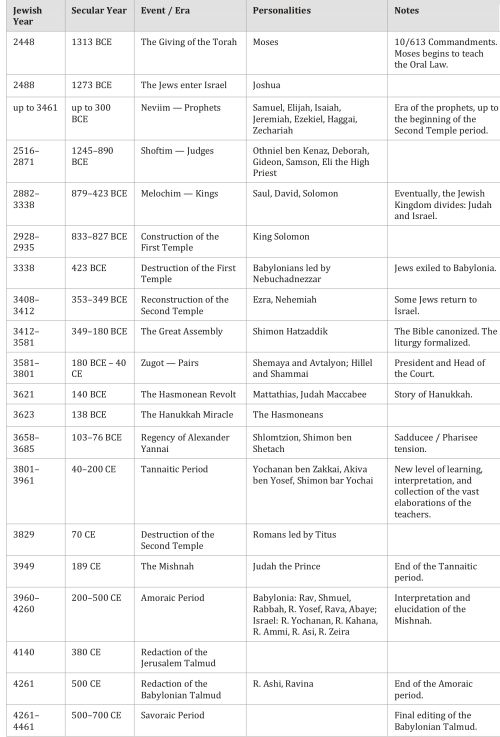
© Copyright, all rights reserved. If you enjoyed this article, we encourage you to distribute it further, provided that you comply with Chabad.org's copyright policy.
(3) Rabban Yochanan b. Zakkai, Tannaitic era - second generation (c. 40 - c. 80 CE). Rabban Yochanan b. Zakkai was a Jewish leader and scholar who managed the Jewish people's transition to life without the Temple. As Nasi (head of the Sanhedrin), he sought an accommodation under the Roman occupation but could not persuade the Zealots - which led to the destruction of Jerusalem. He escaped and revived Jewish life at Yavneh (20 km south of Jaffa). This included the preservation of the Temple rituals outside the Temple. (Per Sefaria / Dr. Michael Sperling and Wikipedia)
(4) Eliezer ben Horcanus (1st-2nd century), a student of Rabban Yochanan ben Zakkai. Eliezer represents "halakha rishona” - the traditional oral laws transmitted from teacher to teacher from Sinai (Pirkei Avot 1:1) without forgetting, extrapolating, or innovating. Like his teacher Rabban Yochanan ben Zakkai, Eliezer says: "I have never instructed anything that I had not learned from the Master” (Tosefta Yevamot 3:4; TB Sukkah 28a; Avot d-Rabbi Natan 14). See Appendix 1 to Book Two, Chapter 3 of the present essay.
(5) - Exodus 31: "18. When God had ceased speaking with Moses on Mount Sinai, He gave him the two tablets of the Law, tablets of stone, written with the finger of God.” - Exodus 32: "16. These tablets were the work of God, and the writing was the writing of God, engraved upon the tablets.”
(6) "The following are the fourteen principles [translator's note: for selecting the Commandments out of the text of the Torah]: 1. Do not count rabbinic Commandments in this list. 2. Do not include laws that are derived from one of the thirteen principles of Torah exegesis. 3. Do not count mitzvot that are not binding upon all generations. 4. We do not include "comprehensive' directives in the count. 5. The reason for a mitzvah is not counted on its own. 6. A mitzvah that has both negative and positive components is counted as two. 7. The different applications of a mitzvah are not taken into consideration individually. 8. Do not count a negative declaration among the prohibitions. 9. Do not count the number of times a commandment is mentioned in the Torah, but only the act that is forbidden or commanded. 10. Do not regard a preparatory act as an independent mitzvah. 11. If a mitzvah is composed of a number of elements, do not count them separately. 12. When you are commanded to perform a certain action, do not count each part of the action separately. 13. We do not count the number of days during which a mitzvah is performed. 14. We do not count the punishment imposed for each violation.” (Introduction to Sefer Hamitzvot / The Book of the Commandments, Maimonides - https://www.chabad.org/dailystudy/seferHamitzvos.asp?tdate=5/19/2022)
(7) From the explanations advanced over time, Dr. Maurice M. Mizrahi has synthesized six types of answer to the question "Why did Moses smash the Tablets of the Law?”: 1. Because God told him to do so. 2. Because the tablets were too heavy. 3. So that idolaters might not have access to the Torah.
4. To diminish the punishment owed to the Israelites. 5. To save the Israelites by claiming that they did not know the law. 6. To commit a sin that would make him share the punishment of the other Israelites. (https://images.shulcloud.com/618/uploads/PDFs/200806-WhyDidMosesBreaktheTabletsEkev.pdf)
(8) Quotation taken from A History of God, by Karen Armstrong, p. 174 / Editura Nemira / 2009 / Bucharest.
(9) The text of this subchapter, titled here "The Extremes: Idolatry and Iconoclasm,” is a part (revised and adapted) of my article published under the title "Seven Days” / BURSA / December 1, 2020.
(10) The two biblical variants for the writing of the second set of Tablets of the Law: - Exodus 34: "28. [...] And Moses wrote upon the tablets the words of the covenant: the Ten Commandments.” - Deuteronomy 10: "4. And He wrote upon the tablets, as had been written upon the first, the Ten Commandments.”
• Chapter 2
• Stepping Out from Under God's Tutelage
• A. The Future in the Past
The forgetting of the divine Commandments (and their recovery) in the time of Joshua is a spectacular story which, at the other end, is matched by another story, equally spectacular - of how, a millennium and a half later, the forgetting / recovery will have been recalled, cited, and introduced into the Talmud; for this story is not in the Bible.
It never was.
The narrative cited in the Talmud has three versions; some have a beginning, and possibly a body, but the conclusion appears only in juxtaposition to the third version.
All three recount the beginning of the event: namely, that Moses transmitted the Oral Torah to Joshua bin-Nun (his successor in the leadership of the Israelite people), and that Joshua bin-Nun, after Moses' death, will have forgotten a portion of the Commandments (in a different number, from one version to another).
In Appendix 1, all three versions - presented here only in fragments - are given in extenso:
- The Beginning: The Forgetting
- (A) The first version is attributed to Samuel (165 - 254/257 CE), a Babylonian Jew, head of the Talmudic Academy of Nehardea: "The Gemara returns to the issue itself. Rav Yehuda says that Samuel says: Three thousand halakhot were forgotten during the days of mourning for Moses.”
(Temurah 16a:3) - [see note¹ on the notion of "halakhot”].
- (B) The second version is attributed to Rav (175-247 CE), a Babylonian Jew, head of the Talmudic Academy of Sura: "Rav Yehuda says that Rav says: [...] Joshua's strength was weakened, and three hundred halakhot were forgotten by him, and he faced seven hundred cases of uncertainty.” (Temurah 16a:6)
- (C) The third version, being anonymous, could be placed at any point on the timeline up until its recording in the Talmud: "It is taught in a baraita²: One thousand seven hundred a fortiori inferences, verbal analogies, and details of the scribes were forgotten during the days of mourning for Moses.” (Temurah 16a:8)
Rabbi Abbahu (279-320 CE), a Palestinian Jew, rector of the Academy of Caesarea, is mentioned in its extension, but this is not an indication for dating the baraita cited here.
- The Body: The Impossibility of Duplication
- (A) The first version justifies three times, in different ways, why the norms (halakhot) can no longer be duplicated, either by descent from Heaven or by prophecy:
- 1. Joshua, referring to the Torah, cites Deuteronomy 30:12: "It is not in heaven,” deriving implicitly that no further instructions can be received from Heaven.
- 2. Samuel cites Leviticus 27:34, interpreting the specification that "these are the commandments” as a prohibition of any other prophecies.
- 3. Pinchas invokes both of the preceding arguments, thus cancelling out the two sources of divine inspiration through which the forgotten Commandments might be duplicated.
- (B) The second version attributes to God the argument made by Joshua in the first version.
- (C) The third version does not treat the subject of the divine duplication of the forgotten Commandments.
- The Conclusion: The Pilpulistic Recovery
The subject of the recovery of the forgotten Commandments is not treated in any of the versions; but to version (C) the Talmud juxtaposes a quotation from Rabbi Abbahu, which gives the sharpness of human thought as the solution for re-establishing the lost divine Commandments, and names that sharpness "pilpul,” which some exegetes assimilate to a dialectical method.
In Judaism, the consequences of this story are incalculable - the emancipation of man in his relations with God, and the splitting of the opponents over this subject - but these consequences had already taken place in dramatic debates conducted from two centuries before the moment when the versions of the story were recorded in the Talmud (see Third Book, Chapter 3 - "THE TRIUMPH OF MAN / D. The Coup for the Ousting of God”). Is the episode of the forgetting / recovery of the Commandments the cause, or is it an alibi before contemporaries?
Did the emancipation in the relations with God - into which a portion of the rabbinate at the highest level of the early millennium had ventured - have to be covered by a justification?
Depending on the moment at which we place the Talmudic narrative - at the end where the events it relates would have taken place, or at the end where the relating was set down - we obtain two different narrations that mutually exclude each other.
Does this story - which would wish to have fallen Prometheus-like from the Bible into the Talmud - occasion the elevation of man's status, bringing him closer to God?
Or, on the contrary, is it in fact an unscrupulous stepping out from under God's tutelage?
The application of the "Principle of Circularity”3 used in explaining the apparent contradictions of the Pentateuch seems here to be inoperative.
In the case of the story about the forgetting / recovery of the Commandments - however much those who related it might have striven to insert it into the breviary of the Bible, into the white space preserved between Deuteronomy and the Book of Joshua bin-Nun - a self-referential circularity between the Bible and the Talmud nevertheless cannot be established, because, although the Talmud refers to the Bible, the Bible does not refer to the Talmud.
Consequently, the explanation for the appearance of this story is to be sought not in the Bible, but in the exterior, factual circumstances that promoted it into the Talmud.
Notes
(1) Halakhah (Hebrew: "the Way”), with the variants Halakha, Halakah, or Halachah - in Judaism, the totality of laws and ordinances that have evolved from biblical times to regulate the religious rigors, the daily life, and the conduct of the Jewish people (Encyclopaedia Britannica); Halakhot - plural; laws / norms / derivations and applications.
(2) Barayata (singular, baraita) - an Aramaic word (meaning "external”) designating a Tannaitic tradition (the period approximately between the years 10 and 220 CE) that is not incorporated into the Mishnah (which, alongside the Gemara, forms the body of the Talmud); the relation of the Barayata to the Mishnah is thus represented as similar to that of the apocrypha to the canonical biblical writings. (Per Jewish Encyclopedia and Wikipedia)
(3) "THE CIRCULARITY OF THE PENTATEUCH / Do We Descend Into the Bible or From It?” / BURSA / June 1, 2022, founds the "Principle of Circularity” in interpretation, which offers a systematic justification for coherent readings wherever reason is in indecision.
• B. Survival in Exile *
(*) This part of the text (an abridged synthesis) draws upon the resources offered by the Jewish Encyclopedia, the Jewish Virtual Library, Wikipedia, and others; the categorical character of the historical assertions in this subchapter is inherited from the sources used.
The three narrators cited in the Talmud in the case of the forgetting / recovery of the Commandments were Jews from the Babylonian exile, contemporaries of one another, from two or three generations that overlapped in the course of the third century.
Rav (Abba Arikha) and Samuel / Shmuel (Samuel bar Abba) appear in the Talmud as associates in direct debates, while Rav Yehuda (Judah bar Ezekiel) was the disciple of both - the one mentioned in the Talmud four hundred times as citing them, though he is known to have cited them anonymously on still more occasions.
The fourth, Rabbi Abbahu, a Palestinian Jew active at Caesarea, was of a younger generation, but maintained correspondence with Samuel.
Rav founded an academy at Sura, and Samuel came to lead the one at Nehardea - both raising their prestige and sealing the intellectual independence of Babylonian Jewry.
In the annals of the Babylonian schools, the year of Rav's return from Palestine (219 CE), where he had pursued his academic instruction, is registered as the starting point in the chronology of the Talmudic age.
Samuel, for his part, was the first to apply the principle "The Law of the Land is the Law” (dina d'malkhuta dina) - which establishes, for the Jews, submission to the civil law of the country in which they live; it is regarded as a religiously mandated obligation, and disobedience constitutes a breach of Jewish Law.
In certain cases, if they are in the spirit of Jewish Law, the laws of the adoptive country take precedence over the halakhic laws - Commandments and / or their derivations.
The biblical origins of this idea derive from Jeremiah's letter to the Babylonian exiles: "Seek the welfare of the country to which I have carried you away captives, and pray to the Lord for it; for in its welfare lies your own happiness!”
(Jeremiah 29:7).
The political origins lie in the conditions of Sassanid rule (after the conquest of Babylon in 226 CE), under which non-payment of taxes led to the mortgaging or confiscation of property.
It is said that "The Law of the Land is the Law” would be the only foreign element incorporated into the structure of halakhic law.
It is an explicit negation of the Law, interiorized within the Law - yet Samuel held that other Jewish regulations too ought to be adapted to Persian law.
But "dina d'malkhuta dina” had been preceded, as a principle, in the Synoptic Gospels, and earlier still by the Prosbul attributed to Hillel, which fluidized credit and permitted the collection of tribute by the Romans in occupied Judea, without the interruptions of the Sabbatical or Jubilee years (see Book Two, "C.1. The False Motivation” in "Lawyerly Contortions Before God”).
• C. Survival Under Foreign Occupation
The celebrated reply of Jesus Christ - "Render unto Caesar...” - in the Synoptic Gospels is a direct ancestor of Samuel's dina d'malkhuta dina, with the difference that the derogation from the Law made by Jesus comes not from the need to survive in exile, but under Roman occupation - an exile within one's own country.
Historians affirm that the Gospel of Mark was written around the year 70 CE, 150 years before the conquest of Babylon by the Sassanids, and still longer before the moment of the accession of the Sassanid king Shapur I (241 CE), when one may assume Samuel began the application of "dina...”.
Probably the episode of the forgetting of the Commandments by Joshua, as an alternative assertion between Samuel and Rav (related by Rav Yehuda), will have been inscribed in the Talmud at a date subsequent to Samuel's death (254 or 257 CE).
If we agree that the Gospel of Mark recorded a real dialogue held by Jesus concerning the payment of tribute, then the dialogue ought to precede "dina...” by another forty years or so - that is, by nearly two centuries.
The Gospels recount that the Herodians and the disciples of the Pharisees challenged Jesus to a public debate, in which they set Him a dangerous trap:
"17. Tell us, then: What think You? Is it lawful to give tribute unto Caesar, or not? 18. But Jesus, knowing their guile, answered: Why tempt ye Me, ye hypocrites? 19. Show Me the tribute money. And they brought Him a denarius. 20. Jesus said unto them: Whose image is this, and whose inscription upon it? 21. They answered Him: Caesar's. Then said He unto them: Render therefore unto Caesar the things that are Caesar's, and unto God the things that are God's.” (Matthew 22)
With minor differences, the episode is recounted in the other Synoptic Gospels as well (Mark 12:14-17 and Luke 20:22-25).
For the Jews, the subject of the tribute in the Sabbatical years was extremely sensitive - not so much economically as religiously - for among God's Commandments figured Shmita, the complex of laws obliging the forgiveness of debts once every seven years.
From these Commandments the rabbis derived not only the obligation to forgive debts in the Sabbatical year, but also the prohibition against their repayment (they could have been paid only when accompanied by the debtor's declaration that the payment was a gift; but even under this hypothesis the creditor was obliged to refuse - a protocol that could be observed formally in dealings with the Roman occupier, but which before God would have been merely the attempt at a stratagem).
According to the historians, the Israelites' religious self-abnegation created for the Romans a problem they had encountered nowhere else, in none of the countries of the empire: although they had the means necessary to pay the tribute, sometimes even in excess, the Israelites preferred to be massacred themselves, together with their families, rather than turn away from God through the violation of the Commandments - the loss of the meaning of life being worse than death.
The resistance of the Israelites risked the extinction of the people, being so massive and so homogeneous that Gaius Julius Caesar (100-44 BCE), grateful to King Herod for his support in the Alexandrian war, granted the Israelites the freedom of not paying the tribute in the Sabbatical year - which is documentarily attested1.
Consequently, the question "Is it lawful to give tribute to Caesar, or not?” was meant to annul Jesus' space of reply, since, on the one hand, the assertion that the tribute should not be paid would have counted as a rebellion against the occupier, while, on the other hand, the assertion that it should be paid would have counted as a renunciation of God.
It was a deadly question.
Jesus' reply contextualizes: "Show Me the tribute money.” This may be an allusion to the fact that the tribute money was distinct from the money used to purchase the animals destined for sacrifice (which could only be bought from the Temple) - they were monies issued by the Temple, with internal circulation, obtainable through exchange with the Roman denarii only from the money-changers of the Temple (it seems that the money-changers angrily driven from the Temple by Jesus had their function and place of work within the Temple, and were therefore there licitly).
The contextualization is synthetic: the tribute money is the Romans' money, devoid of religious significance, while "our” money serves a holy meaning.
In the second step of the reply - "Whose image is this [...]?” - one may suspect an allusion to the Second Commandment of the Decalogue, "You shall not make for yourself a graven image!” - anathematizing the Roman denarius which, through the inscription on the reverse, for example, "ΘΕΟΣ ΣΕΒΑΣΤΟΣ ΚΑΙΣΑΡ” (in Greek - God, Augustus, Caesar), claimed the deification of the emperor whose profile was "graven” in bas-relief on the obverse (in the case of the coin taken here as the example, Tiberius - the Roman emperor at the time of Jesus)2.
From here, the elegant solution offered by Jesus comes, as it were, without effort: submit to Roman law, but this temporary concession does not mean the abandonment of God's Law! (In this variant of the significations, the payment of tribute may be considered, in a sense, as connected with the rejection of idolatry.)
Samuel's "The Law of the Land is the Law” has been viewed by some as a pragmatic evasion in the face of brute force; but it is manifest in the case of "Render unto Caesar...”, through which Jesus sought to defend the observance of the Commandments under conditions of occupation.
Much later, about a millennium and a half on, the apostasy of the famous "Messiah” Sabbatai Zevi (1626-1676) - the formal renunciation of Judaism under threat of execution (though he is said by some to have continued practicing Judaism in secret) - counts, in all likelihood, as the extreme limit of this line of resistance which merges into resignation.
Of course, apostasy was not invented by Sabbatai Zevi; but no apostate had been a "Messiah” before him.
Notes
(1) Flavius Josephus (Jewish Antiquities / vol. 2, p. 217), Editura Hasefer, Bucharest, 2001, electronic edition:
"GAIUS CAESAR, IMPERATOR FOR THE SECOND TIME, has decreed: I. The entire country, with the exception of Joppa, shall pay tribute to the inhabitants of the city of Hierosolyma each year, with the exception of the seventh, called the Sabbatical, when custom requires that no fruits be gathered, and no sowings be made.”
(2) "The Denarius in Mark 12:15” / Peter Lewis / The Australian Numismatic Society / Library: http://the-ans.com/library/2012PeterLewis.html
• D. A Talmudic Subject, Jewish Terminology
Both solutions for nuancing the application of the divine Commandments - both dina d'malkhuta dina and "Render unto Caesar...” - draw or seek their validation from God.
According to Christian tradition, in the hypostasis of Jesus we are speaking of God Himself, as "Man in the full strength of the Word” - a Romanian expression with a double sense (both valid: full Man / divine Word), apt in this context, which avoids the polemic between "incarnation” and "embodiment.”
In rabbinical literature, the notion of Memra / Ma'amar (the Word) is used to designate God, being regarded as a manifestation and as an attribute of God's power.
Borrowing the idea, "Man in the full strength of the Word / Memra” becomes a defining expression; it can be used, within Christianity, as a synonym for Jesus Christ.
Through the divine status attributed to Him, Jesus validates through Himself the nuancing of the Commandments.
In Samuel's case, we have to do with the claim of a completion of the Oral Torah (from God, through Moses) - an innovation justified by the forgetting of certain Commandments and by the emancipation of man.
For Christians, the voluminous specialized terminology employed in Jewish exegesis is exasperating, being one of the two great reasons - not the chief one - for which the Christian world does not really feel the need to make its way through it (if it does not reject it altogether); the chief reason, however, is that Judaism is another religion (although, partly, the two overlap, and "it does not matter by which road you approach God,” as Muhammad affirms), while Christianity disposes of its own exegesis, with passionate challenges of its own.
Nevertheless, the present essay unfolds in predominantly Jewish terminology (with the explanations reserved to the space of the footnotes), since it is dedicated to innovation in the matter of the norms that derive from the divine Commandments - a subject which, in its explicit form, appears proper to Judaism, since it has its origin in the Oral Tradition / Talmud, and not in the Bible.
The participation of men in the formulation of the Commandments is important for Christianity as well, since when Jesus Christ speaks of "the Law and the prophets”1, he refers directly to the Torah and, implicitly, to the body of the divine Commandments - in the formulation that had reached those times, at a millennium's remove from the time of Moses.
Consequently, what follows seems necessary, if we are interested in the measure in which the Commandments are divine and the measure in which they are human - and the Jewish terminology used throughout the essay, unavoidable.
The fact that the story of the partial forgetting of the Oral Torah is introduced into the Talmud long after the (relative) dating of Jesus' crucifixion is no proof that the apocryphal story would not have a pre-Christian source - all the more so since it is plausible2: the rabbinate raises the opinion that the Talmud restores the Oral Torah, which is an explicit acknowledgment of its partial loss.
Notes
(1) Luke 16:16: "The Law and the prophets were until John; since then the kingdom of God is preached, and everyone is forcing his way into it.”
(2) The anecdotal mentions that follow run parallel to the argument, playing the role of seasoning:
A complete reading of the Talmud (2,711 pages) requires more than seven years of reading at the rate of one page per day. Yet Rabbi Yitzhak Kaduri, who died at the age of about 108 in Jerusalem in 2006, is said to have known the entire Talmud by heart (along with Rashi's commentaries as well).
It is therefore not impossible that the Oral Torah could have been memorized by Moses' disciples - assuming, further, that in the form received by Moses it was not so branched out in debates, but would have been presented in a categorical, non-debatable form (and thus far shorter than the Talmud).
All of this disproves Maimonides' opinion in the Introduction to his commentary on the Mishnah that "it is not possible for any person to remember the entire Talmud by heart” (p. 110).
• E. Inventiveness Derived from the Prohibition Against Innovation
According to the story of the forgetting cited in the Talmud, the Torah can no longer be duplicated, its recovery can no longer be effected prophetically or through divine inspiration - the episode invoking as its argument the fragment from Deuteronomy 30:12: "It is not in heaven” (see Appendix 1).
In the biblical context, the four words "It is not in heaven” serve a different sense - they do not insinuate that the Commandment would have been in heaven and is no longer1.
For rigorous expression, the biblical context would oblige a reformulation: the Commandment "is not [even] in heaven”... "Nor is it beyond the sea” - that is to say, the Torah is not inaccessible; it is easy to grasp both with the mind and with the heart, and is practically applicable.
By contrast, in the context of Temurah, the quotation gives rise to sophisticated interpretations - for example, that in the formulation of the Torah Moses too participated, and therefore, in his absence, it is unrepeatable; this idea could be validated (with difficulty, and only halfway), but the divine "inability” to duplicate it is "impossible” to accept in the logic of the biblical material: "The Holy One, blessed be He, said to Joshua: "It is impossible to tell you these halakhot, because the Torah is not in the Heavens'” (see Appendix 1).
The text cited in the Talmud not only unabashedly denies God's omnipotence - implicitly, it also denies His omniscience.
The Talmud also cites the second justification of the impossibility of duplication, citing again Elazar who says that, in the verse of Leviticus 27:34 - "These are the commandments which the Lord commanded Moses on Mount Sinai for the sons of Israel” - the expression "These are the commandments” forbids any prophet from introducing any new element from now on” (see Appendix 1).
The beginning of inventiveness on the basis of the prohibition against innovation pertains to a logic that is, if not bizarre, then subtle - divine inspiration is rejected, while human creativity is promoted.
The impossibility of duplication prophetically and / or by descent from heaven is the premise of the idea of recovery through the sharpness of the mind ("Pilpul”). In the Talmud's quotation, God advised Joshua to cross the Jordan and to begin the conquest of Canaan in order to escape with his life from the people's fury2, giving him the preoccupation of war: "But in order to save yourself from the Jewish people who wish to kill you, go and exhaust them in war, so that they will leave you in peace.”
Cynical.
Has God ever shown Himself, cynically, in the Bible?
Rather, this is the human attitude of the one who relates, transposed upon his personal idea of "God.” The cynicism of the narrator gives rise to doubts about his character and about the authenticity of the text of the narration.
Notes
(1) Deuteronomy 30:
"11. For this commandment which I command you today is not too difficult for you, nor is it far off. 12. It is not in heaven, that you should say: Who will go up for us into heaven and bring it to us, and make us hear it, that we may do it? 13. Nor is it beyond the sea, that you should say: Who will cross over for us beyond the sea and bring it to us, and make us hear it, that we may fulfill it? 14. But the Word is very near to you; it is in your mouth and in your heart, that you may do it.”
The biblical fragment seems an echo of the Babylonian proverb with which "The Dialogue of Pessimism” (a text dated to around 1000 BCE) concludes: "Who is so tall as to reach the heavens? Who is so broad as to encompass the whole world?”
(2) Pirkei Avot 3:8:
"Rabbi Dostai ben Rabbi Yannai said in the name of Rabbi Meir: anyone who forgets a word of his study, Scripture reckons him as though he were guilty of death, as it is said: "Only beware, and watch yourself diligently, that you do not forget the things which your eyes have seen [...]' (Deuteronomy 4:9).”
• F. The Sorcerer's Apprentice Rav Yehuda •
(• ) This part of the text is based mainly on "The Jewish Spiritual Heroes,” Volume III, Gershom Bader, New York, N.Y., 1940; on portions of the Talmud, the Jewish Encyclopedia, and other sources available on the internet (Jewish Virtual Library, Wikipedia, etc.).
Focused on the (enormous!) sayings attributed to Rav and to Samuel, the reader of the story cited in the Talmud is on the verge of paying no attention to the narrator - Rav Yehuda - cast in the secondary role of the disciple of the two teachers; it is a sleight of hand, for the attention ought to be paid not to the teachers cited, but to the disciple who cites them.
In fact, the disciple was a sorcerer.
For edification, see:
- Appendix 2 - "Rav Yehuda, a Doubtful Source”;
- Appendix 3 - "A Study on Ancient Greek Sophistry: Aristotle (Sophistical Refutations) Applied to Plato (Euthydemus)”;
- Appendix 4 - "Pilpulistics, Similarities with Sophistry.”
Over Rav Yehuda there hovers his contemporaries' suspicion that he invented his quotations (probably as suited him at the moment), and that he appropriated those of others in his own name1; in addition, his morality appears questionable2.
The dubious aspect of Rav Yehuda as the source of both stories about the forgetting of the Commandments by Joshua - one attributed to Rav, the other to Samuel - renders the very story of the forgetting itself dubious.
For the third source - a baraita - being anonymous, might also originate from Rav Yehuda (there is no element of confirmation for this).
Therefore, the story of the forgetting of the Commandments is no longer of great importance, in itself, for the subject pursued in this essay: the human siege upon the divine quality of the Commandments.
It remains important only through its consequences... logical, ahistorical - since the consequences that may be attributed to it are also prior to it, and therefore
the story plays the role of a justification for something that was said and/or done earlier (see "E. An Unjust Excommunication, a Jest of God?” in Book Two, Chapter 3, THE TRIUMPH OF MAN). [Translator's note: per the Table of Contents this section appears as F under Chapter 4; the author's cross-reference is preserved as in the original.]
As is said: "One who is behind the cover of the Ark should visualize himself as if he were standing in front of the cover of the Ark...” (Berakhot 30a).
Notes
(1) The situation here would call for the notion of "plagiarism,” but it would not have corresponded to those times in which one was passing from the oral fluidity of the text to its fixation in writing; consequently, the immorality of appropriating another's sayings could not be regarded as a "crime,” but rather provoked mockery.
(2) Rosh Hashanah 35a: "The Gemara answers: Rav Yehuda was different, because he prayed only once every thirty days. During the rest of the month, he did not engage in prayer, since he was occupied with the study of the Torah. Therefore, for him, even the regular weekday prayers were like prayers recited intermittently.”
• G. The Missing Link
The times pressed toward emancipation; the contortionistic immorality of Rav Yehuda answers the necessity of the moment - it covers the earlier derogations from the Commandments, and even Hillel's2 takkana1 in suspending the Divine Law of Forgiveness.
This story then allows Rabbi Abbahu to metamorphose the biblical passage of the conquest of Debir into the figure of the recovery of the forgotten Commandments through the sharpness of Othniel's mind (pilpul - precisely the method practiced by Rav Yehuda in his Academy at Pumbedita) - and to consolidate the opinion of human liberty in self-regulation, unleashing its creativity.
But earlier still, Samuel would not have arrived at dina d'malkhuta dina if the confidence in the tradition of the oral transmission of the Commandments had not been shaken from its foundations even before his time - in the dramatic debates in Palestine between Eliezer ben Horcanus (1st-2nd century CE) and Yehoshua ben Hananiah (died 131 CE), continuators of the giant and sometimes tragic confrontation between the liberal Hillel and the conservative Shammai, on the one hand, and, on the other, the crucial dispute between Hillel's descendants and Jesus Christ - concluded bloodily and with the generation of a new religion: Christianity, which celebrates the Man-God.
These generations of scholars, from the watershed at the beginning of the first millennium, introduced reason with aplomb into the relations with God and His Commandments - so that in the Talmud we find ancient principles for interpreting the Tanakh / Old Testament, and, with some frequency, the notion of "inference,” which implies a systemic organization either of the text or of the concept behind it - that is to say... God's logic.
Anton Dumitriu3 relates what Diogenes Laertius (180-240 CE) - a contemporary of Rav Yehuda, but from a cultural universe considered different - says of the Stoic Chrysippus of Soloi (281-208 BCE): "Diogenes Laertius tells us that "he was a dialectician of such renown that very many believed that if the gods practiced dialectics, they would practice no other than that of Chrysippus.'”
The Greek Stoics invented the notion of logic, called before them "dialectic”; nearly all of them were born in the East, in zones of contact / influence with those of the Jewish Babylonian exile.
But even if the existence of a common cultural vein between the Greek Stoics and the Jewish scholars in exile were to be disproved, the mirage of divine logic seems to have seduced them similarly.
Under the hypothesis that he might discern and follow divine logic, man emancipates himself, becomes His partner, and, under certain conditions, even divinizes himself.
Can this be?
The mission of Jesus seems to have referred to something of the kind - the divinization of man and of his world, the earthing of the celestial Kingdom.
That is another chapter - the missing link.
Notes
(1) Takkana - a rabbinical rule admitted within the Halakhah, on condition that it not be contradictory to any Commandment; Hillel, however, suspended a whole complex of Commandments.
(2) Hillel (110 BCE - 10 CE; the age of 120 years may have been attributed to him out of piety); a Babylonian established in Jerusalem, the last Nasi (prince of the Sanhedrin) of the Zugot generations (pairs equal in status, at the head of the Sanhedrin), regarded as the supreme authority in the interpretation of the Torah, in open conflict with his pair, Shammai (50 BCE - 30 CE). Hillel and Shammai are called in the Talmud "the fathers of the world,” contemporaries with the period attributed to the childhood and / or maturity of Jesus Christ.
(3) Anton Dumitriu, History of Logic, p. 203, Editura Didactică şi Pedagogică, Bucharest, 1975.
• Appendix 1
• The Three Versions in the Talmud
Temurah - a tractate of the Talmud on the biblical prohibition against attempting to exchange an animal that has been sanctified for the Temple in Jerusalem with another animal that has not been sanctified (Leviticus 27:10 - "He shall not substitute good for bad, nor bad for good; but if one does substitute one animal for another, then both that which was substituted and that which was given in exchange shall be holy”).
The subject serves as presenting grounds that may be taken into account in the consecration of interpretations regarding the Commandments.
The three versions of the forgetting / recovery of the Commandments by Joshua figure in Temurah 16a and are presented in what follows:
[Version A]:
"3. The Gemara returns to the issue itself. Rav Yehuda says that Samuel says: Three thousand halakhot were forgotten during the days of mourning for Moses. The Jewish people said to Joshua: Seek guidance from Heaven, so that you may recover the forgotten halakhot. Joshua said to them: "It is not in heaven' (Deuteronomy 30:12). Once the Torah was given at Sinai, the sages of each generation must establish the halakha. No new halakhot may be added or subtracted by heavenly instructions or by prophecy.
4. Many years later, the Jewish people said again to Samuel: Seek halakhic guidance from Heaven. He said to them: This is not possible, as the Torah says: "These are the commandments which the Lord commanded Moses to tell the children of Israel on Mount Sinai' (Leviticus 27:34). The word "these' indicates that from now on no prophet is permitted to introduce
any new element regarding the Torah and its mitzvot [pl., Commandments] through prophecy. [...]
5. At the time of Moses' death, the people said to Pinchas: Seek halakhic guidance from Heaven, so that you may relearn the forgotten halakhot. Pinchas said to them: "It is not in the heavens' (Deuteronomy 30:12). The people said to Elazar: Seek halakhic guidance from God. He told them that the verse says: "These are the commandments,' to teach that from now on no prophet is permitted to introduce any new element.”
[Version B]:
"6.• Rav Yehuda says that Rav says: Just before the time when Moses, our Teacher, departed this world and went to the Garden of Eden, he said to Joshua: Ask me [to clarify for you] all the cases of uncertainty that you have in matters of halakha, so that I may clarify them for you. Joshua answered him: My Teacher, have I ever left you for a moment and gone to another place? Have you not written about me in the Torah: "But his servant Joshua, the son of Nun, a young man, departed not out of the tent' (Exodus 33:11)? If I had had any case of uncertainty, I would have asked you earlier. Immediately after he said this, Joshua's strength weakened, and three hundred halakhot were forgotten by him, and he faced seven hundred cases of uncertainty, and the whole Jewish people rose up to kill him, since he could not teach them the forgotten halakhot.
7. The Holy One, blessed be He, said to Joshua: "It is impossible for Me to tell you these halakhot, because the Torah is not in Heaven. But in order to save yourself from the Jewish people who wish to kill you, go and exhaust them in war, so that they will leave you in peace.' As it is said: Now after the death of Moses the servant of the Lord, the Lord spoke to Joshua the son of Nun, Moses' minister, saying: "Moses My servant is dead; now therefore arise! Go over this Jordan' (Joshua 1:1-2). This shows that, immediately after Moses' death, God commanded Joshua to lead the nation into battle.”
[Version C]:
"8.• It is taught in a baraita: One thousand seven hundred a fortiori inferences, verbal analogies, and details of the scribes were forgotten during the days of mourning for Moses.
9. Rabbi Abbahu says: Just so, Othniel, the son of Kenaz, restored them by means of his sharp mind [pilpulo], as it is said: And Caleb said: "To him that smites Kiryat-Sefer and takes it, I will give Achsah my daughter as a wife.' And Othniel, the son of Kenaz, the brother of Caleb, took it; and he gave him Achsah his daughter as a wife (Joshua 15:16-17). The name "Kiryat-Sefer,' which literally means "the village of the book,' is homiletically interpreted as a reference to those parts of the Torah that had been forgotten, while the expression "he took it' refers to Othniel's perspicacity and learning.”
(Translated from the English.)
Notes
According to Maimonides (1135-1204), regarded as the most important Jewish scholar of the Middle Ages, Pinchas and Elazar had also been Moses' disciples, alongside Joshua; but Moses had selected only Joshua as the transmitter of the Oral Torah:
"4. Although the Oral Law was not written down, Moshe our Teacher taught all of it to the seventy elders of his magistracy; and Elazar, Pinchas, and Joshua, all three of them received it from Moses. And to his disciple Joshua, Moshe our Teacher transmitted the Oral Law and commanded him concerning it. And thus Joshua taught it orally throughout his life.” (Introduction to the Mishneh Torah)
• Appendix 2
• Rav Yehuda, a Doubtful Source •
(• ) The text is based mainly on "The Jewish Spiritual Heroes,” Volume III / Gershom Bader / New York, N.Y. / 1940, on portions of the Talmud and other sources available on the internet (Jewish Encyclopedia, Jewish Virtual Library, Wikipedia, etc.).
Rav Yehuda was not born of woman, for he was simply an angel - so said his teacher Samuel, who, impressed by the student's perspicacity, called him "a sharp intelligence.”
By contrast, Rav Yehuda himself does not seem to have prized his teachers very highly, since it is said that whenever, in the course of his study, he encountered problems without any juridical significance in his own time, he would say: "Such matters were of interest to Rav and Samuel.”
Despite this, the Babylonian Talmud is studded with hundreds of quotations which Rav Yehuda attributed to his teachers Rav and Samuel.
Rav Yehuda thus assiduously cites his teachers (probably in order to build up his own authority) - teachers whom he in fact considers superseded by the times - confirming the cynicism noted at the end of subchapter "E. Inventiveness Derived from the Prohibition Against Innovation.”
The section devoted to Rav Yehuda in The Jewish Spiritual Heroes states: "However, it frequently happened that, when Rav Yehuda would cite a declaration of Samuel's, other scholars would deny that Samuel had ever said it. Even Rav Yehuda's own brother, Rami bar Ezekiel, once said: "Pay no heed to what my brother says in the name of Samuel.' On other occasions, when Rav Yehuda said something in his own name, other scholars said: "What Rav Yehuda is saying now, in his own name, is a quotation from Samuel!'”
As follows from this, his contemporaries considered him lacking in honesty, maintaining that:
- he invented quotations;
- he appropriated others' judgments.
The accuracy of the text quoted above from The Jewish Spiritual Heroes is not impeccable: according to Chullin 44a:6, when his brother Rami bar Ezekiel refuted Rav Yehuda, he referred not to a quotation in the name of Samuel, but to one in the name of Rav. The error would not be serious, for Rav Yehuda himself frequently stated that he was unsure of the source of his information - which may be taken as extreme honesty, but also, on the contrary, as a cunning precaution should he be invalidated.
Equivocal too is Rav Yehuda's piety: it is said that he omitted the daily prayers in order to give more time to study1. Of course, the fact would trouble no atheist, were such conduct not suspect of hypocrisy.
The method of study introduced by Rav Yehuda in the Academy at Pumbedita, which he led, provoked contradictory reactions among his students; the opposition of some went so far as their moving to Palestine. The Jewish Spiritual Heroes names the method as "sophistic”2 in an improper manner, because:
A. The application of a term from ancient Greek philosophy to ancient Jewish exegesis is abusive - the influence of ancient Greek thought upon Jewish thought in Babylon is still under discussion3;
- Aristotle is never mentioned in the Talmud (some maintain that there would have been a prohibition);
- some affirm, on the contrary, that the Greek Stoic logic of the second century BCE (considered "divine” by Diogenes Laertius), standing in opposition to that of Aristotle, has its roots in Eastern thought (it can be observed that all the Greek Stoics of that school are Easterners by birth - from the surroundings of Babylonia, and indeed even directly from Babylon)⁴;
B. One of the defining traits of the Sophist - that of being a paid teacher - is absent in Rav Yehuda's case: it is said that he was not poor, that he maintained himself from the wine trade, and that he charged no fee for the teaching he transmitted.
On the other hand, the lack of scruples characteristic of the Sophist is fully to be found in Rav Yehuda as well.
For comparison, see Appendix 3 ("A Study on Ancient Greek Sophistry”) and Appendix 4 ("Pilpulistics, Similarities with Sophistry”).
The apocalyptic exaggerations that draw forth wrath or irony are common to the Sophist and to Rav Yehuda:
"He said to his attendant: I wish to fast; take off my shoes as a sign of affliction. He removed one of his shoes, and the rain came. When he began to take off the other shoe, Elijah [author's note: the prophet Elijah, who was taken alive to Heaven and never died] came and said to him: "The Holy One, blessed be He, has said: If you take off your other shoe, I shall destroy the entire world, so that you may no longer be tormented.'” (Taanit 24b:4).
Of course, humor and irony evolve, and it is possible that, after eighteen centuries, we believe we recognize the sarcasm; but perhaps, on closer examination, we shall find that neither the concept nor the practice will have existed in the third century.
And yet, how are we to understand Diogenes the Cynic when he warns a little boy born out of wedlock who, from the doorway of his house, was throwing pebbles at the riders on the road: "Take care lest you strike your father!”
The irony is unmistakable.
The same doubt persists also over the understanding of Rav Yehuda's complex personality, for, by all signs, he strove with all his might to preserve the intellectual priority of the Jews of Babylon over those of Palestine, and he understood piety as devotion to the community.
Which, among the ancient Greeks, defined the demiurge.
Notes
(1) Rosh Hashanah 35a: "The Gemara answers: Rav Yehuda was different, because he prayed only once every thirty days. During the rest of the month, he did not engage in prayer, since he was occupied with the study of the Torah. Therefore, for him, even the regular weekday prayers were like prayers recited intermittently.”
(2) The Jewish Spiritual Heroes: "Rav Judah bar Ezekiel developed an entire group that was known by the designation "the sharp minds of Pumbedita,' and that was said to be capable of "pushing an elephant through the eye of a needle' by their sharp logic. This kind of study was very popular among the younger students. There were nevertheless others who did not attach themselves to Rav Judah's form of learning and left his Academy. Many of them even used the excuse that they had been suddenly seized by the desire to go to Palestine. In truth, however, we may suppose that the sophistry [author's emphasis] of Pumbedita was a very important factor in their decision to leave. It may also be supposed that Rav Judah's method of study was well known in Palestine as well, and no one accorded it recognition. And when one of Rav Judah's students, Rav Aba, decided to leave for Palestine, he was afraid of being ridiculed for his manner of argumentation. When he came to Palestine and said something, the scholars laughed at him, in fact.”
(3) "There is no doubt that the a fortiori argument arose independently in different cultures at different times, simply due to the fact that it is a natural form of human reasoning.” (Extract from A Fortiori Logic / Avi Sion, Ph.D. / Geneva, Switzerland / 2013)
(4) "The juridical tradition of the Talmud is a continuation of the Babylonian tradition,” affirmed Andrew Schumann (University of Information Technology and Management of Rzeszow, Poland) in the study "Babylonian Roots of Talmudic Logic,” maintaining that the original source is to be found in the Sumerian codes of laws, having reached the Talmud successively through the Akkadians and the Babylonians. https://filozofia.uj.edu.pl/documents/4371778/126599593/schumann.pdf/29962a1f-835d-4e6b-8077-909bfde44cca
• Appendix 3
• A STUDY ON ANCIENT GREEK SOPHISTRY: Aristotle ("Sophistical Refutations”) Applied to Plato ("Euthydemus”)
Abbreviations:
- SR = Sophistical Refutations / Organon IV / Aristotle / Editura Ştiinţifică / Bucharest, 1963;
- E = Euthydemus / Plato / Editura Ştiinţifică şi Enciclopedică / Bucharest, 1978.
Definitions:
- Refutation = the syllogism of contradiction, in which the conclusion contradicts the opponent's thesis, or the thesis contradicts the opponent's conclusion; (thesis = a position justified by arguments or motives);
- Sophistical refutation = a false syllogism of contradiction, despite the deceptive appearance of valid reasoning.
Failing to distinguish between Socrates' lesson in protreptic and the spectacular but senseless (at first sight, at least) demonstrations of the Sophists, the anonymous figure at the end of Plato's dialogue Euthydemus rejects philosophy en bloc, maintaining that it "is not worth even two pennies” (E 304e).
Yet Plato had written the dialogue precisely with the purpose of dissociating philosophy from sophistry - a task inherited from Socrates and later taken up by Aristotle, and carried out, more than once, with passion.
The result was that for a long period the Sophist movement was identified with sophistry.
The need that the Sophists' purported omniscience satisfied (at a certain level) was that of integrating the event intelligibly, thus making possible adequate orientation in everyday life.
To this end, the Sophists elaborate algorithms whose application to concrete situations (of dialogue - under conditions in which a dialogue could become a political event) leads to success (the persuasion of the public).
The principle of all these algorithms is constituted by the sophism of "ignoratio elenchi” - "the ignoring of the refutation” (SR, p. 292).
Understanding by refutation (according to Aristotle) a syllogism with a conclusion contradictory to a given conclusion, "the ignoring of the refutation” would consist in failing to produce a genuine refutation - either by failing to produce an authentic contradiction (in linguistic sophisms), or by failing to produce valid syllogisms (in extra-linguistic sophisms).
A condition that the Sophist must, however, satisfy in order to succeed is that of knowing, in each case, what an authentic refutation would be - otherwise there is the danger, signaled by Plato, that, ignoring what refutation is, it might be affirmed out of ignorance.
In order to avoid this situation, the Sophist must dispose of the most varied knowledge, must have the capacity to consider all points of view bearing upon the fact under discussion - which led Hegel later on to compare the cultural position of the Sophists with the form and content of the Enlightenment.
From this collision of ignorance and knowledge in the Sophists' procedure derives their capacity to maintain anything - including, with full awareness of this situation, the assertion that they know everything.
To this is opposed the Socratic "I know nothing,” which displays outwardly, as something not yet acquired, the goal of knowledge - that which, in the Sophists, is closed up within, in the individual.
It is therefore natural for Euthydemus, as omniscient, to substitute himself for the divinity - for whom there is no Law to be known, since the divinity itself is the law - and to declare to Socrates: "... by Zeus, you shall know always and absolutely everything, if such is my will” (E 296a).
Just like a fighter, the Sophist is psychologically prepared for combat and employs psychological weapons, among which Aristotle (SR, pp. 319-320) names the following:
- 1. Extending the argumentation, so as to make it as difficult as possible for the opponent to embrace all the perspectives opened by the discussion.
This method was so well known that it occasions for Euthydemus a sophism of a special kind, by which he defeats Socrates at the very moment when he himself was at a loss.
Thus, ostensibly, Euthydemus forestalls Socrates' use of this procedure of extending the argumentation, by telling him: "Do not draw out your speech in the old man's manner” (E 295c).
In reality, however, Socrates was attempting to dismantle a false syllogism; in order that the deception not be revealed, Euthydemus deceives the audience by accusing Socrates of making use of extension of argumentation.
To escape the accusation, Socrates would have to carry his first intention through to the end - but would also have to reveal the sophism included in this new difficulty imposed by Euthydemus - which (even setting aside the fact that the Sophist could yet interrupt him again on other occasions) extends the argumentation to such a degree that it falls under Euthydemus' accusation and validates it.
In its entirety, the sophism presents itself thus:
- if Socrates justifies himself (a fact all the more difficult to accomplish since he was forestalling a sophism not yet uttered), he becomes guilty of "drawing out speech” and is thus refuted by Euthydemus' accusation;
- if Socrates does not justify himself, he is refuted through the sophism he had tried to forestall.
In Plato's dialogue, Socrates prefers the latter alternative as the more dignified; but the situation indicates that, even in the case of one's knowing the sophistic stratagems, they are difficult to overcome without coming away compromised (before an audience more easily manipulated) - the only escape being to decree that the Sophists' demonstration is a mere game.
- 2. The rapidity of the argumentation, with the aim of making it harder to follow the dialogue and to reply promptly.
In Plato's dialogue Euthydemus, the procedure is applied to Cleinias, as the younger and less qualified one: "Hardly had Euthydemus finished speaking, when Dionysodorus caught the word in mid-air like a ball, and, aiming at the boy...” (E 277b).
The method, however, becomes vulnerable through the limited number of types to which the diversity of sophisms is reduced - a fact that leads to repetitions which annul the advantage gained through rapidity.
The idea is suggested by Plato when he has Socrates explain the manner in which the confusion "wise / instructed,” "to understand / to learn” was provoked - only after the Sophists had carried out the same vicious argument in two similar variants, without Cleinias' opposition having been able to constitute itself.
- 3. Introducing premises as though they were conclusions accepted by the opponents as the outcome of inductions.
This procedure, combined with the preceding one, makes the possibility of counter-argumentation more difficult and provokes...
- 4. ...The anger of the respondent, who, being troubled, defends himself less effectively.
The necessity of correlating procedures 2), 3), 4) is illustrated by Plato in the following fragment (E 283:d-e): "So then, you wish him to become what he is not, and to be no longer what he now is! Hearing his words, I felt I was losing my head; I had not yet recovered when he resumed: "It means that, since you wish him to be no longer what he is now, you wish, it seems, his death.' [...] Hearing such a thing, Ctesippus, with his beloved in mind, leapt up as if scorched: "[...] A curse upon your head!'”
The Sophist's lack of scruples generates, mirror-fashion, a symmetrical attitude in his opponent - which compromises both in the eyes of the audience; in general, the four procedures mentioned have as their purpose the undermining of the respondent's authority, the annulment of his prior experience, the provocation of dispute on a terrain where decisive is the ability to mystify, and the victor is whoever is the more convincing.
Plato saves Socrates, in the dialogue just mentioned, only by compelling Ctesippus, justified by his youth, to take on the blows and tasks which would otherwise have degraded the master's prestige.
The procedure of this Socratic alter ego, used by Plato in other dialogues with the purpose of marking stages of an ascent in content, is here sacrificed to a tacit victory of Socrates' authority.
One could affirm that, in this respect, Plato himself proceeded as a Sophist. Moreover, throughout the Platonic dialogue we witness a series of (apparent) victories of the Sophists. They pass from one theme to another as in The Thousand and One Nights one passes from one tale to another: the character of a tale narrates another tale, in which there is another narrator. Often, the end of the series does not return to the first narrator and is not accomplished by the closure of the intermediary tales, but, simply, by the rising of dawn.
Similarly, the Sophists choose a word, an expression, and, extracting it from the context in which the interlocutor had employed it, ascribe to it, as intention, the expression of another signification existing within the universe of discourse of the linguistic entity in question.
In this way they open the way to another theme - a procedure (analogous to the step-by-step method by which the Paradox of the Bald Man was constructed) - permitting the reaching of any conclusion starting from any premises.
The procedure has, however, also a doctrinal justification - the thesis advanced by Antisthenes and Lycophron (cf. W. K. C. Guthrie, The Sophists): "Names have a natural affinity with their objects, which are known through the direct contact of thought with the object.”
According to this thesis, the word actualizes itself with its entire sphere of significations, regardless of context.
From this follows the necessity (recognized by Aristotle in the Topics, Book Two, Chapter 3) that, in the course of argumentation, all the hidden or overt senses of words should be taken into account - words which thereby become unchanging entities of the constructively conceived discourse.
In this light, the Sophists' demonstrations target precisely this non-constructivism of ordinary language, which they compromise by reductio ad absurdum, thus calling for the establishment of the principle of identity.
Under a hypothetical invariance of the identity of signification of the word as it traverses diverse contexts, the Sophists' demand that the respondent confine himself to "yes” or "no” without attempting nuances becomes justified - since any subsequent distinction is superfluous, having had to be included in the discourse from the very beginning.
In the case, however, where the respondent has not understood that he was to use words in the manner described (and this is ordinarily the case), there follows the familiar alternative:
- a. either a redefinition of the concept is attempted, which risks being prolonged, if not indefinitely, then at least beyond the time allowed for a discussion;
- b. or one arrives at the contradiction pursued by the Sophist from the very beginning, through the consideration of the complementary senses of the concept used in the controversy.
To summarize: the Sophist imposes his victory by means of a metalogical pseudo-syllogism, in which the premises and the conclusion are actualizations of the logical principles:
- starting from the presumption of the observance of the principle of identity;
- by means of the response observing the principle of the excluded third;
- one concludes to the non-observance of the principle of non-contradiction.
The logical principles are implicit in the Sophists' game, leaving Aristotle the task of making them explicit, by combating sophistry.
• Appendix 4
• Pilpulistics, Similarities with Sophistry
Kiddushin ("Betrothal”) is the last tractate of Seder Nashim ("The Order of Women”), which deals with family law, recorded between the years 450 and 550 CE in the Babylonian Talmud.
Its four chapters discuss primarily the laws bearing upon betrothal.
Also addressed are the laws of acquisition, the sending of representatives for judicial actions, descent, and the prohibition of sexual relations between a man and a woman who are betrothed but not yet married.
The pilpulistic method introduced by Rav Yehuda at the Academy of Pumbedita may be taken seriously as an attempt to reconstruct the lost text on the basis of the traces left in the textual vicinity - which presupposes the study of the existing text as a whole, the precise definition of terms and of the distinctions among them, but, above all (something implied yet stated nowhere), the thesis that the initial text was a whole - coherent, non-contradictory, stable, and complete (that is, a system).
Unfortunately, Rav Yehuda - on the contrary - speculates upon the instability of texts in a deconstructionist (Derridean) sense, approaching sophistry through his lack of scruples.
• Kiddushin 70a
"12. The Gemara recounts a related occurrence: There was a man from Nehardea who entered a butcher's shop in Pumbedita. He said to them: Give me meat. They said to him: Wait until the servant of Rav Yehuda bar Yehezkel has taken his meat, and then we shall give you yours. The man said to them in anger: Who is this Yehuda bar Sheviske'el - a denigrating name for a meat-gluttonous eater - that he should go before me and take it ahead of me? They went and told Rav Yehuda what the man had said. Rav Yehuda excommunicated him, in accordance with the halakha concerning one who disparages a Torah scholar. They further told him that the same man had the habit of calling people slaves. Rav Yehuda proclaimed concerning him that he was a slave and could not marry a Jewish woman.
13. The Gemara continues the story: That man went and summoned Rav Yehuda to trial before Rav Nahman, who was a judge in Nehardea. When the summons arrived in Pumbedita, Rav Yehuda went before Rav Huna to seek his advice. Rav Yehuda said to him: Should I go, or should I not go? Rav Huna said to him: As regards the obligation of going, you are not required to go, since you are a great man and are therefore not under the jurisdiction of Rav Nahman's court. But because of the honor of the house of the Exilarch¹, since Rav Nahman was the Exilarch's son-in-law, arise and go.
14. Rav Yehuda arrived in Nehardea and found Rav Nahman building a parapet. Rav Yehuda said to Rav Nahman: Does the Master not hold in accordance with that halakha which Rav Huna bar Idi says in the name of Shmuel: Once a person has been appointed leader of the community, it is forbidden for him to work in the presence of three persons, lest he degrade the honor of his position?² Rav Nahman said to him: It is only a small fence [gundarita] that I am building. Rav Yehuda said to him: Is the term ma'akeh, which is written in the Torah, or the corresponding term mechitza, which the Sages have used, unpleasing to you? Why do you use a term that is used neither by the Torah nor by the Sages?
15. During their meeting, Rav Nahman said to him: Let the Master sit on the bench [karfita]. Rav Yehuda said to him: Is the term safsal, which the Sages have used, or the word itzteva, which the common people say, unpleasing to you? Why do you use uncommon terms? Then Rav Nahman said to him: Let the Master eat a citron [etronga].
Rav Yehuda said to him: Behold what Shmuel said: Anyone who says etronga gives evidence of a third of soulful arrogance. Why? He should say either etrog, as the Sages named it, or etroga, as the common people say in Aramaic. To say etronga is a sign of snobbery, as it was used by the aristocratic class. Subsequently he said to him: Let the Master drink a cup [anbaga] of wine. Rav Yehuda said to him: Is the term ispargus, as the Sages named it, or anpak, as the common people say, unpleasing to you?³
16. Later, Rav Nahman said to him: Let my daughter Donag come and pour us drink. Rav Yehuda said to him: Behold what Shmuel says: One cannot use a woman for such a service. Rav Nahman answered: She is a minor. Rav Yehuda replied: Shmuel says explicitly: A person cannot use a woman at all, regardless of whether she is an adult or a minor.
17. Later, Rav Nahman suggested: Let the Master send greetings of peace to my wife Yalta. Rav Yehuda said to him: Behold what Shmuel says: A woman's voice is regarded as nakedness, and no one may speak with her. Rav Nahman answered: It is possible to send your greetings through a messenger. Rav Yehuda said to him: Behold what Shmuel says:
• Kiddushin 70b
"1. Greetings cannot be sent to a woman even through a messenger, because this might cause the messenger and the woman to relate to each other inappropriately. Rav Nahman countered by suggesting that he send his greetings through her husband, which would remove all concerns. Rav Yehuda said to him: Behold what Shmuel says: Greetings cannot be sent to a woman. Yalta, his wife, who had heard that Rav Yehuda had won the exchange, sent him a message: Release him and have done with him, lest he equate you with yet another ignoramus.⁴
2. Wishing to bring the proceeding with Rav Yehuda to an end, Rav Nahman said to him: What is the reason that the Master is here? Rav Yehuda said to him: The Master sent me a summons. Rav Nahman said to him: Now that I have not even learned the Master's manner of speaking, since you have demonstrated your superiority over me by rebuking me even for such matters, could I have sent a summons to the Teacher? Rav Yehuda drew the summons from his bosom and showed it to him. As he did so, Rav Yehuda said to him: Here is the man, and here is the document. Rav Nahman said to him: Since the Master has come here, let him present his statement, so that people may not say: The Sages flatter one another and do not judge one another by the letter of the law.
3. Rav Nahman began the deliberation and said to him: What is the reason that the Master excommunicated that man? Rav Yehuda answered: He caused discomfort to an agent of one of the Sages, and he therefore deserved the punishment of one who causes discomfort to a Torah scholar. Rav Nahman challenged this answer: If so, let the Master flog him, as Rav would flog one who caused discomfort to an agent of the Sages. Rav Yehuda answered: I punished him more severely than that. Rabbi Yehuda maintained that excommunication is a more severe punishment than flogging.
4. Rav Nahman further asked: What is the reason that the Master proclaimed concerning him that he is a slave? Rav Yehuda said to him: Because he has the habit of calling people slaves, and it is established: Anyone who disqualifies others by declaring that their descent is defective - this is a sign that he himself is of defective lineage. Another indication that his lineage is defective is that he never speaks in praise of others. And Shmuel said: He disqualifies with his own defect. Rav Nahman replied: One can say that Shmuel said this halakha only insofar as he ought to be suspected of being of defective lineage. But did he in fact say it insofar as one could proclaim concerning him that he is of defective lineage?⁵
5. The Gemara continues the story: Meanwhile, that litigant arrived from Nehardea. That litigant said to Rav Yehuda: You call me a slave? I, who come from the house of the Hasmonean kings? Rav Yehuda said to him:
Behold what Shmuel says: Anyone who says, "I come from the house of the Hasmonean emperors,' is a slave. As will be explained, of their descendants only slaves remained.
6. Rav Nahman, having heard this exchange, said to Rav Yehuda: Does the Master not hold in accordance with the halakha which Rabbi Abba says that Rav Huna says that Rav says: As regards any Torah scholar who continues to teach a halakhic ruling concerning a certain matter - if he stated it before any action concerning himself intervened, one should listen to him, and his ruling is accepted; but if not - if he cited the halakha only after he himself was involved in an incident bearing upon the halakha he cites - they do not listen to him, because of his personal involvement? Your testimony concerning what Shmuel ruled should be disregarded, since you asserted it only after the incident.⁶ Rav Yehuda said to Rav Nahman: There is Rav Mattana, who supports my report, since he also heard this ruling of Shmuel's.
7. The Gemara continues: Rav Mattana had not seen the city of Nehardea for thirteen years. On that very day he arrived. Rav Yehuda said to him: Does the Master remember what Shmuel said when he was standing with one foot on the bank and one foot on the ferry? Rav Mattana said to him: Behold what Shmuel said at that time: Anyone who says, "I come from the house of the Hasmonean kings,' is a slave - because none of them remained except for that young woman who climbed up onto the roof and raised her voice and said: "From now on, anyone who says, "I come from the house of the Hasmonean emperors,” is a slave.' Apart from this girl, the only remaining members of the family were Herod's descendants, and he was an Edomite slave.
8. The girl then fell from the roof and died, leaving only slaves from the Hasmoneans. With the confirmation of the report of Shmuel's declaration, they also made it public in Nehardea concerning him - that is, the man who claimed to come from the Hasmonean kings - that he was a slave.⁷
9. The Gemara relates: On that day, in Nehardea, several marriage contracts were broken, since the marriages of many were nullified after they discovered that they had married slaves. When Rav Yehuda was leaving Nehardea, they pursued him, seeking to kill him with stones, because on account of him it had been publicized that their lineage was defective. Rav Yehuda said to them: If you are silent, you are silent. But if you do not remain silent, I shall reveal concerning you this declaration⁸ in which Shmuel said: There are two lines of descendants in Nehardea. One is called the house of the dove, and one is called the house of the raven. And your mnemonic with regard to lineage is: the unclean bird, the raven, is impure - that is, defective; and the clean one, the dove, is pure - that is, without defect. Hearing this, they cast from their hands all those stones with which they had intended to kill him, because they did not wish to reveal who was of defective lineage. And as a result of all the stones cast into the river, a dam appeared in the river Malka.⁹”
(Translation from the English, and notes, by MAKE)
Observation: It seems that Rav Nahman was indeed superficial and arrogant, such that the cascade of stinging lessons administered to him here by Rav Yehuda was deserved.
Notes
(1) Exilarch = the political head of the Jews in Babylonian captivity.
(2) The attempt to humiliate Rav Nahman: Rav Yehuda attacks the honor of his judge by using the argument from authority.
(3) Rav Yehuda asserts his exegetical and linguistic superiority in order to intimidate his judge.
(4) Rav Yehuda humiliates the judge's family - first feelings concerning the daughter, then those concerning the wife - by suggesting shameful ideas. Rav Yehuda systematically hides behind the authority of Shmuel (Samuel). Does anyone besides Rav Yehuda know Shmuel's sayings?
(5) Rav Nahman draws the distinction between suspicion and ascertainment.
(6) Rav Yehuda argues that the litigant is descended from slaves on the basis of a declaration the litigant made after Rav Yehuda had called him a slave - which is inadmissible.
(7) The coincidence is dubious: after thirteen years of absence, Rav Mattana revisits Samuel's declaration, which he recalls without hesitation upon being given the description of the circumstance in which Samuel made it!
What could be the probability of such a thing happening by chance? Moreover, the Jewish procedural rule prescribes that, for declarations to be validated, they must be confirmed by two witnesses - which here is not fulfilled.
(8) Blackmail. Rav Yehuda wants only to save his own skin; he is not seeking to tell the truth.
(9) A metaphor arising from a thought similar to the Megarian paradox of the heap.
• Chapter 3
• First the Farce, Then the Tragedy of the Loss of Scripture
• A. The Anatomy of the Commandment
The divine Commandment is composed of two segments: the first - a flash of which we have read that it is non-human / divine and that it comes to us from "the lightnings and the thunders and the sound of the trumpets” at the point of contact on Mount Sinai1; the second - an imperative expression in human language concerning what we are to do or not to do; the two segments are assembled by a mysterious articulation (for example, the finger of God / Moses / the Written Torah, as the root of meanings) - an articulation that processes the flash so that it may be recorded in language, and that presupposes the conviction that the divinity communicates with us (with all the consequences of this presupposition in matters of faith).
At first sight, the divine Commandments transfer to us a socially aggregated will (including the Commandments bearing upon individual conduct and upon the self) - a feature concordant with the collective scope of faith, thus stimulating a double elevation out of the gregarious, through norms and through their confirmation in the communion of lived experience; "God has risen up in the assembly of God”2.
When they are not laws (of nature or of society), Commandments that are imperceptible or / and unintelligible are given in vain; to acquire a practical meaning, they pass through mediations - for example, Moses and the Oral Torah (the Talmud, as some maintain, in spite of those who hold that this would be a confusion and that to it must be added Scripture, Mishnah, and Haggadah).
Moses' communication with the people through his brother Aaron the Levite explicitly follows the system of communication between God and men through Moses:
"16. He shall speak in your place to the people; and it shall be: he shall serve you as a mouth, and you shall be God to him.” (Masoretic Text / Exodus 4)
Moses brought to the Torah its written character, but he cannot speak before the people because he is a stammerer:
"10. Then Moses said to the Lord: "O Lord, I am not a man skillful in speech; I speak with difficulty, and I am a stammerer - and this not from yesterday, the day before yesterday, nor from when You began to speak with Your servant; my mouth and my tongue are heavy.'” (Orthodox Bible / Exodus 4)
The people receives the words from Aaron3; Aaron confers upon the Torah its orality.
Notes
(1) Genesis 20:18 [→ Exodus 20:18 - author's recurring citation]:
"And all the people heard the lightnings and the thunders and the sound of the trumpets, and saw the mountain smoking; and seeing this, all the people drew back and stood afar off, in fear.”
(2) "God has risen up in the assembly of God” (Masoretic Text / Psalm 82:1, corresponding to Psalm 81:1 in the Orthodox Bible); the footnote to Psalm 81:1, on p. 217 (Septuagint, vol. 4/1, Editura Polirom / Bucharest, Iaşi) specifies: "In Canaanite mythology, the assembly of the gods is presided over by the god El. The Psalmist demythologizes the image, applying it to the relationship between God and men [...].”
(3) Moses communicates through Aaron:
"28. Then Moses told Aaron all the words of the Lord, which He had commanded him, and all the signs [author's note: the miracles] which He had entrusted to him to perform. 29. After that, Moses and Aaron went and gathered all the elders of the sons of Israel. 30. And Aaron told them all the words which the Lord had spoken to Moses; and Moses performed the signs before the people; 31. And the people believed, and rejoiced that the Lord had visited the sons of Israel and had seen their afflictions; and, bowing down, they worshipped.” (Exodus 4)
• B. The Model for the Transfer of the Torah
Etymology supposes that the name "Aaron” is of Egyptian origin (Harun in Arabic; Aharon in Hebrew), with the meaning "speaking he speaks,” pronounced aa ren - "great name”1 - signaling Scripture's explicit intention to bestow upon Aaron a great destiny in the verbality of the Torah.
Scripture here offers the prototype of the mysterious articulation between the divine "flash” and the "imperative expression” in the human language of the Commandment.
The text of Chapter 4 of Exodus invites the multiplication of this prototype of the relation of transfer between brothers (Moses and Aaron) - both upstream, up to God, and downstream, up to the assembly of the elders and to the people - along the flow of communication of the Torah.
Moses' speech defect may be viewed as symbolic, characterizing the unintelligibility of the divine discourse to those without grace, and suggesting that, before Moses, God did not repress the boundlessness of His non-human expression - and therefore chose him precisely for his capacity to find the linguistic equivalents to "the lightnings and the thunders and the sound of the trumpets” (Genesis 20:18 [→ Exodus 20:18]) heard by all the people on the smoking mountain.
Aaron, in his turn, understands his brother Moses despite his stammer, and has the gift of verbalizing Mosaism in a manner intelligible to the elders and to the people.
Moses appears bound chiefly (not exclusively) to the written character of the Torah.
Aaron appears bound to the oral character of the Torah.
But they are brothers, and brotherhood is the relation between the two Torahs.
The transfer of the Torah along this chain appears to be not linear, but creative - as an obligation toward the growth of the Torah's intelligibility, from God down to the people, in stages in which the human element is invited to assume an ever-greater weight.
The Oral Torah is viewed as allocating and making explicit meanings rooted in the Written Torah.
The role of the human in exploring the divine vein of the Commandments grows ever more pronounced - in measure with the deepening of biblical study and with the amplification of the literature devoted to it (the exegesis) - accompanying the conviction that these human steps bring us closer to God (as lived experience and / or as organizing reference).
If we admit that the Kingdom of God (on Earth) is modeled by the Commandments of God, then it is important to follow the measure of the divine integrity of the Commandments that have come down to us (under the siege of the human) - not so much in order to ascertain the authenticity of the image we have formed of the divine model (or its correspondence with it), but simply to form for ourselves an image somewhat more consistent than the metaphor transmitted to us through the New Testament.
Only then could we speak of authenticity, of correspondence, and / or of some more complicated relation.
The examination of the Talmudic hypothesis that Joshua bin-Nun would have forgotten a portion of the Oral Torah has constituted a first exercise in measuring the integrity of the divine nature of the Commandments propagated throughout history down to us - an exercise whose conclusion stands as its very title: "Stepping Out from Under God's Tutelage”2.
But on the occasion of the narrative of the reign of King Josiah, the Bible itself reveals that, for a stretch of time which some calculate at about 400 years, the Written Torah (or a part of it) will have been lost. The consequences for the nature of the Commandments transmitted from those times are the subject of the present essay.
Notes
(1) See notes 4.10 and 4.14, on pages 168 and 169 respectively, in The Bible According to the Hebrew Text / Exodus / Humanitas / Bucharest / 2019.
(2) See "Stepping Out from Under God's Tutelage” / MAKE / BURSA / 12-14 August 2022.
• C. Books in Mirror
Karl Marx quoted Friedrich Hegel in order to make an addition:
"Hegel remarks somewhere that all great events and personalities of world-historical importance appear, so to speak, twice. He forgot to add: the first time as tragedy, the second time as farce.”1
The addition - "the first time as tragedy, the second time as farce” - has become famous, but the order may be reversed, especially in the cultural domain.
Marx did not pay attention to the fact that tragedy and farce present themselves as the cultural interface of history, and that this is why the sequence sometimes tips over - as in the Bible, where we have at least one example of a figure who appears first as farce and only the second time as tragedy.
As is said: "One who is behind the cover of the Ark should visualize himself as if he were standing in front of the cover of the Ark...” (Berakhot 30a).
In the Bible, the so-called "Deuteronomistic history”2 appears not only to know but even to speculate upon the Marxian idea - so that it attaches to the tragic "revolutionary crisis” of King Josiah the precedent of the farce of Joshua six centuries earlier, disguising Joshua as an undeclared king so that his descendant might resemble him.
"Joshua is in many respects a thinly disguised Josianic figure who plays out the events of the days of the "Deuteronomistic school' [author's note: the days of Josiah] upon the stage of the classical past,” notes Richard D. Nelson.3
It is the manipulation of the reciprocal of what Marx says: "The traditions of all the dead generations weigh like a nightmare on the minds of the living. And precisely when men appear to be occupied with transforming themselves and the things around them, with creating something that has never been before - precisely in such epochs of revolutionary crisis - they fearfully invoke the spirits of the past, calling them to their aid, borrowing from them names, battle-cries, costumes, in order to perform, in this venerable disguise and with this borrowed language, a new scene of universal history.”4
In order for King Josiah to perform "a new scene of history,” it would have been necessary for Joshua to exist, so that he might have something to disguise himself in; but numerous biblical scholars regard the Book of Joshua bin-Nun as a literary processing belonging to the times of King Josiah - and therefore the transfer of "names, battle-cries, and costumes” is the inverse.
The two biblical personalities are symmetrical, in just the measure that the forgotten Oral Torah is symmetrical with the lost Written Torah:
- the Talmud has admitted the story of the forgetting by Joshua of a number of Commandments (this concerns the Oral Torah);
- the Bible relates that, in the time of King Josiah, the scroll of the Law (the Written Torah) was found again - which, therefore, had been lost.
The first story may be classified as an insertion of the imaginary (a "not exactly pious fraud”), introduced in the third century in order to justify the "stepping out from under God's tutelage” - manifest as a movement in the rabbinic world during the three opening centuries of the first millennium.
Perhaps this justifies its being considered a "farce” which - not so much through the consequences of what it says, as through the audacity of its being introduced into the Talmud - de facto signifies the "stepping out from under God's tutelage.”
The second story relates a radical religious reform undertaken by Josiah (a king presented as heroic, dedicated to the Commandments of God, who fails in a war he was not obliged to fight, and in which he finds his death).
It is a "tragedy” symmetrical to the "farce” retro-projected onto Joshua approximately 600 years before Josiah - 1,500 years from the time of the life of the one suspected of having fabricated it (Rav Yehuda), and 3,300 years from the moment of our own life.
So that nothing is certain.
From the point of view of the present essay, investigating the divine integrity of the Commandments that have come down to us and the measure in which the human has invaded them, it is important that, in the Talmud, there are accounts of the forgetting of the Oral Torah, and that, in the Bible, there are accounts of the loss of the Written Torah.
That is to say: it is said that the Torah will have passed through restorations and rediscoveries (punctual or general).
The critique of the Torah (whether Written or Oral) does not pertain to the concern of this study; thus the historicity of Scripture and of its interpretations is invoked only insofar as it participates in the subject.
Notes
(1) These are the opening two sentences of The Eighteenth Brumaire of Louis Bonaparte / Karl Marx / written December 1851 - March 1852 / Karl Marx, Friedrich Engels, Selected Works in Two Volumes, 3rd ed., vol. 1, 1966, Editura Politică, pp. 203-295.
(2) "The majority of biblical scholars believe in a theory according to which Deuteronomy, Joshua, Judges, Samuel, and Kings form part of a single historical opus written in the late period of the First Temple, around 600 BCE. The German biblical scholar Martin Noth called this work the "Deuteronomistic History,' and this is the term used at present.” - Elon Gilad, popularizing summary (https://www.haaretz.com/jewish/2015-06-25/ty-article/.premium/who-wrote-bibles-kings-and-prophets/0000017f-f039-da6f-a77f-f83f15e70000)
(3) "Josiah in the Book of Joshua” / Richard D. Nelson / Lutheran Theological Seminary, Gettysburg / 1981.
(4) The Eighteenth Brumaire of Louis Bonaparte - ibidem.
• D. The Book or the Reform?
By centralizing the religious life of Judah within the Temple of Jerusalem - as part of the aspiration to reunify with Israel - the reforms of King Josiah fit into the following simplified list:
- he abolished the worship of Baal and of the Asherim;
- he abolished the Assyrian astral cult and the worship of the Ammonite deity called Milcom;
- he destroyed the high places¹;
- he exterminated the priesthood considered false;
- he centralized at Jerusalem the Levitical priesthood.
Between the Fourth Book of Kings [→ 2 Kings] and the Second Book of Paralipomena (2 Chronicles) of the Orthodox Bible, there occurs an apparent inadvertency:
1. in the first, the finding of the Book occurs first (chapter 22:8), and only subsequently does Josiah proceed to the reforms (chapter 23:4) - leaving the impression that the reforms were inspired by the Book that had been found;
2. in the second, the order is reversed - the reforms occur first, indubitably, in the twelfth year of Josiah's reign (chapter 34:3), and the finding of the Book occurs after a further six years of reign (chapter 34:8-14).
The explanations that invoke propaganda (for example, that the Scripture which Hilkiah claimed to have found will in fact have been written by him or by his associates, in order to justify the reforms adopted by Josiah) deserve to be noted; and it is true that the biblical text cannot be taken as the historical source of a certain chronology.
On the other hand, the inadvertency may be a "bookmark” (see Appendix 1), calling for closer investigation.
The reforms mentioned in the Fourth Book of Kings and the Second Book of Paralipomena occur, respectively, before and after the rediscovery of the scroll of the Torah - a rediscovery that functions as an axis of symmetry between the two books.
The side on which we stand with respect to the axis of symmetry offers us a story different from the other:
A. The rediscovery of the Book triggers the Reform, or
B. The Reform occasions the rediscovery of the Book.
The two variants appear irreconcilable, compelling an allegorical interpretation.
As an example of another allegory, Rabbi Abbahu2 associates with the reconquest of the locality of Kiryat-Sefer (a toponym which, he says, means literally "the village of the book,” and which is interpreted homiletically as a reference to those parts of the Torah forgotten by Joshua) the idea of the recovery of the Commandments through "Othniel's perspicacity and learning.”
The premises of this interpretation suppose that the Promised Land is one with the Torah - so that the reconquest of a locality (which possibly will have been a center for the archiving of Canaanite administrative documents) represents the recovery of the Commandments and of jurisprudence3.
Concrete fact and allegory interpenetrate.
Likewise, we may admit in the case of King Josiah, too, that the Reform is a mode of recovering the Book, and that the Book calls for the exercise of the Reform - so that to establish the priority of one over the other in chronology is similar to asking which came first, the egg or the hen, even though six years passed between them; on the other hand, the religious centralization introduced by the Reform translates into territorial reunification, and the unified territory is the rediscovered Book of the Law.
"Why was the land lost? Because they did not recite the blessing that precedes the study of the Torah.”4
Notes
(1) The "high places” in the Bible refer to places of worship composed of an altar and an object of worship - a stone pillar or a carved wooden one, representing the deity to which the place was dedicated - set upon heights, sometimes artificially created.
(2) See "Stepping Out from Under God's Tutelage” / ibidem / Appendix 1 / "The Three Versions in the Talmud” / [Version C] (https://www.bursa.ro/ieşirea-de-sub-tutela-lui-dumnezeu-48143747)
(3) This is not the only time the name of a locality mentioned in the Tanakh receives an unexpected meaning derived from the events related as having taken place there; another example is Chobah / Hobah / Hoba ("hiding place”), a locality "to the left of Damascus” (to its north), whose name became a common noun in Hebrew, signifying "debt / sin.” On his way back, after the victory at Hobah, Abraham refuses the reward (fully deserved) offered by the king of Sodom, in order not to take upon himself the sin of indebtedness (not even as a feeling of gratitude):
"14. Abram, hearing that Lot, his kinsman, had been taken captive, gathered his household men, three hundred and eighteen of them, and pursued the enemies as far as Dan. 15. And falling upon them by night, he and his men struck them and chased them as far as Hobah, which is to the left of Damascus. 16. And they brought back all the plunder taken from Sodom; they brought back also Lot, his kinsman, his goods, the women, and the men. [...] 21. And the king of Sodom said to Abram: "Give me the people; take the goods for yourself!' 22. But Abram answered the king of Sodom: [...] 23. That I will not take a thread or a sandal-strap of all that is yours, lest you say: "I have made Abram rich.'” (Genesis 14)
Four chapters later (chapters 18 and 19), the divine judgment upon Sodom and the other four cities of the plain begins and unfolds - cities which shared the same sins: inverted moral values (they punished both pity toward the afflicted and the rendering of help to them), among which homosexuality (rejected by the Commandments) is but one sign.
As a locality where the Israelites win military victories, Hobah appears two more times, in the Book of Judith (4:4 and 15:4-5).
(4) The land and the Book of the Law are bound to each other:
"12. [...] why has the land perished, and been burned like a wilderness, so that no one passes through it any more? 13. And the Lord answered: "Because they have forsaken My Law' [...]” (Jeremiah 9)
Talmud: "Ravina says: They are punished because they do not first recite the blessing over the Torah before beginning their studies.” (Nedarim 81a:4)
• E. Oral Torah Without Written Torah
What influence can the loss of the Written Torah have upon the Oral Torah?
The difference between the Written Torah and the Oral Torah is not that one is written and the other oral - for, at different moments, each has been oral or written: both Noah and Abraham observed the Commandments before they had been written for Moses.
The difference is that, at first sight, the Written Torah is the root of the Oral Torah; but to say such a thing it would be necessary to have established what is understood by "Written Torah” and what by "Oral Torah.”
Because the Written Torah presents itself as an inscription upon a concrete / substantial object - the scroll / book of the Torah - in opposition to the Oral Torah (whose materiality, at the origins, was as vaporous as flying speech), the sages concentrated upon the inseparable character of the two Torahs, in order to dispel the distrust of the sacrality of the diaphanous fabric of the Oral Torah - a distrust legitimized also by the indubitable human participation in its elaboration.
This is why it is difficult to find an exegesis which - alongside the hypothesis of a Written Torah without the accompaniment of the Oral Torah - also addresses the hypothesis of the evolution of the Oral Torah in the absence of the Written Torah.
Insofar as the Oral Torah functions as explanation and debate upon the text of the Written Torah, it becomes a metatext which, in the absence of the text, would seem bound to collapse - as in the fiction films that take up the theme of time travel, where the man of the present disappears if his origin is suppressed.
But the case is not hypothetical.
And the assumption made in those fiction films has not come true.
Before King Josiah, the Written Torah was lost for an uncertain interval of time, but the Oral Torah held firm.
Was the Written Torah lost entirely, or only in part?
Was it lost for 400 years, or only some 50?
These are important debates, but not for the present essay - which does not treat of the spectacular return to God of a people gone astray
in idolatry (a subject well treated by numerous exegetes), but rather of the effect of the loss of the Written Torah upon the Oral Torah.
• F. Aaron Without Moses
From chapter 20 of Exodus through chapter 24, the Book of the Law presents the set of Commandments which God dictates for the obedience of the people of Israel - Commandments which Moses records in writing, in the Book of the Covenant ("4. And Moses wrote all the words of the Lord” - Exodus 24:4).
The exegesis is traversed by controversies over the identification of the Book of the Covenant and the Book of the Law - supposing them to be either one and the same document, or two different documents, or that the one (the Book of the Covenant) is part of the Book of the Law.
Indeed, Scripture makes no clear distinction between them - and in the case of King Josiah, it even appears to confound them: for in chapter 23 of the Fourth Book of Kings, it first mentions the Book of the Covenant, and then - as though it were a matter of the same document - mentions the Book of the Law1.
The divergences can be smoothed away by regarding the Book of the Covenant as a Book of the Law - for today, juridically speaking, a covenant is a "contract,” and "the contract is the law of the parties”; when the subject is the observance of the Law, we speak of the Book of the Law (even if it were only a part of the Book of the Law, completed later); when the subject is the observance of the Covenant, then we speak of the Book of the Covenant.
For a stiff-necked people, such as the people of Israel proves to be2, observance of the Law without the surety of a divine reward seems uncertain - and so God binds Himself:
"11. Keep what I now command you: Behold, I will drive out from before you the Amorite, the Canaanite, the Hittite, the Perizzite, the Hivite, the Girgashite, and the Jebusite.”
This divine promise governs the Book of the Law and transforms it into the Book of the Covenant: "27. And the Lord said again to Moses:
"Write these words for yourself, for upon these words I make a covenant with you and with Israel!'” (Exodus 34).
Ibn Ezra3 affirms that the second pair of tablets (written, as is apparent, by Moses) "serves as the act of witness” for the Covenant. To this it must be added that Moses is the surety of the Covenant.
What words would Aaron have spoken, without those of Moses?
The answer does not belong to counterfactual history; at this very moment of Scripture, when the question arises, it has already been given in the Bible: "1. But the people, seeing that Moses delayed to come down from the mountain, gathered themselves to Aaron and said to him: "Arise and make us gods to go before us, for as to this man, this Moses, who has brought us out of the land of Egypt - we do not know what has happened to him.'”
The surety of the Covenant - he who guaranteed God's promises - has disappeared.
The guaranty has disappeared.
The observance of the Commandments no longer has any purpose.
"2. And Aaron said to them: "Take off the gold earrings from the ears of your wives, of your sons, and of your daughters, and bring them to me.'” (Exodus 32)
These are the words of Aaron, without those of Moses.
Aaron actively leads the casting of the golden calf; in his ministry idolatry returns - impatient4.
If Moses appears bound chiefly (not exclusively) to the written character of the Torah, and Aaron appears bound to the oral character of the Torah (as emerged in subchapter "B. The Model for the Transfer of the Torah”), then the sin of idolatry may be reckoned an effect of the absence of the Written Torah upon the Oral Torah.
King Manasseh (709-642 BCE) and his son King Amon (c. 664 - c. 641 BCE), the direct predecessors of King Josiah, cultivated idolatry.
In an imaginary dialogue between Rav Ashi and King Manasseh (related also in "B. Whose Image Is It?” of Chapter 1 of the First Book), the scholar asks the king:
"Since you were so wise, what is the reason that you engaged in the worship of idols?”
Manasseh answered him: "Had you been there at that time, you would have grasped and lifted up the hem of your garment and run after me out of an unappeasable desire to engage in the worship of idols, and because it was a common belief.” (Sanhedrin 102b)
Probably the expression "at that time” wishes to say that the situation was different - the Written Torah had been compromised; the articulation that converted the divine flash into imperative expression had been destroyed or repudiated; and the divine origin of the Commandments had become imperceptible.
The Commandment hangs suspended in air; the guaranty has disappeared; God was not keeping His word.
Faith fragmented; there followed the multiplication of idols corresponding to perceptible existents; the distinction between representation and god was erased, bringing the satisfaction of direct, concrete contact.
It becomes unimportant whether the idol was carved to represent God or another.
The Law was secularized.
Is this, then, a consequence comparable to its secularization in the Renaissance and the Enlightenment, when it lost its divine incidence and centered its concern upon the autonomy of man - or is this finding - "The Law was secularized” - the conclusion of a perspective influenced by the experience of the Renaissance and the Enlightenment, of modern revolutions and constitutions, of globalization and multiculturalism?
The restoration / rediscovery of the Written Torah in the time of Josiah could not annul the effect which the absence of the Written Torah had had upon the Oral Torah - something of the taste for "stepping out from under God's tutelage” remained, and erupted at the beginning of the first millennium.
The present essay has reckoned Rav Yehuda as lacking in piety because, in the third century, he included in the Talmud imaginary stories - that Joshua, the successor of Moses, would have forgotten a number of God's Commandments - in order to justify creativity in the interpretation of the Law, while giving signs of disrespect toward the divinity.
But perhaps this interpretation is mistaken.
It is possible that Rav Yehuda's ardor toward God was so intense that, on the contrary, he reckoned that it is men who do not deserve God.
Ardor fatalis.
Notes
(1) The Fourth Book of Kings [→ 2 Kings], chapter 23:
"2. Then the king went into the temple of the Lord, and all the Jews and all the inhabitants of Jerusalem went with him - the priests and the prophets and all the people, from the small to the great - and they read in their hearing all the words of the book of the covenant that had been found in the temple of the Lord.”
"21. Afterwards the king commanded all the people, saying: "Keep the Passover of the Lord your God, as it is written in this book of the law!'”
(2) Moses says that the people is stiff-necked:
"9. Saying: "If I have found favor in Your eyes, Master, let the Master go in our midst, for this people is stiff-necked; but forgive our iniquities and sins, and make us Your inheritance!'”
(3) Avraham ben Meir ibn Ezra, known in Europe as Abenezra (1092/1093-1167) - Spanish Jew, scholar, poet in Hebrew, philosopher, philologist, mathematician, astronomer, astrologer, physician, and theologian-exegete. A precursor of biblical criticism, he influenced Spinoza. He was surnamed "the Wise, the Great, and Admirable Scholar.”
(4) Exodus, chapter 32:
"3. Then all the people took off the gold earrings from the ears of their own folk and brought them to Aaron. 4. Taking them from their hands, he cast them in a mould and made of them a molten calf, and he carved it with a chisel. And they said: "Behold, O Israel, your god, who has brought you out of the land of Egypt!' 5. Seeing this, Aaron built before it an altar; and Aaron called out and said: "Tomorrow is the feast of the Lord!'”
• Appendix 1
• The Bookmark
Some people occupy themselves with things of which the overwhelming majority have never heard, and to which, even if they did hear of them, they would attach no importance - for it is not at all clear, for example, what importance the difference between a classical book and a sacred one could have for everyday life.
In fact, the question is so neglected that throughout history only a few have given their opinion on what a classical book or author might be: Italo Calvino - "The classical author helps you to define yourself”; Charles Augustin Sainte-Beuve, citing Goethe - "The classical work is strong, fresh, and healthy”; T. S. Eliot - "The only classical author is Virgil”; and there are a few more, among whom Mark Twain stands out with his sarcastic definition: "A classical book is one that everyone wants to have read, but no one wants to read.”
As regards the notion of a "sacred book,” I believe the meaning is clearer; it is generally accepted that the expression refers to the religious textual corpus regarded as "of divine inspiration,” establishing for us our destiny, our history, and our practices (I would add that it establishes for us the purpose of life).
The divinization of the sacred book among the Jews of the Middle Ages (the Tanakh, called by Christians the Old Testament, is composed of three parts: Torah, Neviim, and Ketuvim - that is, the Pentateuch, the Prophets, and the Hagiography) went so far as to identify it with God - so that, as some report, even today there would be rabbis who, after the service in the synagogue, lift up the scroll of the Torah so that the congregants may admire the anatomy of God.
The Kabbalah of the Middle Ages investigated the consequences of the hypothesis that "the Torah, the Universe, and God are one and the same thing.”
From the fact that the Torah and God are one and the same thing, it follows that the Torah is a perfect book.
The perfection of the sacred book draws forth the observation made by the Argentine writer Jorge Luis Borges that this is precisely what differentiates it from a classical book, which tolerates errors.
The best example to illustrate his observation consists in the comparison between the way the kabbalistic Jews regarded their Torah (as sacred book) and the way the ancients regarded the Iliad and the Odyssey (which were considered classical books already by the Greeks of sixth-century-BCE antiquity).
Quandoque bonus dormitat Homerus ("Sometimes good Homer too falls asleep”) - a verse from Horace's Ars Poetica, taken up by the intellectuals as a maxim - means that even with the great creators one may stumble upon negligences.
According to Borges, sacred books are regarded as perfect, whereas in classical books we may permit ourselves to perceive negligences.
This is the difference.
• Why Homer Is Not Infinite
More often than not, the classical book has been promoted to the reader by the cultural elites - fixed onto a distaff for spinning exegeses, admiration, and recommendations which often obstruct the reader's access to the direct transfer of the experience the author lived through in his writing (this is the way many miss out on contact with Shakespeare, for example - required by school not to read him, but to "study” him).
The author of the classical book is human, and his book is finite, just as the author is.
Homer is finite.
God is presumed to be infinite as well.
The author of the sacred book is considered divine - with all the contradictory qualities ascribed to him by, for example, the faylasuf al-Arabi: all and nothing, all-knowing and knowing-nothing, perpetually-dynamic and unshakable; self-contradiction is the manner in which al-Arabi admits the reference to God - and that, too, only when the circumstance of communication compels the reference (otherwise, He is unmentionable).
Both he and the ancient Jews considered that any reference to God is improper to Him, being a projection of human finitude. The different status of text and author generates different attitudes in the reader: what might be a negligence, a discrepancy, or even an outright error in a classical book is, by definition, impossible in a sacred one.
If we perceive any such apparent aberration in a sacred book, then (since the book, being sacred, is perfect) it is a "Bookmark” left by the Author - a sign that the meaning is not the usual one, but that a wider, deeper, or higher interpretation is called for; in any case, not an ordinary one.
Indeed, more than this: that "Bookmark” itself marks the moment of more personal communication between Author and reader (the generalization of such a language intends an approach to the divinity, but risks the unintelligible - which, moreover, diverts the lived spiritual experience).
The result of this effort of reinterpretation, whenever the sacred text enters into collision with the evident meaning (or the generally accepted one - doxa / opinion), ensures the perfection and the unboundedness of the text - its sacred character being consolidated by the reader.
• THE SECOND BOOK
• Introduction
• An Imperfect World Resigning Itself to Something Worse: The Class Struggle
With the last of the zugot - Hillel and Shammai, "the Fathers of the World,” as the Talmud, with full justification, calls them (see Appendix 1) - this essay descends from the sacred terrain of Scripture (which, with the means proper to the perfection of a sacred book, allowed it to be perceived how the human advances into the divine nature of the divine Commandments) and, following the further evolution of this emancipation, descends, in a manner, into history - where the deeds illustrating the social appropriation of the Commandments no longer carry the mystical charge in themselves, being recorded under the presumption of realism, and bearing direct economic and political connotations.
Politics encloses a ring proper to the evaluation and criticism of gestures - a perimeter of vehemence and militant grappling which, earlier, on the terrain of Scripture, would not have been seemly.
Behind this lies what Marx called "the class struggle,” and it would be fitting to keep this label - the case of the clashes at the beginning of the first millennium within the bosom of Jewry over the subject of the divine Commandments being paradigmatic for Western history in politics and economics, and adding an unexpected meaning to the idea of democracy inherited from the ancient Athenians.
The picture of this transgression of the Book toward the interface of confrontation summons weights: just as biblical tales often find correspondences in history (which may be the source-pretext for the sacred text), so too in post-biblical histories there reverberate sacred echoes which lose their origin as the babylonian secularization proceeds (in the Romanian language, the synonym of the word "chaos” is "babylonia”).
For now, however, we read that the Babylonian Hillel lived 120 years.
The year of his death - the year 10 CE - is unanimously accepted, but the year of birth is controversial; is this age historical, or traditional?
This question arises frequently at the end of the tales that relate his life, indicating literary processing as a solvent of factual information - the two are difficult to separate.
The nebulosity over what we call "reality” increases if we admit the opinion of Walter Benjamin - cited in Year 1: A Philosophical Recounting1 - who spoke of the cultural treasures of the past as plunder carried further into history by the victors.
Hillel is presented by historians as the victor.
Whoever writes "Hillel” with quotation marks refers to Hillel without quotation marks (who appears to us more imprecise than the first).
He has been called Hillel the Great, the Babylonian Glory, the Babylonian - as though he had needed to be distinguished from his successors bearing the name of Hillel, who lined up for fifteen generations as Nasi at the head of the Sanhedrin, down to about the fifth century - watching over the Jerusalem Talmud to the end of its formation.
He has been called Hillel the Elder, inducing confusion between him and his grandson, Hillel Gamaliel the Elder; can both the grandfather and the grandson be "the Elder”?!
More recently, whoever has ignored history has even called him "rabbi” - though the encyclopedias specify that the title appears in the Talmud only after the life of Hillel: his grandson Hillel Gamaliel is the first to have been called "rabban” (a derivative of "rabbi”).
But in the text that mentions him simply as "Hillel” we may be sure that it is Hillel who is meant - and that, in fact, "Hillel,” besides being the name of a person, is also used as a superlative.
In fact, Hillel appears to be such a literary personality, constructed conveniently for the legitimation of the social-economic organization based on credit, built up in the Tannaitic period (the beginning of the first millennium), and which later became permeable to the temptation of interest.
The eventuality that, in a measure (difficult to estimate), Hillel might be a character with traditional attributes and no historical correspondence has no relevance to Hillel's function as legend - used as justification for the withdrawal from beneath certain divine Commandments; his function is a historical reality, regardless of whether Hillel may be in some part imaginary.
As is said: "One who is behind the cover of the Ark should visualize himself as if he were standing in front of the cover of the Ark...” (Berakhot 30a).
It is possible that, metaphorically speaking, tradition has proceeded in the manner Plato did in the dialogues - giving to ideas the faces and characters of men - an eventuality in which it may have done the like in the case of ideas opposed to the Hillelian ones, sustained by his opponents - first Shammai, then Jesus Christ.
In the case of Jesus, the literary component of His person derives from the selection (under divine inspiration, as is said) of the four accounts (out of a great number of other Gospels which became apocryphal after the canonization of the New Testament) - among which, nevertheless, discrepancies have been preserved.
It is natural that such inadvertencies should appear between the narratives of four different authors (the discordances add reasoning to why four, rather than only a single Gospel, should be canonized).
But, on the other hand, the Gospels present another kind of literature than the Torah / Pentateuch - over and above the multiplicity of differences, one may be retained which subsumes the others: the Gospels cannot be conceived as the unceasing celestial labor of the angels (in fact, the Gospels are explicitly attributed to men) - an idea compatible only with the Law handed by God to Moses on Mount Sinai2, upon which the exegesis engages more than 52 angels as permanent workers.
The literary character of the accounts of Jesus' sayings and gestures is asserted implicitly also by the academic hypotheses about "Q” - considered the common literary source for the Gospels according to Matthew and Luke; about "M” - considered the literary source specific only to the Gospel according to Matthew; about the "Book of Signs” - the hypothetical literary source of the Gospel according to John (the Gospel according to Mark is said to have used oral sources, and possibly also written sources, including accounts of the apostles and other early Christian documents).
They are, at all events, literary processings.
Divine inspiration is not the same as dictation: in the case of divine inspiration, the word reconstitutes the fact under sacred impulse, whereas writing under God's dictation restores the sacred impulse itself.
In the case of the Torah / Pentateuch, the hypothesis of the infinite scope and the perfection of the author makes it meaningful for inadvertencies to be given a divine harmonization; it is a literature with the status of independence from any discordance - be it intracorporal, intercorporal, or against what we call "reality” - since it serves higher lived experience, and not any correspondence with anything else.
In the case of the New Testament, the discordances among the Gospels accentuate earthly participation in the interaction with the divinity, being compatible with human accounts from different understandings and perspectives, revealed by the four canonized forms of the Good News.
The Old Testament is an inspiration for the New Testament.
Forewarned that our image of the past is literarily derived, we may investigate it without hesitation as history - since to that it has functioned, and that is what it has become - so that it is no error to treat literary characters as historical personalities: the coincidences are not accidental.
History strikes a spark when we strike the needs of the time against the flint of myths.
Encyclopaedia Britannica writes of Hillel: "He is, in the traditional accounts, the model of patience, and, even when some make repeated attempts to insult him, his serenity and civility remain unaffected. He appears as a fervent supporter of peaceable conduct, a lover of all men, a diligent student, a persuasive teacher, a joyful man with full faith in God. In short, he appears as the model of the ideal Jewish sage.”
The text that follows is based on the traditional accounts and on modern and contemporary studies, and investigates the alternative to the consecrated apologetic opinion - that, for example, in reality, the "full faith in God” attributed to Hillel may be assessed at most as "an inconsistent faith” (if not as "a hypocritical atheism”); that, far from having been "a lover of all men,” he may be considered to have served the wealthy; that, from the position of Nasi, it may be interpreted that he facilitated the conversion of the poor into slaves (contrary to the divine Commandments); that he will have been a collaborator, a tool of King Herod the Great - to whom he facilitated the policy of Hellenization - and that he will have placed his supreme religious authority at the service of the Roman occupant, against his own people.
Literary character or historical fiction - Hillel's integrity unravels under closer examination.
The calm with which, as is said, he meets the insults could bear a name contrary to "serenity”: cynicism.
In going through this essay to the end, the reader will acquire elements in favor of the literary opinion that Jesus Christ opposed Hillel and his teachings.
This struggle may explain (eventually, in addition to the traditional explanations) the sentence of crucifixion - all the more so since it appears to have been dictated by the Sanhedrin, led by someone of Hillel's line: his grandson, Hillel Gamaliel.
The New Testament preserves a luminous memory of Hillel Gamaliel, affirming that he had a major role in the liberation of the apostles; but the Book has not retained the role that he may have played in the drama of Jesus' condemnation.
Finally, the text of the essay will be obliged to advance the scenario according to which, after the execution of Jesus, the Christian movement will have received a decisive impulse from him who had delivered Him to death - Hillel Gamaliel - orienting it contrary to the teachings of Jesus and to the divine Commandments, through his disciple Saul / the Apostle Paul.
Indeed, that the Apostle Paul will have continued the orientation initiated by Hillel, so that he rejected the Law / Torah / Pentateuch (and implicitly attempted to suspend all the Commandments of God).
It will be seen how a world of liberty which the persistence in the fulfillment of the Law would have drawn closer to needs became utopian through the Hillelian deflection toward slavery - under the pretext of "repairing” it.
Notes
(1) Year 1: A Philosophical Recounting / p. 210 / Susan Buck-Morss / Massachusetts Institute of Technology / 2021.
(2) See "Justice and Revolution, Apropos of Homosexuality / Was God at Sodom? (1)” / MAKE / BURSA / 5 January 2022. (https://www.bursa.ro/justitie-si-revolutie-apropo-de-homosexualitate-a-fost-dumnezeu-la-sodoma-1-29292541)
• Appendix 1
• I) Zugot
Historians relate that, between the years 170 BCE and 30 CE - an interval rabbinically named the period of Zugot ("pairs,” singular zug) - the Sanhedrin (the Beit din), the Jewish religious authority composed of priests and scholars, adopted a bicephalous structure of leadership, adding a Nasi ("prince,” a kind of president) equal in rank with the Ab beit din ("chief judge” - a function that had existed beforehand).
The positions of Nasi and Ab beit din were also maintained later (but they were no longer zugot).
Hillel and Shammai were the last of the series of five zugot.
• II) Fathers of the World
"And why do they record insignificant opinions of Shammai and Hillel? To teach the following generations that a man need not [always] insist upon his opinion - for behold, the Fathers of the World did not insist upon theirs.” (Mishnah Eduyot 1:4)
"But just as the Fathers of the World would not stand by their words on the basis of rumors, all the more should anyone (today) not stand by his words on the basis of rumors.” (Tosefta Eduyot 1:2)
Observation: the idea that the expression "Fathers of the World” would refer, according to some commentators, only to the foundation of the Rabbinic World is (possibly) partial; the senses taken up in the Western world have their origin in the controversies between Hillel and Shammai.
• III) Hillel
Hillel was born, according to tradition, in Babylon around the year 110 BCE; he died in 10 CE in Jerusalem; he was a Jewish religious leader, sage, and scholar associated with the development of the Mishnah; the founder of the House of Hillel of interpretation, whose approach freed the law from a literal and strict interpretation.
• IV) Shammai
Shammai ha-Zaken ("the Elder”) (born c. 50 BCE - died c. 30 BCE [translator's note: the original prints "30 BCE”; standard sources give c. 30 CE]), one of the most important Jewish sages of Palestine of his time, opponent of Hillel.
• Chapter 1
• The Smallest in the Kingdom of Heaven: Hillel
• A. Servant of Two Masters
The emancipation in the relations with God, pursued in the background of this essay, is accompanied by a complementary process of the recession of sacrality, as Sforno1 maintains - without specifying that the grounds of his assertion would be legendary: "Despite all the material riches invested in both the Temple of Solomon and that of Herod, in the Tabernacle of Moses - a foldable structure - the presence of God was felt much more than in the Temple built by Solomon, to say nothing of the Second Temple, in which the Presence of God was never manifest.”2
A similar regression seems to take place on the bookish terrain - from the literature of the Torah / Pentateuch to the literature of the Gospels of the New Testament: the latter relate the last days of Jesus Christ (as both man and God) in the earthly world of man, but the character of the text is essentially narrative, without expressing itself self-referentially, as in the first five Books of the Bible. The destiny of the Temple is similar to the destiny of the Book.
The commentary must adapt itself to this descent - which cannot be easy, at the very core of the articulation between the texts of the Old and New Testaments (where the present essay has arrived) - for it must renounce the seductive models (sometimes kabbalistic, triggering by themselves the higher lived experience) used in the case of the Pentateuch, and investigate
the matter without making fuss about the instruments of philosophy, sociology, law, history, and even of finance and politics.
King Herod the Great (74 BCE - 4 BCE) did not himself complete the reconstruction of the Temple of Zerubbabel - the Second Temple - but is said to have begun it in the years 20/19 BCE (Flavius Josephus maintains that it was done in the first ten years, but chroniclers affirm that some works continued until about the year 63 CE), so that Hillel, who - as historians attest - will have been Nasi of the Sanhedrin for forty years, in the period 30 BCE - 10 CE, must have administered, in his last thirty years, the religious emulation which the Temple awakens whenever it is restored or replaced, as worship of God.
The Temple built by the forces of evil is the motif of the pseudepigraph of the Old Testament titled The Testament of Solomon, dated approximately to the first four centuries of the Christian era - as Ştefan Colceriu informs us in his "Introductory Study”3 - that is, possibly bearing the memory of this paradox by which the Temple was rebuilt by the most terrifying dictator among the kings of the Jews, who also assaulted their faith and religious institutions (see Appendix 1).
As historical figure, Hillel must have led the Sanhedrin under a triple determination, which could not but have been reflected upon his religious authority:
- the bloody terror of the local royalty;
- the political and economic submission of the kingdom to Rome;
- the intolerance of the Commandments toward any subordination contrary to that of God.
From this would follow that Hillel had two masters in the worldly hierarchy, and, according to the customary apology of his biographers, who attribute to him humility, he would have submitted also to the celestial, intangible One - which constitutes an equation that he, in fact, does not appear to have solved.
The line of his teachings - liberalism in the interpretation of the Law going so far as to withdraw from it, and to suspend the application of certain divine Commandments - drew upon him repudiations from certain categories of the population, of whose explicit consignment there remains an uncensored fragment of the Sermon on the Mount spoken by Jesus Christ, as it is recorded in the Gospel according to Matthew - I render it in the translation of Cristian Bădiliţă, as being clearer than the synodal one4:
"17. Think not that I have come to destroy the Law or the Prophets; I have not come to destroy, but to fulfill.
18. Amen, I say to you: until heaven and earth pass away, not one iota or one cirta [author's note: the "cirta' is the Hebrew equivalent of a diacritical mark] shall pass from the Law, until all be accomplished.
19. Whosoever shall break one of these commandments, however small, and shall thus teach men, "the smallest' shall he be called in the Kingdom of Heaven; but whosoever shall do and teach [as is fitting], "great' shall he be called in the Kingdom of Heaven.
20. For I tell you: if your righteousness shall not greatly exceed that of the scribes and Pharisees, you shall not enter the Kingdom of Heaven.” (Matthew 5)
The Sermon on the Mount is the most studied text of the New Testament, considered by Christian exegesis as essential for Christianity.
Though it seems to bear an evident meaning (see Appendix 1), exegesis nevertheless passes over the fact that Jesus here relates Himself directly, personally, to Hillel and to his grandson, Hillel Gamaliel.
• B. Portrait of Hillel in the Sermon on the Mount
Verse 19 (Matthew 5) takes precise aim at those who introduced modifications to the divine Commandments, furnishing the composite-portrait of Hillel and of his successors, because:
- on the one hand, tradition attributes to Hillel the promulgation of the Prosbul, suspending for an indefinite time the Commandment of the forgiveness of debts (which ought to have been applied every seventh year), and the whole complex of related Commandments that make up the Shmita (a forgiveness which - as Scripture specifies - is not granted by any man, but directly by God, regardless of the will of the creditors; that is, Hillel sets himself against the will of God and against His celestial governance);
- on the other hand, this is the only case of a rabbinical rule (takkana) that suspends a functional divine Commandment (mitzvah) - which thereby flagrantly exceeds the competence with which the religious authority is invested5;
- the uniqueness of the case removes any doubt as to the reference of this part of the Sermon on the Mount - Jesus speaks unmistakably of Hillel.
The plain character of the reference to Hillel / the Hillelians is supported by two further indications concerning the authority of those repudiated by Jesus Christ:
- not anyone had the standing "to teach men,” but only the Sanhedrin as a collective body - represented by the Hillelians for over four hundred years; it would have been pointless for Jesus to refer to anyone else who would not have had the authority to establish the interpretation of the Law;
- not anyone could authoritatively suspend the application of a mitzvah, but only the collective body of the Sanhedrin, which at the moment of the promulgation of the Prosbul was (according to historians) led by Hillel.
Jesus points with precision at Hillel.
After Hillel's death, the function of Nasi appears to have been taken over by his son, Simeon ben Hillel, and subsequently by Simeon's son, Hillel Gamaliel6 - these being only the first three generations of Hillelians out of the fifteen who succeeded one another at the head of the Sanhedrin; the authoritative line of interpretation of the Law was Hillelian, and was victorious despite any opposition.
For the "Hillelian dynasty,” it seems that the crucifixion of Jesus was only the solution to a problem of the moment; a scenario is plausible in which, after the crucifixion, the Hillelians may have appropriated to themselves the religious movement thus unleashed.
From the earliest texts until its editing at the beginning of the third century by Rabbi Judah ha-Nasi (a descendant of Hillel), the compilation of the Mishnah was watched over by Hillelians, in the capacity of Nasi.
• C. Jesus Opposes Hillel
Once more, in verse 20, Jesus specifies that entry into the Kingdom of Heaven is conditioned upon a deeper knowledge, superior to that of the scribes (the teachers of the Laws) and of the Pharisees (the sect whose defining trait was the strict observance of the Law); Jesus thus rejects the interpretive authority of the Sanhedrin, which was composed of members of these categories (alongside the priests).
From this fragment of the Sermon on the Mount it follows that Jesus openly disapproves of the practice of the Prosbul, instituted by Hillel several decades earlier and ceaselessly upheld by his successors, who came generation after generation to the leadership of the Sanhedrin.
The rejection was risky - provoking the enmity of the local elite, both doctrinally and, above all, economically - but also drawing upon Jesus the hostility of the Roman occupant, since the Prosbul was the articulation that connected, financially, the Roman economy to the Israelite one - two worlds governed by legal codes so different that one may say they were opposed.
If the literary character Jesus will have been founded upon a historical personality; if the year 33 CE were the historical year of the crucifixion of Jesus (as the biblical historians maintain); and if, in the account of the Sermon on the Mount, the Gospel according to Matthew were to have taken up this fragment from an actual discourse - then the repudiation of the Prosbul in which Jesus engages, rejecting it as a practice in lending, takes place in the historical year of the credit crisis that broke out at Rome7, which reverberated throughout the territories of the Roman Empire, all the way to the periphery (see Appendix 2).
In the event that all this will have been real, and that the chronology will have been concordant, then the Gospel according to Matthew may be relating a fragment from a political discourse on a hot subject at that moment of the debt crisis, in which Jesus pleaded for the restoration of the Shmita (the divine Law of the forgiveness of debts in the Sabbatical Year), suspended by the Prosbul promulgated by Hillel.
But the idea of forgiving debts was looked upon with hostility in ancient Rome: faced with the promise of debt cancellation - tabulae novae - made by Catiline8 during the financial crisis of the years 64-62 BCE, Cicero opposed the argument that "The foundation of justice is good faith [translator's note: fides], that is, fidelity and truthfulness with respect to what has been spoken and agreed.”9
Fides, as the goddess of good faith in Roman mythology, was patroness of fidelity to the agreements and contracts entered into - coming into contradiction (every seven years) with the forgiveness of debts through the Shmita imposed by God: "... the Roman government was very hostile to the cancellation of debts between persons, though it sometimes canceled fiscal arrears,” writes Jean Andreau10.
Fides defended the political and economic hierarchy - these are interdependent in the system of state organization of the Roman Empire - including against the governed.
By contrast, the divine Shmita has, as its result, the attenuation of the discrepancies of wealth, cohesion, and the diminution of social tensions - premises for a harmonious society preserving a potential for spiritual elevation.
Notes
(1) Sforno, Obadiah ben Jacob (c. 1470 - c. 1550), Italian Jew, biblical commentator, and physician; while he generally restricts himself to the literal exegesis of the biblical text, or goes beyond it to offer an exposition in concordance with the contemporary scientific perspective (for example, on the Creation), he avoids mystical and kabbalistic interpretations (Encyclopaedia Judaica, Second Edition, Volume 18, p. 333).
(2) Sforno on Exodus 38:24 / Eliyahu Munk, HaChut Hameshulash, Lambda Publishers.
(3) The Testament of Solomon / p. 8 / Humanitas / 2010.
(4) The New Testament / The Gospel according to Matthew / bilingual edition / Original translation and commentary by Cristian Bădiliţă / Editura Vremea / Bucharest / 2015 / p. 37.
(5) In accordance with the Halakha (the body of Jewish religious laws), the application of a mitzvah may be suspended in extremis, for the saving of human lives (which is not directly the case with the Prosbul).
A valid example is furnished by tradition, in the very case of Hillel: "While studying with Shemaiah and Avtalion, Hillel lived in difficult circumstances and earned his living by hard labor. In all, he earned only a small coin a day, half of which he spent on himself and his household, and the other half he gave to the doorkeeper of the academy. But on a certain day he earned not a penny. Neither he nor his family ate on that day; but, being eager to hear the discourse of Shemaiah and Avtalion, and having no money to pay the doorkeeper, Hillel climbed onto the roof of the academy and stretched out beside the chimney, where he could hear the discussion within. All night long he lay thus on the roof. This was in the month of Tevet, in the midst of winter, and all night long it snowed, and the snow covered his entire body to a great height. The next morning, the academy seemed darker than usual. The light of the sky was covered by snow, but when men looked more closely they saw the body of a man under the snow. They climbed up at once and removed the snow, and they recognized the man as Hillel. They washed him and anointed his body with oil, and warmed him before the fire.
Although such labor is forbidden on the Sabbath, the sages declared that a man like Hillel was worthy that the Sabbath be desecrated for his sake” [author's emphasis] (The Jewish Spiritual Heroes / Volume I / The Creators of the Mishna, Hillel / Gershom Bader / New York, N.Y. / 1940).
(6) "Rabban Gamaliel the Elder received the tradition from Rabban Shimon, his father - the son of Hillel the Elder” (Mishneh Torah, Transmission of the Oral Law: 11 / trans. by Eliyahu Touger, Moznaim Publishing). Certain Christian scholars identify Rabban Shimon ben Hillel with the Simeon whom the Gospel according to Luke mentions as having blessed the Infant Jesus in the Temple:
"25. And behold, there was a man in Jerusalem whose name was Simeon; and this man was righteous and God-fearing, awaiting the consolation of Israel, and the Holy Spirit was upon him. 26. And it had been revealed to him by the Holy Spirit that he would not see death until he had seen the Christ of the Lord. 27. And by the prompting of the Spirit he came to the temple; and when the parents brought in the Infant Jesus, that they might do for Him according to the custom of the Law, 28. He took Him in his arms and blessed God and said: 29. "Now lettest Thou Thy servant depart, according to Thy word, in peace, 30. For mine eyes have seen Thy salvation, 31. Which Thou hast prepared before the face of all peoples, 32. A light to reveal Thee to the Gentiles, and the glory of Thy people Israel.'” (Gospel according to Luke 2)
As the exegetes show, the identification of Shimon ben Hillel with Simeon is not supported by sufficient evidence; on the other hand, the launching of this idea without documentary support is illustrative of the assiduity of the efforts to find some connection between Jesus and the Hillelians - in order to dissimulate the antithesis between them, whose outcome was the crucifixion.
(7) "The financial crisis of 33 AD also illustrates how integrated all the parts of the Roman Empire were, since it involved not only Rome but also Egypt, Greece, and France.” ("Tiberius Used Quantitative Easing To Solve The Financial Crisis Of 33 AD” / Bryan Taylor / Global Financial Data) (https://www.businessinsider.com/qe-in-the-financial-crisis-of-33-ad-2013-10)
(8) "Less than two decades after Sulla, Catiline [author's note: c. 108-62 BCE], the infamous populist radical and enemy of Cicero, campaigned for the consulship on an electoral platform of total debt forgiveness. Somehow, he was defeated - probably with the bankers and Romans who had actually paid their debts opposing his candidacy. His life ended shortly thereafter, in a failed coup attempt.” ("The Slow-Motion Financial Suicide of the Roman Empire / The Bailout State Is as Old as Rome,” Monday, August 17, 2015, Lawrence W. Reed and Marc Hyden) (https://fee.org/articles/the-slow-motion-financial-suicide-of-the-roman-empire/)
(9) De Officiis / 23 / M. Tullius Cicero / With An English Translation. Walter Miller. Cambridge. Harvard University Press; Cambridge, Mass., London, England, 1913.
(10) "Personal indebtment and debt forgiveness in the Roman empire” / Jean Andreau / 2012 (https://www.cadtm.org/Personal-endebtment-and-debt)
• Appendix 1
• Solomon's Temple and Notre-Dame Cathedral
The collision between a Talmudic text and a Christian pseudepigraph brings into evidence the trauma caused by the raising of edifices dedicated to God using malevolent forces - as may be perceived in the restoration of the Second Temple by King Herod the Great.
In Gittin 68a, the Gemara takes up the question of why the author of Ecclesiastes, Solomon, had need to use male demons and female demons.
In a passage of the Book of Kings it is said that the stone used for the construction of the Temple was not hewn with axe or other iron tools, but cut with precision, no sound being heard.
Here are the principal ideas of this story in the Gemara:
- Solomon asked how he could cut stone without using iron, and the sages told him to torture male and female demons together in order to find out the secret; but these could not reveal the place where the shamir was, so that Solomon sent to find Asmodai, the king of demons;
- Asmodai was found and captured through the stratagem of a member of the royal retinue, Benayahu, who shackled him with a chain on which a sacred name of God had been engraved;
- Asmodai substituted himself for Solomon and ruled the kingdom for three years, showing his subjects his cruelty and perversity, and attempting to deceive God by means of religious rituals - during which time Solomon lived as a common man;
- Solomon was restored to the throne of Jerusalem, and Asmodai was captured again and brought before the Royal Court;
- Asmodai spoke of the power of women over men, which led to a debate with the rabbi; the defeated demon was released in exchange for a promise of peace with Solomon.
It is to be specified that the Talmudic Tractate Gittin was completed around the year 500 CE - that is, several centuries after the Christian pseudepigraph The Testament of Solomon (whose aim is to mark the extinction of King Solomon's greatness, correlated with his moral decline brought about by his relations with the demons) - which makes the passage invoked here a possible Jewish defensive reaction.
The demons depicted in the sculptures of the Notre-Dame Cathedral (built between 1163 and 1345) could have a lineage from this association between the Temple, demons, and stonemasons.
In The Gargoyles of Notre-Dame: Medievalism and the Monsters of Modernity, Camille Michael keeps a count of the workers employed in the restoration of the Cathedral after the year 1859:
"[...] up to 251 "workmen' were counted. Among them were the "compagnons,' or journeymen, who were members of the "Tour de France' - a corporation of superior status, highly qualified workers, who had their own internal ranks and who traced their origins directly back to the cathedral builders of the Middle Ages, and even to the stonemasons of Solomon's Temple.”
Such a tradition - even if on merely imaginary foundations - suggests the popularity, among the stonemasons of several generations, of stories about the involvement of demons in the raising of sacred edifices.
• Appendix 2
• Jesus Absolutizes the Observance of the Law
Verse 17 (Matthew 5) announces the theme: the relation to what has been called "the Law or the Prophets,” with the alternative between observance / fulfillment and modification / breaking.
In the time of Jesus, "the Law and the Prophets” was the name used for the Bible, since only two of its three parts had been fixed: the Torah / Pentateuch and the Nevi'im / Prophets; the third part - the Ketuvim / Writings - appears to have been definitively settled and canonized in the second century CE, about a century after the estimated date of the crucifixion1; since "the Law and the Prophets” signifies the Law considered from a prophetic perspective, the formulation was sometimes reduced simply to "the Law,” a designation which subsequently extended its scope to the entire Tanakh2.
Jesus specifies that His mission is to fulfill "the Law and the Prophets” / the Scripture of His time.
In verse 18 (Matthew 5), "For verily I say unto you” is rendered in the translation of Cristian Bădiliţă as "Amen, I say to you,” with the interpretation that "It is not a matter of a simple promise, but of an actual reality”3 - that is, it is an ascertained fact; simplifying, the meaning absolutizes the observance of the Law.
Notes
(1) "All this indicates a prolonged state of fluidity as regards the canonization of the Ketuvim. A synod held at Yavneh (approximately 100 CE) appears to have decided this question, but it took a generation or two before their decisions came to be unanimously accepted and the Ketuvim came to be considered definitively fixed. The destruction of the Jewish state in the year 70 CE,
the collapse of the central authority, and the ever-expanding diaspora (Jews scattered in foreign lands) all contributed to the urgent need to provide a closed and authoritative corpus of the Holy Scripture.” (https://www.britannica.com/topic/biblical-literature/The-divisions-of-the-TaNaKh)
(2) Tanakh is an acronym formed from the first Hebrew letter of each of the three traditional divisions of the Masoretic text: Torah (literally "Instruction” or "Law”), Nevi'im (Prophets), and Ketuvim (Writings) - hence, TaNaKh.
The three-part division reflected in the acronym Tanakh is well attested in the rabbinic literature. In that period, however, the name Tanakh was not used.
Instead, the appropriate title was Mikra (or Miqra, מקרא - meaning "read” or "that which is read”) because the biblical texts were read publicly. The acronym "Tanakh” is recorded for the first time in the medieval era.
Mikra continues to be used in Hebrew to this day, alongside Tanakh, to refer to the Hebrew scriptures. In spoken modern Hebrew, they are interchangeable. (https://en.wikipedia.org/wiki/Hebrew_Bible#cite_note-12)
(3) The New Testament / The Gospel according to Matthew / bilingual edition / original translation and commentary by Cristian Bădiliţă / Editura Vremea / Bucharest / 2015 / p. 182.
• Appendix 3
• The Roman Financial Crisis in the Time of Jesus
The mechanism of the crisis is described by the ancient Roman historian Publius Cornelius Tacitus / simply, Tacitus (c. 56-120 CE), in the Annals / 6.16-17:
"Meanwhile, a powerful host of accusers fell with relentless fury upon the class that had systematically increased its wealth through usury - in defiance of a law passed by Caesar the Dictator, which defined the conditions for the lending of money and the holding of property in Italy - a law long since outdated, because the public good had been sacrificed to private interest. The curse of usury is indeed of long standing in Rome, and is the most frequent cause of sedition [translator's note: revolt, uprising, insurrection] and discord, and was therefore suppressed already in the earliest days of a less corrupted morality. First, the Twelve Tables forbade anyone to demand more than 10 percent [in interest], whereas previously the rate had been dependent on the caprice of the rich. Later, by a law introduced by the tribunes, the interest was reduced to half this amount, and finally compound interest was entirely forbidden. It was also restrained by several acts of the people against the evasions which - although they were continually blocked - nevertheless, through strange devices, reappeared. On this occasion, however, Gracchus, the praetor, into whose jurisdiction the inquiry had fallen, felt himself obliged, by the number of persons in peril, to refer the matter to the Senate. In their despair, the senators - none of whom was exempt from a similar guilt - cast themselves upon the indulgence of the emperor. He yielded, and granted them a year and six months, within which each was to settle his private accounts in conformity with the requirements of the law.
There followed from this a dearth of money - the entire credit and the current coinage suffering a great shock - as a consequence of the condemnation of so many persons and the sale of their property, [the proceeds] being absorbed into the imperial fisc or the public treasury. To accomplish this, the Senate ordered that every creditor should have two-thirds of his capital secured upon estates in Italy. Nevertheless, the creditors were suing [the debtors for] payment in full, and it was not respectable for the persons sued to break their word. Thus, at first, there were noisy meetings and unpleasant entreaties; then loud demands at the court of the praetor. And the very device intended as a remedy - the sale and purchase of estates - proved the contrary: the usurers had gathered up all their money for the purchase of land. The facilities for selling were followed by a fall in prices, and the more indebted a man was, the more reluctantly he parted with his property, and many were utterly ruined. The destruction of private wealth precipitated a decline in rank and reputation, until at length the emperor interposed his aid - distributing a hundred million sesterces among the banks, and granting the freedom to borrow without interest for three years, on condition that the borrower offer the state a security in land of double value. Credit was thus restored, and gradually private creditors were found. Nor was the purchase of estates carried out in accordance with the Senate's decree - the rigor of the beginning, as is customary in such matters, in the end becoming negligence.”
(The Complete Works of Tacitus / Alfred John Church; William Jackson Brodribb; Sara Bryant; edited for Perseus / New York: Random House, Inc. / reprinted 1942)
• Chapter 2
• The Roman Twelve Tables Against the Two Jewish Tablets
The association between "the bloody Herod” and his contemporary, "the gentle Hillel,” is disputed in almost the entire literature dedicated to the greatest king of Judah and to "the wisest leader of the Sanhedrin,” respectively - but it will become evident in what follows.
The historical contextualization, though it brings no novelties, is useful because it selects the aspects necessary to the demonstration.
• 1. "Better to Be Herod's Pig Than His Son”
Through atrocity and terror, the reign of King Herod the Great - attested by historians as despotic and criminal - eclipses the confrontation of Hellenistic / Roman civilization (of which he is the provider and propagator) with the Jewish civilization, which he governs with the intention of aligning it with the empire, considering it, probably, backward.
In an enumeration following not the attested chronology but the order of importance from the king's personal perspective, Herod struck down those closest to him - beginning with his beloved wife (he had nine other wives) and her family, and continuing with his own sons (the heir-apparent he killed a few days before he himself died) - followed by the massacre of the Sanhedrin (he eliminated 45 of its members) and the suppression of every opposition, not to mention chainings and tortures with eyes gouged out.
Macrobius says: "When [the emperor Augustus] heard that among the boys under two years of age whose killing had been ordered in Syria by Herod, king of the Jews, his own son [Herod's] had been killed, he declared: It is better to be Herod's pig than his son”1 (which is undoubtedly an allusion to the Commandment of the prohibition against eating pork).
Naturally, the atrocities tend to occupy the foreground in accounts of the rule of those times, although Herod's cruelty alternates surprisingly with tolerance - he even accepts influences - which suggests that, in fact, beyond his unappeasable hunger for power, he pursues a program situated in the histories in the background, although it often competes with the foreground.
Herod the Great is considered the king of the greatest construction works in the history of the Jews - a brilliant strategist who impelled and gave momentum to the economic development of the kingdom, as Eric Meyers, professor of religion and archaeology, among others, affirms:
"There is no one in all Jewish history, I could say without hesitation, who has had a greater influence upon the material culture and the splendor of Israel / Palestine than Herod the Great. His plan of construction was ambitious beyond expectation, beyond any belief. And his capacity to bring in both local and foreign resources for his program of public works was unequaled.”²
Professor Meyers's enthusiasm is not isolated, and for this reason some have wondered whether Herod was not perhaps a great misunderstood figure.
But... "beyond any belief”?!
The expression - even as an imprudent figure of speech - gives one to think, promoting the splendor of the Temple rebuilt by Herod (considered a wonder of the ancient world) above the humility of lived experience and the wisdom of the Book.
It is, perhaps, the most adequate image of Herod's own motivation, beneath which one glimpses with difficulty a third plane of the account of his reign - though perhaps this should be the first to be examined: that of the Hellenization of the Jews, the integration of Judea into the empire.
• 2. History: Divine Laws Beneath Human Laws
From the perspective of the subject of this essay - which seeks to bring out the emancipation of man in the presence of God (something which is not always a process distinct from a straightforward distancing from God) - the fundamental difference between Mosaic Law and Roman Law lies in the source of each: the first is attributed to God, the second is attributed to men (the decemviri, the emperors).
Among the Jews, the Halakha (the literature for the practical application of the 613 Commandments) is regarded by exegetes as an extension of the original Law given on Mount Sinai, but as a different textual corpus3.
The development of the Mosaic Law into Halakha is a process principally of an analytical and derivative nature (and in accordance with prior decisions in similar cases) which - in order to provide answers to the concrete necessities of everyday life - must have recourse to the deconstruction of the sacred text and to intra- and intercorporal associations, under the premises of the faith that the meanings appropriate to the solutions have been planted in the text by the author, that they are rational / governed by a logic shared in common with God, and that they can be brought to light.
Among the Romans, the Law is viewed as an extension of the Twelve Tables4 - the fruit of an empirical and heuristic process, the legal solutions to concrete needs being often imposed through struggles whose victories obliged their imperial promulgation and / or, once promulgated, their observance and application by the local authority: "... a law [author's note: of ancient Rome] reflects someone's pressing need at a given moment. It does not show what was the customary practice in the empire,” as Ramsay MacMullen is cited in Encyclopedia.com5.
Although processed by the Romans themselves, their laws were powerfully influenced by Greek laws and philosophy; when Jerusalem began to orbit around Rome (after the conquest of Judea by Pompey in 63 BCE), the Roman laws were not unfamiliar to the Jews - since, from 334 BCE (when Persia was conquered by Alexander the Great) until the Maccabean revolt (167-160 BCE), they had borne the Hellenistic equivalent under the Seleucid Empire (and also under Hellenistic Egypt).
The Hellenistic culture and lifestyle (which prevailed in the Seleucid Empire) created the so-called "Hellenized Jews,” who adopted the Greek language, the way of life, and the customs of the Hellenes (they began to participate in the panhellenic games), translated Scripture into Greek (the Septuagint); preserving the basic Jewish religious beliefs and practices, they began to integrate elements of Greek mythology and religious practices - the worship of gods from the polytheist pantheon - which was viewed by some Jews as a threat to their identity and religious faith, on account of which the Maccabees reacted.
The religious (and political) autonomy of Judaism, restored by the Maccabees (the Hasmonean Dynasty), came to an end - as the historians relate - when Pompey reorganized the recently conquered territories and included the Hellenistic state of Judea in the Province of Syria, as an autonomous client state.
Judea passed under the domination of the Roman Empire, which began to introduce elements of Roman law into Jewish practices - such as the regulations concerning property, inheritance, and the commercial contract.
These transformations were probably sufficient to bind the economy to the empire, so that the Romans appear no longer to have shown interest in the rest of the Israelite tradition.
Within this historical framework, in the year 37 BCE, it is said that Herod made his entrance, becoming subsequently known as "the Great,” and seven years later, in the year 30 BCE, Hillel became Nasi, the head of the supreme Sanhedrin.
Meanwhile, Herod the Great had already shown that he could change the High Priest at his pleasure, and had exterminated two-thirds of the members of the Sanhedrin; yet the Talmud and the historians avoid this contextualization, pretending that the function of supreme head of religious authority would have been accessed by Hillel along a separate line, independent of the despot who controlled everything in his kingdom.
Yitzhak Buxbaum writes: "What is remarkable about the separation of the two men - Hillel and Herod - and their two worlds is that nowhere, in any source, whether rabbinic or otherwise, do they appear together. In the stories about Hillel and in his teachings, it is almost as though Herod had not existed. Although Hillel and Herod were, respectively, the greatest personalities of their time - the first in the religious sphere, the second in the political - these two giants, one of light, the other of darkness, glide past each other untouched, each in his own world.”⁶
For twenty-six years, the despotic king coexisted with the religious leader - as though they had not existed for each other!?
This is called surrealism.
Without this extraction from the historical context, the falsity of the apology raised on behalf of Hillel would leap to the eye, stimulating controversy.
• 3. Hillel, Herod's Tool
Some contemporary essayists show reservations toward Hillel's declared sanctity; there are a few who have interpreted Hillel's role differently (and even oppositely) to the apologists7, making logical demonstrations and bringing truthful arguments.
In what follows, two unprecedented objections will be set out against the story of the image traditionally attributed to Hillel.
• a) He Did Not Keep the Law
Yitzhak Buxbaum insists: "Hillel, a man of peace, was ready to live with Herod (whose tyranny he certainly hated), but at arm's length.”8
Yet Herod was the king of the Jews, and the king of Hillel, regardless of what Hillel might have been willing to do - at arm's length or pressed close.
And Hillel, without doubt, knew the Torah - like the entire people who called Herod "the Idumean slave,” because one of Herod's parents was Idumean (a foreign people that had converted to Judaism but was not Jewish):
"15. Then thou shalt set over thee as king him whom the Lord thy God shall choose: from among thy brethren thou shalt set over thee a king; thou shalt not be able to set over thee a foreigner, who is not of thy brethren.” (Deuteronomy 17)
All the Jews knew that, according to the Law, Herod could not be their king - being forbidden by God to set up a foreigner as king.
If Hillel "was ready to live with Herod” as king, then Hillel was ready to disregard the divine Commandment.
Which, in his capacity as "a man of peace,” he in fact did.
History and the circumstances suggest that it was not Hillel and his "brethren” who set Herod as king - as the divine Commandment in Deuteronomy ordered - but very likely the reverse: Herod set Hillel as Nasi, just as Herod chose and changed the High Priest.
Naturally, anyone realizes that Yitzhak Buxbaum is writing an apology, and that, in fact, Herod had been set as king by the Roman emperor Caesar Augustus - so Hillel had no choice; and the fact of his having coexisted peacefully with Herod the Great cannot be reproached to him fully, if he wished to remain alive (although he could have done without the function of Nasi).
But what may be reproached to Hillel fully is that he did not hesitate to extend his "pacifism” contrary to the divine Commandment, under the hypocritical appearance of a man too holy to involve himself in any conflict - which, evidently, constructs an alternative difficult to resolve under the threat of death.
This is yet another reference to Hillel in the Sermon on the Mount - "Whosoever shall break one of these commandments, however small, and shall thus teach men...” - for the "pacifism” in the relation with Herod breaks the simple Commandment "My Law shall ye keep; [...]” from Leviticus 19:19.
Hillel did not keep the Law of God.
He stood passively by - "at arm's length” - at the breaking of the Law, and not as some ordinary Jew, but in the capacity of supreme head of religious authority.
A century later, passivity of this kind would be reckoned a crime calling for punishment9 - but it was never reproached to Hillel by the religious authority.
Hillel was a Pharisee - that is, he was part of the sect said to observe the Law strictly; by tolerating "peacefully” the breaking of the Law, Hillel broke the Commandment "My Law shall ye keep,” but he also failed to respect his own membership in Pharisaism.
Although of Pharisaic origin, the liberalism in the interpretation of the Law promoted by Beth Hillel (the School of Hillel) - daring even to suspend certain divine Commandments - has historical and religious importance, not only in the distortion it introduces into Judaism, but also as the source of an attitude that finds its echo in the Epistles of the former Pharisee who became the Apostle Paul.
• b) He Assaulted the Law
From Hebrew, the word "Sanhedrin” is translated as "council” (an assembly of Jewish scholars and Pharisees, with the role of judicature and religious interpretation).
In Greek, for "council” one says "bouleos.”
All those who have dealt with the Prosbul mention the possible Greek etymology of this acronym, supposing that it abbreviates two words: "before” (pros) and "council” (bouleos) - from whose combination results the expression "Before the Council,” which summarizes the procedure in which the creditor and the borrower present themselves before the Sanhedrin and sign an agreement by which they agree that the sum lent shall be available for collection even after the Sabbatical Year10.
In general, in the vast literature dedicated to the Prosbul, the indication of its connection with Greece is reduced to etymology.
In reality, however, it is not only the etymology of the term that is Greek, but the very mechanism of the Prosbul procedure attributed to Hillel - as Joshua Kulp11 recounts: "Almost a century ago, Ludwig Blau was the first to observe that, in the Greek papyri found in Egypt, the term Prosbul refers to the transfer of the debt obligation by judicial decision. According to its usage in those documents, when a Prosbul exists, in the event that a borrower does not repay a loan, the court has the right to put up his goods for public auction and then to use the proceeds to repay the creditor. The majority of subsequent scholars have accepted Blau's identification of the rabbinic Prosbul with the Greek Prosbul.”
Fides, the Roman goddess of the observance of contractual relations, has her Greek equivalent in Pistis - both being associated with trust and credibility in business, as values considered essential for the maintenance of commercial and social relations in Greco-Roman antiquity.
In antiquity, the concept of property over lands was different among the Romans (annual censuses were carried out to establish the right of access to functions in the state, conditioned upon a certain level of wealth) from what it was among the Jews.
The patronage of the goddess Fides promoted the rigor of the observance of contracts - in which transfers of property over lands could change the configuration of the ruling class in ancient Rome.
In the Roman social, political, and economic system, property over land was, of necessity, an absolute right; and, proceeding from this, commercial contracts in general had to be observed and eventually guaranteed - credits being guaranteed with property over lands.
By contrast, the lands of Eretz Israel ("the Land of Israel”) are reckoned by the Jews as the property of God12, so that, in accordance with the divine Commandments13, once every seven Sabbatical Years (in the Jubilee years, every 49 years), alienated lands return to the descendants of those to whom, after the death of Moses, the lands had been distributed at the moment of entry into the Promised Land.
The Jews did not have a right of property in the Roman sense over lands (and they have none even now), but rather a right of use - from which derived the relative character of agreements, which also governed the loan contracts.
Whereas, among the Romans, the enslavement of the one who did not repay the loan was ineluctable - the slave losing his liberty until ransom - among the Jews, enslavement, in its maximum duration, could not exceed the term of seven years: the interval between two Sabbatical Years.
The instituting of the Prosbul alters not only the Jewish legislative code, but the way of life and faith - from whose perspective it may be seen how a pagan goddess, Fides, assaults the Law of Moses, dictated by God.
Hillel does this in the service of the Hellenizer Herod - the king in the service of the Roman Empire.
Notes
(1) "11. Cum audisset inter pueros quos in Syria Herodes rex Iudaeorum intra bimatum iussit interfici filium quoque eius occisum, ait: Melius est Herodis porcum esse quam filium.” (Ambrosius Theodosius Macrobius, Saturnalia / Book II / chapter IV:11) (http://penelope.uchicago.edu/Thayer/L/Roman/Texts/Macrobius/Saturnalia/2• .html)
(2) "Jews and the Roman Empire” / Eric Meyers, professor of religion and archaeology / Duke University (https://www.pbs.org/wgbh/pages/frontline/shows/religion/portrait/jews.html)
(3) The word "halakhah” (from the root halakh, "to go”) - the part of Judaism that refers to legality (as distinct from aggadah, the name given to material, especially in the rabbinic literature, that does not refer to legality) - embraces personal, social, national, and international relations, and all the other practices and obligations of Judaism. (Encyclopaedia Judaica, Second Edition, Volume 8, p. 251)
(4) The Twelve Tables, establishing the rights and obligations of Roman citizens regardless of rank, were drawn up by a commission of ten members - the decemviri - in the years 451 and 450 BCE, and posted in the Forum, engraved on bronze tablets, with the purpose of eliminating the arbitrariness of judgments.
(5) https://www.encyclopedia.com/environment/encyclopedias-almanacs-transcripts-and-maps/law-and-religion-law-and-religion-ancient-mediterranean-world
(6) The Life and Teachings of Hillel / p. 60 / Yitzhak Buxbaum / First Rowman & Littlefield edition, 2004.
(7) "At the Time of Jesus, This is What Actually Happened in Israel: The Truth about Hillel and his Times” / Manfred Davidmann (https://www.solhaam.org/articles/fn3.html)
(8) The Life and Teachings of Hillel / p. 61 / Yitzhak Buxbaum / First Rowman & Littlefield edition, 2004.
(9) Sanhedrin 27b/19-20:
""And they shall stumble one upon another' (Leviticus 26:37). This verse is interpreted homiletically in the sense that the Jewish people will stumble one over another on account of another's iniquity - that is, one is punished for another's sins, which establishes that all Jews are considered guarantors, that is, responsible for one another.
The Gemara answers: There, in the verse from Leviticus, reference is made to a case in which others had the capacity to protest against the sin but did not protest. Consequently, they are punished for not having protested. [...]”
(10) Gittin 36a:12:
""And this is the essence of the text of the Prosbul: I transfer to you, the judges so-and-so, who are in such-and-such a place, the right to collect any debt that is owed to me by so-and-so, so that whenever I wish - for the court now has the right to collect debts. And the judges or the witnesses sign below, and that is sufficient. The creditor will then be able to collect the debt in the name of the court, and the court may give it to him.'”
(11) "Mishnah Gittin: Tikkun Olam - What Is It?” / Joshua Kulp / December 6, 2017 https://www.sefaria.org/sheets/90792.2?lang=bi&with=AboutSheet&lang2=bi
• Joshua Kulp is a contemporary American-Israeli Talmudic scholar.
* Lajos Blau (German: Ludwig Blau; 29 April 1861 - 8 March 1936) was a Hungarian scholar and publicist, born in Putnok, Hungary.
(12) Leviticus 25:
"23. The land ye shall not sell forever, for the land is Mine; and ye are strangers and sojourners before Me.”
(13) The Commandments concerning the Year of Jubilee, in "Structure of the 14 Books”:
"[...] (16) to grant the redemption of land in that year, which is the rule for inherited lands or for lands that have been purchased; (17) the land shall not be sold forever; [...]”
The complete restatement of the oral law (Mishneh Torah) / The Law as it should actually be practiced by all in our day, by the Master Teacher Moshe son of Maimon (also known as RaMBaM or Maimonides), in Hebrew according to the Yemenite manuscripts and in English as prepared by the staff of Mechon Mamre. Copyright © 2011 by Mechon Mamre, 12 Hayyim Vital St., Jerusalem, Israel.
• Chapter 3
• Lawyerly Contortions Before God
The need for the logical disciplining of disputatorial dialogue arose in the war of unformalized words, where any interruption implies the abandonment of the other party, regardless of the reason.
For example, if the other has ceased speaking in the middle of a sentence, then he will no longer be in the right - since his interlocutor continues to speak, and that is what counts before an audience lacking discernment.
No literary text can defend itself alone against interpretations made in bad faith - since, being composed of words and "drawing out speech in the old man's manner”1, a further discourse can be added to the initial text that reduces its original importance and makes the author's intention irrelevant in relation to the senses of the added commentary. The extension of the added commentary multiplies the opportunities for the diversion of the initial meaning.
The Bible is in the situation described above, and any commentary - even one in good faith - increases the literature devoted to it, reducing the weight of the sacred text within the ocean of exegesis, and diluting sacrality. This process is complementary to that of the appropriation of the divine meanings - which, in fact, figures among the presumed intentions of the commentators.
Numerous Jewish exegetes consider the Talmud and the Zohar to be sacred texts, alongside the Bible - although they are conceived around it.
Together with these, the Bible has a lesser weight than it would have without them.
Therefore, the rebuttal of Hillel's arguments - by the extension of the text surrounding Scripture - represents a trap of which the reader, at least, must be warned, so that he may take upon his own responsibility the risk of continuing to read.
The linguistic and logical maneuvers with which Hillel attempts to argue that the Prosbul does not contravene the Law - even if each of them suffers from sophistical fractures - sin chiefly through a lack of faith, although they attempt to mimic it.
Only through the idolization of words is it possible that, for two thousand years, a world that divinizes the Author of Scripture should admit that the recovery of a debt from the debtor does not contravene the Commandment of the cancellation of debts, inscribed with clarity in the Book it considers Holy.
It is desolating to find that God's Commandments have been interpreted as mere words, and have remained without defense before hostile interpretations; it is desolating to see the obstinacy with which the exegesis dedicated to this subject has clung to failed arguments; it is desolating to witness the two-millennium struggle against God's Commandments - from a position which can be nothing other than that of rejecting Him; and it is desolating that this scandal, set off two thousand years ago, has been carried on permanently under the appearance of piety.
Notes
(1) The expression is used by the Sophist Euthydemus, in the Platonic dialogue that bears his name, with the aim of confounding Socrates: "Although you always understand very well, you will never answer, for you go on babbling nonsense and drawing out speech in the old man's manner.” (Euthydemus / Plato / 295:c)
This procedure of psychological alteration - the drawing-out of speech - is the first (of four) mentioned by Aristotle in the Sophistical Refutations. [See First Book, Chapter 2, Appendix 3 - A STUDY ON ANCIENT GREEK SOPHISTRY: Aristotle ("Sophistical Refutations”) Applied to Plato ("Euthydemus”)]
• 1. False Motivation
The Talmud relates1 that Hillel instituted the Prosbul when he observed that, around the approach of the Sabbatical Year (in the course of which God commands the canceling of debts), out of fear of being left without the moneys lent, some no longer granted loans and thus violated the Commandment in Deuteronomy 15:9, which is formulated in the Romanian Orthodox Bible thus:
"Beware that no unrighteous thought enter into thy heart, saying: The seventh year, the year of remission, is at hand; and let not, on this account, thine eye be unmerciful to thy poor brother, so as to overlook him; for he shall cry out against thee unto the Lord, and great sin shall be upon thee.”
The hesitation in granting credit at the approach of the Sabbatical Year is, therefore, anticipated in the Bible; and the Commandment "Beware that no unrighteous thought enter into thy heart [...]” may not be sufficient to combat the hesitation in the case of the "ritual” believer, but is sufficient for one of a humble heart.
The lacuna is not in the system of Commandments, but, eventually, in fidelity to the divinity - which, through the cancellation of debts in the seventh year, imposes a societal behavior, transgressing individual interest in favor of the cohesion of the community (with benefit to each member, including the creditor) - as the immediately following verse suggests:
"10. Give him, give him, and lend him as much as he asks and as much as he needs; and when thou givest, let not thy heart be saddened - for on account of this, the Lord thy God shall bless thee in all thy works, and in all that shall be wrought by thy hands.” (Deuteronomy 15)
The verse appears twice in the concept of "Kingdom of God” (see the Third Book, Chapter 2), interpreted in the sense that, besides the moral obligation for the cultivation of social justice through the granting of help where it is needed, it also has the purpose of ensuring dignity and the diminution of social tensions.
The instituting of the Prosbul diverts its significance as aid (drawing on the threat of perpetual enslavement) and annuls its purpose.
In accordance with the Commandments that forbid interest on loans2, the loan was a "brotherly aid” - contributing to the attenuation of the discrepancy in wealth and to the de-tensioning of the social context, as the preceding verse suggests:
"7. And if there be any of thy brethren poor in any of thy cities, in thy land which the Lord thy God giveth thee, thou shalt not harden thy heart, nor shut thy hand against thy poor brother.” (Deuteronomy 15)
Absurdly, instead of mobilizing resources by which to consolidate devotion to the Commandments (the Law, God, and the Community), Hillel - the head of the supreme religious authority - suspends the Commandment of the cancellation of debts, and maintains that he has done so "in order to repair the world” / Tikkun ha-olam: people will continue to grant loans.
In biblical culture, when they are not granted as brotherly aid, loans are vectors of enslavement.
Manfred Davidmann writes: "This struggle was about position, influence, and control over the communities - about changing the well-disposed rules of behavior, so that people could be oppressed and exploited.”3
The path toward slavery through an ever-deepening indebtedness appears characteristic of life in ancient Rome (the Romans had a dedicated word for this process: nexum - "the slavery of the debtor” - which, although abolished as a practice more than 300 years BCE, had impressed its stigma upon the society of the empire).
By eliminating the control valve of the cancellation of debts, the Prosbul articulates Judea with the Roman Empire.
Hillel is a collaborator of the Roman occupant and a tool of the Hellenizer Herod - without whose support he probably would not have dared to suspend Commandments of God.
Hillel continues the Hellenistic aggression - Seleucid, Egyptian, and Roman - against the Jewish way of life, modeled by the Commandments.
And he conquers.
In the subchapter "He Did Not Keep the Law” (Chapter 2, Section 3, subsection a) it became evident that Hillel did not keep the Law, as God had commanded for all; but here it has become evident that not only did he not keep the Law, but, as Jesus says, he broke it - with a boldness that betrays unbelief - having its echo among his fellow countrymen, the Babylonian scholars of more than two centuries later, Samuel bar Abba and his disciple Rav Yehuda.
Hillel precedes the principle "The law of the land is the law” (dina d'malkhuta dina) attributed to the Babylonian Samuel - only that Samuel had formulated it in Nehardea, that is, in exile.
The essential difference is that Hillel made room for Roman law not in exile, but in Eretz Israel - collaborating decisively in the cancellation of the national identity.
That is, by losing the Torah, he gave the land to perdition, as Jeremiah imagines it4.
The divine Commandment "Beware that no unrighteous thought enter into thy heart” becomes, in a way, comical - for it seeks to prevent a fear without foundation after the instituting of the Prosbul, and thus remains pointless.
And the pretension that the instituting of the Prosbul "repairs the world” (Tikkun ha-olam) implies the idea that Hillel repaired God's mistakes.
It is an apotheosis of the grotesque.
This seems to be the end of the process of human emancipation in relations with God (for atheism does not maintain relations with God).
The Jews were directed to integrate themselves into the economic and social system proper to ancient Rome (a symbol of the world without God), renouncing the Commandments.
The Roman Empire was preferred to the Kingdom of God.
With the Roman rules taking root, the Commandments became utopian.
This ending opens the alternative of the recovery of piety - to which Jesus dared in the first century - as against the deepening of impiety to the point of the repudiation of the Law, formulated tortuously (but expressively) in the Epistles of
the Apostle Paul - in solidarity with the rejection of the Divine Voice (Bat Kol) in the rabbinic debates recorded in the Talmud, corresponding to the second and third centuries (see also Chapter 4, "The Triumph of Man”).
It is no longer surprising that, then, Rav Yehuda dared to include in the Talmud imaginary stories to justify his creativity in the interpretation of the Law - while giving signs of a lack of respect toward the divinity.
Notes
(1) Gittin 36a:11:
"• The Mishna taught that Hillel the Elder instituted a document that prevents the Sabbatical Year from canceling an outstanding debt [prosbol]. We learned in a mishna there (Shevi'it 10:3): If one writes a prosbol, the Sabbatical Year does not abrogate the debt. This is one of the matters that Hillel the Elder instituted, because he saw that the people of the nation were refraining from giving loans in the period of the Sabbatical Year - for they were worried that the debtor would not repay the loan, and they thereby violated what is written in the Torah: "Beware that there be not a base thought in thy heart, saying: The seventh year, the year of release, is at hand; and thine eye be evil against thy poor brother, and thou give him nothing' (Deuteronomy 15:9). He arose and instituted the prosbol, so that the collection of those debts would also be possible, in order to ensure that people would continue to give loans.”
(2) Biblical verses against interest.
- Deuteronomy 23: "19. Thou shalt not lend upon usury to thy brother - neither silver, nor bread, nor anything that may be lent upon usury.”
- Exodus 22: "25. If thou lend money to the poor brother of My people, thou shalt not press him hard, nor lay upon him usury.”
- Leviticus 25: "35. If thy brother shall grow poor and come to straits before thee, help him - whether stranger or native - that he may live with thee. 36. Thou shalt not take from him interest or increase [...].”
- Psalm 14 [= Psalm 15]: "5. He has not given his silver upon usury, nor taken gifts against the innocent. He that doeth these things shall not be moved forever.”
- Ezekiel 18: "7. He oppresses no one, and restores the pledge to the debtor; he commits no theft; he gives of his bread to the hungry, and covers the naked with a garment; 8. His money he does not give upon usury, nor does he take interest.”
- Proverbs 22: "26. Be not among those who give the hand - those who stand surety for debts.”
(3) "At the Time of Jesus, This Is What Actually Happened in Israel: The Truth about Hillel and His Times” / Manfred Davidmann.
(4) Jeremiah 9: "12. [...] why has the land perished, and been burned like a wilderness, so that no one passes through it any more? 13. And the Lord answered: "Because they have forsaken My Law' [...].”
• 2. Deviations from Pharisaism in the Origin of Christianity
From the biblical proverb "The rich man rules over the poor, and the borrower is the slave of the lender”1 - through Hillel's Prosbul (which abrogates the hope in the cancellation of debts and maintains enslavement as the fatality of pauperization) - the Apostle Paul's Epistle to the Ephesians, in the New Testament, comes to consecrate the obedience of the slave to his master, in Chapter 6:
"5. Slaves, obey your earthly masters with fear and trembling, with a sincere heart, as you obey Christ, [...]”²
The verse was used, until beyond the middle of the nineteenth century, against the black slaves, by American slave owners3.
Certainly, here, the commentaries can be oriented toward the subject of the master-slave relationship (and so the exegetes do); but if we do not "draw out speech in the old man's manner,” then it is observed that the Apostle Paul's verse stands - if not in contradiction, then at least in opposition - to the first Commandment of the Decalogue: "6. I am the Lord thy God, Who brought thee out of the land of Egypt, from the house of bondage. / 7. Thou shalt have no other gods besides Me.” (Romanian Orthodox Bible, Deuteronomy 5)
In exchange, Paul's order flagrantly contradicts the divine Commandment of Leviticus 25: "10. Ye shall hallow the fiftieth year, and proclaim liberty throughout the land unto all its inhabitants.”
The Apostle Paul exhorts the slaves / servants to look upon their master as though he were Christ / God - which is opposed to the spirit of the Decalogue and contrary to the attitude of the Jews, who did not hesitate to choose death rather than to bow down to the Roman emperor as to a god (as had been demanded of them).
The depreciation of divinity to the level of the slave owner, and / or the elevation of the slave owner to a rank comparable with that of God / Christ, seem to have their origin in the subtle mutation operated by Hillel's clan upon Judaism - a mutation which flowers in Christianity, through the Apostle Paul's determining contribution to its formation.
The promoter of the Prosbul, Hillel, is the grandfather of Hillel Gamaliel - and the latter, in turn, is the teacher of Saul of Tarsus4, who, from a certain moment, became the one who called himself the Apostle Paul; so that the direction toward the Roman concept of nexum - from immovable material debt (if it is not repaid) to deprivation of liberty, and to an ideology developing the obedience of the slave - is outlined along three generations of the same family of thought deviated from Pharisaism.
At the origin, Hillel, Rabban Gamaliel, and Paul / Saul were, all three, Pharisees - a political faction that (unlike the Sadducees) believed in the resurrection and in the life to come (a seal which we find again in Christianity); but on a branch of an ever more liberal interpretation of the Law, deviating from its strict observance (which was the defining mark of Pharisaism).
The association of the Apostle Paul with the Evangelist Luke - who is said to have been his close collaborator and traveling companion - extends the eventual Pharisaic and Hillelian influence over four generations, and to more than half of the New Testament.
But the New Testament regards Hillel Gamaliel with benevolence, relating (in the Acts of the Apostles, a text written by the Evangelist Luke) his decisive intervention for the saving from death and the release of the apostles5 - so that it is to be presumed that the Hillelian influence (of Pharisaic extraction) upon the New Testament was not limited to the words of Paul and Luke, but extended also to those of the other apostles.
By daring to suspend a part of the Commandments, Hillel exemplified man's stepping out from under God - a road that will subsequently be traveled to its end, both in Christianity (through the rejection of the Torah by the Apostle Paul) and in Judaism (through the dramatic establishment, in the course of the same century, of what could be called "rabbinic democracy”).
The courage of Saul / Paul to reject the Law / Torah en bloc, and the courage of his rival (of the immediately following generation), Rabbi Joshua ben Hananya6, to reject the interpretation given by God to the Law - both derive from the precedent created by Hillel's audacity, and both are Hillelian echoes.
This did not prevent Joshua ben Hananya from polemicizing with the Judeo-Christians, whom he considered heretics - although neither did he himself submit any longer to God.
But, as is said in the Talmud, at the sight of Joshua ben Hananya's "creativity,” God smiled.
It is to be presumed, therefore, that He also smiled at the Apostle Paul's Epistle to the Galatians - where the annihilating question appears: "Why then the Law?”7
Notes
(1) Masoretic Text: Proverbs (corresponding to "Wisdom of Solomon” - Pildele lui Solomon - in the Romanian Orthodox Bible) 22:7.
(2) This is the version from "Noua traducere în limba română” (Holy Bible, New Romanian Translation) / 2006 / Biblica, Inc., which uses the word "Slaves.” (https://www.biblegateway.com/passage/?search=Efeseni%206%3A5-9&version=NTLR)
The Romanian Orthodox Bible translates differently:
"5. Servants, obey your masters according to the flesh, with fear and trembling, in the purity of your heart, as unto Christ. [...]”
(Romanian Orthodox Bible / New Testament / Ephesians, Chapter 6)
(3) "Thurman (• ) recounts the strategy of his maternal grandmother, Nancy Ambrose - to whom, kept illiterate by the slavery into which she had been born, the Bible was read, but who then would no longer hear of the Apostle Paul. She told Thurman: "Always the white master used something from Paul as his text. At least three or four times a year, he used as a text: «Slaves, be obedient to those who are your masters..., as Christ says.» Then he went on to show how it was God's will that we should be slaves, and how, if we should be good and happy slaves, God would bless us.'
She insisted that the meaning of the text must respect her criterion of describing a "God in whom it is worth believing.'
A text whose interpretation diminishes the humanity of its hearers cannot tell the truth concerning justice or any other transcendent idea.”
Year 1: A Philosophical Recounting / Susan Buck-Morss / p. 210 / Massachusetts Institute of Technology / 2021.
(• ) Howard Washington Thurman (November 18, 1899 - April 10, 1981) was an American author, philosopher, theologian, mystic, educator, and civil rights leader.
(4) Acts of the Holy Apostles 22:
"3. I am a Jewish man, born in Tarsus of Cilicia and raised in this city, learning at the feet of Gamaliel, in great detail, the ancestral Law - being full of zeal for God, as ye all are today.”
(5) Acts of the Holy Apostles 5:
"33. But they, hearing, were greatly enraged and took counsel to slay them.
34. And there rose up in the Sanhedrin a Pharisee, named Gamaliel, a teacher of the Law, honored by all the people, who commanded that the men be put outside for a little while,
35. And he said unto them: Men of Israel, take heed to yourselves what ye are about to do to these men.
36. For before these days, Theudas rose up, saying that he was somebody, to whom a number of men, about four hundred, attached themselves - who was slain; and all who hearkened to him were dispersed and brought to nothing.
37. After this rose up Judas the Galilean, in the time of the census, and drew much people after him; and he too perished, and all who hearkened unto him were scattered.
38. And now I say unto you: Refrain from these men, and let them alone; for if this counsel or this work be of men, it will come to nothing;
39. But if it be of God, ye cannot destroy them - lest haply ye be found to be fighters against God.
40. And they hearkened to him; and calling the apostles, and beating them, they commanded them not to speak any more in the name of Jesus, and let them go.
41. And they departed from the presence of the Sanhedrin, rejoicing that they had been counted worthy to suffer reproach for His name.
42. And every day, in the temple and in their houses, they did not cease to teach and to preach Christ Jesus.”
(6) Rabbi Yehoshua ben Hananya (c. 80 - c. 110): a Tanna of the third generation, he was only second after R. Eliezer among the students of R. Yochanan b. Zakkai. He founded an academy in Peki'in and became the rival of R. Eliezer. His independence brought him into conflict also with the authority of Rabban Gamaliel II - known as Gamaliel of Yavneh (a grandson of Gamaliel I, who, in his turn, according to tradition, was a grandson of Hillel); when he finally submitted to him, he became the most influential scholar of his time.
He polemicized with the Judeo-Christians, considering them heretics.
(7) English Standard Version 3:19: "Why then the Law?”
• 3. Il Sfumato del Nuovo Testamento
Behind are Pharisaism and Saul of Tarsus; ahead are the Apostle Paul and Christianity; and in the middle is the Revelation, as he himself assures us - and / or the deviation from Pharisaism, incorporating Hellenism, as one may observe.
With its root in Judaism, Christianity detached itself in successive layers of biblical and theological glazes, superimposed over the centuries with a sfumato effect1 - the first layers are seen beneath the color of the last layers, softening the logic of the drawing, so that the derivation of the subject of faith enters into chiaroscuro.
The discovery by Tertullian2 that Jesus Christ is one of the beings of the Trinity - "He is one God, from Whom are reckoned these degrees, forms, and aspects, under the names of the Father and of the Son and of the Holy Spirit” - was laid down, in the third century (approximately), above the thesis that Jesus Christ is the divinity of the Logos in the body of a man, which the Evangelist John had formulated about a century earlier.
The conception of the Trinity - that the Father and the Son and the Holy Spirit are each, integrally, God, and together are One God - became central in Christianity, in spite of the evident fact that, formally, it presents itself as a linguistic artifice, since it does not respect the logical principle of identity3.
But Tertullian's thesis of the Holy Trinity, superimposed over the thesis of Hellenistic inspiration of the Evangelist John concerning the identity of the Logos with Jesus Christ, forms a transparent stratum in which both are superimposed over the thesis of the Apostle Paul - who was the first, around the years 50-60, to launch the affirmation of the divine nature of Jesus Christ:
"5. Let this mind be in you which was also in Christ Jesus, 6. Who, being in the form of God, did not consider it a robbery to be equal with God, 7. But emptied Himself, taking the form of a servant, being made in the likeness of men, and being found in appearance as a man.” (Philippians 2:6)
The thesis above provides justification to the preceding one - which lacked it at the moment of its formulation, and which was therefore logically risky.
Without the linguistic artifice of the Trinity - which makes One out of three Gods - how could Christianity not appear as polytheism, when it presents Jesus Christ also as God?
And without the identification of the Word with God, and of the Logos with the Word, and of Jesus Christ with the Logos, how could the affirmation of Jesus Christ as God be justified?
Tertullian emphasized the union between the two natures of Jesus - the human and the divine; John emphasized the divinity of Jesus; and Paul emphasized the importance of salvation through faith in Jesus.
All three contributed to the development of early Christian theology and to the understanding of the nature of Jesus Christ as transmitted by the later Christian tradition.
The fundamental thesis for Christianity - that Jesus Christ has a divine nature - consolidated by the successive layers, represents a radical change of perspective, and is opposed to traditional Judaism, where the faith in one single God is fundamental and central.
Beneath the ground of the Christian painting, the Jewish layer of a different spirit is glimpsed (see Appendix 1, "The Imprint of God”), recalled in the leitmotif - "That it might be fulfilled what was spoken by Isaiah the prophet, who says...” (Matthew 8:17; 12:17; 21:4).
But there can be counted tens of verses from the New Testament that, in order to validate themselves, allude to or explicitly cite prophecies from the Old Testament.
The motive for certain actions in the New Testament lies in the desire for the fulfillment of certain prophecies of the Old Testament - which inaugurates the way named here, in Italian, as "Il Sfumato del Nuovo Testamento.”
Saints and heretics have maintained that the New Testament replaces the Old Testament4 - although they are not comparable.
This fundamentalist intention has its own absurdity: the multiple references to the Old Testament present in the New Testament would remain without their referents, so that the result would be an amputated substitute.
The idea of replacement is a matter of a mistaken calculation: the New Testament requires the Old Testament - without which, among other things, entire citations of the declarations of Jesus Christ Himself would have to be eliminated, as for example Matthew 5:
"17. Think not that I have come to destroy the Law or the Prophets; I have not come to destroy, but to fulfill,”5
which establishes that the Old Testament must have a continuous importance within the Christian tradition.
From the point of view of this essay - whose subject is the gap between humanity and what is understood by "divinity” - the biblical texts present themselves with a unitary status: that of subjective opinions expressed under divine inspiration. With the exception, however, of the Torah / the Law / Deuteronomy, whose status as revealed divine text is (in general) recognized both in Judaism and in Christianity.
This difference of status legitimates a radical difference of treatment in the interpretation of the two kinds of text:
- By a transfer of the supposed providential qualities of the Author, the text of the Torah, considered revealed, can be conceived as infinite - both extensionally (which is realized through the circularity of the spiral reading) and intensionally (through the unboundedness of the meanings allocated, under the premise that they were planted there by the divinity and await being discovered);
- Although considered holy books, the rest of the texts of the Bible bear discrepancies, as a natural consequence of the fact that they are arranged by men, and the divine inspiration that stimulates them is externalized in the course of personal processings.
Thus it is that the Apostle Paul writes in Galatians 3:
"24. So the Law was our schoolmaster unto Christ, that we might be justified by faith. 25. But now that faith is come, we are no longer under a schoolmaster.”
This means that the Old Testament (axially traversed by the Torah / the Law) would have ended its role and gives place to the New Testament - which had not yet been written.
Although this is one of the defining theses of the Apostle Paul - upon which he insists while pouring the foundation of Christianity - the drastic character of his assertions becomes nuanced in the wider context of his writings - it becoming perceptible that he adapts (without concern for contradiction) to the audience he addresses.
Paul does not hesitate to find the origin of Jesus Christ in the books of the Old Testament - the very text whose relevance for faith he has just invalidated:
"And again Isaiah says: "And there shall appear the root of Jesse, He who rises to reign over the nations; in Him shall the nations hope.'” (Romans 15:12)
In this verse, he invokes Isaiah 11:10 from the Old Testament:
"And in that time, the Branch from the root of Jesse shall be as a standard for the peoples; the nations shall seek Him, and His dwelling shall be full of glory,” - whose explicitation is found later in Ruth 4:22: "To Jesse was born David.”
This succession of verses is intended to attest to the royal genealogy of Jesus; but both in Matthew 1:6-16 and in Luke 3:23-38, descent from the House of David is indicated only for Joseph - who was His adoptive father - so that Jesus cannot be assimilated to "the Branch from the root of Jesse.”
The discrepancy is one of detail, and although it is not the only one in the New Testament, it is of importance only to signal the distinct status of the text, whose readers are "servants of the New Testament - not of the letter, but of the spirit” (2 Corinthians 3:6).
This verse from Corinthians, however, is the bearer of three contradictions that ruin it (without taking into account the contradiction with the Law itself): a) it is self-contradictory; b) it will be contradicted by the Evangelist John; and c) it enters into contradiction with the sayings of Jesus.
- a) Among the meanings of the word "letter” is included that of "a graphic sign from the alphabet of a language; character” (DEX 2009); Paul does not take into account the fact that one of the principal pathways for the transfer of experience in the "service of the spirit” is the Epistle, which he himself entrusts to the "letters” - and his readers receive his ideas through the "letter”; since the "letter” mediates the culture of the "service of the spirit,” the "letter” itself cannot be inadvertent to the purpose which it mediates - so that the Apostle Paul finds himself in self-contradiction: what he maintains is contrary to what he does;
- b) The Evangelist John 10:35: "Scripture cannot be set aside”; the polysemy of the terms "letter,” "word,” and "Scripture” is sometimes cut short and aligned in synonymy by the New Testament:
- "6. Who has made us competent to be servants of the New Testament - not of the letter, but of the spirit; for the letter killeth, but the spirit giveth life” (2 Corinthians 3:6) - here, the opposition with "the spirit” indicates, for "letter,” the meaning of the Law / Torah / Scripture;
- "It is written: "Not by bread alone shall man live, but by every word that proceedeth out of the mouth of God'” (Matthew 4:4) - here, Jesus cites "the word that proceedeth out of the mouth of God” as a synonym of Scripture;
- From the two foregoing citations there results the synonymy between "letter” and "word,” and the fact that each of them can refer to "Scripture” (see also the Third Book, Appendix 3 - A. The Divine Tattoo).
The Evangelist John binds indissolubly the word to God:
"1. In the beginning was the Word, and the Word was with God, and God was the Word” (John 1:1) - and to Jesus Christ: "14. And the Word became flesh and dwelt among us, and we beheld His glory, glory as of the Only-begotten from the Father, full of grace and truth.”
The argumentation knotted in this association of citations binds the Letter, the Word, the Scripture / the Law, and Jesus Christ / God into a unitary chain - which, in a rather surprising way, is asserted even by the Apostle Paul himself:
"For the word of God is living and active, and sharper than any two-edged sword, and pierces even to the dividing of soul and spirit, of joints and marrow, and is able to judge the feelings and thoughts of the heart.” (Hebrews 4:12)
Although it can be argued that the polysemy of the terms in the chain does not permit their synonymy (see Third Book / a. The Divine Tattoo) - and that, eventually, the Evangelist John does not contradict the sayings of the Apostle Paul, but only offers a personal perspective within the Christian convictions - it is nevertheless indubitable that, by attempting to confer coherence, he opposes him; and the impression, after a detailed examination of the sayings of the two saints, is that they stand not only in accord, but also in disagreement;
- c) Another meaning of the word "letter” (which the Apostle Paul himself uses) is that of the Law (the one which God is said to have entrusted to Moses), as results from Romans 7:
"6. But now we have been delivered from the Law, having died to that in which we were held as slaves, so that we should serve in the newness of the Spirit, and not according to the old [letter - author's note] / character.”
Jesus Christ is cited (Matthew 5) with the opposite opinion:
"19. Therefore, whoever shall break one of these commandments - even the least - and shall teach men so, he shall be called least in the kingdom of heaven; but whoever shall do and teach them, the same shall be called great in the kingdom of heaven.”
The expression "shall be called great in the kingdom of heaven” carries the meaning of salvation.
The Apostle Paul's attempt vastly exceeds the target of merely "breaking one of these commandments” - for it gives rise to the repudiation of the entire Law, comprising all the divine Commandments - so that he falls into the category of the one upon whom Jesus Christ bestows the designation of "least in the kingdom of heaven.”
The situation is provoked by the Apostle Paul himself - through his insistence on promoting the faith in Jesus Christ, who demotes him "avant la lettre”6, in accordance with the citation from Matthew 5:
"18. Amen I say unto you: until heaven and earth shall pass away, not one iota or one tittle shall pass away from the Law.”
If, as it can be seen, the Apostle Paul is a vector of the liberal line inaugurated by Hillel in the interpretation of the Law and in the attitude toward God, then it can be said that Jesus Christ rejects them both - en bloc.
Tolerance toward the approximations and the leaps from one extreme to another in the Apostle Paul's epistles cannot extend to those founding theses that ruin in themselves their declared aim - as has been seen to happen above.
The Apostle Paul proceeded in the same way also in the case of the elevation of the slave-owner to the rank of divinity:
"Servants, obey your masters according to the flesh, with fear and trembling, in the purity of your heart, as unto Christ” (see Section 2 of this chapter, "Deviations from Pharisaism in the Origin of Christianity,” note 2).
This thesis of the Apostle Paul - contrary to those advanced by Jesus Christ - derives from the doctrine of the original Pharisaism of Hillel's clan, serving not "the spirit,” but "the establishment.”
Notes
(1) Sfumato: the technique in painting of the imperceptible passage from light to shadow, developed (among others) by Leonardo da Vinci in the case of several paintings;
- Glaze (Romanian glasiu): a clear and transparent color applied (in painting) over a denser color, and serving for the rendering of chiaroscuro.
(2) Tertullian, born Quintus Septimius Florens (born c. 150, Carthage - died after 220, Carthage), was an early Christian writer, the first Patristic writer to publish in the Latin language - for which reason he was called "the father of Western Christianity” and "the founder of Western theology.”
Tertullian is the first author to have used the word Trinitas as the equivalent of the Greek τριάς, to designate the Holy Trinity. (Wikipedia)
"Adversus Praxeas” / chap. 2 / Tertullian:
"[...] we believe that there is only one God, but under the following dispensation, or oikonomia, as it is called - that this one God has also a Son, His Word, who proceeded from Himself, through whom all things were made, and without whom nothing was made. He, we believe, was sent by the Father into the Virgin and was born of her - being both Man and God, the Son of Man and the Son of God; and that He was called by the name of Jesus Christ; we believe that He suffered, died, and was buried, according to the Scriptures; and that, after having been raised by the Father and brought back to the heavens, to sit at the right hand of the Father; and that He shall come to judge the living and the dead; Who has also sent from the heavens, from the Father, according to His own promise, the Holy Spirit - the Paraclete, the sanctifier of the faith of those who believe in the Father and in the Son and in the Holy Spirit.”
The idea of the Trinity appears in an incipient form in the formulation of Jesus, related in the Gospel according to Matthew (written, it seems, in the period between the year 70 and the year 100):
"18. And drawing near, Jesus spoke to them, saying: All power has been given Me, in heaven and on earth. 19. Therefore, going, teach all the nations, baptizing them in the name of the Father and of the Son and of the Holy Spirit.” (Matthew 28)
These two verses precede the last verse of the Gospel of Matthew.
In his book The Orthodox Corruption of Scripture (Oxford University Press, 1993), Bart Ehrman affirms that the Trinitarian formula in Matthew 28:19 may have been added subsequently in order to support the Trinitarian theology developed later by the Christian Church.
(3) Subsequently, the logical difficulty in the conception of the Trinity occasioned the introduction of the Filioque clause - the addition of the four words "and from the Son” to the Nicene Creed - which, theologically, justified the Great Schism between the Orthodox Church and the Catholic Church in the year 1054.
In the Nicene Creed, it is said that the Holy Spirit "proceeds from the Father” (in Latin, "qui ex Patre procedit”).
In the eighth century, the Catholic Church began to add the Filioque clause, so that the Creed should affirm that the Holy Spirit "proceeds from the Father and from the Son” ("qui ex Patre Filioque procedit”).
This addition was motivated by the desire to emphasize the unity and equality of the Son with the Father within the Holy Trinity - but it was rejected by Orthodoxy with a subtle argument: the maintaining of a defining expression that is non-rational concerning the Holy Trinity is a boundary stone - it signals the limit at which logic must stop, since the Godhead cannot be investigated rationally, but only through the experience of faith.
Otherwise put: discourse concerning God is improper - which superimposes the Orthodox conception over the original Jewish conception, in which YHWH is only a sign for God, but can in no way be vocalized (as "Yahweh”) nor treated as a word that would be His name.
(4) Among those who, in the first three Christian centuries, considered that the Old Testament was no longer necessary - being replaced by the New Testament - figure both the Holy Apostle Paul and the heretical cardinal Marcion of Sinope, to whom others are added: Tatian the Syrian, Clement of Alexandria, etc.
The Apostle Paul writes in 2 Corinthians 3:
"6. Who has made us competent to be servants of the New Testament - not of the letter, but of the spirit; for the letter killeth, but the spirit giveth life. 7. And if the service unto death, engraved in letters upon stone, was carried out in glory - so that the sons of Israel could not fix their eyes upon Moses's face, on account of the passing glory of his face - 8. How shall not the service of the Spirit be much more in glory?”
And he insists:
"14. But their minds were hardened - for unto this day, at the reading of the Old Testament, the same veil remains, unlifted, since it is set aside through Christ; 15. And to this day, when Moses is read, a veil rests upon their heart.”
(5) In the supposed period of the life of Jesus Christ, only the Torah (the Law / the Pentateuch) and Neviim (the Prophets) had been canonized - whereas only after the first century was the Ketuvim (the Sacred Books - the Psalms, Proverbs, Ecclesiastes / Ecclesiastes of Solomon, the Song of Songs, the Book of Job, the Book of Ruth, the Lamentations of Jeremiah, the Book of Daniel, the Book of Ezra, and the Book of the Twelve Minor Prophets) canonized.
Therefore, when Jesus uses the designation "the Law or (/and) the Prophets,” he refers only to the Torah and Neviim as the entire Bible - not to the entire textual corpus, which was subsequently designated by the acronym Tanakh (TNK = Torah + Neviim + Ketuvim).
The Christian canon admitted, in the Old Testament, supplementary books ("deuterocanonical”) as against the Jewish canon: Tobit, Judith, Solomon, Sirach (Ecclesiasticus), Baruch, Daniel (including Susanna and the Three Young Men), and Maccabees (I, II, and III).
The Ethiopian Orthodox Church accepts, in addition, the Book of Enoch and the Book of Jubilees.
(6) [Translator's note: footnote marker (6) appears in the body of the text on p. 154, but no corresponding note was provided in the source. "Avant la lettre” is a French expression meaning "before the term existed” or "before the fact” - here indicating that Jesus's pronouncement in Matthew 5:19 effectively demotes Paul before Paul existed.]
• 4. Why the Law?
The scandal sparked by the Apostle Paul's question "Why the Law?” in the Epistle to the Galatians has lasted two thousand years; according to the historians' periodization, the Epistle was written, probably, around the years 50-51 CE; and, in relation to the date of the writing of the present essay, the most recent controversy concerning it took place on the occasion of the catechesis at the Vatican given by Pope Francis on August 11, 2021, against which the Israelite rabbinate protested.
In fact, the citation invoked incompletely, in Italian, by Pope Francis is "19. Perche allora la legge?” (Galatians 3 - Biblia Catolica Online), which means "Why then the Law?”
The Orthodox variant "19. Then what is the Law?” appears to be the more semantically correct variant for the Greek expression "Τί οὖν ὁ νόμος;” used by the Apostle Paul.
From a strictly semantic point of view, "Perche allora la legge?” is a different question from "Then what is the Law?”
In the Italian variant, the question is focused on the role for which the Law was instituted - but it can be interpreted as a rhetorical question, suggesting that there is a contradiction between faith and the Law.
In the Romanian variant, the question requests a definition of what the Law is.
The Christian tradition admits that these meanings complete each other, and that both translations are correct - but this also means that the Christian interpretation of the founding texts is more flexible, renouncing the terminological rigor and the hierarchy of interpreters and of interpretations that had been built up in the Jewish exegesis.
Moreover, the purpose of the Law may also define it - but the Apostle Paul does not seek to be explicit, since the verse continues in an illogical manner: "19. Then what is the Law? It was added for the transgressions of the Law [...]”
The affirmation is unintelligible - something that does not exist cannot be transgressed before it is added; the developments proceeding from this impossibility become delirious.
The broadening of the context in which this nonsense appears, the flexibility of interpretation, and the historical circumstantiation of language can confer meaning upon it1.
But the expression itself does not have it, and it behaves as dangerously as a "black hole,” so that the developments configure a universe with its reason withdrawn - provoking a vertigo of a nature to be confused with "the spirit.”
The verse "servants of the New Testament - not of the letter, but of the spirit” covers this prestidigitation, liberating from every logical obligation of expression.
Anything can be asserted, if it is asserted by "the servant of the spirit”:
"7. What shall we say then? Is the Law sin? By no means. But I had not known sin except through the Law. For I would not have known covetousness, had the Law not said: Thou shalt not covet!” (Romans 7)
In common understanding, covetousness / desire is originated in need; and the Law regulates it in a civilizing manner, ensuring the functionality of common life.
Yet the inversion of relations in Romans 7:7 ("For I would not have known covetousness, had the Law not said: Thou shalt not covet!”) cannot be contradicted, since it is presented in the first person - as a personal experience - and therefore, however strange it may be, it can be admitted as a sincere confession of an anomaly, an exception to ordinary experience.
But this means that the derivations on the basis of the Apostle Paul's abnormal personal experiences cannot be destined for generalization. The cited verse, however, also presents the originality of formulating a suspicion that the Law might be sin itself - although, in the First Epistle of the Apostle John, the notion of "sin” is defined as "the transgression of the Law”: "[...] sin is lawlessness”2.
This meaning comes from numerous biblical verses and exegetical considerations.
The negative connotations inserted into the Law by the Apostle Paul can be regarded as developments of this particular experience, which is unfit for generalization:
- the curse of the Law3;
- the slavery of the Law4;
- the death and corruption brought by the Law5;
- the Law multiplies sin6, etc.
The Apostle Paul's opposition to the Law must have been scandalous, given that one of the greatest Israelite festivals - "Shavuot” - eternalizes the moment when the divine Law, the Torah, was given to the Jewish people on Mount Sinai.
Paul manifests his pronounced hostility to the Law - in spite of the nuances by which he does not repudiate it altogether, but reserves to it the subordinate role of schoolmaster toward the faith in Jesus Christ, which liberates from under the "yoke of the Law”:
"But if you walk in the Spirit, you are not under the Law” (Galatians 5:18).
The contradiction between Psalm 118 [= Psalm 119]: "1. Blessed are the blameless in the way, who walk in the law of the Lord”7 and the Epistle to the Romans 3:20: "Because no one shall be reckoned righteous before God through the deeds of the Law” - is difficult to camouflage, because the facts of certain pretense to which each refers exclude one another:
- the first affirms the certainty that there exist blessed blameless ones;
- the second affirms the certainty that there are no blameless ones.
But Paul puts himself in a position difficult to maintain - disregarding even the words of God from Deuteronomy 11:
"26. Behold, I set before you this day blessing and curse: 27. Blessing shall ye have if ye hearken to the commandments of the Lord your God, which I speak to you this day; and a curse, if ye hearken not to the commandments of the Lord your God.”
If the blessing had been impossible - as Paul maintains - then the promise of God would have been in vain, and the divine competence would be questionable.
At this level, the doubts sown by the Apostle Paul's theses gain courage - for the incapacity of men to fulfill the divine
Commandments turns the examination back upon the Creator of man and upon His intentions - transforming the entire biblical literature into a dreamlike delirium, with no other way out than "in the spirit.”
The repudiation of the salvific role of the Law of God appears to be the result of an evolution of less than a century - inaugurated by Hillel's daring to suspend certain Commandments characteristic of Jewish society, under the pretension that this "repairs the World”; in the subtext, the reparation became necessary on account of God's mistakes.
The Apostle Paul takes up the idea and generalizes it onto the entire Law - and not merely onto a few Commandments - applying two concomitant operations:
- 1. He separates the Law from the union with God in which it is conceived, and twists it against its divine author - which generates for the Apostle the inconsistencies of appreciation: the Law brings curse, slavery, death, and sin, but at the same time "the Law is holy, and the commandment is holy and just and good”;
- 2. He pays no attention to the social role of the Law in ensuring functional common life (and humanity itself), but concentrates upon its spiritual echo - restricting the concern to the individual, on which account he establishes salvation as the end of man; this commutation into subjectivity permits the double localization of the Law - outside and inside - generating the paradoxical expression by which the Law was given for the transgressions of the Law.
To Paul, his Pharisee teachers had probably transferred a certain laxity toward the Law (which received the name of "liberalism,” characteristic of Hillel) - in spite of the Commandment "19. My Law shall ye keep” (Leviticus 19).
In its turn, the definition of salvation as divine absolution from sins burdens providence with the permanent task of the act of grace granted to the believers - individually and in a continuous flow.
The ridiculousness of the pretension that a man - even the Apostle Paul - would be informed about the service of salvation professed daily by God is difficult to absorb.
This is an evident projection of a human idea upon Him about Whom Dionysius the Pseudo-Areopagite says that it would be more fitting to call Him... "the Nothing”8 - for God is not found in the series of known existents.
Of course, the argument of revelation remains to the Apostle Paul.
But revelation is rejected by the Jews of the generation immediately following Paul - arguing that it concluded on Mount Sinai.
These, in their turn, are the disciples of another Gamaliel from Hillel's lineage.
Whence one can draw the conclusion that the detachment from God - although it takes place relatively concomitantly in different religions - has a familial and collegial air.
But this does not prevent the Talmudists of the epoch from engaging in theological controversies with the Judeo-Christians and considering them heretics - just as the Christians called the Jews "pagans,” a notion that the Jews had themselves invented with application to the peoples of a religion other than their own - an irony of history.
Sforno says that God never manifested His presence in the Second Temple (the one restored by Herod, during the ministry of Hillel); if an absent God can be further obscured, then that took place at the destruction of the Temple by the Romans in the year 70 CE - which occurs a few years after the Apostle Paul had written his Epistles.
"12. [...] why has the land perished, and been burned like a wilderness, so that no one passes through it any more? 13. And the Lord answered: "Because they have forsaken My Law [...]'”
To the Apostle Paul's question "Why the Law?” God had answered long before.
Notes
(1) An example of interpretation that might confer meaning upon the affirmation that "the Law was added for the transgressions of the Law” was advanced in the essay "Places of Meeting with God II / d) Does God Not Allow Himself to Be Idolized?” / MAKE / BURSA / June 12, 2022, in which the hypothesis was launched that Moses may have smashed the first Tables of the Law in order to prevent their idolization.
But, since God furnishes the Law once again, this interpretation cannot support the illogical opposition between the Law and God (as the Apostle Paul operates), but the logical opposition between the Law and its transgression.
(2) Epistle 1, John 3:
"4. Whosoever commits sin commits also lawlessness - and sin is lawlessness.”
(3) Galatians 3:
"10. For all who are of the works of the Law are under a curse; for it is written: "Cursed is everyone who does not persevere in all things written in the book of the Law, to do them.'”
(4) Galatians 4:
"21. Tell me, you who wish to be under the Law, do you not hear the Law?
22. For it is written that Abraham had two sons: one from the bond-woman, and the other from the free-woman.
23. But the one from the bond-woman was born according to the flesh, while the one from the free-woman was born according to the promise.
24. Such things have another significance, for these (women) are two testaments: one from Mount Sinai, in Arabia, and corresponds to the present-day Jerusalem, which lies in bondage with its children;
25. But the free one is the Jerusalem from above, who is our mother.
26. For it is written: "Rejoice, thou barren who dost not bear! Burst forth in joy and cry out, thou who hast no birth-pangs - for many are the children of the forsaken one, more than those of her who has a husband.'
27. But we, brethren, are after Isaac - children of the promise.
28. And just as then the one born according to the flesh persecuted the one born according to the Spirit, so it is now also.
29. But what does Scripture say? "Cast out the bondwoman and her son, for the son of the bondwoman shall not inherit together with the son of the freewoman.'
30. Therefore, brethren, we are not children of the bondwoman, but of the freewoman.”
(5) Romans 7:
"8. But sin, taking occasion through the commandment, worked in me every kind of covetousness. For without the Law, sin was dead.
9. And I once lived without the Law - but when the commandment came, sin sprang to life;
10. And I died! And the commandment, given unto life, I found to be unto death.
11. Because sin, taking incitement through the commandment, deceived me and slew me through it.
12. Therefore the Law is holy, and the commandment is holy and just and good.
13. Then has that which is good become for me the cause of death? By no means! But sin, in order to manifest itself as sin, brought me death through what was good - so that sin, through the commandment, might become beyond measure sinful.”
(6) Romans 5:
"20. [...] And the Law entered also, that sin might be multiplied.”
(7) Psalm 118 [= Psalm 119]:
"1. Blessed are the blameless in the way, who walk in the law of the Lord.
2. Blessed are those who keep His commandments, and seek Him with all their heart,
3. For those who work iniquity have not walked in His ways.
4. Thou hast commanded that Thy commandments be kept exceedingly.
5. Oh, that my ways might be directed to keep Thy commandments!
6. Then shall I not be ashamed, when I look unto all Thy commandments.
7. I will praise Thee in the uprightness of heart, that I may learn the judgments of Thy righteousness.
8. Thy commandments I shall keep; forsake me not unto the end.
9. By what shall a young man set his way aright? By keeping Thy words.
10. With all my heart have I sought Thee; reject me not from Thy commandments.
11. In my heart have I hidden Thy words, that I should not sin against Thee.
12. Blessed art Thou, O Lord, teach me Thy commandments.
13. With my lips have I uttered all the judgments of Thy mouth.”
(8) "Dionysius the Pseudo-Areopagite, The Divine Names. The Mystical Theology,” as cited in A History of God / p. 161 / Karen Armstrong / Nemira / 2009.
• Chapter 4
• THE TRIUMPH OF MAN
• A. Disapproval Does Not Suspend the Study
Exegesis can be one construction over another - using smaller fragments or entire rooms of the construction underneath or alongside.
The advantage over philosophy is that many of the parts of the new construction are prefabricated elements that effectively contribute to the resistance, to the façade, and to the ornaments - so that there are foreign to the new the discontinuity of resuming ab initio, the desolating seizure of the present, and the exiling into history of the predecessors - characteristic of the "lovers of wisdom,” who, at present, are rewriting dictionaries in order to ascertain what effects this can have upon the image of the world.
Beneath the overwhelming sensation provoked by the immensity of the exegetical labyrinth, there is the compensation that never does this adventure of edification take place among strangers - without forefathers - and even that they come somehow to life and work side by side: the boundary between the realms fades, those absent remaining to be seen "from behind”1.
As it is said: "Someone behind the cover of the ark should visualize himself as if he stood before the cover of the ark...” (TB Berakhot 30a).
It is an animation that can be a part of the motivation of exegesis - in addition to the inherent lived experience of communion (personal characteristics of the edification of the Kingdom of God).
The process of projecting the spirit into words upon a surface that allows itself to be furrowed by signs - so that, after decoding, the experience of the one who wrote is transferred to the other who reads - will probably be replaced somehow by a more efficient technology; but the purpose remains the same.
Yet, just as it is said that the Hebrew language is proper to the meanings within Jewish exegesis, and that, likewise, without the Arabic language we cannot have real access to the Qur'an - so the exegetical construction feels itself proper to the technology of text, at least until that technology becomes minoritarian.
What follows is an evident construction out of "prefabricated parts,” undertaken without the illusion that it will receive adherences - but only with the intention of furnishing the trajectory of an experience; adherence or disapproval are not taken into account, since, in any case, Proverbs of Solomon 4 commands:
"13. Hold fast to instruction, and do not let it go; keep it, for it is thy life.”
Concealing the source within a chain of three rabbis citing one another successively, the Kabbalah cites: "You do not respect Me, and you do not study the Torah either. Me you may not respect, but the Torah you must study - for in its light you shall find Me.”
Therefore, disapproval should not be allowed to suspend the study.
• B. The Aspiration Toward Purity
The aspiration toward purity - in a broadened acceptation, including not only ritual purity, but also the governance of the Law and the observance of the Covenant for the assurance of the functionality of social life2 (impregnating the preoccupations of Judaism) - can probably be taken into account as the inner impetus of the becoming of the beliefs at the beginning of the first millennium in the basin of the spread of the Israelites.
The fact that, in our contemporary period, the aspiration toward purity appears to have disappeared from among the springs of individual origin of social evolution - apart from the obstacle that it raises to the understanding of the transformation of antiquity - draws attention to the fact that, inasmuch as, in particular, the concern for purity may appear as a cultural echo, it draws its sap from the indiscernible interface of the relation between the individual and communal life, thus achieving a certain autonomy that escapes the social stereotype.
It becomes plausible that the movements at this interface feed the reservoir for the archiving of aspirations - from which historical events, according to their needs, detach the peripheral ones and bring them to the center; a theory in the light of which, for example, the merging of man with God appears as a reaction to their division (whether we call it man's emancipation, apostasy, or indifference - a phenomenon on which this essay has focused).
The Apostle Paul's hostility toward the Law (see "Why the Law?”) can have its origin attributed, three generations back, to King Herod the Great's intention of the Hellenistic modernization of Judea - which, being applied by Hillel through the introduction of the Prosbul, aligns it with the practices of Roman Law and takes it out from under Mosaic Law.
This is the remarkable precedent in which - in an interpretation alternative to the generalized apology raised on behalf of Hillel - the man entitled with the highest authority in the interpretation of the divine Law suspends its application, under the word that he is exercising a correction (of God's mistakes, as may be understood), for "a better world” (tikkun ha-olam).
Implicitly, he contests God's competence, and shifts the concentration from the finding of the meanings of the divine Law to its adaptation to the needs of the time - which he claims to be new (without it being possible to discern whether, in fact, they do not proceed from a political or even personal calculation).
The updating of the divine Law is appropriated by the competence of man and therefore becomes debatable, requiring a decision either by consensus or by majority vote - in both cases being explicitly human.
This may be another significance of the Talmudic affirmation that out of the controversy between Hillel and Shammai there resulted two Torahs - an affirmation that perhaps should not be limited to the two interpretations in conflict, but eventually refers to the conservation of the Torah de'oraita (the written Torah) on the one hand, and the Torah she-be'al peh (the oral Torah) on the other, which in its turn mediates the derivation of the Torah de-rabbanan - the laws and rules established by the rabbis and Jewish authorities in various historical periods, evolving even to the point of annulling the text of origin.
The online library "Sefaria” records in the section dedicated to Beit Shammai:
"According to the Kabbalah, however - although Jewish practice follows Beit Hillel in our times - it will follow Beit Shammai in the messianic period.”3< ''i >
In Christianity, the "messianic period” is associated with the concept of the Kingdom of God.
By superimposing different beliefs and epochs separated by more than a millennium, a synthesis in this regard between the Christian concept and the Kabbalistic hypothesis leads to the idea that Hillel diverted the evolution away from the Kingdom of God - and that the appearance of Jesus Christ as Messiah intended that Jewish practice should pass to following Beit Shammai, fulfilling the Kingdom of God.
It is pure speculation.
The Hillelian filiation of the rejection of the Law by the Apostle Paul explains why the New Testament preserves a luminous memory of Hillel Gamaliel - although, most probably, it was he who presided over the Sanhedrin that decided the crucifixion of Jesus.
Such self-contradiction establishes an unprecedented perspective upon the crucifixion - as the symbol of a new religion devoted to man merged with God.
Sensitive to the disavowal of God's incarnation in the Law, the Apostle Paul compensates by giving witness to the divinity of Jesus Christ:
"9. For in Him dwells, bodily, all the fullness of the Godhead.” (Colossians 2)
The idea may be an echo of the Book of Enoch, which attributes a divine character to the righteous one, whom it calls the Son of Man:
"2. Then I asked one of the angels who were with me, and who had explained to me all the mysteries concerning the Son of Man. I asked him who he was, from where he came, and why he accompanied the Ancient of Days. He answered me with these words: "This is the Son of Man, to whom all justices are sent.' [...]” (Enoch 43 / Ethiopian version)
The title of Son of Man is here bound to the subject of justice / the Law, of judgment, and of righteousness according to deeds4 - a subject which, subsequently, Hillel opened like a wound in the body of Judaism.
Although the Book of Enoch is not part of the biblical canon recognized in most Christian and Jewish traditions, the period considered as that of the life of Jesus (and also that of the Apostle Paul) precedes the crystallization of the canon - so that the pseudepigraphic writing, which today is also apocryphal, could have been the basis upon which Jesus called Himself the Son of Man.
A reverberation of the same idea is found three centuries later in the Babylonian Talmud (Sanhedrin 65b:16), where Rava (c. 280-352 CE) speculates upon the verse "2. But your iniquities have made a separation between you and your God [...]” (Isaiah 59:2) in order to extract a conclusion that supports the enigmatic suggestions of Jesus: "In other words, there is no distinction between God and a righteous person who has no sins; and just as God created the world, so can the righteous.”
Called "Teacher” in the Gospels, Jesus is dated to the early Tannaim period - the period of the "teachers” - those who repeat what was once taught; a manner by which can be denoted the activity of the restoration of the Law.
The celebrated verse from Matthew 5: "17. Think not that I have come to destroy the Law or the Prophets; I have not come to destroy, but to fulfill,” - suggests a constancy of Jesus's preoccupations regarding the observance of the Law - eventually, with its prophetic function and its practical fulfillment - binding Him Himself to justice, and implicitly to the title Son of Man, as it is conceived in the Book of Enoch.
The merging of man with God in Jesus Christ is a satisfactory solution for the Apostle Paul - who finds himself under the pressure of the division he had inserted between the Law and God.
The Christianity sealed by the Apostle Paul appears as a (Hillelian) solution to Hillel's attack upon the divine Commandments - it is a new religion that sacrifices "the idea of Jesus Christ” twice: once as a character of the narrative, and once again as doctrine - because the Gospels present Jesus, in fact, as continually demanding reason and the Law.
The literature of his Epistles thus finds the intellectual strategy that generates them - imperturbable in the face of the sophistical constructions to which it is forced to resort: they become "theological mysteries,” decreed as impregnable before reason, on the foundation of a declared revelation - the more evident the sophism, the more faith is solicited.
Presenting Christianity, however, as a Pharisaic-Hillelian derivation from Judaism would be relatively inappropriate - inasmuch as, in almost the same period, Judaism itself lives the shudder of revolution, proposing in turn an even more radical solution, with an opening toward atheism.
Notes
(1) Between "being seen from behind” (spatial) and "being seen in retrospect” (temporal - din urmă), the difference is as between spatial order and temporal: "The Gemara relates that Rabbi Yehuda HaNasi said: My incisiveness - increased above that of my colleagues - is due to the fact that I saw Rabbi Meir from behind; that is, I sat behind him when I was his student. Had I seen him from the front, I would have been even more incisive - as it is written: "And thine eyes shall see thy teacher' (Isaiah 30:20). To see the teacher's face increases understanding and sharpens the mind.” (TB Eruvin 13b:5)
(2) Each Commandment - regardless of the subject to which it refers - is doubled by another, one and the same, which establishes the obligation of fulfillment: "32. And ye shall say to them: See, ye shall act as the Lord your God has commanded you, and turn neither to the right nor to the left!” (Deuteronomy 5)
Therefore, the purity derived from observing the Law encompasses all the 613 Commandments - and the observance of the Commandments takes on a ritual dimension, conferring a higher significance upon any gesture in everyday life.
(3) https://www.sefaria.org/topics/beit-shammai?tab=sources
(4) Reward according to deeds:
- "12. If thou wouldst say: "Behold, I knew nothing!' - does not He who weighs the hearts perceive with His gaze, and does not He who watches over thy soul know and reward man according to his deeds?” (Proverbs of Solomon 24);
- "11. Once God has spoken - these two things have I heard: that power is of God, and Thine, O Lord, is mercy; for Thou shalt reward each one according to his deeds.” (Psalm 61 [= Psalm 62])
- "27. For the Son of Man shall come in the glory of His Father, with His angels; and then He shall reward each one according to his deeds.” (Matthew 16)
• C. The Shaking of Trust in the Commandments
The devotion to God of some of the Jews modified its countenance for survival in exile, but also at home, under Roman domination - where, as the historians affirm, from the year 60 CE the preparations of the Zealots begin for the revolt unleashed six years later and ended in the year 70 CE (with the defeat of the Jews and the destruction of the Second Temple).
The last four - up to seven - years of Paul's life1 are projected against the backdrop of the tensions preceding the war for the Israelite liberation from the Roman occupant; but the Apostle appears to have been preoccupied rather with extending the area of inclusion of Christianity and with maintaining its identity in relation to Judaism2 - so that the Romans appeared to him rather as allies against a common adversary, than as a common adversary alongside that of the Zealot movement:
"1. Remind them to be subject to the authorities and rulers, to obey, to be ready for every good work” (Titus 3) - Paul commands his disciple Titus in the Epistle destined for the church in Crete, which was under Roman rule. Likewise in 1 Timothy:
"1. I exhort, therefore, first of all, that requests, prayers, intercessions, and thanksgivings be made for all men, 2. For kings and all who are in high positions - that we may lead a peaceful and quiet life in all godliness and dignity.”
The two Epistles are dated approximately in the years 62-65 CE - that is, in the period in which, in Paul's country of origin, the Zealots had organized themselves and had begun to promote armed resistance. The political dimension of the kneeling in the Apostle's teachings cannot be denied.
By maintaining that true liberation comes through faith and inner transformation, Paul proves that his reticence toward the signs of liberation does not have to do with any calculation of military opportunity, but simply consecrates bondage in social life - exhorting toward submission to authority throughout the extent of the empire and beyond it, with respect to authority in general.
Probably, in becoming a citizen of the Roman Empire - with all the advantages by which this quality differentiated him from others3 - the Apostle Paul defines himself (in his mind) also as a citizen of the world (the Roman Empire, although it coexisted with the Persian Empire and the Chinese Khanate, cultivated its image as a universal empire - especially in the Pax Romana period, within which Paul lives).
Just as in the passage from egg to larva, then to pupa and butterfly, the identity of Saul of Tarsus, becoming the Apostle Paul, undergoes a complete metamorphosis: from Jewish Pharisee to killer and persecutor of Christians4; then he changes sides, converts to Christianity, and becomes the Apostle who doctrinally edifies Christianity; he becomes a Roman citizen and commands submission to authority (including the imperial) - thus passing into the contrary of the Pharisaic tradition (which was to preserve Jewish faith and practices, in spite of Roman control, and to maintain Jewish identity and traditions).
The chameleon-like behavior - contrary even to his own convictions - and the "sincere declaration of insincerity” are suitable to a politician, not to a founder of a religion:
"20. To the Jews I was as a Jew, that I might gain the Jews; to those under the law, as one under the law (though I myself am not under the law), that I might gain those under the law.” (1 Corinthians 9)
The peaceful and spiritual approach to the preaching of Christianity, and the submission to authority for which the Apostle Paul militated, stand in antithesis to the Zealot military preparations for liberation from Roman rule - with which he was contemporary.
The result of the war of liberation was a national disaster: the looting and burning of Jerusalem, the deportation and massive enslavement of the Jewish population, persecutions and discriminations against the Jewish communities dispersed in the diaspora - are recorded in history, together with the fact that the Romans liquidated every form of Jewish resistance and attempted to suppress Jewish identity and autonomy - culminating in the destruction of the Second Temple, the House of God.
Apparently, the Apostle Paul had been prophetically right to reject the Law of God (which does not admit bondage) - and the collaborationist line initiated by Hillel receives its practical validation.
Trust in the Commandments and in their inherited interpretation emerges so shaken that it inspires forms of shaking off divine domination, developed in Judaism - in a symmetrical manner - by colleagues of a subsequent generation, but contemporaries of Saul of Tarsus / the Apostle Paul, gathered around Gamaliel I and Gamaliel II.
Notes
(1) Researchers believe that the Apostle Paul was born sometime between the years 5 BCE and 5 CE, and that he died around 64 CE or 67 CE.
(2) The Apostle Paul's references to Jewish aggression against Christianity:
- Titus 1:
"10. For there are many rebellious, idle talkers, and deceivers - especially those of the circumcision - 11. Whose mouths must be shut, as they overturn entire households, teaching, for sordid gain, what is unfitting.”
- 1 Timothy 1:
"3. When I departed for Macedonia, I urged you to remain in Ephesus, in order to command some not to teach a different doctrine, 4. Nor to attend to fables and to endless genealogies of generations, which bring rather quarrels than the saving work of God in faith; 5. But the goal of the command is the love that comes from a pure heart, from a good conscience, and from sincere faith, 6. From which some, having wandered, have turned to empty speech - 7. Wishing to be teachers of the Law, but understanding neither the things they say, nor the things about which they give assurance.”
(3) Acts of the Apostles 22:
"25. And when they had stretched him out to scourge him, Paul said to the centurion who was present: Is it lawful for you to scourge a Roman citizen, and one uncondemned? 26. And when the centurion heard, he went to the commander to inform him, saying: What are you about to do? For this man is a (Roman) citizen. 27. And the commander, coming to him, said: Tell me, are you a Roman (citizen)? And he said: Yes!”
(4) Although the verses 59-60 and verse 1 cited below are consecutive in the narrative of the martyrdom of Saint Stephen (known as the first Christian martyr), the author of the Book Acts of the Apostles - the Evangelist Luke, collaborator and traveling companion of Paul - has separated them into distinct chapters (chapters 7-8); the turn of the page softens the bloody vision of the role played by the future Apostle Paul.
- Acts of the Apostles 7:
"59. And they were stoning Stephen, who prayed, saying: Lord Jesus, receive my spirit! 60. And, kneeling down, he cried out with a loud voice: Lord, do not lay this sin to their charge! And, having said this, he died.”
- Acts of the Apostles 8:
"1. And Saul shared in his killing.”
• D. Rabbinic Democracy
A "metahalakhic” debate (a more theoretical and analytical approach concerning the source of the authority of Jewish law - the relation between the sacred texts and their application in practice), unparalleled in the Talmud, is found in Bava Metzia 59b - to which studies of very high intellectual quality have been devoted1.
Appendix 1 reproduces the debate; reading it is necessary for a better understanding of the exposition that follows; but, in summary, the fragment relates that, having exhausted the logical argumentation in favor of the interpretation he supported, Rabbi Eliezer appealed to divine support - asking that miracles take place to prove the correspondence between his opinion and God's intention.
Although the miracles asked for by Eliezer took place - in each case, instantly - the rabbis continued not to accept his opinion, rejecting the nature of miracles as unfit for an argument of the interpretation of the Law.
Finally, a Divine Voice was heard confirming Eliezer's correctness.
Yet Rabbi Yehoshua rejected even the words of the Divine Voice - maintaining that the Torah no longer rests upon divine interventions since its delivery on Mount Sinai - and he invoked in support of this opinion the verse that refers to the Law ("commandment”) in Deuteronomy 30:12, which he cited fragmentarily: "It is not in heaven.”
In completion, at the explanatory request of the Gemara, Rabbi Yirmeyah cited fragmentarily the verse from Exodus 23:2, in the form "Incline after the many,” as an argument according to which the decision in matters of controversies of interpretation of the text of the Law follows the rule of the majority.
Finally, the Prophet Elijah - who never died but was taken to heaven alive - related that the dispute provoked the smile of
God, who said twice: "My children have triumphed over Me.”
The Jewish religious authority functions on the basis of the teachings of the Talmud - so that, following the search for consensus in the interpretation of the law, the rule of the majority in the decision-making process, presented (among others) in Bava Metzia 59b, has exerted a significant influence (although there are variations in the decision-making methods of various rabbinic authorities throughout history and at present).
The interpretation of the Torah - which tradition affirmed had been received by Moses on Mount Sinai - diminished in authority, leaving the rabbis the liberty to debate and to participate in the decision, even on the hypothesis that the human outcome might be contrary to God's intentions.
This may be reckoned as a victory of man and his emancipation - if it were not, in reality, the result of the prevalence of the Greek and Roman system (familiarized, in epochs of democracy, with citizen participation in the decision) over traditional Judaism and over the God of the people of Israel.
It is, in fact, a political defeat of Judaism.
But not also doctrinal: the logic used by the victors is vicious (although of... Greek inspiration).
• E. The Coup for the Ousting of God²
The arguments brought by Yehoshua and Yirmeyah in Bava Metzia 59b are based upon manipulations of Scripture - such as to affirm the contrary of the biblical meaning.
They bring two arguments, invoking the authority of two verses from the Torah:
• 1. "It Is Not in Heaven”
Yehoshua enters into confrontation with the Divine Voice / Bat Kol.
He invokes the verse from Deuteronomy 30:12 - from a context which, on the contrary, brings out the unity between God and man, through the Commandment, and not their disunion (insinuated, for example, in the Epistles of the Apostle Paul):
"11. For this commandment which I command thee this day is not unintelligible to thee, and is not far away. 12. It is not in heaven, that thou shouldst say: "Who will go up for us into heaven, to bring it down and give it to us, that we may hear it and do it?' 13. Nor is it beyond the sea, that thou shouldst say: "Who will go over the sea for us, to bring it to us, that we may hear it and fulfill it?' 14. But this Word is very near to thee; it is in thy mouth and in thy heart, that thou mayest do it.” (Deuteronomy 30)
- The expression "It is not in heaven” has, in the following verse, the counterpart "Nor is it beyond the sea”; thus it is a verbal formula by which the intelligibility of the Commandment is affirmed - as does the verse "11. For this commandment which I command thee this day is not unintelligible to thee, and is not far away.”
- Naturally, the intelligibility of the Commandment underscores its human aspect - the mediation by which the Commandment does not remain only Word, but becomes deed ("that thou mayest do it”).
Yehoshua, however, selects from the context only five words - "It is not in heaven” - with the intention, explained by Yirmeyah, of showing that the Torah / the Commandment declares about itself that it was given [already] on Mount Sinai [and, therefore, any subsequent revelation is uncalled for].
The maneuver has no subtlety (see also First Book, Chapter 2 - "Stepping Out from Under God's Tutelage”).
By the same method of argumentation, if Yehoshua had selected not five but only three words - "It is not” - then it would have resulted that the Torah does not even exist.
It is absurd.
Although the manipulation of the biblical text is evident, it did not receive in the Talmud the rejoinder it deserved - but was taken up again in Temurah 16a:(3-6-8), in the imaginary episode of the forgetting of the Commandments by Joshua - analyzed already in "Stepping Out from Under God's Tutelage”3 - a title fitting also here, for Yehoshua's intention.
• 2. "Incline After the Many”
About 180 years elapsed between the death of Yehoshua (c. 110 CE) and the birth of Yirmeyah (c. 290 CE), according to the approximate dates furnished by historians.
In the meantime had lived Rav Yehuda (220-299 CE), who had taken up Yehoshua's argument "It is not in heaven” in order to justify the necessity of human creativity - pilpul - in the restoration of halakhic norms imagined as having been lost.
Thus, Yirmeyah has (from Rav Yehuda) the explanation of the enigmatic argument with which, hundreds of years before, Yehoshua was said to have confronted the Divine Voice.
Bava Metzia 59b continues: "The Gemara asks: What is the relevance of the phrase "It is not in heaven' in this context?”
Yirmeyah is himself creative - so he introduces yet another biblical citation: "Because the Torah was already given at Mount Sinai, we do not take into account a Divine Voice - as has already been written at Mount Sinai in the Torah: "Incline after the many.'” (Exodus 23:2)
Although it is not observed at first glance, we witness a coup against God in two steps, separated by approximately two centuries:
- In the first, Yehoshua evacuated divinity from the position of authority over the interpretation of the Law (of which He is the Author);
- In the second, into the position of authority that had been vacated, Yirmeyah installs the rabbinate - invoking "Incline after the many” as the principle of validation of interpretations.
But, as in the case of the other biblical citation, "Incline after the many” was taken out of context - and not only that, but it was also transformed from a negation into an affirmation: for the original is the reverse: "Thou shalt not follow the many to do evil; and thou shalt not bear witness at a trial to please the multitude [so as] to depart [from the truth].” (Masoretic Text: Exodus 23:2).
Two questions:
I) Why does the narrative in Bava Metzia choose this awkward citation?
It is easily observable that the cited biblical verse depicts with exactitude the situation in which Eliezer is placed by the account in Bava Metzia: Eliezer is alone, in confrontation, as it seems, with the entire assembly of the rabbis - and he does not allow himself to be persuaded by their multitude.
Therefore, the original verse "Thou shalt not follow the many” was an argument supporting his position4 before an assembly of believers.
Eliezer is not just any rabbi; rather (as it is said), in his generation he is the depositary of the tradition come, from mouth to mouth, in a direct line, from Moses5.
Therefore, this is precisely Eliezer's vocation: to be the one who confronts the multitude, in the name of the divine interpretation, as it is reckoned.
The verse from Exodus 23:2 is addressed to him in a special way - as it is addressed to his forefathers who bore the same task, and to the descendants who inherit it.
The invocation of this verse in this story cannot be a coincidence - it suggests that Eliezer defended himself against the overwhelming majority of rabbis by invoking "Thou shalt not follow the many.”
With literary imagination, it may be imagined that this biblical argument of Eliezer will postpone, for some two hundred years, the conclusion of the narrative in Bava Metzia - until Yirmeyah was able to turn the citation from the negative form into the affirmative, with the illogical pretension that nevertheless both have the same truth value. Which was not only not rejected by the Talmud, but was even incorporated as a clarification of the problem.
And, as the solution, the Talmud relates that it would have been validated by God.
II) By what miracle of logic did "Thou shalt not follow the many” become "Incline after the many”?!
The solution of the mystery of this transformation from a negative proposition into an affirmative one - with the pretension that they are equivalent - comes from Ibn Ezra6, who reveals in his commentary on Bava Metzia 59b:
"Our rabbis, blessed be their memory, have derived from this verse the law that halakhah follows the opinion of the majority. They have transmitted to us the truth, that from what Scripture says - "Thou shalt not follow the many to do evil' - we learn that we are commanded to follow a multitude that wishes to do good.”
Ibn Ezra lived shortly before the Renaissance of the twelfth century (when the genuine work of Aristotle was rediscovered by translation from Arabic) - approximately a century before Pope John XXI (1276-1277), who is said to have been a Jew named Petrus Hispanus7, an influential medieval logician.
Therefore, the admirable scholar Ibn Ezra (who has a crater on the Moon) cannot be reproached for not having discerned the illicit logical maneuver operated by "our rabbis” represented by Yirmeyah.
The reproach would be undeserved, all the more so as the Commandment, being an imperative proposition, bears a process of conversion more subjective - depending on the interpretation and the intention of the communication: a breach through which manipulation can slip in.
The logically correct converse of the verse is "Follow the many in truth,” and not "in good” - which disqualifies the testimony of Yirmeyah and of "our rabbis”8.
The correct attribution of meanings to the two biblical verses invoked in Bava Metzia 59b invalidates the talmudic foundation here for the rule of the majority.
In addition, regardless of the currents of thought contemporaneous with us, the removal of the author's interpretation from his own text - while nevertheless invoking the text as an argument (as the rabbis do here, combatting Scripture with Scripture) - is an autocontradictory procedure that collapses.
The theses supported by the rabbis against Eliezer (and against the divine intervention) do not stand logically, but impose themselves as victorious - proving only that no text, however holy it may be considered, can defend itself, by itself, against political manipulative aggression.
God was evacuated by cunning, through two distortions.
Notes
(1) Although sometimes in disagreement, the text that inspired this part of the essay is "Elu v'Elu: Two Schools of Halakha Face Off On Issues of Human Autonomy, Majority Rule And Divine Voice of Authority” / Noam Zion / 2008 Shalom Hartman Institute / Jerusalem, Israel. Naturally, the Babylonian Talmud and the support of exegesis form part of the bibliography.
(2) The idea of "coup” is recalled in "Elu v'Elu,” but the intention is attributed to Eliezer: "[...] a kind of coup d'etat that threatens to bring down the walls of the Beit Midrash.”
(3) "The biblical fragment [from Deuteronomy 30] appears to be an echo of the Babylonian proverb with which the "Dialogue of Pessimism' concludes (text dated around 1000 BCE): "Who is so tall as to reach the heavens? Who is so broad as to encompass the entire world?'” ("Stepping Out from Under God's Tutelage” / g) Inventiveness Derived from the Prohibition of Renewal / note 1 / MAKE / BURSA / August 12-15, 2022)
(4) "Elu v'Elu,” p. 5: "But pragmatism would never have been sufficient to sustain the authority of the original texts without religious faith - in Scripture as the word of God, and in the Talmud as the revealed or genealogically authorized interpretation and application of this word. For this reason, it is always possible to return to the originals, citing God, so to speak, against the rabbis.”
(5) "Elu v'Elu,” p. 8: "Eliezer ben Horcanus, a student of Rabban Yochanan ben Zakai, together with Rabbi Yehoshua, is a representative of Beit Shammai. Eliezer represents «halakha rishona» - the traditional oral laws transmitted from teacher to teacher from Sinai (Pirkei Avot 1:1) - without forgetting, extrapolating, or innovating. Like his teacher, Rabban Yochanan ben Zakai, Eliezer says: "I have never learned anything that I did not learn from the Master.'”
(6) Avraham ben Meir ibn Ezra (1092/93-1167), better known as Ibn Ezra (in Europe, Abenezra), was a medieval Spanish Jewish commentator on the Torah, poet, philosopher, and grammarian. He is famous for his biblical commentaries, which, alongside those of Rashi, are omnipresent and indispensable. His commentaries focus on grammatical explanations and on the peshat (simple, direct) sense of the text. He influenced Spinoza. He was nicknamed "the wise, the great, and the admirable scholar.” A crater on the Moon has been named Abenezra in his honor.
(7) Petrus Hispanus (Petrus Juliani) (early 13th century - 1277), a Jewish physician, logician, and cleric (Portuguese / Spanish) converted to Christianity, who became Pope under the name John XXI (1276-1277). Representative of the logical tradition of the University of Paris; his work Tractatus (Summulae logicales) served as a textbook in many medieval universities and was commented upon by authors from various philosophical and theological schools. Works on medicine ("Thesaurus pauperum”) and on psychology ("De anima”) are attributed to him. According to some authors, there may be two persons of the same name: one who wrote only works on medicine and psychology and later became pope, and another who wrote only works on logic.
(8) The logical derivation operated by "our rabbis,” as Ibn Ezra expresses himself (without challenging their conclusion, which flagrantly contradicts the verse from which they started), is vicious.
It has the appearance of a "conversion by contraposition” from Aristotelian logic - an operation consisting in the transformation of a conditional proposition into another conditional proposition, in which the conditional terms are negated and inverted, so that the resulting proposition has the same semantic content but opposite truth values. In reality, from the exhortation "Thou shalt not follow the many to do evil,” logically and rigorously we learn "Follow the many to non-evil,” and not "to the good,” as "our rabbis” have derived. In the judicial context of the verse from Exodus 23:2 ("thou shalt not bear witness at a trial to please the multitude”), the terms "evil” and "good” are relative - what is good for the plaintiff is evil for the defendant, and vice versa. Therefore, the term "evils” refers to false testimony ("Thou shalt not follow the many to false testimony,” in accord with the Commandment of the Decalogue), and therefore the antonym of "evils” in this context is not "the good,” but "the truth”: and from the truth, in this judicial circumstance, the good follows - defined as just judgment.
"Thou shalt not follow the many to do evil” means: bear witness to the truth, regardless of the pressure of the many.
The pressure of the many may not be immoral, but only the fruit of a mass illusion - so that the Commandment in its authentic form has the role of strengthening firmness.
• F. An Unjust Excommunication - A Joke of God?
If the carob tree flies, uprooted, at Eliezer's request - and likewise at his request the stream begins to flow backward, the walls of the schoolhouse tilt, the Divine Voice takes his side when he asks - if the Prophet Elijah reveals to mortals what God said on that occasion, and that He smiled - naturally, this is a fiction, and pursues an aim other than to recount history.
The aim is to say that the majority decides:
"Because the majority of the rabbis disagreed with Rabbi Eliezer's opinion, the halakhah is not established in accordance with his opinion.”
But the literary craft of this talmudic fragment is more fantastic than it appears: it gives the impression that the narrative has temporal unity - because it uses, at the beginning of the account, the words "on that day,” which it repeats in the epilogue: "On that day, [...] the Sages reached a consensus regarding him [Eliezer], and excommunicated him.”
The epilogue of the narrative is surprising, since the Gemara had to wait two centuries to receive Yirmeyah's answer "Incline after the many” (probably because, within two hundred years, only one dares to pretend that a divine Commandment affirms its own contrary).
Therefore, the vicious conclusion that halakhah is not established in accordance with Eliezer's opinion could not have been drawn "on that day,” but only two centuries later.
It did not stand at the foundation of Eliezer's excommunication - although the excommunication is attested by historians.
It would result that the rabbis excommunicated Eliezer arbitrarily - if we took the story seriously.
The literature of fiction cannot be refuted by the laws of nature.
It constructs a universe with its own laws - the carob tree flies, the stream flows backward, the walls of the schoolhouse and the Divine Voice participate in the debate, and God Himself smiles.
All these "belong to the convention,” in the name of the message that the story wishes to transmit.
But the fact that Eliezer was excommunicated following a rabbinic conclusion justified two centuries after his excommunication makes the narrative of doubtful taste - erasing the boundary between the fantastic and the false, and suggesting that there an injustice was committed. The dictatorship of the majority.
Even though they will not have had access to Aristotelianism, the commentators were, after all, sensitive to the equivocation - so that in the Tosafot1, alongside the paragraph that affirms that God smiled, the following note was added:
"He smiled and said: "My children have triumphed over Me.' And what was said at the beginning of Avodah Zarah (3b) - "There is no more laughter before the Holy One, blessed be He, since the Temple was destroyed' - has remained an established matter; while here it is a question only of a joke that He said.”
"My children have triumphed over Me” is a joke of God?
Was Eliezer excommunicated as a result of this joke?
"And the Sages said: Who will go to inform him [Eliezer] that he has been excommunicated? Rabbi Akiva, his beloved disciple, said to them: I will go - lest some unsuitable person inform him in a painful and offensive manner, thereby causing him to destroy the entire world.” (Bava Metzia 59b:6)
The threat seems grave - within Eliezer's power lies the turning of waters and the twisting of walls - and he, desperate, has lost his reason for being, as the story relates.
So how - God was joking?!
Having lost its dignity, inducing the impression of falsification (in addition to the vicious logical operations) - this literary fragment has also lost its rational cadence, accepting that God smiles while Eliezer must resist the temptation to destroy the world.
God smiles in the face of the distortion of His own Word.
Eliezer is punished for having followed the Word of God. In the end, this is the variant in Judaism of the triumph of man over divinity.
But Judaism is not the only religion in which interpretation is at the mercy of the majority - history records similar occurrences in Christianity:
- Marcion was excommunicated (in the year 144 CE) two to three centuries before the Christian canon was established;
- Although not attested by any biblical textual basis, the doctrine of the Trinity was favorably voted at the Council of Nicaea (in the year 325 CE) by 313 bishops out of the 318 participants - and so it remained.
The majority decided that each of the beings of the Trinity is God, and that together they are God - a deliberately illogical doctrine, thus signaling the boundary up to which reason can advance in the knowledge of God.
A subtlety that did not gain unanimity.
According to testimonies, in the end, of the five bishops who opposed it, only two - Theonas of Marmarica and Secundus of Ptolemais - maintained their opposition, and were exiled and anathematized.
Naturally, Arius was excommunicated.
But why - why does the Tosafist mention the Temple?!
How much does Eliezer's excommunication recall the loss of the Temple?
"The Gemara relates: His eyes poured forth tears, and as a result the entire world suffered: a third of the olives suffered, and a third of the wheat, and a third of the barley. And some say that even the dough kneaded in the hands of a woman became corrupted. The Sages said: There was great sadness on that day, for every place to which Rabbi Eliezer directed his gaze was burned.” < ''i >
Since the loss of the Temple, laughter has perished.
"Rabbi Akiva said to him: "Master, your colleagues seem to be distancing themselves from you.' He used a euphemism, since in fact it was they who were sending away Rabbi Eliezer.”
Why does the Tosafist mention the Temple precisely when God recognizes the triumph of men over Himself?
The divine smile - a translucent pain at the irreversible estrangement?
Notes
(1) Tosafot ("additions”) are medieval commentaries upon more than thirty of the treatises of the Talmud. They take the form of critical or explanatory glosses, and are printed, in most editions of the Talmud, in the outer margin of the page, on the opposite side from Rashi's commentaries. The authors of the Tosafot lived in the 12th-13th centuries in Germany, France, England, and Italy, and are known as the Tosafists (in Hebrew, B'aley HaTosafot). Their roots lie in the work of Rashi - in fact, Rashi's sons-in-law and grandchildren are considered among the founders and the most influential members of the Tosafot school. Their commentaries upon nearly every treatise of the Talmud have been collected, edited, supplemented, and transmitted from generation to generation, certain collections gaining greater importance (depending on the treatise and the locality). Their approach is analytical, comparative, and incisive, and often adopts a critical position toward Rashi's commentary.
• Appendix 1
• About the text:
Since Bava Metzia 59b relates the performance of miracles upon request, this fragment from the Babylonian Talmud (TB) - which has the form of a play - belongs to fiction.
Bava Metzia ("The Middle Gate”) is the second of a series of three tractates from Seder Nezikin ("The Order of Damages”), which deal with civil laws. It focuses chiefly on interpersonal matters not related to damages - such as property litigation, usury, the return of lost objects, custody, rental, lending, and the responsibilities of workers and employers.
Composed: Talmudic Babylonia (c. 450 - c. 550 CE)
According to some opinions, the debate related below would have taken place after the destruction of the Second Temple - but, if it was a historical fact, then it was evidently intensely processed literarily. As a stage play, it is fitting that, before the reproduction of the fragment from TB Bava Metzia 59b, the characters who animate it be presented, with the specification that they are historically documented.
• The Characters, in Order of Appearance:
1. Eliezer ben Hyrcanus: Tannaim - third generation; one of the most prominent sages (tannaim) of the 1st and 2nd centuries in Judea (the presumed date of his birth lies in the decades before the destruction of the Temple in 70 CE; died c. 110 CE). He was considered to be the most brilliant disciple of Rabban Yohanan ben Zakkai (who, in his turn, was the first Jewish sage called rabbi in the Mishna).
R. Eliezer b. Hyrcanus was nevertheless a controversial figure. A continuator of Beit Shammai, very conservative in his approach to the Torah, he was isolated and eventually excommunicated (herem) by his colleagues. Eliezer ben Hyrcanus is said to have been a colleague and brother-in-law of Gamaliel II (a grandson of Hillel Gamaliel), being married to his sister Ima Shalom - which is contradictory with the information in the Encyclopaedia Judaica, according to which Beit Hillel and Beit Shammai had suspended marriages that led to kinship between representatives of the two schools.
The Encyclopaedia Judaica notes that Graetz identified him with Eleazar, son of Hananiah - mentioned by Flavius Josephus as a leader of the Zealots in the rebellion against Rome - but his opinion was not widely accepted. If what Graetz affirms were to be proven true, then the dispute in Bava Metzia 59b would acquire political significance.
2. Yehoshua ben Hananyah: Tannaim - third generation; a colleague of Eliezer ben Hyrcanus, regarded as second only to him among the students of Yochanan ben Zakkai. He founded an academy in Peki'in and became the rival of Rabbi Eliezer. His independence brought him into conflict also with the authority of Rabban Gamaliel (II), to whom he finally submitted. After doing so, he became the most influential scholar of his time.
3. The Divine Voice: Bat Kol (Hebrew, literally "the daughter of a voice”) - that is, the echo of a heavenly voice that reveals to man the will, the choice, or the judgment of God.
4. Yirmeyah: Amoraim - third and fourth generation (c. 290 - c. 350 CE). A student of R. Abuha and colleague of R. Zera, R. Yirmeyah was known for his humility, as well as for his demanding and strange questions. Eventually, he reached the point of being expelled from the academy.
5. Rabbi Natan [HaBavli]: Tannaim - fifth generation (c. 135 - c. 170 CE); a Babylonian scholar with great respect for the Land of Israel. When he moved there, he was elected head of the court under R. Shimon ben Gamliel - an office he held also under the leadership of R. Yehuda HaNasi. He was a prolific and perspicacious scholar, and is well known as the author of Pirkei D'R. Natan, an ethical and homiletic treatise loosely based on Pirkei Avot.
6. Elijah / Eliyahu was a prophet in the Book of Kings who upheld the worship of God during the reign of King Ahab - a period in which many turned to the Canaanite god Ba'al. He performed miracles to prove the superiority of God. Eliyahu never died, but was taken up to the heavens in a chariot of fire.
7. God
(Information from the Encyclopaedia Judaica, other encyclopedias, Wikipedia, and Sefaria)
• TB Bava Metzia 59b (Translation):
"On that day, when they discussed this matter, Rabbi Eliezer responded with all the possible explanations in the world to support his opinion - but the rabbis did not accept his explanations.
[Hebrew/Aramaic source text appears here in the original.]
Failing to convince the rabbis logically, Rabbi Eliezer said to them: If the halakhah is in accordance with my opinion, this carob tree shall prove it. The carob tree was uprooted from its place to a distance of one hundred cubits - and some say four hundred cubits. The rabbis said to him: One does not bring halakhic proof from a carob tree. Rabbi
Eliezer then said to them: If the halakhah is in accordance with my opinion, the stream shall prove it. The water of the stream turned back and began to flow in the opposite direction. They said to him: One does not bring halakhic proof from a stream.
[Hebrew/Aramaic source text appears here in the original.]
Rabbi Eliezer then said to them: If the halakhah is in accordance with my opinion, the walls of the study house shall prove it. The walls of the study house inclined inward and began to fall. Rabbi Yehoshua rebuked the walls and said to them: If learned scholars dispute one another in matters of halakhah, what is the nature of your involvement in this dispute?
The Gemara relates: The walls did not fall, out of respect for Rabbi Yehoshua - but they did not straighten, out of respect for Rabbi Eliezer; and they are still inclined to this day.
[Hebrew/Aramaic source text appears here in the original.]
Rabbi Eliezer then said to them: If the halakhah is in accordance with my opinion, Heaven shall prove it. A Divine Voice came forth from Heaven and said: Why do you dispute with Rabbi Eliezer, when the halakhah is in accordance with his opinion in every respect in which he expresses an opinion?
[Hebrew/Aramaic source text appears here in the original.]
Rabbi Yehoshua rose to his feet and said: It is written: "It is not in heaven' (Deuteronomy 30:12). The Gemara asks: What is the relevance of the phrase "it is not in heaven' in this context? Rabbi Yirmeyah says: Because the Torah was already given at Mount Sinai, we do not take into account a Divine Voice - as has already been written at Mount Sinai in the Torah: "Incline after the many' (Exodus 23:2). Because the majority of the rabbis disagreed with Rabbi Eliezer's opinion, the halakhah is not established in accordance with his opinion. The Gemara relates: Years later, Rabbi Natan met the Prophet Elijah and said to him: What did the Most High do at that time, when Rabbi Yehoshua made his declaration? Elijah said to him: The Most High smiled and said: My children have triumphed over Me; My children have triumphed over Me.”
• THIRD BOOK
• Introduction
• AMELIORATION SUPPRESSES THE IDEAL
• The Bloody Disjunction Between "the Kingdom of God” and "Tikkun ha-Olam”
The expressions "the Kingdom of God” and "Tikkun ha-Olam” correspond to the hope of access to an ideal / better world, conceived / permitted by the divinity - and can be understood as synonyms (as indeed they appear in some authors); but they have the potential to differ, not only through the different innovative processing of their common origin (the Tanakh / the Old Testament), but also in that, being connected, they are suspect of, in fact, suppressing one another - as will result from the text of the essay that follows; the demonstration occasions, inevitably, the sketch of an unprecedented contribution to the discursive construction of "the Kingdom of God.”
Having preoccupations whose roots are in the Bible, this essay could be suspected of exegetical intentions; but the expressions "the Kingdom of God” and "mip'nei tikkun ha-olam”1 promised, in their time, modalities of functional rebalancing of society, corresponding to a higher purpose of life - precisely what, today, we are seeking as an antidote to the disorganization that undermines the meaning of the world (the most perceptible crises - social, economic, and financial) - so that the interest in the subject is rather practical than of an exegetical nature.
The transposition of solutions suited to the Bronze Age and to slave-holding society onto contemporary problems would betray a doubtful humor; but the stereotypies in collective organization, the invariants of human life, and the millennial persistence of the axiological reference-point raised by the sacred texts of the Abrahamic religions allow the examination of ancient solutions to be not merely suggestive, but even stimulating, instructive - and, therefore, recommendable.
The present essay has its origin in my book "The Solution to the Crisis / Terminus a quo” (Editura RAO, Bucharest, 2016 - the book can be read freely, online, in English, on the website www.bursa.ro), where I included some of my press articles on the subject of the financial crisis published (between 2010 and 2016) in the Romanian financial daily BURSA; the work concludes that the solution to the world financial crisis is not of a financial nature, but resides in the projection of the desirable world (Apocalypsis) and in its practice.
The search for the concept of the desirable world in the Judeo-Christian sacred texts presents certain advantages:
- the research is supported upon the processing of thousands of other searchers from present and past generations2, synchronized in an imaginary debate which, as in the Talmud, takes no account of the temporal gap separating the opinions expressed (fatally, the undertaking is traditional and, to a degree, ahistorical);
- it avoids, for the moment, the toxic problems of planning a collective multidisciplinary research undertaken with contemporary instruments (philosophy, sociology, economics, law, ethics, and certainly others) - and of the appropriation, by the political will, of the result of this process; for it is not certain that more poisonous consequences would follow if we were to leave to chance the evolutions of our disorganization toward purposelessness (which, in fact, appears most likely to occur);
- it can benefit from the carrying power of religious piety, before being appropriated politically.
The New Testament relates Jesus Christ's declaration that the mission for which He had been sent was to proclaim the Gospel of the Kingdom of God3 - but it is unanimously admitted that an unfolding of the concept is missing from the Christian text, which reports only the gestural and / or verbal reactions of Jesus in various biographical circumstances - from which we obtain, at most, an exterior contour of the notion, without ever being inside.
The fact generates a triple challenge:
a) it is contradictory that the New Testament does not present the very doctrine whose preaching was the mission of the life of its central character (and very probably the reason for His condemnation to death); the Gospels do not tell us explicitly why Jesus Christ lived and why He died (the reasons were developed and interpreted by the Apostle Paul and the subsequent Christian tradition); is this a deliberate omission, or did the authors of the canonical Gospels simply not succeed in making explicit the Gospel of the Kingdom of God, in spite of Jesus's efforts? - there are indications to support both variants;
b) the believer yearns for his admission into the Kingdom of God - whose certainty he can acquire only after the appropriation of the concept that is lacking to him;
c) the intelligence, regardless of faith, is incited to scour the sacred text for the satisfaction of understanding.
This triple challenge fermented the vast literature consecrated to defining "the Kingdom of God” - a literature that was nourished by the generous metaphysical suggestions which this so expressive name inspires, and which cannot be refuted by anyone, although confirmation is also not at hand (a frequently used textual support is found in "the Prophets”).
Yet the New Testament indicates that the ideational source for the Kingdom of God comprises the Law and the Prophets4 - that is, the Tanakh / the Old Testament; which could be the reason that most probably, at the date when Jesus specified the Law as a "bibliographical source” for the Kingdom of God, He referred to the Torah (written and oral) - on the basis of which, subsequently, the corpus of the 613 divine Commandments (Mitzvot) was established, the Commandments received on Mount Sinai by Moses, who is said to have transferred them onward.
Although tradition maintains that the Commandments were transmitted from generation to generation unchanged, it nevertheless records the loss of 300 of them (or even more, from the very first transfer) and the affirmation of their subsequent recovery; then, the wholesale wandering of the Book itself (in entirety or in part) and its rediscovery during the reign of Josiah5 in the 7th century BCE (some exegetes even suspect that the Pentateuch was lost forever, and that the finder, the priest Hilkiah, is in fact its author); the disputable manner in which Rabbi Simlai6 arrived at the figure 613, and the intuitive modality by which this figure became the numerical value of the multitude of Commandments - rejected by some exegetes as foreign to the rabbinic tradition; but, above all, the unsuccessful effort along nearly a millennium of brilliant minds to find concretely the list of the 613 Commandments - which, at last, Maimonides establishes, in a laborious work7.
And although his list is vigorously and argumentatively contested, it becomes generally accepted.
In all these reincarnations, tribulations, and adventures of the list of Commandments, the action and the spirit of men participated - so that, all the more, the Commandments came to be defined as "a place of meeting with God,” in every domain of social and spiritual life, and not merely as an open multitude of obligations charged by God to each member of humanity.
If it is improper for us to pronounce upon the divine reason and motives, nevertheless the human processing and participation in the normative space of the divine Commandments confer upon them the presumption of coherence - the uniqueness and the consistency of self-identity of each Commandment, the observance of the principle of the excluded middle and of the non-contradiction of the corpus of Commandments - which are qualities of human logic, with a view to comprehensibility.
The presumption supports the present essay in the configuration of what we may call "the Kingdom of God” - by the assembly of the divine Commandments into a normative system of the organization of society, corresponding to the values of the Torah.
At the center of this construction is found Tzedakah, with its two Laws - the Law of Forgiveness and the Law of Liberation - whose observance is the divine condition for the conclusion of the final Covenant between God and the People of Israel, by which God permits them to use the Promised Land / Eretz Israel and bestows upon them priority in the World.
Shmita functions bivalently - for its observance not only fulfills the condition of the Covenant, but ensures social cohesion, economic efficiency, and the ambient context that engages the ethical and spiritual values promoted and imposed by the Commandments; these values are presupposed as defining the Kingdom of God - an ideal human organization whose promised supremacy is realized through itself, without any transcendental intervention other than that of the promise.
It is an intelligible miracle - the Promise is fulfilled through the Covenant (the divine promise, through the human observance of the Commandments).
As it is said: "Someone behind the cover of the ark should visualize himself as though he were standing before the cover of the ark...” (Berakhot 30a).
Invoking the fact that Shmita inhibits credit around the Sabbatical Year because it provokes a cyclical economic blockage, Hillel introduced the procedure of the Prosbul - under the word that it "repairs the world” (Tikkun ha-olam) - authorizing the bypassing of the Law of Forgiveness through lawyerly and linguistic quibbles, for credit in continuous flow.
The practice of the Prosbul altered Shmita (whose observance was the condition of the fulfillment of the divine Promise of the Covenant) - and thus made its realization impossible - and, eventually, that of the Kingdom of God, which remained a messianic utopia.
Moreover, God Himself became an exterior instance - whose words can be distorted.
The radical modification of the Commandments, into their very contrary, is the extreme limit of a long process of alteration of the divine character of the Commandments - which opened the line of rabbinic creativity, in which the validity of the interpretation of the sacred text corresponds to a human decision adopted by the vote of the majority, rejecting the invocation of the divine intention behind the words of the Commandments (the authoritarian interpretation, with its origin in the oral Torah).
This development consummated in the Amoraim period appears to have sprung from the controversy between "a better world” (Tikkun ha-olam) and "an ideal world” (the Kingdom of God) - transformed into a bloody conflict which apparently obscured its ideational motive, yielding, probably, before the spectacular narrative culminating in the crucifixion of Jesus.
The configuration of the Kingdom of God in this essay does not claim its descent from the Bible except inasmuch as each one can find in the Book what he seeks, and can read it in his own manner; and it does not propose it as a social ideal, but as a basis for discussion and a reference for testing.
Notes
(1) "Tikkun ha-olam,” in the acceptation of "Aleinu leshabei'ach” - a prayer from the Siddur, the classical Jewish prayer-book: "To speedily see the splendor of Your might, to cause the detestable (idolatry) to be removed from the earth, and the (false) gods to be utterly cut off, to takein olam - to repair / improve the world - under the Kingdom of the Almighty” ("to speedily see Your mighty splendor, to cause detestable (idolatry) to be removed from the land, and the (false) gods will be utterly "cut off', to takein olam - fix / repair / establish a world - under the Almighty's kingdom”) - (https://en.wikipedia.org/wiki/Tikkun_olam)
(2) "The Kingdom of God: A Bibliography of 20th Century Research. Update Les³aw Daniel Chrupca³a / Created: 5 July 2007. Last modified: 11 November 2019” is one of the bibliographic lists present on the internet (https://www.academia.edu/41346521/The_Kingdom_of_God_A_Bibliography_of_20th_Century_Research._Update) - which, without being the only one of its kind, is dedicated exclusively to works on the subject of the Kingdom of God; the list extends over 400 pages, displaying about 6,000 studies.
(3) "And He said to them: I must preach the kingdom of God to other cities also, for therefore have I been sent.” (Luke 4:43)
(4) "Think not that I have come to destroy the Law or the Prophets; I have not come to destroy, but to fulfill.” (Matthew 5:17)
(5) "When they took the silver that had been brought into the temple of the Lord, then Hilkiah the priest found the Book of the Law of the Lord, which had been given by the hands of Moses.” (Second Book of Paralipomena / Second Chronicles, chapter 34:14)
(6) The total number of the Commandments was established in the second half of the 3rd century (c. 250-290) by Rabbi Simlai, an amora of the second generation, by calculating the gematria of the word Tawrah (the Arabic pronunciation Tawrah for Torah); see: (https://www.sefaria.org/Makkot.24a.2?lang=bi&with=Chidushei%20Agadot&lang2=en / The William Davidson Talmud / Makkot 24a)
(7) Mishneh Torah, written between the years 1170 and 1180.
• Chapter 1
• A. The Search for the Concept of the Kingdom of God
Since, as the author of the essay, I assume the choices and the processing that lead to the concept of "the Kingdom of God” presented here, I will have interventions written in the first person, so that no one may confuse them with expressions of consecrated exegesis.
The assumption of responsibility for this conceptual construction exempts me from being accused of a frequent confusion: numerous exegetes of the Bible present their researches as discoveries of the "true meaning” hidden by God behind the letters.
This is not my case.
Others, starting from the biblical text, calculate the year, the month, the day, and the hour in which the meeting of God with Moses on Mount Sinai took place.
All respect for the attempt - but I regard Scripture as a spiritual strategy, and not as a historical narrative.
Some physicists have used the instruments of science to elaborate theories about the origins of the Universe, finding that the scientific data correspond to the point of identity with the assertions of Genesis - while the Theory of the Evolution of Species has been "excommunicated,” because it is said to contradict the Bible.
This is not my case.
The conceptual construction of "the Kingdom of God” belongs to me; it is not some "unsealing of the arcana” of God's text, nor some "scientific explanation” by contemporary sociology and law of their ancient source (yet without our being able to affirm categorically, for want of proof, that it does not correspond to the Gospel of Jesus).
The concept of "the Kingdom of God” which I propose in what follows has nothing to do with archaeology (and very little with history), although its primary material is exclusively biblical.
For a long time I believed that I would proceed in a manner similar to the restoration of an ancient pitcher, starting from the medley of shards found in the same site. The important thing, from my point of view, is that the shards fit together.
The construction here is not a reconstruction - as in the case of the evaluation of Deuteronomy as an ancient constitution.
In the first third of the past century, the Protestant theologian, the German Albrecht Alt1, compared the Commandments of Deuteronomy with other ancient legal codes - such as the Code of Hammurabi - in order to identify and to understand the origins and the development of Israelite legislation. Subsequent developments advanced the idea that Deuteronomy is the ancestor of constitutions, so that there appeared works which put this idea in evidence - such as, for instance, the essay of Daniel J. Elazar (1934-1999), "Deuteronomy as Israel's Ancient Constitution: Some Preliminary Reflections.”2
The difference between what Daniel J. Elazar (and others) presents and what I have conceived here is that my essay does not make a synopsis of Deuteronomy (or the Bible), and does not explain the concept of the biblical text (as he does, with absolute merit and justification); rather, I assemble the Commandments by following the logic of structuring, in virtue of certain values identified as "supreme” by personal choice, under a cultural-subjective impulse. For example, "liberty” as a foundational moral value is a personal choice - although the epoch in which I live has imposed it as such, and so it is no originality; moreover, it figures as a supreme value in "liberation theology”; and the same with "spirituality.”
The result of this processing I propose as the concept of the Kingdom of God.
Is this concept the one that Jesus Christ preached?
If we were to find discrepancies between the biblical text and the construction here, then the answer would be categorical and negative.
But as long as the construction proposed here consists, exclusively, of a good-faith assembly of the verses of the Bible, we have no way to give an answer to this question - for we could invalidate the concept, but we cannot validate it - a characteristic of subjects with open interpretation.
In "The Unknown Kingdom of God,” Timothy L. Price observes3:
"The very complexity of the biblical teaching about the Kingdom of God is one of the reasons why such diverse interpretations have appeared in the history of theology. Isolated verses can be cited for most interpretations, which can be found in our theological literature. The Kingdom is a present reality (Matthew 12:28), and yet it is a future blessing (1 Corinthians 15:50). It is an interior spiritual blessing of redemption (Romans 14:17), which can be experienced only through being born again (John 3:3), and yet it will have to do with the governance of the nations of the world (Revelation 11:15).”
This means that, so long as it has a biblical basis, the interpretation becomes a variant on the list - without excluding the others - and this is the applicable condition in the case of the present text. The construction of the concept of the Kingdom of God is an attribute of every generation; for otherwise the ministry of Jesus would not have had any purpose, as the famous verses of Deuteronomy 30 show:
"11. For this commandment, which I command thee this day, is not too hard for thee, nor is it far off. 12. It is not in heaven, that thou shouldest say: Who shall go up for us to heaven, to bring it to us, that we may hear it and do it?”
Upon closer examination, the two verses are antichristic - what purpose can the Incarnation have, when "14. But this Word is very near unto thee; it is in thy mouth, and in thy heart, that thou mayest do it”?
The mission of Jesus is not the mission of Moses.
The only variant in which Jesus remains necessary is for Him not to be merely a tanna who repeats the teaching of former times (He sternly demands the observance of the Law), but to confer upon the Law a coherent structure (which the Law does not have) - and thus "to fulfill it.”
Two things result from this:
- 1. Conceptually, the Kingdom of God is a rational ordering of the Law;
- 2. The Kingdom of God preached by Jesus is a concept of the historical time of Jesus.
If the New Testament had transmitted to us Jesus's Gospel (rather than merely mentioning it), then the hierarchization of the Commandments would have been its principal subject.
This might be considered the great novelty brought by Jesus - the structuring of the Commandments into an ordered, hierarchized whole, constituting the concept of the Kingdom of God - in opposition with the traditional Jewish preference, which is to enumerate the Commandments, out of respect for the word of God, refraining from their hierarchization, so as not to suggest that some might be less important than others.
"At first sight, we are tempted to believe that the finite form would be characteristic of those cultures we consider mature - inasmuch as they know the surrounding world and have identified and defined its order,”
says Umberto Eco in "The Infinity of Lists,” continuing,
"while the procedure of enumeration would be, by contrast, typical of primitive cultures, which still have an imprecise image of the universe and confine themselves to lining up, in an equal manner, the properties they know how to name - without, however, attempting to install a hierarchical relation among them.” ("The Infinity of Lists” / p. 18 / Editura RAO, 2009)
Although treating another subject, Eco says, prudently, "at first sight” - and he does well, for the case of the Commandments treated here; because, among the Jews, their maintenance in the form of enumeration is neither primitivism nor conservatism, but extreme piety.
Man cannot proceed to the "installation of a hierarchical relation” between the Commandments except under a divine impulse - it is a reasonable motive for the recognition of the divinity of Jesus.
The fact that a systematic presentation of the Kingdom of God is missing from the canonical Gospels no longer appears as a lacuna of the New Testament, but as an exhortation to the active search for the concept appropriate to each epoch.
The lacuna can be an invitation.
On the one hand, the list of the Commandments remains unchanged; on the other, the number of the commandments that systematize the Kingdom of God varies depending on the conditions.
This is one sense of Jesus's declaration in the "Sermon on the Mount” - for (in an aspect less observed) He does not in fact absolutely reject the flexibility of the Law:
"18. For verily I say unto you: Till heaven and earth pass, one jot or one tittle shall in no wise pass from the Law, till all be fulfilled.” (Matthew 5)
"Till all be fulfilled” - but after that?
Although Jesus suggests the immutability of the Law, its eternity is nevertheless dependent upon fulfillment - and when it comes to fulfillment, then it comes to evolution, variability, and adaptation to needs.
Indeed, the absence of the Temple, the absence of the priestly class, and life in diaspora annul the possibility of applying a large number of the Commandments from among the 613 of Maimonides - a list which was not known in the time of Jesus4.
For example, the restitution to the descendants of the people of Israel of the alienated lands - which had been allotted to their ancestors at the entry into the Promised Land, a prominent Commandment of the Jubilee - cannot be applied in exile.
Jesus is shown as being aware that, although the Commandments are valid, some have nevertheless remained without subject - as, for example, regarding the nationalist Commandments: "11. And I say unto you, that many shall come from the east and west, and shall sit down with Abraham, with Isaac, and with Jacob in the Kingdom of Heaven.” (Matthew 8)
The Gospel of the Kingdom of God preached by Jesus is suited to His historical epoch.
Notes
(1) Albrecht Alt (1883-1956) - "Die Ursprunge des israelitischen Rechts” ("The Origins of Israelite Law”), published for the first time in 1934.
(2) Daniel J. Elazar (1934-1999) - "Deuteronomy as Israel's Ancient Constitution: Some Preliminary Reflections” (https://www.jcpa.org/dje/articles2/deut-const.htm)
(3) (https://www.academia.edu/14195713/Chapter_1_The_Unknown_Kingdom_of_God)
(4) For example, Eliezer Danzinger affirms, in "How Many of the Torah's Commandments Still Apply?”: "Of the 248 positive commandments, only 126 are currently applicable. And of the 365 negative commandments, only 243 are still applicable. So, in total, at present, 369 mitzvot are still operative.”
(https://www.chabad.org/library/article_cdo/aid/541686/jewish/How-Many-of-the-Torahs-Commandments-Still-Apply.htm)
But the number of Commandments with current applicability varies from one author to another.
• B. Interpretation of the Bible Is Not a Reinterpretation
Apart from a plausible image of the Kingdom of God, the conceptual construction attracts toward an alternative for the desirable world - with roots in a sacred document.
Submerged in contemporaneity, the millennial document develops the desirable world corresponding to the problematic of the present period.
The image is another when the solvent of the epoch changes - an uncertain process (dependent, in addition, on the assiduity of the searching); but, in any case, if only because we imagine it, it helps so that the world should not appear unraveled.
It can be a kind of constant revolution of the dictionary.
In this sense, there is a probability that the proposal for the concept of the Kingdom of God may present coincidences with the Gospel of Jesus.
In what follows, I have not taken the expression "the Kingdom of God” as metaphorical (as the thousands of texts dedicated to this subject do), but have presumed it as referring to a certain system of social organization - and therefore, apparently, I attribute to Jesus Christ - He who declares that the purpose for which He came was to announce it - not only a role as spiritual leader, but also intentions entailing political consequences.
The hypothesis is common with that from which proceeds the "liberation theology” launched by Gustavo Gutierrez1 in the 1960s-1970s of the past century:
"It is a theology open - in the protest against the demeaning of human dignity, in the struggle against the despoliation of the vast majority of humanity, in liberating love, and in the construction of a new, just, and fraternal society - to the gift of the Kingdom of God.”2
In his essay "The Theology of Liberation,” the Reverend William Cosgrave shows: "Following Marx's affirmation that "philosophers have only interpreted the world in various ways; the point, however, is to change it' - and realizing that social analysis alone cannot go further than interpretation, the activists and theologians of liberation take another step and pass to action for social justice and liberation” (p. 510); but, a page earlier, he had acknowledged that the vision of the Kingdom of God is "general, and even vague”3.
At this point I intervene with the present work - yes, it is helpful if the Church understands the assumption of an active role in the realization of the desirable world, but it is irrational to set out to change the world in conformity with "a general, and even vague vision.”
Although it is incontestable that liberation from poverty, oppression, and injustice imposes itself in any case, nevertheless the changing of the world without a defined and clear vision brings not change but only revolt - it is simple logic, without my having recourse also to the experience of communism.
Therefore, as I promised in the "Introduction,” the present essay searches in the Bible for modalities of functional rebalancing of society, corresponding to a higher purpose of life, which appear to be promised by the concept of "the Kingdom of God.”
The denomination "the Kingdom of God” suggests a functional system.
When He preaches His Gospel4, Jesus implies the idea of the structuring of the Commandments - so that we gather all the biblical elements to construct it:
- The Commandments are divine;
- Reason processes them so that the Commandments may be understood (without which they are given in vain);
- The idea of structuring is divinely validated.
There remains only to attempt the structuring.
Inevitably, in the processes of derivation and interpretation proper to such a construction, reason and logic are engaged - and it is not certain that these are proper to the matter under investigation (a literature considered sacred by almost a third of humanity) - nor that, put to work, they would not defile it.
An evaluation of the relations of Holy Scripture with rationality and logic is opportune - before the essay advances, making use of them.
Notes
(1) Gustavo Gutierrez (born 1928) is a Peruvian philosopher, Catholic theologian, and Dominican priest, considered the founder of liberation theology, whose origin is in Latin America.
In "A Theology of Liberation” he writes: "The Kingdom is gratuity, is sharing. It is justice, and is the living as brothers. It is already present and active in history, even if it is not yet realized.”
(2) Gustavo Gutierrez / "A Theology of Liberation” / p. 12 / translation of: "Teología de la liberacion.” Originally published: Maryknoll, N.Y.: Orbis, 1973.
(3) "Final goal - a new humanity. Another basic element in the theological method of liberation theology is its vision of the future, its final or ultimate goal. This is what it calls a new humanity, the "Utopia' toward which we tend - when all oppression and injustice will have been eliminated, and justice and integral liberation realized. This will be the reign of love and of the perfect justice of God - the Kingdom of God at last, and totally come. This vision, even if general and even vague, is the inspiration for the entire struggle for justice and liberation which now takes place - and for the critical reflection on it, which we call the theology of liberation.” ("The Theology of Liberation” / William Cosgrave / The Furrow / Vol. 37, No. 8, August 1986 / p. 509)
(4) Mark 1: "14. After John was delivered up, Jesus came into Galilee, preaching the Gospel of the Kingdom of God.”
• C. The Aversion to Rationality
The communication between God and Moses on Mount Sinai is so powerful a narrative of the Holy Book that the subsequent fusion of revelation and reason - a process which has been traced in earlier episodes of this essay - passes into shadow, and even stimulates a certain Jewish aversion to the appropriation of holiness by rational means, as being unsuitable or, at best, subordinated.
The unknowability, which distinguishes God from the series of known existents, founds the mysterious character of His name - the Tetragrammaton YHWH is His sign, and not His name, and is not permitted to be vocalized - and even arrives at justifying that the assertion "God exists” is a step toward atheism, inasmuch as it projects upon Him the human notion of existence.
The idea is convenient to the convergence between faith and atheism, eliminating the subject of the conflict; for "to be or not to be” transforms from an ontological alternative into one of language: "Ehyeh-Asher-Ehyeh” ("I am that I am”) is a circular expression, in which, taken as a logical proposition, the logical subject and the logical predicate change places, depending on the side on which thought is found in the loop of infinity1.
It is a field of linked paradoxes - for the erasure of this boundary between faith and atheism gives free hand to the rational investigation of faith - in which (another paradox) faith becomes an experience of the process of thinking; so that atheism and faith, in forms that avoid proselytism, become only nuances of attitude.
Notes
(1) Exodus 3: "14. And God answered Moses: "I am that I am.'”
- In Hebrew, the expression "Ehyeh-Asher-Ehyeh” has an uncertain meaning, having been translated variously:
- "I am that I am” or "I am what I am”;
- "I am the One who I am” or "I am who I am”;
- "I shall be what I shall be” or "I shall be who I shall be.”
- The proposition "I am that I am” can be developed to infinity: "[(I am that I am) am that I am] am etc.”
• D. Reason - A Divine Gift
Contrary to negative theology, in the only place in the Old Testament in which the expression "the Kingdom of God” appears1, it is linked to wisdom (a notion that includes rationality):
"10. Again, wisdom led by straight paths the righteous one who fled from the wrath of his brother, showing him the kingdom of God and giving him knowledge of holy things.” (The Wisdom of Solomon 10)
The case is spectacular: the Wisdom of Solomon was not admitted into the Tanakh - it is considered apocryphal by the Hebrew canon (and by the Protestant canon); but, although pseudepigraphic, it figures in the Old Testament for the Orthodox and the Catholics.
Beyond the suspicion of Christian influence - historians accept that it would have been written, at the latest, possibly during the first Christian century - whoever reads in this the sign of Jewish reticence toward the hymn raised to wisdom by the Wisdom of Solomon must, nevertheless, adopt a flexible position: distrust in the capacity of human reason to break through to the divine is combated, usually, with the verse "26. And God said: "Let us make man in our image, after our likeness,' [...]” (Genesis 1) - which infuses an optimism sustained by great scholars:
- Rashi equates "likeness” with "the power to understand and to discern,” it being interpreted that, here, he speaks also of reason;
- Sforno says that the expression "in our image” signifies "a species designed to live eternally, because it is predominantly intellectual”;
- Vilna Gaon2 explains the verse: "All things in the world are found in man, and his soul is similar to its Creator through D'varim [...],” where D'varim ("words” in Hebrew), in the context mentioned, refers to the human capacity to express thoughts, ideas, and emotions through words;
- For Irenaeus, Clement, Origen, and Gregory of Nyssa3, the translation from the Hebrew with the term "likeness” must be understood as the Platonic "assimilation” (in Plato, true knowledge consists in the recognition of the similitude between the human soul and the ideas).
In Hebrew, the expression "B'tzelem Elohim” - which was rendered "in His image” - translates ad litteram "in the image of God,” which opens for Sforno the possibility of a generous commentary4, in which he shows that its meaning is "that which reflects the divine.”
From this it follows that the development of logic and reason counts as a process of drawing near to God - reflecting Him ever more adequately - and therefore, in the terms of faith, their progress brings not defilement, but sanctifies.
And likewise, it is not an act of pride that the sayings of God should be investigated - it is exactly what He insistently asks.
In that first century of the first millennium, Judaism and Christianity appear to have made the most of the virtues of reason and logic - having as consequences ever more evolved proposals in the principles of interpretation of the sacred texts, going as far as the development of "pilpulistic” investigation (rejected by a part of the conservative rabbis).
Notes
(1) The notion of "the Kingdom of God” is also implied here, but the expression is not used as such:
"20. Wherefore, the desire of wisdom leads to the eternal kingdom.” (The Wisdom of Solomon 6)
(2) Elijah ben Solomon Zalman, known under the name of Vilna Gaon, or by his Hebrew acronym Gra (1720-1797), was a Lithuanian Jewish Talmudist, halakhist, kabbalist, and the most important leader of the misnagdim (non-Hasidic) Jews of the last several centuries. He is called in Hebrew ha-Gaon he-Chasid mi-Vilna, "the pious genius from Vilnius.” Through his annotations and amendments to the Talmud and other texts, he became one of the best-known and most influential figures in rabbinic study since the Middle Ages.
(3) Septuagint / Vol. 1 / p. 54 / POLIROM / 2004.
(4) Sforno: "«B'tzelem Elohim» - «In the image of God» - when the word «Elohim» appears as a description (that is, in the nature of an adjective) refers to creatures that are spiritual in
their essence, not merely that they possess spiritual potential. Such beings are devoid of physical matter - they are completely disincarnate. This confers upon them a fundamentally infinite nature. This is also the reason that such an adjective - an attribute - is applied both to God and to His angels. The term is also used in connection with judges - to describe the predominantly intellectual function which they must perform in order that their decisions may reflect true justice. While it is an incontestable fact that the human intellect functions without direct dependence on any part of the body, that it does not age along with the rest of the body it inhabits but on the contrary sometimes improves while the body ages and becomes barely able to sustain the soul which inhabits it; and while it is also a fact that the exercise of the intellect does not lead to fatigue, etc., it is nevertheless not called «Elohim» - something divine - but only «tzelem Elohim» - «something that reflects something divine.» Until this intellect has acquired hochmah (wisdom) - namely, a veneration toward God and a love for Him, its Creator - it is imperfect. From this it follows that man's task is to perfect his God-given intelligence by the acquisition of the knowledge and the understandings that can be offered only through the study of the Torah and through the practice of the laws of the Torah. If atheist intellectuals do not use their intellect in the way in which God wished it to be used, it in fact becomes a negative asset, an obstacle - so that ultimately it proves to be entirely vain, as is indicated in Psalm 49:21: «Man, in his magnitude, does not understand; he is like the beasts, which perish.» This entire lesson is condensed in the two words «b'tzelem Elohim.»”
• E. The Definition and Bibliography for "the Kingdom of God”
The assembly of certain declarations of Jesus Christ scattered through the Gospels creates the chance of presenting a coherent image of the concept of "the Kingdom of God” which He preached:
- 1. The verse "I must preach the kingdom of God to other cities also, for therefore have I been sent” (Luke 4:43) makes known that Jesus's mission is the Gospel of the Kingdom of God1;
- 2. The verse "Think not that I have come to destroy the Law or the Prophets; I have not come to destroy, but to fulfill” (Matthew 5:17) makes known that Jesus's mission is to fulfill the Commandments2;
Treating the two verses as the premises of a syllogism - and establishing that the middle term is "the mission” - an unprecedented conclusion results:
- If the mission of Jesus is the Gospel of the Kingdom of God;
- If the mission of Jesus is to fulfill the Commandments;
- Then the Gospel of the Kingdom of God consists in the Fulfillment of the Commandments (given that Jesus does not declare that He bears any other mission).
The conclusion furnishes a definition for "the Kingdom of God,” on the one hand; and, on the other, indicates the bibliography of the concept: the Commandments.
In this conceptual context, it is possible that "the fulfillment of the Commandments” does not mean only the factual observance of the Commandments, but, before that, their configuration into a system which functionally hierarchizes them.
From this it follows that the task of constructing the concept of "the Kingdom of God” consists in the assembly of the Commandments into a functional system, guided by the rigor of ensuring the values promoted in the Bible.
The location, in the Old Testament Commandments, of the bibliography for the concept of "the Kingdom of God” becomes a plausible explanation for why Jesus's Gospel is not related in the New Testament; what was lost is the systemic structure (which perhaps was not retained), but not its documentary basis, which had no sense in being replicated in the canonical gospels.
Despite Jesus Christ's preaching of the Kingdom of God - attested by the canonical Gospels throughout Palestine: Galilee, Samaria, Judea, Perea, and Jerusalem - the systematic concept (if it ever existed) may have remained an esoteric teaching:
"10. He said: To you it is given to know the mysteries of the kingdom of God, but to the rest in parables - so that seeing they may not see, and hearing they may not understand.” (Luke 8)
It suffices that the Old Testament was not eliminated from the Christian canon (as Marcion attempted).
Notes
(1) "The Good News” is the Romanian translation of the Greek word εὐαγγέλιον - having as Romanian correspondent "Evanghelie”; Jesus's mission, declared by Himself (according to the Gospel of Luke), is the Gospel of the Kingdom of God - that is, another than the canonical Gospels, and one not present in the New Testament.
(2) "The Law or the Prophets” refers to the biblical material available in the time of Jesus, in which the greater part of the Commandments is found.
• F. The Authenticity of the Documentary Corpus - The Commandments
The concept of "the Kingdom of God” will be configured by the systematics of the divine Commandments - which, being in such a large number, probably cover the important aspects of social, economic, and political life, as well as those of the interior life.
Just as the authenticity of the shards must be attested before the ancient pitcher is reassembled, so too must the Commandments be evaluated - to what extent do they proceed from revelation, how much have they undergone human intervention?
Despite the pretension that the Commandments would have been transferred intact, from Moses up to the dawn of the first millennium and onward, the sacred books record that they passed through interpretations and explanatory reshapings, in waves ever more comprehensive and ever deeper1 - whenever there did not occur disasters such as the loss and recovery of some or of the entire Book, or their deliberate ignoring and the worship of other gods.
The avatars through which they have passed induce doubt regarding the divine authenticity of the multitude of Commandments.
The doubt is removed by Jesus Christ:
"18. For verily I say unto you: Till heaven and earth pass, one jot or one tittle shall in no wise pass from the Law, till all be fulfilled.”
Jesus validates the Law.
Jesus confirms the validity of the Commandments, in the form in which they had reached His time (but He is not responsible for what occurred to them afterward); for example, the question of the Apostle Paul "Why the Law?”2 is contrary to the intentions of Jesus Christ.
Precisely this is the type of deviation to which Jesus refers when He declares: "19. Whosoever therefore shall break one of these least commandments, and shall teach men so, he shall be called least in the kingdom of heaven” - only that here He was referring to Hillel.
Behold, however, that just as Hillel's doctrine imposed itself in Judaism, so too has Paul's doctrine imposed itself in Christianity - being followed by the majority of believers.
With the same subject of the observance of the Commandments is also the one listed at number eight in Maimonides's3 list from Mishneh Torah:
"8. Let His good and just ways be imitated, according as it is written: "and walk in His ways.'” (Deuteronomy 28:9)
But the verse from which Maimonides claims to generate this "meta-Commandment” is not an imperative proposition, but a conditional one:
"May the Lord God make of thee His holy people, as He hath sworn unto thee and unto thy fathers - if thou wilt listen to the commandments of the Lord thy God, and wilt walk in His ways.”
Does the relatively forced character of the derivation of the Commandment in the List of Maimonides invalidate it?
The artificiality of Maimonides's (Rambam's) list of Commandments is indubitable - if only because they are 613 in number: there is no reason that the numerical value of 613 of the word "Torah,” obtained through gematria, should refer to the number of divine Commandments.
The only quality of this idea is that, by attributing it to Simlai (who lived in the 2nd century), the Talmud has somehow endorsed it - and, taken as information answering a perplexity common to all, it was generally accepted, in spite of the weak justification.
Maimonides's list was immediately criticized.
For example, in "Hasagot ha-Ramban” ("The Observations of Ramban”), Nahmanides rejects several dozen Commandments - both affirmative and negative - from Maimonides's list, and introduces others (without it being a number equal to those rejected), of which he says that Rambam (Maimonides) had forgotten them.
The modifications promoted by Nahmanides may have their significance - but what is truly important is that, in the end, he admits that Maimonides's list became very influential, that the majority of the Jewish community accepts and follows it, and therefore he agrees to use
Maimonides's list as a general reference point, in spite of his personal reservations.
Sometimes, the opinion which gathers the majority acquires, through the multitude's reference to that reference-point, a social quality by which it surpasses the importance of objections (even well-founded ones), if the objections do not radically overturn the opinion.
Nahmanides understands this.
I have taken the list of Commandments drawn up by Rambam as documentary basis for the configuration of "the Kingdom of God”; I have considered the risk low that they should be altered in relation to the Commandments validated by Jesus - because the concept that is to be constructed here is elaborated without the integration of the Commandments which do not refer to the system of social and individual life (the Commandments which refer to rituals, purity, etc. are not integrated).
In any case, the biblical text - presumed to be unchanged from the one in the time of Jesus - functions as a control witness.
Notes
(1) See "The Imprint of God” / MAKE / BURSA / 17.04.2023.
(2) "Why the Law?” / MAKE / BURSA / 18.04.2023.
(3) The list of Commandments accepted in Judaism is the one drawn up by Maimonides in "Mishneh Torah” (written between 1170 and 1180), which is evidently a human work with a sought-after result.
• Chapter 2
• The Kingdom of God
• (Concept Sketch)
• Introductory Note
In the construction of the concept, I have maintained numerous Commandments specific to biblical times because they have relevance also today - such as the prohibition "thou shalt not put the sickle into thy neighbor's standing grain” - considering not only that "the sickle” is an acceptable symbol for the reaper, combine, or other agricultural implement used today in industrialized agriculture, but that the whole verse can be considered an intuitive metaphor.
According to many (among whom Max Weber), Judaism developed a profound bond between religion, culture, and national identity.
As a religion with a national specificity, Judaism discriminates the regime of non-Jewish slaves from that of Jewish ones - adapting, regarding the non-Jews, to the slave-holding conditions of the time, but rejecting them for the Israelites - as illustrated, among other verses, by Leviticus 25:
"44. And to have thy slave and thy bondmaid, thou shalt purchase a slave and a bondmaid from among the peoples around you.”
The ethnic discrimination is manifested also in the structure of the Shmita.
At point A.5.2. Cancellation of Debts, if this had been a documentary study of the Bible, then b. The Exception of Foreigners from the Cancellation of Debts would have had to figure here:
"3. From him of another people thou shalt demand the debt; but whatever thou hast against thy brother, thou shalt forgive him.” (Deuteronomy 15)
No - this is not a documentary study to highlight the inconsistencies of the biblical text - but the construction of a concept guided by axiological markers proceeding from the Bible - which requires the option for C. The Protection of Widows, Orphans, and Strangers (see the concept sketch):
"34. The stranger who has settled among you shall be unto you as your native; thou shalt love him as thyself - for ye also were strangers in the land of Egypt. I am the Lord your God.” (Leviticus 19)
The Commandment is the more impressive in that, although it refers to non-Jews, it establishes the standard - the nucleus - of the Golden Rule both in Christianity and in its equivalent in Judaism: "Love thy neighbor as thyself.”
It appears that Jesus made no discriminations:
"21. And they asked Him, saying: Master, we know that thou speakest and teachest rightly, and respectest no man's person, but truly teachest the way of God.” (Luke 20)
Through the Apostle Paul, Christianity categorically annuls discrimination:
"28. There is neither Jew nor Greek, there is neither slave nor free, there is neither male nor female - for ye are all one in Christ Jesus.” (Galatians 3)
Therefore, the liberating provisions of the Shmita and the Jubilee are characteristic of the Kingdom of God - destined by Jesus to all, without discrimination - while the provisions referring to the servitude of non-Jews remain, here, without subject.
Likewise, the fact that the Levites are permitted at any time to redeem the houses in their cities (a provision of the Jubilee) is without subject in the case of the universalization of the concept of the Kingdom of God.
An important role in this configuration is played by the fact that the Kingdom of God, although based on the Commandments of the Tanakh, is nevertheless subject to a presumed conception of Jesus Christ.
In some cases, after the biblical verses, I have included explanatory notes - marked with [A.N.] - which I considered necessary for the understanding of the conceptual structure; and with the same role I have inserted titles and subtitles, marking the advance from one section to another.
[Translator's note: [A.N.] = "Author's Note” - the rendering of the original [N.A.] ("notă a autorului”).]
In certain situations, I have detailed in the Appendices the choice of the verse and the meaning with which I cite it.
Of course, this is an example of construction, and I assume its lacunary character - indeed, I specify from the title that it is a concept sketch.
I hope, by this, to stimulate research in the subject - because I believe that human organization is at the edge of evolution, and we need the rainbow of a revelation for the next step.
• Fundamental Thesis:
• Man Has the Status of a Spiritual Being
"26. Let us make man in our image, after our likeness.” (Genesis 1)
[A.N.] The fundamental thesis affirms that man is endowed with a spiritual potential whose realization reflects holiness.
See Appendix 1 - "In the Image and Likeness.”
"2. Be ye holy, for I, the Lord your God, am holy.” (Leviticus 19)
[A.N.] The chapter of Leviticus 19, in which this Commandment figures, is called "the Ritual Decalogue” - because, although it is not an exact repetition of the Decalogue, it nevertheless includes many of the moral and ethical elements of the Ten Commandments, but in a wider and more detailed context. The Commandments are the vehicle for the translation of spiritual potential into the realization of holiness, through their observance.
"33. I am the Lord, who sanctify you.” (Leviticus 22)
"31. Ye shall keep my commandments, and ye shall fulfill them: I am the Lord.” (Leviticus 22)
• Coordinated Thesis:
• Spiritual Elevation Requires Dedication
"5. If a man hath taken a wife recently, he shall not go to war, nor shall any duty be imposed upon him; let him remain free at his house for a year, that he may rejoice with his wife whom he hath taken.” (Deuteronomy 24)
[A.N.] Spiritual dedication is conditioned by being unburdened of interferences - just as in the case of a marriage at its beginning - dedication is dependent on liberty. Holiness is correlated with spiritual devotion and the separation from material conditioning.
See further "The Full Liberty” and Appendix 2 - "Supplementary Understanding / "Binah Yeseirah.'”
"13. Happy is the man that hath found wisdom, and the man that hath acquired understanding;
14. For its acquisition is more precious than silver, and its price greater than that of the purest gold.” (Proverbs of Solomon 3)
"24. And the disciples were astonished at His words. But Jesus, answering again, said unto them: Children, how hard it is for them that trust in riches to enter the kingdom of God!” (Mark 10)
• Subordinated Theses:
• Full Liberty - Condition of Dedication
"6. "I am the Lord thy God, who brought thee out of the land of Egypt, out of the house of bondage.
7. Thou shalt have no other gods before Me.'” (Deuteronomy 5)
[A.N.] See further "The Decalogue” and Appendix 3 - "I am the Lord thy God.”
• Means, Conditions, and Effects:
• The Decalogue - Ensuring Compatibility with Communal Life
[A.N.] The Decalogue renders the individual compatible with communal life - not only by disciplining the relations between individuals, but also by offering an ethical code of collective reference through which communal life becomes perceptible.
1. "I am the Lord thy God, who brought thee out of the land of Egypt, and out of the house of bondage. Thou shalt have no other gods before Me!” (Exodus 20:2-3)
2. "Thou shalt not make unto thee a graven image, nor any likeness of anything that is in heaven above, or that is in the earth beneath, or that is in the waters under the earth! Thou shalt not bow down to them, nor serve them; for I, the Lord thy God, am a jealous God, visiting upon the children for the iniquity of the fathers that hate Me, unto the third and fourth generation.” (Exodus 20:4-5)
3. "Thou shalt not take the name of the Lord thy God in vain - for the Lord will not leave unpunished him that taketh His name in vain.” (Exodus 20:7)
4. "Remember the day of rest, to keep it holy. Six days shalt thou labor, and do in them all thy work; but the seventh day is the rest of the Lord thy God: thou shalt do no work therein - neither thou, nor thy son, nor thy daughter, nor thy manservant, nor thy maidservant, nor thine ox, nor thine ass, nor any cattle of thine, nor the stranger that remaineth with thee.” (Exodus 20:8-10)
5. "Honor thy father and thy mother, that it may be well with thee, and that thou mayest live many years upon the land which the Lord thy God shall give thee.” (Exodus 20:12)
6. "Thou shalt not kill!” (Exodus 20:13)
7. "Thou shalt not commit fornication!” (Exodus 20:14)
8. "Thou shalt not steal!” (Exodus 20:15)
9. "Thou shalt not bear false witness against thy neighbor.” (Exodus 20:16)
10. "Thou shalt not covet thy neighbor's house; thou shalt not covet thy neighbor's wife, nor his field, nor his manservant, nor his maidservant, nor his ox, nor his ass, nor any of his cattle, nor anything that is thy neighbor's!” (Exodus 20:17)
• Liberation from Economic and Political Enslavement
"6. For the Lord thy God shall bless thee, as He hath spoken unto thee; and thou shalt lend unto other peoples, but thou shalt not borrow; and thou shalt rule over many peoples, but they shall not rule over thee.” (Deuteronomy 15)
"9. Thou shalt not oppress a stranger, nor distress him; for ye know the soul of the wanderer, for ye also were wanderers in the land of Egypt.” (Exodus 23)
"7. The rich rule over the poor, and he that borroweth is servant to him from whom he borroweth.” (Proverbs of Solomon 22)
• Attenuation of Disparities of Wealth
"35. If thy brother shall become poor and be brought to distress before thee, help him - whether stranger or native - that he may live with thee.
36. Thou shalt not take of him interest or increase, but thou shalt fear thy God, that thy brother may live with thee. I am the Lord.
37. Thou shalt not lend him thy silver at usury, nor give him thy bread to take back with increase.” (Leviticus 25)
[A.N.] The taking of interest on credit is considered an act of hostility - accentuating the disparity of wealth.
"7. And if there be among thee a poor man, one of thy brothers, in any of thy cities upon thy land which the Lord thy God giveth thee, thou shalt not harden thy heart, nor shut thy hand from thy poor brother;
8. But thou shalt open thy hand wide unto him, and shalt grant him loans sufficient for his need, and for the want which he suffereth.” (Deuteronomy 15)
• Ensuring Harmony and Well-Being
"18. Do my commandments and all my ordinances; do and keep all these, and ye shall dwell in peace upon the land.
19. The land shall yield her fruit, and ye shall eat your fill, and ye shall live in peace upon it.” (Leviticus 25)
"4. Only thus shall there be no poor among you; for the Lord shall bless thee in that land which the Lord thy God giveth thee as thy possession, to have as inheritance,
5. If thou wilt listen to the voice of the Lord thy God, and wilt strive to fulfill all these commandments which I am telling thee today.” (Deuteronomy 15)
• Ensuring Dignity and Diminishing Social Tensions
"10. Give him, give him also loans - as many as he shall ask of thee and as much as he shall need; and when thou givest unto him, let not thy heart be saddened, for on this account the Lord thy God shall bless thee in all thy works, and in all that the work of thy hands shall undertake.” (Deuteronomy 15)
[A.N.] See also A.5.2. "The Cancellation of Debts / c.1. The Obligation of Granting Loans.”
"17. He that hath mercy on the poor lendeth unto the Lord - and He will repay him his good deed.” (Proverbs of Solomon 19)
• Ensuring Conditions for Spiritual Elevation
"13. And when thou shalt send him free, thou shalt not send him away empty-handed;
14. But thou shalt furnish him from thy flocks, from thy threshing-floor, from thy press; give unto him also of that with which the Lord thy God hath blessed thee.
15. Remember that thou also wast a slave in the land of Egypt, and the Lord thy God redeemed thee. Behold the reason why I command thee these things today.” (Deuteronomy 15)
• Laws of Social Justice, Harmony, and Justice:
• Tzedakah
Tzedakah = the moral obligation for the cultivation of social justice through the granting of help where there is need - being the ancient equivalent of the contemporary concept of "social assistance.”
"17. He that hath mercy on the poor lendeth unto the Lord - and He will repay him his good deed.” (Proverbs of Solomon 19)
"13. He that stoppeth his ear at the cry of the poor - he too, when he shall cry, shall not be answered.” (Proverbs of Solomon 21)
"16. Give of thy bread to the hungry, and of thy garments to the naked. Of all that thou hast in abundance, give alms - and let not thine eye grieve when thou givest alms!” (Tobit 4)
• A. Modalities of Help
A.1. Financial donations
"7. And if there be among thee a poor man, one of thy brothers, in any of thy cities upon thy land which the Lord thy God giveth thee, thou shalt not harden thy heart, nor shut thy hand from thy poor brother;
8. But thou shalt open thy hand wide unto him, and shalt grant him loans sufficient for his need, and for the want which he suffereth.” (Deuteronomy 15)
A.2. Offering food or resources
"22. When ye shall harvest the corn upon your land, ye shall not gather what remaineth after the reaping of your field, and the ears that fall under the sickle ye shall not gather - but ye shall leave these for the poor man and for the stranger. I am the Lord, your God.” (Leviticus 23)
[A.N.] This verse refers to the practice of peah and leket. Peah is the corner of the field which must be left unreaped for the poor; while leket refers to the fallen ears which the harvesters should not pick up - leaving them for the poor.
The fact that the Commandment refers to wheat does not limit it only to that - it is an example for any kind of crop.
A.3. Help granted personally to those in need
"5. If thou see the ass of thine enemy fallen under his burden, thou shalt not overlook him, but shalt lift it up together with him.” (Exodus 23)
A.4. Social assistance (Ma'aser Ani - the tithe for the poor)
"28. And after the passing of three years, take all the tithes of thy revenues of that year and lay them up within thy dwellings;
29. And let the Levite come - for he hath no portion nor inheritance with thee - and the stranger, and the orphan, and the widow that are in thy dwellings; and let them eat and be filled, that the Lord thy God may bless thee in all the works of thy hands which thou shalt do.” (Deuteronomy 14)
[A.N.] In the Jewish tradition, agricultural lands are allowed to rest in every seventh year, according to the Shmita (see further).
In the first two years of the seven-year cycle, as also in the fourth and fifth years, the secondary tithe ("Ma'aser Sheni”) is set apart. In the third and sixth years of the cycle, "Ma'aser Sheni” is replaced by "Ma'aser Ani.”
A.5. Shmita
The application of Tzedakah in the Sabbatical Year.
[A.N.] I considered that the Shmita is a particular case of Tzedakah in the Sabbatical Year - and therefore I have integrated it into the structure of Tzedakah, at the indicative A.5., following A.1., 2., 3., 4.; on the other hand, the Law of Shmita has a separate personality, and is well-known by virtue of the attack to which Hillel subjected it; so that I have inscribed it with a font size equal to that of the Tzedakah of which it is a part, distinguishing it from the rest of the Commandments on the same taxonomic stratum.
I have proceeded likewise also in the case of the Law of the Jubilee (Yowel).
A.5.1. The Rest of the Land
"4. And the seventh year shall be a year of rest for the land, the rest of the Lord; thy field shalt thou not sow, and thy vine shalt thou not prune in that year.” (Leviticus 25)
a. The prohibition upon sowing, harvesting, and tending the crops:
"5. That which groweth of itself upon thy field thou shalt not reap, and the grapes upon thine unpruned vines thou shalt not gather - so that this year may be one of rest for the land.” (Leviticus 25)
b. The consumption of the produce of the land in the Sabbatical Year:
"6. And these fruits shall be, during the rest of the land, food for thee, for thy slave and for thy bondmaid, for thy hired servant and for thy stranger who hath settled with thee.” (Leviticus 25)
b.1. "7. For thy cattle and for the wild beasts upon thy land, let all its fruits be food.” (Leviticus 25)
A.5.2. The Cancellation of Debts
"1. In the seventh year thou shalt make a release.” (Deuteronomy 15)
a. Details about the cancellation of debts:
"2. And this shall be the manner of the release: every lender who hath given a loan to his neighbor shall release the debt, and shall not demand it any more from his neighbor or from his brother - for a release hath been proclaimed in honor of the Lord thy God.” (Deuteronomy 15)
b. The obligation to help:
"7. And if there be among thee a poor man, one of thy brothers, in any of thy cities upon thy land which the Lord thy God giveth thee, thou shalt not harden thy heart, nor shut thy hand from thy poor brother;
8. But thou shalt open thy hand wide unto him, and shalt grant him loans sufficient for his need, and for the want which he suffereth.” (Deuteronomy 15)
c. The obligation to grant loans even if the year of the cancellation is near:
"9. Beware that there enter not into thy heart the iniquitous thought, and that thou say: The seventh year is drawing near, the year of the release - and that on this account thine eye should not be merciful toward thy poor brother, and that thou shouldest overlook him; for he will cry against thee unto the Lord, and it shall be a great sin upon thee.” (Deuteronomy 15)
c.1. "10. Give him, give him also loans - as many as he shall ask of thee and as much as he shall need; and when thou givest unto him, let not thy heart be saddened, for on this account the Lord thy God shall bless thee in all thy works, and in all that the work of thy hands shall undertake.” (Deuteronomy 15)
[A.N.] The verse figures also at "Subordinated Theses: Full Liberty, Condition of Dedication / Ensuring Dignity and Diminishing Social Tensions,” because it has a double significance. (See also Second Book, Chapter 3 - "Lawyerly Contortions in the Face of God / 1. False Motivation”)
A.5.3. The Freeing of Slaves
The principal Commandment - the freeing of slaves in the seventh year:
"12. If thy brother be sold unto thee - Hebrew man or Hebrew woman - six years shall he be a slave unto thee, and in the seventh year thou shalt send him away from thee, free.” (Deuteronomy 15)
a. The treatment of slaves with kindness and respect after their being freed:
"13. And when thou shalt send him free, thou shalt not send him away empty-handed;
14. But thou shalt furnish him from thy flocks, from thy threshing-floor, from thy press; give unto him also of that with which the Lord thy God hath blessed thee.” (Deuteronomy 15)
b. The remembrance of the fact that the Hebrew people was freed from slavery in Egypt:
"15. Remember that thou also wast a slave in the land of Egypt, and the Lord thy God redeemed thee. Behold the reason why I command thee these things today.” (Deuteronomy 15)
A.6. Yowel / Jubilee
The application of Tzedakah in the Jubilee Year.
[A.N.] - The intersection of the Commandments from Yowel with the similar ones from Shmita has been eliminated; considering Yowel an extension of the Shmita into the fiftieth year, here are exposed only the supplementary Commandments specific to the Jubilee which are not found in the Shmita.
a. The prohibition of agricultural work:
"11. The fiftieth year shall be unto you a year of release: ye shall not sow, nor shall ye reap that which groweth of itself upon the land, nor shall ye gather the fruit of the unpruned vines;
12. For this is a jubilee - holy shall it be unto you; the fruit of the field shall ye eat.” (Leviticus 25)
[A.N.] The prohibition of agricultural work in the Jubilee follows immediately after that of the Shmita year, leaving agriculture on pause for two years in a row.
b. The buying and selling of land:
"15. According to the number of the years that have passed since the last jubilee thou shalt buy from thy neighbor, and according to the number of the years of harvest he shall sell to thee.
16. If there remain many years until the jubilee, raise the price; but if there remain few years, lower the price - for a certain number of harvests he selleth thee.” (Leviticus 25)
c. The restitution of lands transferred out:
"10. Ye shall sanctify the fiftieth year, and proclaim release throughout your land unto all its inhabitants. It shall be unto you a year of release, that every man may return unto his estate; every man may return unto his field.” (Leviticus 25)
d. The right of redemption:
"25. If thy brother, who is with thee, shall become poor and shall sell from his inheritance, let his near kinsman come, and buy that which his brother selleth.
26. But if any man shall have no kinsman, and his own hand shall enable him, and he shall find what he needs for the redemption,
27. Then he shall count the years of his sale, and what is over he shall return to him to whom he sold it - and he shall return to his estate.
28. But if his hand shall not find sufficient to return to him, then the land sold by him shall remain in the hand of the buyer until the year of jubilee - and in the year of jubilee the buyer shall go out, and the seller shall enter again into his possession.” (Leviticus 25)
• B. The Rights of Workers
a. The payment of workers without delay
"14. Thou shalt not do injustice to him that worketh for wages - to the poor and to the destitute one among thy brothers, or among the strangers who are in thy land and in thy cities.
15. But thou shalt give the wage on the same day, and let not the sun set before this - for he is poor, and his soul awaiteth this payment - lest he cry against thee unto the Lord, and it be a sin upon thee.” (Deuteronomy 24)
b. The right to rest
"12. Six days shalt thou do thy work; but on the seventh day thou shalt rest, that thine ox and thine ass may also rest, and that the son of thy bondmaid and the stranger that is with thee may take a breath.” (Exodus 23)
c. The protection of workers' rights and the prohibition of exploitation
"13. Thou shalt not do injustice to thy neighbor, nor rob him. The wage of the hired servant shall not remain with thee until the next day.” (Leviticus 19)
• C. The Protection of Widows, Orphans, and Strangers
a. Ensuring rights and protection
"22. Unto no widow and unto no orphan shall ye do evil!” (Exodus 22)
b. Avoiding injustice and oppression
"9. Thou shalt not oppress a stranger, nor distress him; for ye know the soul of the wanderer, for ye also were wanderers in the land of Egypt.” (Exodus 23)
c. The obligation to treat strangers with kindness and empathy
"34. The stranger who hath settled among you shall be unto you as your native; thou shalt love him as thyself, for ye also were strangers in the land of Egypt. I am the Lord your God.” (Leviticus 19)
• D. Regulation Against Abuse
a. Moderation
"24. If thou shalt enter thy neighbor's vineyard, thou mayest eat grapes until thou art satisfied - but into thy basket thou shalt not put any.
25. And when thou shalt enter into thy neighbor's corn, pluck the ears with thy hands - but thou shalt not put the sickle into thy neighbor's standing grain.” (Deuteronomy 23)
[A.N.] Commanding moderation in the appeal to tolerance and help in two different cases - the gathering of grapes and the gathering of grain - though the principle is the same in both cases, the verses do not limit themselves to these, but establish an inductive, generalizing line.
b. Diligence
"12. Six days shalt thou do thy work; but on the seventh day thou shalt rest, that thine ox and thine ass may also rest, and that the son of thy bondmaid and the stranger that is with thee may take a breath.” (Exodus 23)
[A.N.] The same Commandment is found at B. The Rights of Workers / b. The Right to Rest, because it is bivalent: on the one hand it expresses the worker's right to rest, on the other it obliges diligence - so that the tasks be concluded within six days.
In this manner, the Commandment prevents abuse in the request for help from others.
c. Proportional help
"8. But thou shalt open thy hand wide unto him, and shalt grant him loans sufficient for his need, and for the want which he suffereth.” (Deuteronomy 15)
[A.N.] The same Commandment is found at A.5.2. The Cancellation of Debts / c. The Obligation to Help, because it is bivalent: on the one hand it establishes the obligation to help, on the other it establishes that help should not exceed the needs.
• E. Justice
a. The prohibition of false testimony
"16. Thou shalt not bear false witness against thy neighbor!” (Exodus 20)
b. The impartiality of justice
"15. Thou shalt not do injustice in judgment; thou shalt not regard the face of the poor man, nor be deferential to the face of the mighty one - but with justice thou shalt judge thy neighbor.” (Leviticus 19)
c. The protection of the innocent
"7. From every lying word shalt thou keep thyself; thou shalt not kill the innocent and the just, for I will not pardon the iniquitous.” (Exodus 23)
d. The avoidance of corruption
"8. Thou shalt not accept gifts, for gifts blind the eyes of them that see, and pervert just causes.” (Exodus 23)
e. Protection against slavery
"7. If it shall be found that any man hath stolen one of his brothers from among the sons of Israel, and, making him a slave, hath sold him - let that thief be slain, and thou shalt root out the evil from among thee.” (Deuteronomy 24)
• Appendix 1
• "In the Image and Likeness”
The effort of generations - from deep antiquity up to today - of making explicit the Holy Scriptures, of meditating upon them, and of attributing meanings, finds its primordial literary impulse in the unity (or accord) of humanity with divinity, established by verse 26 of the first chapter of Genesis.
But its importance is not limited to this - for "Let us make man in our image, after our likeness” postulates not only the spiritual potential of the human being, but also the purpose of God's creation; the proposition can be interpreted as imperative - a Commandment which obliges to the safeguarding of the status - holy - of man as a spiritual being.
The Kingdom of God is imagined here as pursuing the actualization of man's spiritual potential - in the implicit observance of this Commandment.
The verse can be reformulated as a fundamental thesis, thus: "Man has the status of a spiritual being” - which, taking into account its origination in a Commandment, is not a constative proposition, and is not merely normative, but requires the rising from the potential to the actual.
This central thesis I attribute to the concept of "the Kingdom of God,” structuring the Commandments around it so that they fulfill it through their concurrence - in a Declaration.
The choice is personal, but not arbitrary, because:
- 1) It expresses a general aspiration.
- 2) It corresponds to a plausible interpretation of the declaration of Jesus Christ, cited in John 3: "3. Jesus answered and said unto him: Verily, verily I say unto thee: Unless one be born from above, he cannot see the kingdom of God.”
Jesus's answer may be suspected of referring to Genesis 1: "26. Let us make man in our image, after our likeness,” in which man receives the potential to reflect the image of God - and, when he actually does so, it counts as a second birth.
I emphasize that Jesus does not say that the "birth from above” ensures entry into the Kingdom of God - but only its visibility; and therefore it is a question of a "birth” of a spiritual nature, implying both reason and lived experience.
The idea of a Declaration on the basis of the Commandments is, however, no originality - since some authors regard the Torah as a "Jewish constitution.”
Having in mind the absolute character of the unknowability of God, and the relative character of the "deification of man” (the Christian aim), in a progressive process of reflecting Him - the conceptual construction of "the Kingdom of God” can make use of the instruments which the disciplines of gnoseology place at its disposal, as a cultural act of piety.
• Appendix 2
• Supplementary Understanding / Binah Yeseirah
The spiritual potential opened by the verse "26. Let us make man in our image and after our likeness” (Genesis 1) is sustained by the immediately following verse "27. And God made man in His image; in the image of God He made him; He made them male and female” - which, apart from the care not to discriminate between the masculine and the feminine, can receive wider meanings; for example, that a femininity of God might be supposed, under the name "Shekinah” (which is of the feminine gender).
The Kabbalah developed the idea of the femininity of the Shekinah.
The term "Shekinah” proceeds from the Hebrew root shakan - which means "to dwell,” "to settle,” or "to reside.” In the biblical tradition, the Shekinah is often associated with tangible manifestations of the divine presence - such as the cloud that covered the Tabernacle, or the flame that burned in the burning bush without consuming it, which Moses saw. The Tabernacle and, later, the Temple in Jerusalem are considered the places where the Shekinah dwelled in a special way.
In the ceremony of welcoming the Sabbath, there exists a tradition of "greeting” the Shekinah, as a bride coming to join the bridegroom - which engages the verse "5. If a man hath taken a wife recently, he shall not go to war, nor shall any duty be imposed upon him; let him remain free at his house for a year, that he may rejoice with his wife whom he hath taken.” (Deuteronomy 24)
Beyond the direct meaning of the verse, which commands the freeing of the bridegroom of any preoccupation other than that of making his bride happy, one perceives a connection with "Binah Yeseirah” (Supplementary Understanding), which the Talmud (in Niddah 45b, citing Yehuda Ha Nasi) attributes to women: "This teaches us that the Holy One, Blessed be He, gave to woman a greater understanding [bina] than that of men.”
The allocation of this year free from cares to be with his wife is not only an act of love or of familial duty, but also a profound spiritual opportunity for the man to connect with the divine feminine.
In the first year of marriage, Deuteronomy 24:5 exempts the man from war - and also from labors related to war; and, according to the interpretation of some exegetes, it exempts him also from taxes and imposts: "He shall be free,” says Bekhor Shor (c. 1145 - c. 1195).
It is a kind of "personal Sabbatical Year.”
Liberation from daily cares is the condition of spiritual fulfillment.
The idea of liberation figures in the first Commandment of the Decalogue, and returns, as a leitmotif, at the end of numerous Commandments of God - signaling their spiritual character.
• Appendix 3
• "I am the Lord thy God”
The expression "I am the Lord thy God” is repeated tens of times in different contexts of the Old Testament - being constantly understood as a declaration through which God affirms His authority over men, an authority which infuses the nature of the Commandments: "55. For the sons of Israel are My slaves; My slaves are they, for I brought them out of the land of Egypt. I am the Lord your God.” (Leviticus 25)
In what follows, I shall explore the variant of the liberating meaning of the expression "I am the Lord thy God.”
Being contrary to the direct sense, the liberating meaning is hard to grasp - unless we reckon God "savior,” as He presents Himself: "6. I am the Lord thy God, who brought thee out of the land of Egypt, out of the house of bondage.” (Deuteronomy 5)
If He is liberator, then the enslavement is to liberty.
He declares that we are "the slaves of liberty.”
But what can we and what can we not affirm about the God of the Scripture?
• A. The Divine Tattoo
The Torah and Jesus can be regarded as Divine interventions in the world of man - if we do not take into account the Jewish and Christian specificities, the different meanings corresponding to these concepts in their respective traditions - in which both cases behave as revelations of the sacred entity that is common to them.
The fact that they are hierophanies of the same kind gathers them together in the verse "17. For the Law was given through Moses, but grace and truth came through Jesus Christ.” (John 1)
From a perspective not employed, the discursive pair in this verse is not the one composed of Moses and Jesus (for Moses is presented to us as wholly man), but of Law and Jesus - which have in common the divine nature (and the human).
But the possible associations on the relation God - Law - Word - Jesus do not limit themselves to this.
In Romans 7, the Apostle Paul identified νόμος (nomos / the Law) with λόγος (logos / Word / letter): "6. But now we are released from the Law, being dead to that wherein we were held captive - that we should serve in the renewal of the Spirit, and not after the old letter.”
That Paul disjoins Jesus from the Law does not prevent the Evangelist John from establishing the identity between the Word and Jesus Christ:
"14. And the Word was made flesh, and dwelt among us, and we beheld His glory, the glory as of the Only-Begotten of the Father, full of grace and truth.” (John 1)
Indeed, the chapter had begun with the famous verse "1. In the beginning was the Word, and the Word was with God, and God was the Word” (John 1) - by which he had equated the Word with God.
In a hypothetical (and from a cultic point of view, undesirable) flattening and schematization of the depth of the discursive aura around each of the four notions, the resulting equation intersects:
- Jesus and the Word;
- the Word and the Law;
- the Law and God;
- God and the Word;
- Jesus and God.
One of the conclusions of this scheme of thought emphasizes that Jesus is credited as the personification of the Law (see also Second Book,
Chapter 3 - "Lawyerly Contortions in the Face of God / 2. Il Sfumato del Nuovo Testamento”).
This "systematization” of the manner in which the four words circulate in the New Testament receives a subsequent confirmation, from the Jewish side of the Abrahamic defile, through the late midrash related by Moshe Idel: "Before the creation of the world there were no hides for the parchment on which the Torah should be written, since there were no animals. And then upon what was the Torah written? Upon the arm of the Holy One, Blessed be He, with a black fire upon [the surface of] a white fire.”1
The Torah presents itself as a tattoo upon God's skin - an image which confirms the overlap between Law and God obtained through the schematization upon the four notions from the New Testament, and confers an intuitive sense to the relations between sign and the sacred (see also Chapter 1 - C. "The Extremes: Idolatry and Iconoclasm”).
• B. Texture and Scripture
• B.1. Reality
Karl Marx said that the dispute over the existence or non-existence of God is a sheer waste of time.
So it appears.
"What is important is that billions of people relate to Him as to an omnipresent third party, witness in the very conscience of the believer, in interpersonal and group relations, a normative and governing reference-point - and which, in this manner, has no need of anything but faith in order to exist, even if as "Nothing.'
Reality furnishes a whole list of certainties, found in opposition to the theological and philosophical debates about the nature and/or supernature of God, unwrapped in the phantasmatic sphere of language, which can permit itself anything - including its own self-annulment.
• B.1.1. The Intervention of Philosophy
As long as theology takes care to situate God beyond language and reason - that is, beyond the instruments of debate - onto-theological debate has a limited relevance, if not even a null one.
Philosophy can occupy itself with a multitude of things in connection with God; but God Himself is a subject improper to philosophy.
Nevertheless, certain philosophers of the past century have struggled to express the lack of the perception of God's texture, offering asylum to some theses of apophatic theology.
- For example, Jacques Derrida says: "I am sure that true believers know this better than others, for they experiment in permanent atheism. And I know that the great mystics experience this. They experience the death of God or the disappearance of God, God being named «non-existent»: «I pray to someone who does not exist.»"
Even Levinas says somewhere that he is, in a way, an atheist, because he does not understand God as an existent being.
"God is not an absolute being.'2
- Emmanuel Levinas, however, is not as firm as Derrida presents him, for he admits the possibility of a knowledge of God: "God - whatever His ultimate meaning may be, and in a certain sense empty - appears to human consciousness (and especially in Jewish experience) «clothed» in values; and this clothing is not foreign to His nature or to His supernature.'
For the beautiful assertion at the end of the citation ("and this clothing is not foreign to His nature or to His supernature'), Levinas omitted to explain the basis - which, in fact, exists only if Levinas wishes it to be so.
The "supernature' which Levinas attributes to God is an echo of the "superexistence' from the conception of the philosopher John Scotus Eriugena (810-877): "God is more than existence.'
Eriugena in his turn applied here the third way of expression imagined by Pseudo-Dionysius the Areopagite (5th century), who, in order to pass through the strait between "God is wise' and "God is not wise,' slipped through "God is more than wise.'
About this "third way,' Karen Armstrong writes: "[...] it was not a matter of a linguistic trick, but of a discipline which, through the juxtaposition of two mutually exclusive propositions, helps us to cultivate a sense of mystery, represented by the very word we use, «God» - since He cannot be limited to a purely human concept.'4
The procedure is similar to that of the Holy Trinity, in which each Being is the whole God, and together they are the One God - which, deliberately, it is said, is illogical (it breaks the logical law of identity).
When the certainty of God's existence is evoked in the process of communication, onto-theology is forced to have recourse to artifices of language - including tautologies (as God Himself presents Himself, through "Ehyeh-Asher-Ehyeh”), paradoxes, or at least autocontradictions.
As long as these expressions have any purpose other than to communicate the unintelligible thing that they say in themselves, they can be understood as boundary-markers up to which reason can advance, but, in any case, they are not foreign to linguistic artifice, which evades an onto-theological assertion.
The appeal to the artifice of language is a rational, metadiscursive decision, in order that reason should mark its own territory, delimiting it from "mysteries” and predominantly soulful lived experiences (which, in fact, cultivates an unnatural interior dissociation).
• B.2. The Text
There are also more demanding persons who, in order to assure themselves of the existence of divinity, would prefer a hand-to-hand struggle with the angel - like the one painted in the picture "Vision after the Sermon” by Paul Gauguin5 - or at least "face-to-face” meetings, such as those related in Moses's tent, after the departure from Mount Horeb.
For personal confrontation, these have at their disposal Holy Scripture, and from it at least the Pentateuch - which is recognized both by the Jews (and Samaritans) and by the Christians as a revealed text.
The postulation, however, of the holiness of the text is not necessarily convincing for atheists; rather, as appears in the Kabbalah, what is convincing is the study of Scripture, in which it is not faith that is required, but good faith: "You do not respect Me and you do not study the Torah: Me you may not respect, but the Torah you must study, because in its light you will find Me.”
For the process of thinking and understanding, these boundary-markers strewn through artifices of language have an uncertain status; the artifices of language are not part of discourse, although they make use of semes.
They do not transfer experiences corresponding to the meanings of the language, but limit the discourse.
They could be called "discursive enclosures,' which could be treated bivalently, as:
a) foreign to meaning (eventually, similar to the presumed exteriority that we call "reality');
b) as semes of a text.
The integration into the text of the "discursive enclosures' - the linguistic artifices - opens certain possibilities of "direct contact' with the non-human, because it permits linguistic speculations upon that which is not idea (of course, we find ourselves in the empire of the non-rational).
One of the most fortunate of such speculations profits from the common Latin etymology of the words "text'5 and "texture'6 - derived both from "texere' - "to weave, to unite, to fit together.'
According to the Online Etymology Dictionary, in medieval Latin, "textus' means "the Holy Scriptures, text, treatise,' while "textura' means "cloth, texture, structure.'
It is a piece of fortune.
The text is discursive, the texture is quasi-objectual - and both derive from "fitting together' in the weave.
The text of Scripture can be duplicated, but its texture is ineffable - it is born spiritually, is considered sacred, and cannot be copied.
The etymological coincidence between "the Holy Scriptures” and "texture” suggests a scriptural onto-theological perspective.
The idea that the Torah has "the texture of God”:
"And then upon what was the Torah written? Upon the arm of the Holy One, Blessed be He, with a black fire upon [the surface of] a white fire” (see a. "The Divine Tattoo”).
In a way, this idea is less toxic than the substitution of God with the working class, and, in any case, engages us intellectually in experiential situations (corresponding to the discipline to which Karen Armstrong refers, that "it helps us to cultivate a sense of mystery”).
The subject has been touched upon in "The Circularity of the Pentateuch: Do We Descend into the Bible or Out of It? / Characters in Our Own Book.”
• Yahweh Yasha / God the Savior
The orientation which admits an intersection of meaning between the spheres of the words God - Jesus - the Law - the Word alludes to an ineffable texture of spiritual elevation.
For one who cannot bear the "Nothing” behind the word God ("the All,” "the Supernature,” "More than the Wise One,” "the Absence,” "the Void,” etc.), Scripture - which is an incontestable certainty - offers him its "texture,” whose "con-secration”7 is incontestable.
The "con-secration” comes from reality and from its list of certainties invoked above - the believers, their books, the exegesis, the clergy, the church - but also from the effort of all to realize holiness, the infinite, perfection, plenitude, and splendor.
Whether immanent or attributed, but in any case raised from the Earth, the meaning of the world and the purpose of each one in it are presupposed in the weave of Scripture.
The dogmatic experience released by the reading of Scripture evokes "the celestial texture of the text.”
What is the name of the angel of the Torah?
- Is it Elijah, sent by God to descend upon the student in order to illumine for him the meanings of the Torah?
- Or is it Maghid - who does not preexist, but takes being upon deepening in the study of the Torah, in order to interpret it?
The dispute over the name has no kind of importance in relation to the meaning of the message and the functions of Scripture.
The aspiration to which Scripture responds (whether innate or infused) can be proposed as the "texture” of God, corresponding to Mircea Eliade's definition of the notion of "the sacred”: an "interruption” of daily reality, through which something from the profane world signifies or becomes a manifestation of something which transcends this reality.
The perspective proposed places the first Commandment of the Orthodox Decalogue8 in a special light:
"6. I am the Lord thy God, who brought thee out of the land of Egypt, out of the house of bondage.
7. Thou shalt have no other gods before Me.” (Deuteronomy 5)
The Commandment is the Scriptural basis for the refusal to bow down to the Roman emperor in his hypostasis as god - Zeus, Augustus, Caesar9 - a hypostasis attested by the inscription upon the Roman denarius from the time of Jesus, freeing from any earthly domination.
Furthermore, "No man can serve two masters” (Matthew 6:24 and Luke 16:13). < ii >
We perceive that the Commandment no longer signifies the passage from Egyptian bondage under a personal God; rather, it sends back to the salvation which is found again in "the text” - the absolute liberation, with a view to spiritual elevation.
It is not a question of the choice between two masters, but of the liberation from any master - for "the slave of an aspiration” is another kind of definition for liberty.
The passage from "the house of bondage” into "the house of liberty.”
This may be the meaning of the verse from Leviticus 25:
"39. When thy brother shall become poor and shall be sold unto thee, thou shalt not put him to slave's labor;
40. But let him be with thee as a hireling or a stranger, and let him labor for thee until the year of jubilee;
41. And then he shall depart from thee, both he and his children with him, and shall return unto his kindred, and shall enter again into the possession of his fathers.
42. For they are My slaves, whom I have brought out of the land of Egypt.”
My slaves - that is, the slaves of Liberty.
Liberty (but not arbitrary), corresponding to the idea of slave of God, in which God can receive the specific name of "Yahweh Yasha” ([Hebrew: יְהוָה יָשַׁע]) / "God the Savior” - "the Liberator.”
Slave of God can mean more than free man; it can mean the holy status of a free man.
With this liberating meaning of the first Commandment of the Decalogue, I articulate it to the central thesis of the Kingdom of God - "Man has the status of a spiritual being” - adding to it "In Full Liberty,” as a subordinate thesis and condition.
The two theses can be united into a single proposition - "Man has the status of a spiritual being in full liberty” - but they are two different aspects of a process in progress, which awaits to be sustained by subordinate norms.
The fulfillment of "the Kingdom of God” demands economic liberty - a whole chapter ready to be integrated: Shmita and the Jubilee, particular cases of Tzedakah.
Notes
(1) "Kabbalah and Interpretation” / p. 69 / Moshe Idel / Polirom / 2004.
(2) The film "Absent God - Emmanuel Levinas and the Humanism of the Other” / 2014 / minute 28:21 (https://www.youtube.com/watch?v=qbGaXEqxSvU)
(3) "Nine Talmudic Readings” / "Toward the Other” / pp. 14-15 / Emmanuel Levinas / Indiana University Press / BLOOMINGTON & INDIANAPOLIS / 1990.
(4) "A History of God” / p. 239 / Karen Armstrong / Nemira / 2009.
(5) "Text” = at the end of the 14th century, "the formulation of any written thing,” from Old French "texte,” Old Northern French "tixte” meaning "text, book; the Gospels” (12th century), derived from medieval Latin "textus” meaning "the Holy Scriptures, text, treatise” and, in late Latin, "written account, content, characters used in a document.” This formation comes from the Latin "textus,” which means "style or texture of a work,” having the literal sense of "thing woven.” The Latin term is based on the past-participle form of the verb "texere,” meaning "to weave, to unite, to fit together, to plait, to construct, to fabricate, to construct” (derived from the Proto-Indo-European root teks- meaning "to weave, to fabricate, to make; to make a frame of wickerwork or straw”). (Online Etymology Dictionary)
(6) "Texture” = at the beginning of the 15th century, "network, structure,” from Latin "textura,” meaning "cloth, texture, structure,” derived from the root of the verb "texere,” meaning "to weave” (from the Proto-Indo-European root teks- meaning "to weave, to fabricate, to make; to make a frame of wickerwork or straw”). The sense of "structural character” is recorded from the 1650s. (Online Etymology Dictionary)
(7) The etymology of the word "consecration” suggests sanctification as a collective process: "To consecrate,” from the Latin consecrare / "to sanctify,” from con-, com / "together,” and sacrare, from sacr-, sacer / "sacred.”
(8) Among the Jews, the two verses are the corresponding first and second Commandments; among the Catholics and Lutherans, the first Commandment includes also the prohibition of the graven image. Among the various Abrahamic confessions, the Commandments are distributed differently, but in all of them figures the prohibition "Thou shalt have no other gods before Me”; in an implicit form, it is also present in Surah Al-Baqarah 255 of the Qur'an: "There is no god but He, the Living, the Eternal!” (The Qur'an, p. 44 / Editura Herald / Bucharest / 2005).
(9) See "d) Survival under Foreign Occupation” in "Stepping Out from Under God's Tutelage” / MAKE / BURSA / 12-15 August 2022.
• Conclusion
Liberty placed as the condition by which the potential of spiritual elevation should become effective opens the complementary side of the concept of "the Kingdom of God” which I propose, in comparison with the interpretations that speak of "the Kingdom of God” only as of an interior moral reservoir, with which we shall have been equipped at our divine origination.
Those interpretations have the merit of having vanquished the deprivation of liberty in past human organizations which practiced it openly; the withdrawal into a "Kingdom of God” hidden in the soul, inaccessible to hostile circumstances, was justified and conferred liberty in the face of injustice, recluse confinement, and even of torture and death.
Today, however, when "liberty” as a moral, economic, and social-political value is promoted by the constitutive acts of the majority of countries (in different interpretations of the concept), the limitation to interior liberty is anachronistic and calls for reactions such as Latin-American "liberation theology.”
Interior liberty, as an idea, is a good already gained, for thousands of years, and the sentiment of it accompanies spiritual elevation, beyond conditions; today, however, the conditions permit the aspiration that interior liberty should be inspired from social, economic, and political circumstances - the marginalization of alienation, the recovery of unity for the integrity of man and of society.
This is the aspect emphasized by the concept of "the Kingdom of God” sketched here.
The need for the undertaking of this book was prefigured in the course of the researches into the causes of the "subprime crisis” unleashed in the United States of
America in the years 2007-2008, and which irradiated throughout the whole of Christendom, transforming itself, in 2010, into the "crisis of over-indebtedness.”
Contrary to the opinion of the majority of financiers (and here I include also prestigious laureates of the Nobel Prize for economics), the crisis of over-indebtedness could not be overcome; planetary debt is growing along a divergent curve, in wide intervals of time distancing itself from the curve of the growth of global Gross Domestic Product.
We have, already, 13 years of continuous, irresoluble crisis: the tension in the countries of origin is restrained by the export of the crisis into the neighborhoods (the dollar and the euro function as currencies for the internationalization of the crisis), but this is a "pyramid scheme” with a known end.
In my book "The Golden Calf / The Meaning of Interest” / Bucharest / Editura BURSA / 2017, I put in evidence the fact that we live in an economic, financial, social-political, and religious organization (that of Christendom) whose foundations are the result of a radical mutation undergone in the century of Shakespeare, through the opening of two new directions:
- 1. The Great Geographical Discoveries, which:
i) required credits for the financing of exploration;
ii) initiated the activity of arbitrage between the values differently attributed on the continent of destination relative to those on the continent of return;
iii) initiated globalization;
- 2. The Reformation (Protestantism), which proved permeable to the legalization of interest - which facilitated lending.
I showed in "The Meaning of Interest” that, in principle, the dimension and the profit from arbitrage activity are inversely proportional to the progress of globalization (and to the homogenization of the values circulated among different branches of activity), so that, if interest on credit initially facilitated globalization, in its turn globalization (which is accompanied by a process similar to that of communicating vessels) asphyxiates interest.
The result is that the return no longer justifies the interest, so that this model of social-political organization for economic development, initiated 500 years ago, has a foreseeable, fatal end.
I followed the phenomenon in real time, in the analyses published in the Romanian financial daily BURSA (with figures, graphs, accounts of significant events, and declarations of experts on the subject), and I structured the information and the conclusions in my book of 2015 - "The Solution to the Crisis / Terminus a quo” / Bucharest / Editura RAO and Editura BURSA.
On page 98 (for solutions I and II) and, respectively, page 115 (for III), I write:
"Through articles published in BURSA, and through communications within the framework of conferences organized by BURSA, in the last four to five years, I have slipped in three kinds of suggestions regarding what I believe would constitute the solutions to the financial crisis specifically, but also to the other contemporary crises, among which the financial crisis is only the most visible (the food crisis, the water crisis, the energy crisis, and the spiritual crisis) [...]:
I. A solution of a spiritual nature, with political implications - Revelation (we have the rare occasion to dream by necessity the Utopia, the world we desire), leading to a "Charter' of the spiritual status of man (the fundamental thesis: "Man has the status of a spiritual being' can found a Constitution).
II. A solution of a political nature, with social implications - the passage to direct democracy [...];
III. A solution of a social nature, with economic implications - polycentric organization, on the principle of self-management, realizing conditions for the complementation of competition with cooperation, the redefinition of management for the maximization of profits, but without the dissipation of natural resources and the degradation of the planet; it is an alternative path for globalization, opposed to the one recommended by the masculine laureates of the Nobel Prize and by Pope Benedict XVI.”
The text which I conclude here responds to those things which I projected eight years ago; its necessity I reckon urgent, the wars were foreseeable (they figure as a lack of solution mentioned in "Terminus a quo”) - they are consequences of the lack of imagination (at the very least).
The sketch of the concept of "the Kingdom of God” which I have proposed represents a model, through which I exhort to reflection.
I hope it may merit the name of "Apocalypse.”
For "Apocalypse,” at its origins, does not mean the end of the world, but the revelation of the new world - it is what every new generation needs, and we, more than others, find ourselves at a crossroads.
-----------------------------
• Epilogue
A book about "the Kingdom of God on Earth” flows in the riverbed of Jesus Christ's promise: "The time is fulfilled, and the kingdom of God is at hand.” (Mark 1:15)
Navigating over the lines, the reader has reached the other shore.
Once the book has been read, the Kingdom ought to come at the stroke of an oar.
The Letter and the Universe.
It is an expectation infused by the Gospels.
Of the 49 references of Jesus to the Kingdom of God which I have identified in the canonical Gospels, ten - one-fifth - affirm one and the same idea: that the Kingdom of God is at hand.
The vain expectation (of two thousand years) has caused the term "at hand” no longer to mean "the immediate future,” but "the interior universe.”
What could be closer?!
The splendor of the Kingdom of God awaited to appear very soon - "Verily I say unto you: There are some of those that stand here, who shall not taste of death till they see the Son of Man coming in His kingdom.” (Matthew 16:28) - has been transformed into a splendor of the soul; and the concept of the Kingdom of God has no longer encompassed also the revolutionary meaning in social-political life.
The restoration of this meaning in the Concept Sketch presented above configures a harmonious, relaxed, prosperous, supportive society, animated by compassion, in which the members are free, cordial, economically active, and available for spiritual elevation. But the splendor promised by the expression "Kingdom of God” is not found again in the Concept Sketch.
The splendor should be found in the society structured in this manner.
The good intention of the study and of the interpretation, I hope, may confer upon it the beauty necessary to the concept of "the Kingdom of God,” which ought to be sought in the first two Books of this study.
The contact with the wise ones of antiquity may yield delight.
MAKE
20.11.2023

























 Euro
Euro Dolar SUA
 Franc elveţian
 Liră sterlină
 Gram de aur