English


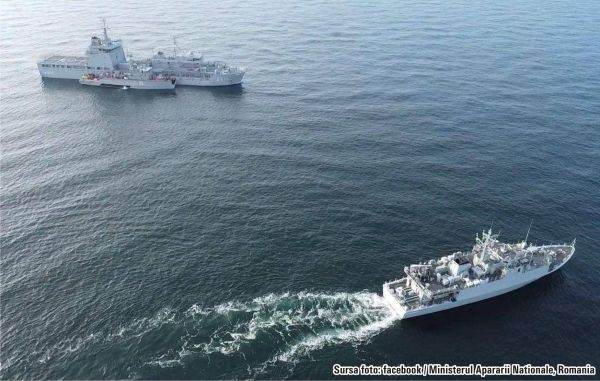
At a time when some UN member states, which have not signed or ratified the United Nations Convention on the Law of the Sea, the legal framework that guarantees freedom of navigation and prohibits tolls for transit through international straits (UNCLOS), are beginning to restrict and even monetize access to essential maritime routes, Europe needs a common naval force, states an article published by the Euractiv website. According to the cited source, the idea has begun to take shape in Western chancelleries, a fact demonstrated, according to the daily The Guardian, by the action of Great Britain which, as announced by Gwyn Jenkins, the head of the British Royal Navy, wants to create a unified naval force with nine European countries to deter future Russian threats from the "open maritime border" in the north.
Another reason why a European naval force is needed is what is happening in the Strait of Hormuz, the cited sources show. Iran has imposed fees of up to $2 million for crossing one of the world's most important energy arteries, the first time in modern history that a state has introduced a permanent sovereignty fee over an international strait. Moreover, the system is not neutral: China, Russia and India benefit from preferential treatment regarding access for their ships to the Strait of Hormuz, while many states are disadvantaged. Basically, we are not talking about a simple transit fee, but about an instrument of economic coercion, a geopolitical weapon established by the regime in Tehran.
The data is telling. Approximately 20% of the global oil flow and a significant part of the world's liquefied natural gas trade transit the Strait of Hormuz daily. For Europe, the impact is direct: between 12% and 14% of LNG (liquefied natural gas) imports come from Qatar and depend on this route. In parallel, around 40% of global trade passes through the Strait of Malacca, and trade flows between Europe and Asia critically depend on this artery. In the Red Sea, Bab el-Mandeb is also becoming a pressure point, as the Houthi rebels have threatened to impose their own transit taxes. We are no longer talking about isolated incidents, but about a pattern that is beginning to be repeated.
This development confirms what experts have been warning for months: freedom of navigation is no longer guaranteed implicitly. "Rules do not collapse overnight, but they can be eroded point by point,” a G20 finance minister recently said, according to Euractiv. And the precedent set by Iran is the first in a possible series. If it remains unchallenged, other states with strategic geographical positions will be tempted to follow the same model. The idea of the "global commons” - the oceans as a common good of humanity - risks being replaced by a logic of fragmentation and control.
Traditionally, the guarantor of this freedom has been the US Navy, but its capacity to act quickly and decisively in all theaters simultaneously is increasingly limited. The operational environment in areas such as the Persian Gulf is extremely complex, saturated with naval mines, drones and anti-ship missiles, which exponentially increases the risks and costs of intervention. In the first weeks of the current crisis in the Middle East, the American reaction was delayed and cautious, which allowed the consolidation of the new status quo. The power vacuum created is not theoretical, but palpable.
For Europe, the consequences are multiple and immediate, the sources cited claim, showing that maritime transport costs have increased, insurance premiums for ships transiting risk areas have increased, and supply chains have begun to fragment. In an economy deeply dependent on energy imports, raw materials and industrial components, these developments translate into inflationary pressures and strategic vulnerability. Therefore, it is no longer just a security issue, but one that directly affects the price of energy, food and consumer goods.
In this context, the idea of a European naval force can no longer be postponed, the sources cited show. Europe already has significant elements of such a capability. France and the United Kingdom operate aircraft carriers and have experience in remote force projection, and NATO's maritime structures - standing naval groups and mine clearance groups - provide an existing operational framework. The problem is not a lack of resources, but fragmentation and the absence of an integrated command oriented towards European interests.
Building a European navy would involve, first of all, integrating these capabilities into a coherent system. There is no need for a new fleet, but rather the coordination of existing ones under a common doctrine and with clear objectives. The ability to escort commercial convoys becomes essential. The historical lessons are clear: during the oil wars of the 1980s, US escort operations drastically reduced attacks on shipping and restored trade flows. Europe must be able to do the same independently.
Second, the sources cited argue that investment is needed in capabilities specific to today's environment: mine warfare, drone defense, missile defense, advanced maritime surveillance, and naval logistics for long-term deployments. Without these elements, any naval presence is symbolic, not operational. Third, strategic partnerships must be developed with the states that control or protect these sensitive areas, from Singapore and Malaysia in Southeast Asia to the Persian Gulf states.
The sources cited also show that the SAFE mechanism, which prioritizes land and air defense, reflects an incomplete approach to European security. No matter how sophisticated air defense systems or land forces are, they cannot compensate for the vulnerability of an economy that depends on unsecured sea routes.
That is why Europe cannot credibly talk about strategic autonomy if it cannot protect its own trade and energy flows. The costs of such a transformation are significant, but the alternatives are much more costly. If the current trend continues, every maritime chokepoint will become a source of taxes, uncertainty and geopolitical risk. In such a scenario, Europe will pay not only more for energy and goods, but also in terms of influence and stability. A joint naval force is not just a military investment, but a condition for the survival of the European economic model. At stake is not only freedom of navigation, but Europe's ability to remain a relevant actor in a world where rules are no longer respected unless they are defended.


















 Euro
Euro Dolar SUA
 Franc elveţian
 Liră sterlină
 Gram de aur