English


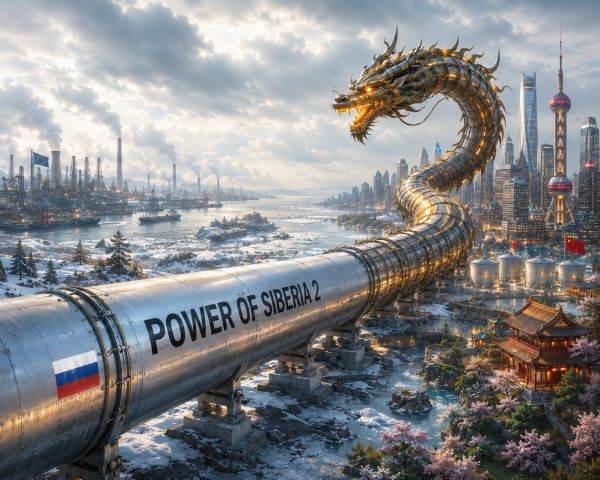
The Beijing summit exemplifies how the closure of the Strait of Hormuz - which disrupts approximately one fifth of global oil supply - changes the profitability calculations of energy integration on a global scale.
The closure of the Strait of Hormuz intensifies concerns regarding energy security in Asia, providing Beijing with additional incentives to secure its Russian supplies, while Moscow needs revenues to sustain its economy.
The prolonged lack of access to alternative hydrocarbon markets has left Russia dependent on trade with China, under unfavorable terms dictated by Beijing - a fact demonstrated by the decline in Russian oil exports to China following the imposition of American sanctions in 2025 and by the prolonged negotiations over the Power of Siberia 2 pipeline.
This asymmetry reflects a broader phenomenon: when the costs of cross-border financing rise dramatically for certain economic corridors, pressure intensifies toward the realignment of capital and commodity flows.
China has consistently delayed discussions regarding this pipeline because it considered its energy security ensured, due to the diversification of energy sources it has achieved.
China has built substantial energy reserves and can wait until there is hope that the conflict in the Middle East will end.
This dynamic illustrates a fundamental characteristic: when an economic actor possesses credible exit options, the profitability thresholds for new strategic commitments shift in its favor.
• Consequences for Romania
Russia ratified additional cooperation agreements related to the Yamal LNG project in February 2026, while in April 2026 Chinese and Russian companies signed cooperation memorandums related to a proposed cross-border hydrogen transport corridor - the first cross-border hydrogen transport corridor between the two nations. These create precedents for new forms of technological integration that could exclude the European space.
Romania finds itself in a dual position - vulnerable and, at the same time, potentially advantaged. On the one hand, due to its geographical position on the eastern edge of the EU and NATO, it risks being bypassed by the new East-West energy corridors taking shape between Central Asia, the Caucasus and Central Europe, on alternative routes (a reconfigured TRACECA, the Trans-Caspian corridor, connections through Turkey). On the other hand, that same position makes it indispensable for any European energy architecture alternative to Russian supplies - through the Black Sea terminals, the Neptun Deep offshore developments and the transit capacity of the BRUA pipeline.
The concrete stakes for Bucharest are threefold. First: accelerating investments in interconnection with the Republic of Moldova, Bulgaria and Hungary, in order to transform Romania into a regional hub, not merely a terminal point. Second: the decision regarding the expansion of Constanţa's capacity to process larger quantities of American and Qatari LNG, which will compete directly with Russian volumes redirected toward Asia. Third: positioning the national industry within the value chains of green hydrogen and nuclear energy (SMRs), where the Sino-Russian fragmentation of energy technologies opens windows of opportunity for medium-sized European suppliers.
The cost of inaction is measurable: if Romania does not secure its role within the next 24-36 months, investment decisions in European energy infrastructure will consolidate other regional hubs - Greece through Alexandroupolis, Poland through ¦winouj¶cie, possibly Turkey - while the geographical advantage will turn into a permanent opportunity cost.
• Potential for systemic spillover
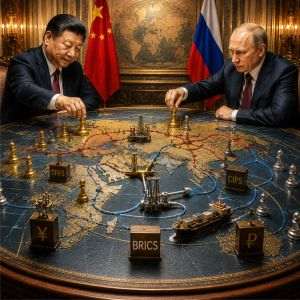
The Sino-Russian energy alliance does not represent merely a bilateral transaction, but a reconfiguration of the global architecture of prices and risk.
For China, Russia is the largest foreign source of fossil fuels: in 2024, crude oil, natural gas and coal imported from Russia accounted for 20%, 23% and 25%, respectively, of China's total imports.
This concentration creates systemic vulnerabilities, but also arbitrage opportunities for actors capable of navigating between the emerging blocs. The current fragmentation of the global economic space could become irreversible if alternative clearing and financing mechanisms that bypass the Western system become consolidated, transforming the current transition period into a new long-term bipolar order in which intermediary actors - including medium-sized European states - will be compelled to choose, explicitly or tacitly, the side toward which their critical dependencies lean.















 Euro
Euro Dolar SUA
 Franc elveţian
 Liră sterlină
 Gram de aur