English


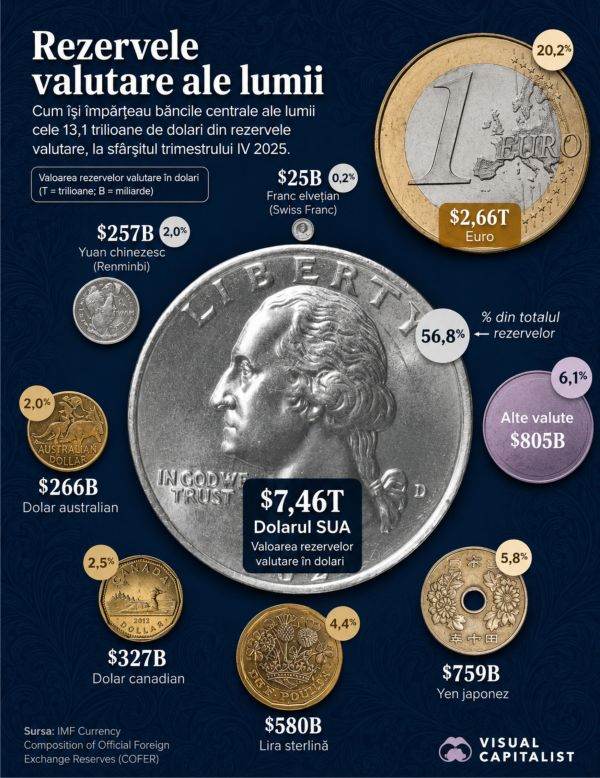
Central banks held a total of $13.1 trillion in foreign exchange reserves at the end of 2025, with the US dollar continuing to dominate global holdings, according to visualcapitalist.com. Despite years of talk of "de-dollarization," reserve managers still keep the majority of their assets in dollar-denominated instruments. Meanwhile, the euro remains the main alternative, and the Chinese yuan's share has fallen from recent highs.
The cited source shows how global reserves were allocated in various currencies at the end of 2025, based on IMF data.
• The dollar - the most important reserve currency
Despite dedollarization efforts, the US dollar remains by far the world's most important reserve currency. Central banks together held US$7.46 trillion in dollar-denominated reserves at the end of 2025, representing 56.8% of the global total.
The dollar's dominance stems from the size of the US economy, the depth of US Treasury markets, and its central role in global trade and finance.
Many commodities, including oil, continue to be priced and settled in dollars, which strengthens demand for the currency worldwide. The dollar's share has gradually declined from around 65% a decade ago, but no currency has emerged as a clear replacement.
• Euro remains the main alternative
The euro is the world's second-largest reserve currency, with $2.66 trillion in holdings and 20.2% of total reserves. Although far behind the dollar, the euro remains the main alternative for central banks seeking diversification. The currency benefits from the economic size of the eurozone and the liquidity of European government bond markets. Together, the dollar and the euro account for more than three-quarters of all global foreign exchange reserves.
Beyond these two leaders, the Japanese yen and the pound sterling hold shares of 5.8% and 4.4%, respectively. Next in the ranking are the Canadian dollar (2.5%) and the Australian dollar (2%).
• Yuan - relatively small role
One of the most notable dynamics in terms of reserves is that of the Chinese yuan, which has come to play a relatively small role. Central banks held about $257 billion in yuan reserves in the fourth quarter of 2025, equivalent to just 2% of the global total.
The share of yuan reserves has fallen from a peak of 2.9% in 2022, despite expectations that geopolitical tensions and diversification efforts could accelerate its adoption.
Rather than being directed primarily at the yuan, some of the reserve diversification has been spread across currencies such as the Canadian or Australian dollar, the Swiss franc and a growing collection of smaller reserve currencies.
• Xi Jinping: "The yuan should become an important global reserve currency"
Chinese leader Xi Jinping said in February that the yuan should achieve global reserve currency status. China aims to create a "strong currency" for international trade and investment, according to the Financial Times.
Beijing has long sought to internationalize the yuan, but this year's statement by the Chinese president is clear evidence of his goal of creating a "strong currency" and a broader financial base that Beijing will need to build to support it.
According to the Beijing leader, China must create "a strong currency" and have it widely used in international trade, investment and foreign exchange markets, and also "obtain reserve currency status."
The British publication indicates that Xi Jinping's call reflects Beijing's long-term strategy to consolidate its influence in the global economy, especially against the backdrop of signs of weakening of the US dollar and a change in leadership of the Federal Reserve (Fed), which is prompting other central banks to review their currency portfolios and the risks associated with dollar assets.























 Euro
Euro Dolar SUA
 Franc elveţian
 Liră sterlină
 Gram de aur