English


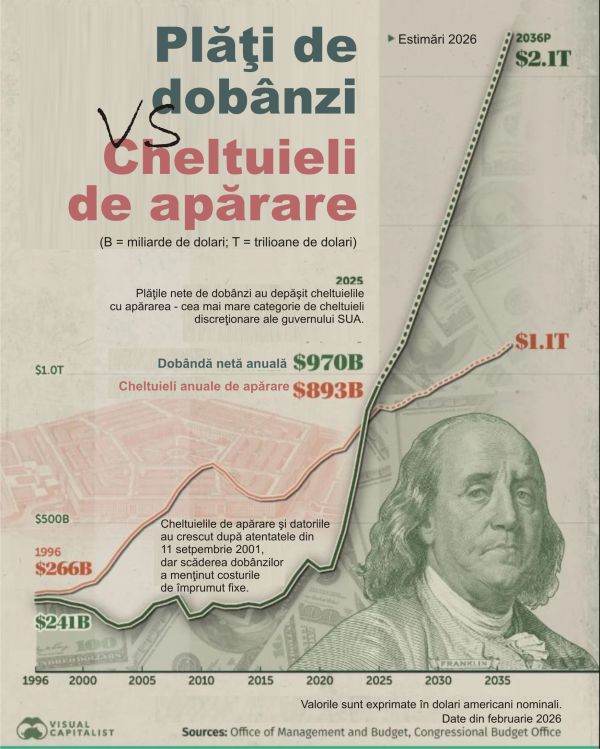
The US is now spending more on interest payments than on national defense for the first time since the late 1920s, marking a turning point in federal priorities, according to visualcapitalist.com.
As debt levels and borrowing costs rise, interest payments are taking up an ever-increasing share of the budget and are projected to reach $2.1 trillion by 2036, far exceeding defense spending.
The cited source presents a comparison of the annual net interest payments of the US and defense spending from 1996 to 2036, according to data/estimates provided by the White House and the Congressional Budget Office (CBO).
• Interest vs. Defense Spending
US interest payments reached $879.9 billion in 2024, exceeding defense spending, which was $850.7 billion, according to the cited source.
Projections through 2036 show that interest payments continue to rise, even as defense spending is also increased.
According to official data, between 1996 and 2001, US defense spending was, on average, about 30% higher than net interest costs, as falling interest rates and budget surpluses kept debt service relatively low. This gap widened sharply after the terrorist attacks of September 11, 2001. Military spending doubled over the next decade, reaching $699 billion in 2011, while interest costs rose more slowly, to $230 billion.
During the low-interest-rate years of the 2010s, borrowing costs remained low even as the federal debt nearly doubled-from $9 trillion in 2010 to $16.8 trillion in 2019-masking the long-term cost of this debt.
After the Covid-19 pandemic, this dynamic reversed. A sudden increase in borrowing, combined with higher interest rates, has led to a significant increase in debt service costs, with net interest expenses nearly tripling to $970 billion by 2025.
At an estimated $1 trillion in 2026, America's net interest bill is expected to become the largest-growing budget item.
By 2036, net interest expenses in the U.S. will double to $2.1 trillion, while defense spending is projected to reach $1.1 trillion.
If current projections hold, the U.S. will spend far more on debt servicing than on national defense within a decade, raising questions about how future budgets will balance economic stability, security, and growth, according to the source.
• Why this change matters
The dynamics mentioned are not just symbolic. They mark a fundamental shift in how the US allocates its resources - towards covering past borrowing, rather than financing current priorities.
As interest costs rise, a growing portion of federal spending is effectively locked up, reducing flexibility for areas such as defense, infrastructure and research. Over time, this can hinder new investment and make it harder for policymakers to respond to economic downturns or emerging challenges.
In other words, higher interest payments don't just reflect rising debt - they actively shape what the government can afford to do next, the cited source concludes.

























 Euro
Euro Dolar SUA
 Franc elveţian
 Liră sterlină
 Gram de aur