English

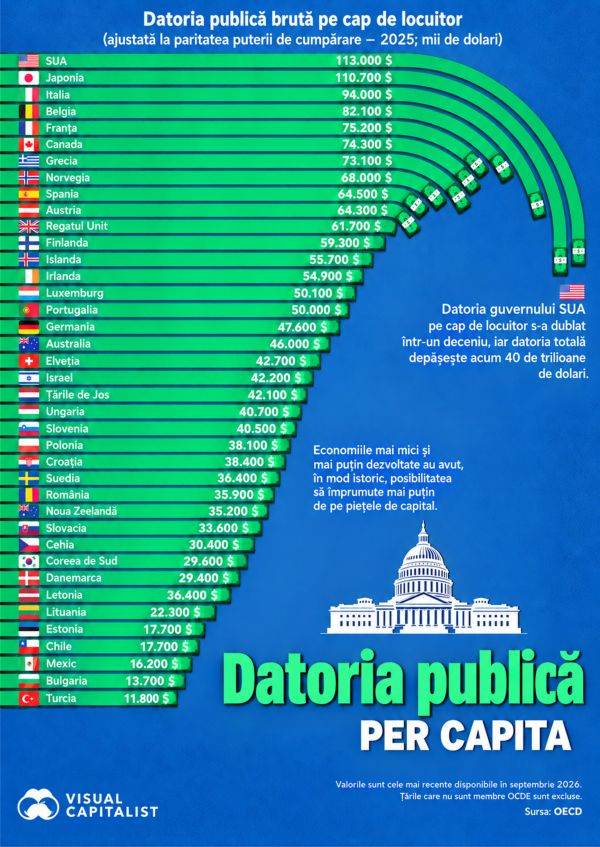
Globally, a sum in the hundreds of thousands of dollars is usually associated with a mortgage, a salary, or a pension account. In two major economies, however, this figure also represents the public debt per capita, according to visualcapitalist.com.
Analyzing debt per capita translates massive figures from national balance sheets into more concrete terms. These values do not represent individual debts and do not, in themselves, indicate whether a country's debt is sustainable.
Using data provided by the OECD, the cited source compared gross public debt per capita across various countries. The figures relate to 2025 (or the most recent year for which data is available) and are expressed in US dollars, adjusted for purchasing power parity.
• Higher debt per capita does not necessarily mean a country is facing repayment difficulties
The top ten spots in the ranking are held by: the USA, Japan, Italy, Belgium, France, Canada, Greece, Norway, Spain, and Austria.
Significant differences exist even between economies with similar levels of wealth. Some of the most striking contrasts appear among major European economies. Italy's public debt of $94,002 per capita is nearly double that of Germany ($47,619), while the figure of $82,089 recorded by Belgium is almost twice that of the Netherlands ($42,114).
Across the entire dataset, the disparity is even greater: US public debt per capita is nearly ten times that of Turkey, which stands at $11,812.
It is important to note that higher per capita debt does not necessarily mean a country faces difficulties in repaying it. Debt sustainability also depends on factors such as the size of the economy, borrowing costs, tax revenues, and investor demand.
• Public debt is steadily rising
The high per capita figures are not static, the cited source notes. In OECD countries, the value of outstanding government bonds reached a record $61 trillion in 2025, up from the $55 trillion recorded just a year earlier. This $6 trillion increase exceeds the annual economic output of any country except the US and China. In other words, OECD governments added an amount roughly equal to the size of the German economy to their bond-based debt in a single year.
However, per capita debt is an indicator of scale, not a verdict on fiscal health. Countries with similar debt levels can face vastly different borrowing costs and repayment risks, depending on economic growth, government revenue, interest rates, and investor demand.
• US debt surpassed $40 trillion in 2026
US government debt crossed the $40 trillion mark for the first time in August 2026, driven by a rise in borrowing linked to healthcare and social security, as well as interest payments on the debt, according to Treasury Department data cited by AFP.
This represents a faster-than-anticipated rise in government debt, given that the Congressional Budget Office had previously projected federal debt would reach approximately $39.4 trillion by year-end. The accelerated growth of US debt occurs against a backdrop of inflation concerns-fueled notably by the conflict in the Middle East and rising energy prices-that have pushed borrowing costs to levels not seen in years, Agerpres notes. US debt has doubled since the 2008 financial crisis and now stands at nearly 125% of Gross Domestic Product (GDP).
"It is well known that the federal deficit is growing at an unsustainable pace," says Jessica Riedl, a budget specialist at the Brookings Institution, noting that while deficits of 3% to 4% of GDP were once enough to alarm financial markets, these levels are now approaching 6% to 7% of GDP.
US President Donald Trump promised during his two terms to cut government spending and the annual deficit. For his part, Treasury Secretary Scott Bessent has indicated that his goal is to reduce the US deficit to 3% of GDP. However, the deficit has widened in recent months, primarily due to customs duty refunds to companies-payments that had been struck down by the Supreme Court in February. Tax cuts and military spending-particularly outlays linked to the conflict with Iran-have also consumed billions of dollars.
Analysts believe, however, that there is no specific debt-to-GDP ratio that automatically triggers a crisis. They also point out that public debt-which excludes claims held by one part of the federal government against another-is a more closely watched indicator than total debt.
"From a psychological perspective, however, these are the benchmarks that alert financial markets to the need to re-examine rising debt levels," concludes Jessica Riedl.

























 Euro
Euro Dolar SUA
 Franc elveţian
 Liră sterlină
 Gram de aur