English

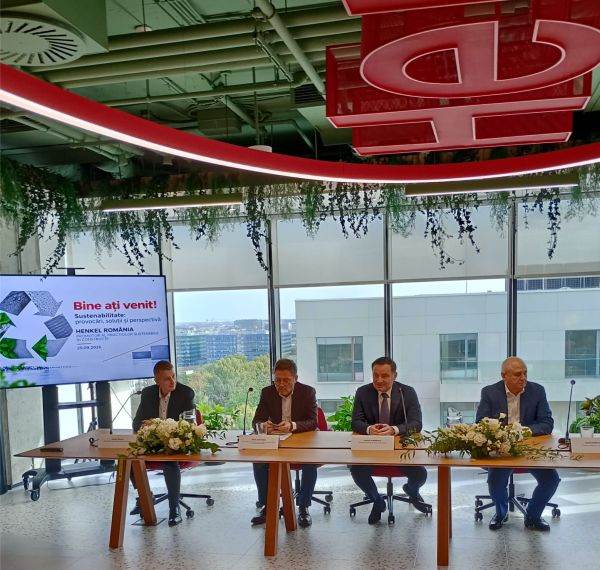
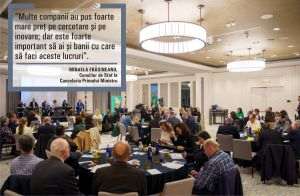
A bucket made from recycled plastic, a silicone cartridge that converts into paper packaging, low-emission cement, and a factory that has achieved carbon neutrality-these represent the practical application of sustainability and circular economy concepts by Henkel Romania. All of this was showcased yesterday during a discussion attended by industry representatives, who outlined the changes being made to production processes while also raising a crucial question: who pays for these measures, and how do the benefits ultimately reach the finished building?
"Sustainability is already in Henkel's DNA. We live it and champion sustainable development," stated Andrei Dumitrescu, President of Henkel Romania. He noted that Henkel published its first sustainability report in 1992-at a time when publishing such a document was not mandatory, unlike after the 2019 implementation of the Green Deal.
"We have set important milestones that are more ambitious than the Green Deal requirements. Starting from the 2021 reporting year, we aim to achieve a global reduction of 42% for Scope 1 and Scope 2 emissions, and 30% for Scope 3, by 2030. As you know, Scope 1 and Scope 2 refer to reducing carbon emissions from our own operations, while Scope 3 involves reducing carbon dioxide emissions across the entire value chain-both upstream and downstream. Furthermore, Henkel aims to reach a 90% reduction by 2045, a target aligned with the SBT Net-Zero standard," stated Andrei Dumitrescu.
Beyond this statement, his presentation focused on a concrete issue: the extent of changes required in a factory, a product, and its packaging to achieve measurable emission reductions. Henkel operates plants in Romania at Pantelimon, Câmpia Turzii, and Roznov, with a combined declared capacity of one million tons per year of cement-based products, adhesives, screeds, fillers, waterproofing solutions, and facade insulation materials. According to Andrei Dumitrescu, the company's investments in Romania have exceeded euro50 million since 2020. The Pantelimon plant represents Henkel's largest construction material production facility in Europe, according to him.
The changes described by the president of Henkel Romania include the installation of photovoltaic panels, the modernization of sand dryers, and the conversion of gas-powered equipment to electric power. The company is considering replacing river sand with limestone sand, using low-emission cement, and utilizing biogas. Dumitrescu noted that investments at the Pantelimon site over the past three years totaled euro2.5 million, while nationwide investments toward these goals have reached euro4 million so far. The stated target is for all Henkel plants in Romania to meet this objective by the end of 2027.
However, there is an obstacle that neither investment nor technology alone can overcome: the price the buyer is willing to pay.
"The financial outlay doesn't necessarily translate into increased sales because, unfortunately, customers are not yet willing to pay more for a product with recycled packaging or reduced carbon emissions. They appreciate it, but it isn't, so to speak, a decisive differentiator," stated Andrei Dumitrescu.
Regarding packaging, the company highlighted the shift to buckets with a high content of recycled plastic, used for products such as tile grout and plaster. According to figures released by Henkel, this project utilized 53 tons of recycled plastic instead of virgin plastic, resulting in a reduction of 668 tons of carbon dioxide emissions. Henkel representatives also showcased a new product featuring silicone cartridges made from recyclable cardboard, with most associated components also being recyclable.
Packaging, however, is only part of the problem. Andrei Dumitrescu also discussed the development of adhesives that allow bonds to be undone-under specific conditions-at the end of a product's life.
"Adhesives are used and designed to create permanent bonds, essentially lasting the entire lifespan of the product. The solution lies in developing adhesives that, through specific processes at the end of the product's life cycle, can be debonded using activation systems-such as UV light, electricity, or heat-thereby allowing key components to be recovered," he explained.
Constantin Damov, President of the Circular Economy Coalition, warned that discussions on sustainability too often stop at recycling. "There is often a tendency for recycling to hijack the concept of the circular economy. Recycling is, in fact, the final intervention; it is almost an admission of failure. Everything starts with eco-design," he said.
In his view, the product must be conceived right also began with the waste it would generate in mind. "What we saw today at Henkel is an example of eco-design; what we have here is now over 99% recyclable. So, practically speaking, almost nothing ends up in a landfill. What does eco-design mean? It means designing not just the product itself, but also the waste we generate. So, Henkel has shown us today that we can design for the waste stage-what happens after our product has been used. I am certain that the full significance of what we are doing here today won't be fully grasped, even though such initiatives ought to be much better promoted and understood within Romanian society. We were discussing mechanized application: the circular economy dictates that we must reduce-so, before we even use something, we need to cut back. Reducing consumption has an extraordinary impact. Globally, 110 billion tons of material are extracted from the planet's mines each year, with 40% to 50% of that going toward construction materials. That is why any move toward circular models has a massive global impact-provided, of course, that such practices are adopted outside Europe as well. Moving on to repair: the construction sector offers us a model-we repair in order to reuse. The best example is that, after using a house for a few years, we don't demolish it; we repair it. There are so many houses and historic buildings across Europe that have been repaired. The circular economy is about reusing what you have already produced. And, of course, we arrive at recycling. All these recycled materials-alternative materials and residues that cannot be recycled-are converted into energy; although there is some debate regarding whether this counts as "energy recovery,' still..." "...all the ash goes into the clinker, so we are also achieving material recovery," stated Constantin Damov.
The pressure on the cement industry highlights just how difficult this transformation is. Adrian Greavu, Sales Director at Heidelberg Materials, explained that approximately one-third of carbon dioxide emissions stem from fuels, while two-thirds originate from the cement production process itself. Consequently, replacing fossil fuels cannot solve the problem on its own. The company is pursuing the use of more alternative fuels, reducing the clinker content in cement, and developing carbon capture and storage capabilities. Heidelberg Materials has set a 2030 target of reducing emissions to below 400 kilograms of carbon dioxide per tonne of cement.
Adrian Greavu also cited the facility inaugurated last year in Brevik, Norway, as an example of new technologies; according to the data he presented, it has a carbon dioxide capture and storage capacity of 400,000 tonnes per year. The initial investment amounted to euro400 million, yet the journey from applying a technology at a single plant to achieving lower-pollution construction involves the entire production and procurement chain.
Irinel Gheorghe, Vice President of the Federation of Construction Employers' Associations and General Manager of SIPEX, also focused on this aspect of the discussion. "Our concern is that the rhetoric shouldn't get ahead of the reality on the ground. Sustainability cannot simply be applied as a label on a product," he warned. A material is manufactured, transported, and installed, and the outcome must be proven through an efficient and sustainable building. To achieve this, said Irinel Gheorghe, a "chain of trust" is required among the manufacturer, consultant, distributor, and builder.
"These are investments we make that ultimately benefit the end user-a party whose perspective is always worth bringing into the conversation, as they are the ones who must bear the costs. These things do not come for free; they entail significant investment, and the client's desire to live in a sustainable, energy-efficient building translates into a price they must be willing to pay," concluded the FPSC vice-president.
The Henkel Romania debate thus highlighted both the progress made and the market's current limitations. Factories can invest in energy, raw materials, and packaging with a lower environmental impact. Cement producers can reduce emissions and attempt to capture those that are difficult to avoid. However, the promise of a sustainable product only becomes compelling when results are clearly measured and the client can see exactly what they are getting for the additional price they are asked to pay.















 Euro
Euro Dolar SUA
 Franc elveţian
 Liră sterlină
 Gram de aur