English

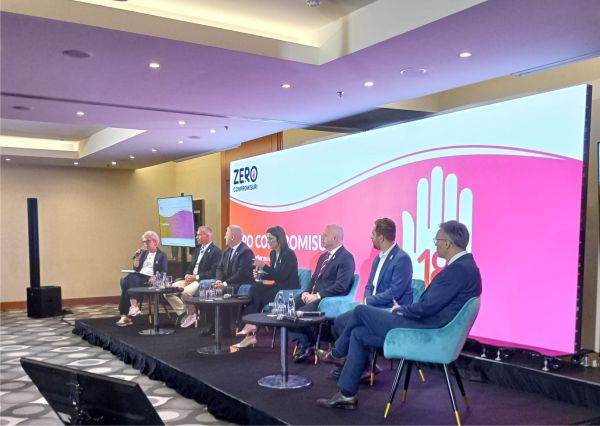
At a time when statistics on tobacco and nicotine product consumption among adolescents place Romania in an alarming position at the European level, Philip Morris Romania, in partnership with the National Authority for Consumer Protection (ANPC), the Association of Romanian Municipalities (AMR), the Hotel and Restaurant Employers' Organization (HORA) and Mega Image launched yesterday the "Zero Compromises" campaign, which aims to transform a legal obligation into a social reflex. The campaign brings together authorities, local administration, manufacturers, retailers and representatives of the hospitality industry to send an unequivocal message: minors' access to tobacco and nicotine products must be stopped, and the law must be applied without exceptions. In support of this campaign, the online platform zerocompromisuri.ro was inaugurated, which contains the main legal provisions prohibiting the sale of tobacco, tobacco products and vaping products, the drastic sanctions that sellers who do not comply with legal obligations risk, as well as preventive measures.
According to the representatives of the entities that initiated this campaign, their approach started from a reality that is as simple as it is inconvenient: our country has legislation that prohibits the sale of tobacco and nicotine products to minors, but the major problem is not the lack of regulations, but their application. That is why the campaign slogan - "Beautiful eyes are no substitute for an ID card” - becomes more than a communication formula. It summarizes the central idea of the entire project: no sale should be made based on assumptions, appearances or indulgence, but exclusively on the basis of verifying the buyer's age.
• 64.6% of citizens believe that the ban on the sale of tobacco, cigarettes and vaping products is not respected
The data that formed the basis for the launch of the campaign were presented by the general director of INSCOP Research, Remus Ştefureac, who explained that the sociological research carried out at the national level reveals a profound paradox of Romanian society. "We have 78.4% of Romanians who declare that Romania has legislation prohibiting the sale of tobacco, tobacco products and vaping products to minors, on the other hand, only a third, 31.2%, believe that the legislation is applied to a large extent. On the other hand, 64.6% believe that the legislation is applied to a small extent, very small extent or not at all. There is an obvious discrepancy between the awareness of the fact that we have legislation and the perception of its application," said Remus Ştefureac. The conclusion is as clear as can be: Romania's problem is not the lack of regulations, but the difficulty of transforming them into everyday behaviors.
Mr. Ştefureac also drew attention to the fact that the phenomenon cannot be treated exclusively as a problem of the authorities. According to the study, 54% of Romanians believe that the main responsibility for enforcing the legislation belongs to state institutions, but the sociologist warns that this perspective is insufficient. "It is a complex problem that cannot be the sole responsibility of the authorities. Often this problem is hidden in the area of private, personal space; the attitude of parents is important. We all expect parents to be the most responsible, but often parents are on one side of the barricade that almost encourages this type of consumption", pointed out Remus Ştefureac.
• Dramatic sanctions for stores that sell tobacco products or vaping products to minors
That is why the campaign aims to mobilize not only state institutions, but the entire ecosystem formed by schools, parents, retailers, local administrations and companies.
The President of the National Authority for Consumer Protection, Csaba Lajos Bekesi, delivered one of the strongest messages of the event, emphasizing that tolerance for violating the law must be zero. "We believe that a well-informed citizen is a protected citizen, but the punitive component of the law must have its say,” he said, insisting that the public must know not only the existence of the rules, but also the consequences of violating them. According to Bekesi, economic operators that sell tobacco products to minors risk severe sanctions, including suspension of activity. "We must say with subject and predicate what happens to the economic operator: it can go as far as suspending the activity, in addition to fines of over 10,000 lei. This year we have almost 400 sanctions and over 1.7 million lei in fines," specified the head of the ANPC, who added: "There is no alternative to smoking for minors. Do you sell tobacco to minors? 10,000 lei fine and we suspend the activity. Do you repeat the contravention? 20,000 lei fine and we close the unit." Bekesi also drew attention to the size of social dimension of the phenomenon, citing data that shows the extent of the problem. "Statistically, 23% of young people up to the age of 15 have smoked in the last week. If we extend the age category to 16, this percentage increases to 31%. It is the highest percentage in the European Union, in Romania. This is a very serious warning for us".
From the perspective of local administration, the mayor of Galaţi and first vice-president of the Association of Municipalities of Romania, Ionuţ Pucheanu, pleaded for a collective approach and for overcoming the reflex of transferring responsibility to someone else.
"We can intervene through the Local Police at economic agents, but a concerted effort is needed. Awareness campaigns must be combined with the punitive side and permanent controls," said the first vice president of AMR, who added: "We need to reach the conscience of the seller and the parents, who sometimes say: "let it go, a cigarette won't hurt'". We need to make a common front. I think we should promote the idea that not smoking is cool. For young people, what is fashionable catches on and the creation of such values would be auspicious."
• Carmina Fuste, Philip Morris: "Zero Compromises means zero tolerance"
An essential perspective also came from the industry. Carmina Fuste, CEO of Philip Morris Romania, explained that for the company she leads, the concept of "Zero Compromises” is synonymous with zero tolerance: "For us, Zero Compromises means zero tolerance. In the channels where we have direct influence, such as our own stores, all staff receive the same training and face the same consequences. The rule is simple: we only sell to adults, and if there is any doubt, there is an obligation to ask for an ID card.”
The CEO of Philip Morris Romania emphasized that the rules are applied without exceptions, including by prohibiting minors from entering our own stores, even when they are accompanied by their parents. "In our stores and production facilities, we do not allow minors to enter, even if they are accompanied by their parents; we have signs at the entrance that specify this,” said Carmina Fuste, who also detailed the mechanisms used in the online environment, where age verification requires additional procedures.
"When we sell online, the first step is self-declaration of age, but then we do a rigorous age verification, by scanning the face or the ID card. Upon delivery, according to Romanian law - which is one of the best in Europe - we do not deliver in lockers, but only through individuals who must verify that the recipient is an adult. Moreover, we have a Mystery Shopper program. We send people who look like minors to our stores to check if the staff complies with the rules. If not, the person is fired immediately. We are talking about the zero exceptions principle”, stated Ms. Carmina Fuste.
• Ion Biriş, HORA: "We have legislation, difficult to apply in reality”
On behalf of the hospitality industry, Ion Biriş, vice president of HORA, pleaded for a balance between the firmness of the application of the rules and legislative realism.
"We are absolutely 100% in favor of respecting the laws, but at the same time we are equally categorical and vehement in being willing to engage in a dialogue to make these laws applicable. We are all in favor of respecting these norms. We all have children, we all want to have businesses where we are not always in conflict with the authorities. Let's try to make some simple, clear laws that are easy to respect," said Ion Biriş, who also pointed out the difficulties in the field: "We do not sell tobacco or alcoholic beverages to minors under any circumstances. What happens in reality? Groups of minors always have at least one adult at the table who purchases these products, presenting an identity card proving that they are of age, after which they are consumed by everyone else. We respect the law 100%. Are we solving something? Absolutely not." That is why Vice President Hora believes that combating the phenomenon must go beyond the relationship between the retailer and the buyer: "We are most interested in these rules being applied. There are rules, there is legislation and we are all trying to implement it. But the most important message is to try together, all those involved, to create a relevant legal framework with the possibility of being applied.”
For his part, Bogdan Biţă, Legal Director of Mega Image, presented how one of the largest retailers in Romania is trying to eliminate the risk of sales to minors through procedures and technology.
"The law must be respected consistently, without exceptions, without negotiations, without any kind of tolerance. This is exactly what we are trying to convey to our employees. Our responsibility as a retailer is very great. We are practically the last filter before consuming final destination. In our stores, when a product that is prohibited for minors is scanned at the cash register, an alert immediately appears on the cashier's screen. A red screen: «Product prohibited for minors. Please check your ID». The system is updated daily and includes precise information on the minimum age required for purchase. Moreover, for alcoholic and energy products, including at self-checkout counters, the process cannot continue until an employee verifies the buyer's age. Basically, the counter is blocked until the store employee comes to verify the buyer's identity and age", explained Bogdan Biţă, emphasizing that the results are encouraging and that the system helps employees to be constantly attentive to their obligations.
In essence, the main message of the "Zero Compromises" campaign is that preventing minors from accessing tobacco and nicotine products cannot be left exclusively to an institution, a company or a professional category. A joint effort is needed in which the state enforces the law, retailers verify the identity of buyers, companies train their employees, schools and parents assume their educational role, and society stops treating adolescents' first contacts with these products with indulgence. After all, as the participants at the launch conveyed, "Zero Compromises" is not just a campaign. It is an attempt to transform compliance with the law into a social and moral standard, in a country where, too often, the rule exists, but its application remains optional.
























 Euro
Euro Dolar SUA
 Franc elveţian
 Liră sterlină
 Gram de aur