 English


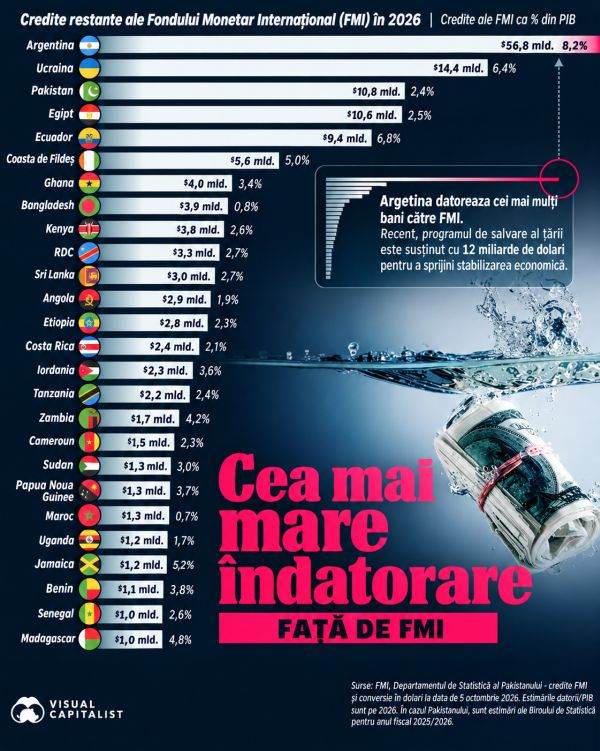
From Argentina's recurring financial crises to Ukraine's wartime financing needs, countries turn to the International Monetary Fund (IMF) for assistance when economic pressures intensify.
Visualcapitalist.com has compiled a ranking of countries based on their outstanding credit to the IMF, using official data from the financial institution as of early October 2026. The figures are expressed in U.S. dollars, and each country's outstanding credit is also presented as a percentage of its projected 2026 GDP.
• Argentina leads the list of debtors
Argentina tops the ranking with $56.8 billion; its outstanding balance exceeds the combined debt of the next six countries with the highest levels of borrowing from the IMF. Ukraine ranks second-by a considerable margin-at $14.4 billion, followed by Pakistan ($10.8 billion), Egypt ($10.6 billion), and Ecuador ($9.4 billion).
At 8.2% of its projected GDP, Argentina's outstanding credit to the IMF also represents a substantial portion of its economy. Argentina's unusually large debt reflects a long history of borrowing from the IMF. In 2018, amid a currency crisis, the country secured a record-breaking financing agreement worth $57 billion, followed by another major program in 2022. Its most recent agreement, approved in April 2025, provided $20 billion in financing, including an immediate disbursement of $12 billion. The program aimed to stabilize the economy, rebuild foreign exchange reserves, and restore investor confidence.
• Why Argentina repeatedly turns to the IMF
Argentina's repeated reliance on IMF loans reflects decades of currency crises, high inflation, and limited access to international capital markets. Although the country had fully repaid its debt to the IMF during the term of former President Nestor Kirchner in the 2000s, it returned to the Fund for emergency financing in 2018.
The subsequent recession, the depreciation of the national currency, and difficulties in meeting repayment obligations led to further negotiations and a new agreement in 2022.
Under the leadership of President Javier Milei, Argentina has pursued spending cuts, fiscal discipline, and a more flexible exchange rate system. The 2025 agreement with the IMF supported these reforms, and an assessment conducted in May 2026 unlocked an additional $1 billion in funding.
• Distinct challenges for Ukraine and Pakistan
The loans taken on by Ukraine reflect the extraordinary costs stemming from the 2022 Russian invasion. The war has damaged infrastructure, disrupted economic activity, and placed immense pressure on public finances, making international assistance essential for maintaining economic stability.
In February 2026, Ukraine secured a new IMF financing program worth $8.1 billion-part of a broader $136.5 billion international support package, the cited source notes. These funds are intended to bolster financial stability during the war, while also laying the groundwork for reconstruction and recovery.
Meanwhile, Pakistan faces long-standing challenges, including low tax collection, foreign currency shortages, and debt within the energy sector. Its IMF-backed reforms focus on broadening the tax base, rebuilding foreign exchange reserves, and improving public finances. In May 2026, another program review unlocked approximately $1.3 billion in funding, including support for climate resilience.
• World Bank and IMF Support Changes to Debt Sustainability Framework
Last month, the executive boards of the World Bank (WB) and the International Monetary Fund (IMF) approved proposed reforms to the joint debt sustainability framework for low-income countries, aiming to better reflect a more complex and riskier environment, according to Reuters.
The joint review-the first since 2017-recommends adjustments in several areas, including improved analysis of domestic debt and an expanded assessment of long-term development challenges, such as climate change, Agerpres reports.
Following these reforms, the analysis of risks to debt sustainability will be enhanced by refining how borrowing capacity is measured, and new tools for assessing debt sustainability will be introduced.
Furthermore, the World Bank and the IMF will improve their "tools for realistic assessment" and implement stress tests to ensure the consistency and accuracy of forecasts, while encouraging countries to enhance the transparency of their debt data.
The two institutions use the debt sustainability framework to analyze and evaluate a country's capacity to take on new debt without jeopardizing the repayment of existing loans. These changes were recommended as many low-income countries face rising debt levels.
The changes are expected to become operational in the second half of 2027.

























 Euro
Euro Dolar SUA
 Franc elveţian
 Liră sterlină
 Gram de aur






























Reader's Opinion