English


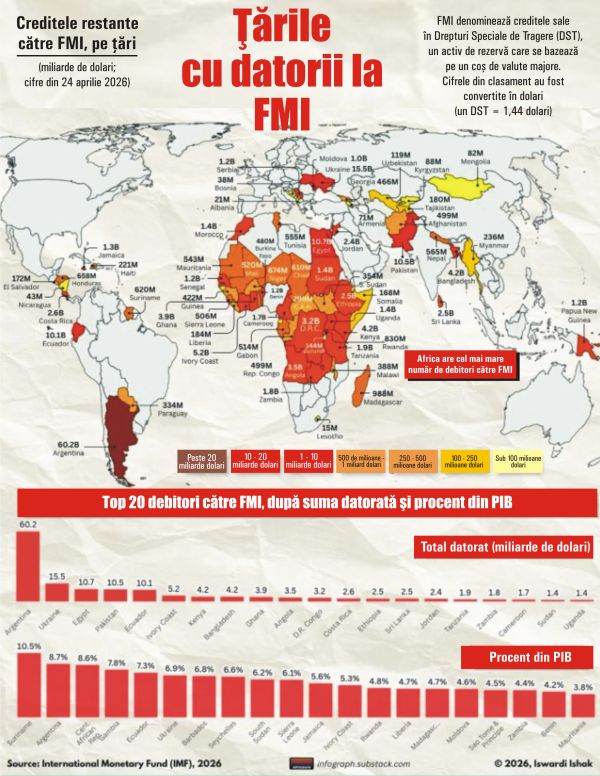
Dozens of countries currently rely on the International Monetary Fund (IMF), as economic problems put pressure on public finances. Although the loans are widespread, only a few countries account for a large share - led by Argentina, which is far ahead of the others, according to visualcapitalist.com.
The cited source presents the ranking of debts to the International Monetary Fund, by country, according to data from the financial institution, available in April 2026.
• The largest debtors to the IMF
Argentina is not only the largest debtor to the IMF - it is also in a league of its own, with debts almost four times greater than the next largest country. With over $60 billion in outstanding loans (8.7% of GDP), Argentina's debt reflects a long cycle of inflationary crises, currency instability, and repeated IMF programs spanning decades.
The next largest debtors include Ukraine ($15.481 billion; 6.9% of GDP), Egypt ($10.669 billion; 2.5% of GDP), Pakistan ($10.5 billion; 2.6% of GDP), and Ecuador ($10 billion; 7.3% of GDP). At the same time, dozens of countries have debts of less than $1 billion, mainly in Africa.
Suriname stands out in relative rather than absolute terms. The South American country has the highest debt to the IMF as a percentage of GDP (10.5%), reflecting a severe economic crisis since the early 2020s. After years of fiscal mismanagement, falling oil revenues and rising external debt, Suriname failed to meet its sovereign obligations in 2020. This led to an IMF-backed restructuring program aimed at stabilizing public finances and reducing inflation, according to the cited source. The adjustment process involved significant austerity measures and currency depreciation.
• Why countries turn to the IMF
Countries typically borrow from the IMF during times of economic difficulty. These situations often fall into a few common categories: balance of payments crises - when countries cannot pay for their imports or service their external debt; currency instability - sudden devaluations or losses of foreign exchange reserves; fiscal imbalances - large government deficits and rising public debt.
For example, Argentina has repeatedly requested IMF assistance in the context of inflationary and currency crises, while countries such as Sri Lanka and Pakistan have turned to the IMF during severe external debt pressures.
• How IMF debt works
Unlike traditional loans, IMF financing is denominated in Special Drawing Rights (SDRs), an international reserve asset created by the IMF. SDRs are based on a basket of major currencies: the US dollar, the euro, the Chinese yuan, the Japanese yen, the pound sterling.
Countries receive SDR allocations or loans, which can then be exchanged for a major currency. For the ranking presented by visualcapitalist.com, the figures were converted into US dollars (approximately $1.44/SDR).
• IMF loans spread across Africa
Africa is notable not for the size of IMF loans, but for their spread. The continent has the largest number of debtor countries, reflecting persistent structural challenges that make external financing a recurring necessity, according to the cited source. This reflects structural challenges such as: dependence on raw materials; limited fiscal capacity; exposure to external shocks.
Many African nations borrow relatively smaller amounts, but their dependence on IMF support is widespread.
• Criticism and controversies
Despite its role as a financial backstop, the IMF has faced criticism over its lending conditions. Loan programs often require economic reforms, such as austerity measures, which can be politically and socially difficult. Critics argue that these conditions can slow growth or worsen inequality, while supporters say they are necessary for long-term stability.
The International Monetary Fund this month downgraded its global growth forecast for 2026 after the Iran war led to higher energy prices and supply chain disruptions, Reuters reported, according to Agerpres. The IMF warned that the global economy could be on the brink of recession if the conflict worsens and oil prices remain above $100 a barrel through 2027. The most optimistic baseline scenario assumes a short-lived war in Iran and projects global economic growth of 3.1% in 2026, down 0.2 percentage points from its January estimate. In this scenario, oil prices would average $82 a barrel this year, down from the recent level of around $100 for Brent crude futures. In the absence of the Middle East war, the IMF would have improved its global economic growth forecast this year by 0.1 percentage points to 3.4%, thanks to a continued boom in technology investment, lower interest rates, less severe US tariffs and fiscal support from some countries. In the negative scenario of a longer conflict, in which the price of a barrel of oil remains at about $100 this year and $75 in 2027, the IMF estimates that the world economy will register an advance of 2.5% in 2026. In January, the IMF expected the price of oil to fall to about $62 in 2026. In the IMF's most severe scenario, in which the conflict deepens and spreads, and the price of crude oil is much higher, causing major disruptions in markets and tightening financial conditions, global GDP will grow by only 2%.





















 Euro
Euro Dolar SUA
 Franc elveţian
 Liră sterlină
 Gram de aur