 English


Meta's metaverse, Apple's electric car, Cruise's robotaxis, and Humane's artificial intelligence devices are among the tech bets that have proven costly for the companies involved-and have been a source of significant disappointment. In some cases, projects have been abandoned; in others, investments continue, even though commercial results fall far short of expectations. The tech industry is built on the promise of progress, as well as on the willingness of investors to fund projects that do not yield immediate profit. Sometimes, bets on the future turn into successful ventures-as was the case with smartphones or cloud computing services. At other times, however, billions of dollars are poured into products that the public fails to adopt at the anticipated pace, into technologies that lack sufficient maturity, or into business models that cannot withstand the reality of the market. The last few years have provided several striking examples. Failures and withdrawals within the tech sector demonstrate that financial resources, reputation, and innovative capacity are no guarantee of commercial success.
• The Bubble Questioned
Massive investments in technological infrastructure are fuelling fears of a potential financial bubble, as technology company valuations rise while recouping invested capital remains a challenge. According to The Guardian, Amazon, Alphabet, Microsoft and Meta estimate their combined capital expenditure at approximately $650 billion in 2026, primarily to develop the infrastructure required for Artificial Intelligence. These sums raise questions about investment returns and the market's ability to sustain current valuations.
Michael Burry, the investor known for anticipating the 2008 subprime mortgage crisis, is now warning, according to The Energy Mix and the Seeking Alpha platform, about the risks posed by the massive spending of major technology companies. In his view, investments in infrastructure and hardware do not guarantee profits commensurate with the capital committed, while high valuations could amplify losses in the event of a market shift.
An important warning has also come from the European Central Bank (ECB). In an analysis published on the institution's blog in August, economists Malin Andersson, Johannes Breckenfelder, Stefano Corradin, Kalin Nikolov and Maria Antonietta Viola identified parallels between the current AI-driven stock market boom and historical episodes such as the railway boom of the 19th century, the expansion of electricity and radio in the 1920s, and the dot-com bubble of the 1990s. The authors warn that a correction in current stock market valuations is likely, even if artificial intelligence proves to be a technology with major economic implications.
For his part, Sam Altman, CEO of OpenAI, has acknowledged in the US press that investor enthusiasm can become excessive. Ruchir Sharma, an economist and investor, has identified four classic characteristics of a financial bubble in the current boom: overinvestment, asset overvaluation, excessive concentration of holdings, and rising indebtedness. In an interview with Business Insider, Sharma warned that a potential rise in interest rates could trigger a correction by making financing more expensive and reducing liquidity. The risks extend beyond investor losses. A severe correction could affect corporate financing, investment and market confidence, particularly if a substantial portion of the infrastructure being built fails to generate the expected revenue.
• Meta's Metaverse: More than $83 billion in losses
Returning to major technology investments that have yet to deliver immediate validation, one of the most expensive tech bets in recent years is the virtual and augmented reality project developed by Meta-the parent company of Facebook, Instagram, and WhatsApp. In 2021, Mark Zuckerberg changed the company's name from Facebook to Meta, signaling that the group's future would extend well beyond traditional social media. The metaverse-a digital universe where users could work, socialize, purchase products, and attend events through avatars-was envisioned as the next major computing platform. However, the financial results have been far less spectacular than the stated ambitions. According to Meta's annual report, the Reality Labs division-responsible for virtual and augmented reality products-posted an operating loss of $19.2 billion in 2025, compared to $17.7 billion in 2024. The division's revenue for 2025 stood at approximately $2.2 billion. Based on calculations derived from the company's annual results, the cumulative operating losses for Reality Labs between 2020 and 2025 have reached approximately $83.6 billion. It should be noted, however, that these figures encompass the entire virtual and augmented reality division, rather than just the development of the metaverse. The issue is not that the technology fails to function; virtual reality headsets exist, and there is genuine potential for applications in industry, education, and entertainment. The challenge lies in the fact that the general public has not adopted virtual environments to the extent required to sustain the investments made. For many consumers, wearing a headset remains uncomfortable, and the available experiences do not always justify the cost of the devices or the time spent in the virtual environment. While Meta has not abandoned the field, the scale of these losses raises questions regarding the pace at which the company can transform its investments into a profitable business. This is an example of a project that cannot be declared an outright failure, yet one whose financial outcome has proven extremely costly.
• Apple Car: A decade of work with no car on the market
Apple has demonstrated its ability to transform entire industries through products like the iPhone and iPad. However, its attempt to enter the electric vehicle market did not yield the same result.
The project, codenamed "Titan," was in development for approximately a decade. The company even explored the possibility of creating an autonomous vehicle-one that would be radically different from conventional automobiles. According to Reuters, which reported the company's decision in February 2024, Apple has abandoned the project, with some of the involved employees set to be reassigned to artificial intelligence initiatives. The endeavor never reached the stage of launching a commercial vehicle. The total cost of the project was never officially disclosed in a separate financial statement, so estimates circulating in the press should be viewed with caution. Nevertheless, a decade spent on research, development, testing, and the recruitment of automotive industry specialists represents a significant commitment of resources-even for a company of Apple's scale. This failure highlights the challenges a technology company faces when expanding into a sector where software is only one component of the final product. The automotive industry entails industrial investments, complex supply chains, regulatory homologation, safety requirements, service infrastructure, and well-established competition. Apple was able to abandon the project without jeopardizing its core business; for smaller companies, such a withdrawal could have meant disappearing from the market entirely.
• Cruise: when the autonomous car becomes a safety issue
For years, autonomous vehicles have been presented as a possib A revolution in urban transport is underway. The promise is attractive: driverless taxis, lower operational costs, and services available around the clock. However, the experience of Cruise-a company controlled by General Motors-illustrates just how complex the transition from technological demonstrations to large-scale commercial operation truly is. In 2023, an accident in San Francisco, in which a Cruise robotaxi struck a woman and dragged her after the impact, triggered investigations and led to the suspension of the company's permit to operate driverless vehicles in California. In January 2024, Reuters reported that General Motors planned to cut its projected spending on Cruise for that year by approximately one billion dollars. The company had disclosed that the division burned through $1.9 billion in cash in 2023 and posted a pre-tax loss of $2.7 billion, excluding certain restructuring costs. In July 2024, General Motors announced the indefinite suspension of the development of the Origin-a robotaxi designed without a steering wheel or pedals-stating that it would instead focus its efforts on a future version of the Chevrolet Bolt. According to Reuters, this decision was linked to both regulatory risks and challenges related to the vehicle's architecture. The Cruise case demonstrates that technological performance alone is insufficient when a product must operate in real-world traffic under unpredictable conditions. A software error can quickly escalate into a public safety issue, and once a serious incident occurs, regaining the trust of both authorities and customers is a difficult task.
• Ford and the price of electrification: Billions lost in a challenging market
The electric vehicle industry offers yet another example of the gap between strategic ambitions and financial results. Ford has invested heavily in developing a lineup of electric vehicles, including the Mustang Mach-E and the F-150 Lightning pickup. However, the American manufacturer has faced weaker-than-anticipated demand, pricing pressures, and difficulties in achieving economies of scale. According to the industry publication electrive.com-which reported on Ford's results for the previous year in February 2026-the "Model E" division posted an operating loss of $4.8 billion in 2025, following a $5.1 billion loss in 2024. While the division's revenue grew by 73% to $6.7 billion, it was not enough to offset expenses. In December 2025, Ford announced a major restructuring of its electric vehicle operations, involving accounting adjustments and the cancellation of certain programs. „Electrive” reported that the manufacturer recorded $10.7 billion in valuation adjustments during the fourth quarter of 2025, partly linked to the abandonment of specific electric vehicle programs. These losses do not mean that the electric vehicle has failed as a technology. The market continues to evolve, and manufacturers are adapting their offerings based on demand, regulatory requirements, and battery costs. Ford's problem is that its investments were scaled for a transition that proved faster than the one actually taking place in certain market segments. For a traditional manufacturer, this transition entails simultaneously developing new platforms, adapting factories, preparing suppliers, and maintaining the profitability of vehicles with conventional engines. If sales volumes fall short of expectations, fixed costs weigh heavily on financial results.
• Humane AI Pin: $241 million invested in an abandoned product
Amid the wave of enthusiasm for artificial intelligence, the startup Humane sought to demonstrate that users could forgo some smartphone functions in favor of a voice-controlled wearable device. The AI Pin, launched in 2024, was designed as an AI-powered personal assistant capable of answering questions and facilitating various tasks without the constant need for a traditional screen.
However, the product received unfavorable reviews, and sales figures were disappointing. According to Reuters, in February 2025, Humane decided to shut down the business operations associated with the device and sell its assets to HP for $116 million. Reuters reported that the startup had raised approximately $241 million in funding. Following the termination of the service, the AI Pin's features that relied on the company's servers became unavailable. The comparison between the funding raised and the transaction value is telling, but it should not be interpreted as an exact measure of the investors' loss: the amount paid by HP covered assets and intellectual property, and does not represent a comprehensive valuation of all the company's financial flows. The Humane case highlights a problem within the market for AI-powered devices: the mere integration of a high-performing model does not guarantee the creation of a useful product. A new device must offer advantages distinct from a smartphone, function reliably, offer adequate battery life, and justify the asking price.
• Google Stadia: Technology cannot replace a business model
Launched in 2019, the Google Stadia platform promised to transform the video game industry by shifting graphical processing to the cloud. Users could play games over the internet without needing to purchase a traditional console or a high-performance computer. The concept was appealing at a time when streaming services were gaining traction in the music and video sectors. However, Stadia failed to attract enough users and developers to become a viable alternative to established ecosystems. In September 2022, Google announced the closure of the service, and the servers were shut down on January 18, 2023. According to official documentation released by Google, the company provided refunds for eligible hardware and software purchases made through the Stadia store. Unlike other projects on this list, the total cost of Stadia is not represented by a single, clear official figure comparable to the operational losses reported by companies like Meta or Ford. Consequently, it would be inaccurate to assign a specific monetary value to the project without a verifiable financial source.
Its failure, however, had a clear economic explanation: a high-performance technical infrastructure is not enough if users cannot find a sufficient selection of games, if the purchasing model fails to convince them, and if they lack confidence that the service will remain available in the long term. In the digital industry, the shutdown of a platform can even affect consumer trust in similar services-specially when users have invested both time and money into an ecosystem controlled by a single company.
The examples mentioned above do not share the same root cause, nor can they all be classified as outright failures. Meta continues to invest in virtual reality, Ford is developing electric vehicles, and autonomous technology and cloud gaming services have not disappeared. Conversely, the Apple Car and the Humane AI Pin were abandoned in their original commercial form, and Google Stadia was shut down.
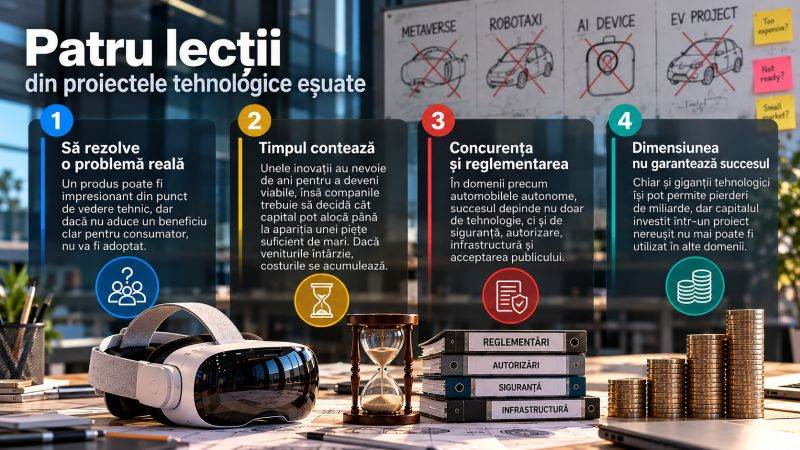
Nevertheless, there are a few common lessons. The first is that technology must solve a genuine problem for the consumer. A product may be technically impressive, yet lack a compelling enough reason for someone to purchase it. The second lesson concerns timing. Some innovations require years to become viable, and companies must determine how much capital they can allocate while waiting for a sufficiently large market to emerge. If revenue is delayed, research and development costs continue to mount. The third lesson relates to competition and regulation. In fields such as autonomous vehicles, success depends not only on software but also on safety, regulatory approval, infrastructure, and public acceptance. Finally, a company's size does not shield it from strategic errors. While tech giants may be able to absorb losses in the billions, capital sunk into an unsuccessful project is capital that can no longer be deployed elsewhere. Risky investments are an essential component of technological progress; without capital available for experimentation, many products that seem indispensable today would never have come into existence. The problem arises when estimates regarding market size, adoption speed, or monetization potential are built more on enthusiasm than on commercial evidence.





















 Euro
Euro Dolar SUA
 Franc elveţian
 Liră sterlină
 Gram de aur






























Reader's Opinion