 English


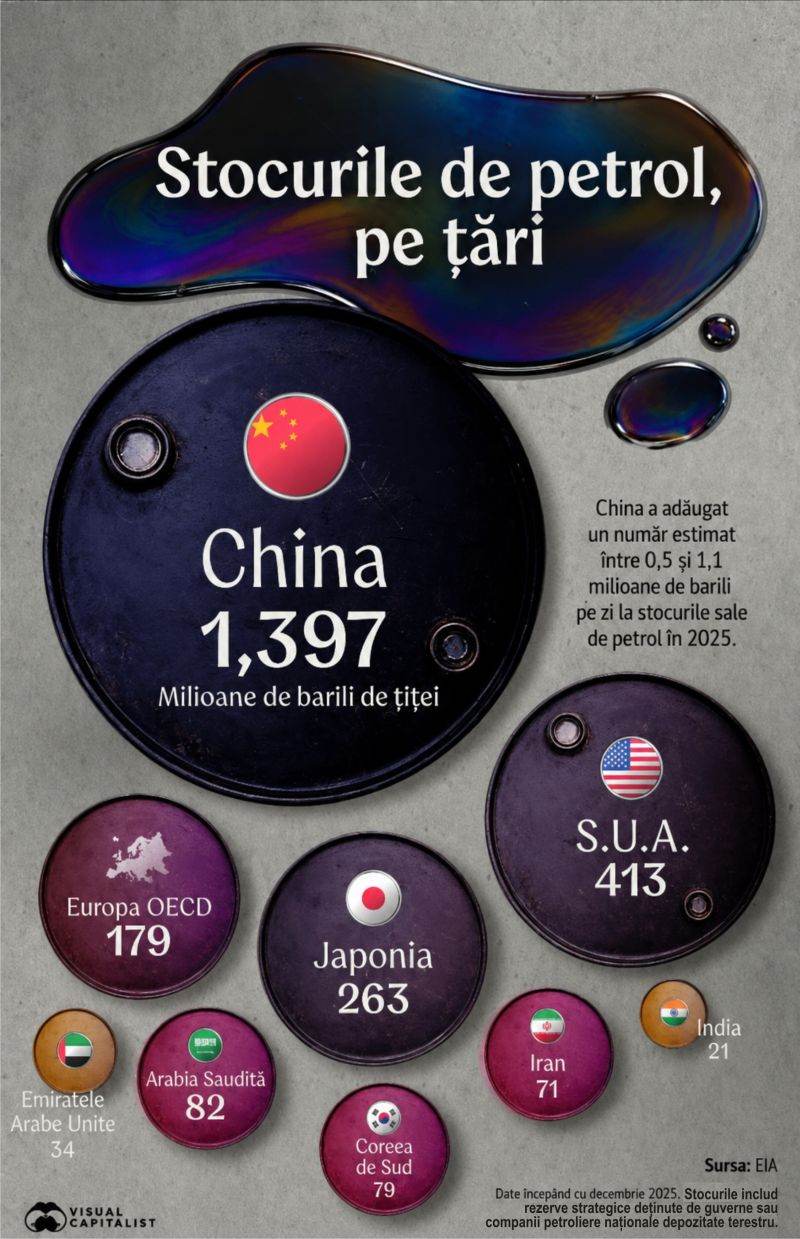
Global strategic oil reserves are one of the clearest indicators of how countries are preparing for energy shocks and geopolitical uncertainties. These strategic reserves help governments stabilize domestic fuel supplies during wars, sanctions, natural disasters or market disruptions, according to visualcapitalist.com.
According to the International Energy Agency (IEA), the world is currently facing one of the largest energy supply disruptions in modern history, following the closure of the Strait of Hormuz, which has put extreme pressure on fuel markets and gasoline prices worldwide.
Visual Capitalist presents a ranking of the largest estimated strategic oil stocks at this time (onshore stocks), using data from the US Energy Information Administration. The ranking highlights which countries are best prepared to deal with disruptions to global oil supplies. The data does not take into account stocks set aside for coordinated emergency release in March 2026 by IEA member countries.
• China, dependent on external supply routes
China's oil stocks stand out in the ranking. Estimated at 1.4 billion barrels, these reserves are larger than the combined strategic reserves of the United States, Japan, OECD countries in Europe, Saudi Arabia, South Korea, Iran, the United Arab Emirates and India. Today, the combined reserves of the listed countries represent about 70% of the total volume of oil stored worldwide.
The size of China's reserves reflects the Asian country's high dependence on external supply routes, including strategically sensitive sea corridors such as the Strait of Hormuz. The larger the reserves, the more flexibility countries have to weather periods of market volatility.
• The United States holds the second largest crude oil reserves
The United States ranks second in the aforementioned ranking, with 413 million barrels in the Strategic Petroleum Reserve, and Japan - third, with 263 million barrels, despite the country's limited domestic energy resources. Because Japan imports almost all of its crude, maintaining large emergency reserves has long been a national priority.
Collectively, European OECD countries hold the fourth-largest crude stockpile, at 179 million barrels.
Several Middle Eastern and other Asian countries also have sizeable strategic reserves, underscoring the growing importance of energy security in both importing and exporting nations, the source said. As global oil demand and geopolitical tensions persist, many countries continue to expand their storage capacity to better protect themselves against future supply disruptions.
• Timeline of oil shocks and strategic reserves releases
The 1973-74 oil crisis, triggered by a global oil embargo imposed by major producers, caused a sharp 300% increase in market prices. The crisis exposed the vulnerability of many industrialized nations to disruptions in oil imports.
The IEA was established in response, with one of its main objectives being to create strategic oil stocks in member countries to reduce the impact of future supply disruptions.
Since 1974, there have been six strategic oil releases: in 1991 - in the run-up to the Gulf War; in 2005 - after Hurricanes Katrina and Rita damaged oil infrastructure in the Gulf of Mexico; in 2011 - in response to the prolonged disruption of oil supplies caused by the Libyan Civil War; in 2022 - following Russia's invasion of Ukraine; also in 2022 - a second release, as the energy crisis deepened; in 2026 (the largest so far) - following the closure of the Strait of Hormuz.
• US - new sanctions to prevent the sale of Iranian oil to China
The United States on Monday sanctioned 12 individuals and entities linked to Tehran, whom it accuses of "facilitating" the sale of Iranian oil to China, AFP reports, according to Agerpres.
Several members of the Revolutionary Guards (IRGC), Iran's ideological army, as well as companies in Dubai and Hong Kong are now on the blacklist of the US government service OFAC. "As the Iranian military desperately tries to regroup,” the Treasury "will continue to deprive the regime of the funds it needs for its weapons programs, its terrorist "proxies,' and its nuclear ambitions,” Treasury Secretary Scott Bessent said on the X platform.
According to the administration's statement, the IRGC "relies on shell companies located in permissive economic jurisdictions to conceal its role in oil sales and to direct the proceeds to the Iranian regime.”
Some of the newly sanctioned companies "were involved in multiple oil shipments (...) each worth tens of millions of dollars,” the Treasury said.
Others facilitated the use of multiple vessels belonging to Iran's Ghost Fleet, a network of ships used to transport oil in circumvention of sanctions.
Because most of Iran's oil exports go to China, Beijing is directly affected by the US-Iranian confrontation and the almost complete closure of the Strait of Hormuz.
Donald Trump is due to travel to China starting today for a meeting with Xi Jinping, the first visit by an American president since 2017. The Middle East crisis is expected to be a major topic of discussion, and Donald Trump could try to persuade Xi Jinping to increase pressure on Tehran.
• Reuters: OPEC oil production - at its lowest level in two decades
OPEC oil production fell in April to its lowest level in more than 20 years, according to a Reuters survey, after the war between the US, Israel and Iran severely affected exports through the Strait of Hormuz, news.ro reports. Total output from the 12 OPEC members fell by about 830,000 barrels per day in April to 20.04 million barrels per day. Reuters notes that the level is the lowest since at least 2000, excluding changes in the cartel's composition.
The drop comes despite the fact that eight countries in the OPEC+ alliance had previously agreed to increase production in April. The conflict that began in late February and the effective blockade of the Strait of Hormuz made it impossible to implement the plan.
Kuwait recorded the largest production reduction, after a full month of export disruptions.
Saudi Arabia and Iraq also reported further declines, while the United Arab Emirates was the only major Gulf producer to manage to increase its output, benefiting from alternative export routes that avoid the Strait of Hormuz.
The Reuters survey shows that the current level of production is even below that recorded during the 2020 pandemic, when global oil demand collapsed.
In parallel, oil prices have returned to growth after Donald Trump declared that the truce with Iran is "in a critical state", and markets fear that the energy blockade could continue for months.


















 Euro
Euro Dolar SUA
 Franc elveţian
 Liră sterlină
 Gram de aur





























