English


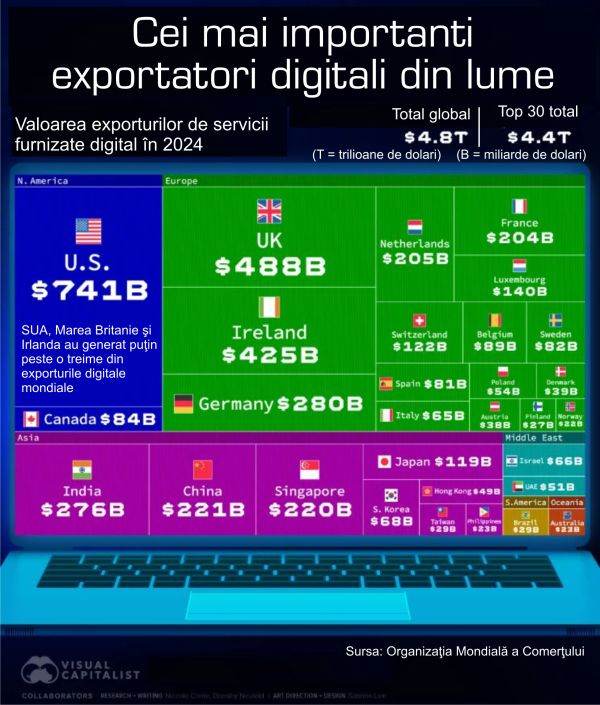
From Amazon.com's massive cloud services business to Spotify's streaming audio subscriptions, digital exports totaled $4.8 trillion worldwide last year. What's more, they accounted for more than two-thirds of global services exports, according to an analysis by visualcapitalist.com, which notes that American tech giants play a major role not only in driving U.S. digital exports, but also in countries like Ireland, where Meta, Google and other major players have their European headquarters.
The cited source presents the top 30 countries in the world by digitally shipped exports in 2024, based on data from the World Trade Organization.
• The U.S. holds the lead, with digital exports of $741 billion
U.S. digital exports reached $741 billion in 2024 (+11% annually), covering 15% of the global total. The United States is the world's top digital economy. While these exports include the billion-dollar advertising businesses of Meta and Google, they also cover online education, financial services and a wide range of services delivered without face-to-face human interaction, according to the source.
With exports of $488 billion, the United Kingdom ranks second in global digital sales. Today, about 3.2 million jobs in the UK are tied to digital exports, driven by its technology and financial services industries.
Ireland ranks third, with $425 billion in digital exports. The European country's exports grew by 24% in 2024, the fastest rate of growth among the largest exporting nations, according to the source. In particular, Ireland's role as a European hub for major technology firms means that many regional digital sales are attributed to the country, increasing its role in the global digital economy.
In places 4-10 we find the following countries: Germany ($280 billion), India ($276 billion), China ($221 billion), Singapore ($220 billion), Netherlands ($205 billion), France ($204 billion) and Luxembourg ($140 billion). Next, in positions 11-20: Switzerland ($122 billion), Japan ($119 billion), Belgium ($89 billion), Canada ($84 billion), Sweden ($82 billion), Spain ($81 billion), South Korea ($68 billion), Israel ($66 billion), Italy ($65 billion), Poland ($54 billion). From 21st to 30th place, the top of digital exports looks like this: United Arab Emirates ($51 billion), Hong Kong ($49 billion), Denmark ($39 billion), Austria ($38 billion), Brazil ($29 billion), Taiwan ($29 billion), Finland ($27 billion), Australia ($23 billion), Philippines ($23 billion), Norway ($22 billion).
• EU wants to simplify digital rules
The European Union announced last month a series of measures aimed at reducing the burden of regulations in the field of Artificial Intelligence, so that European companies, from factories to newly established units, will spend less time on administrative work and ensuring compliance and more time on innovation and expansion, notes a press release from the Community Executive, according to Agerpres.
At the heart of the European Commission's new digital package presented in November is a digital omnibus streamlining rules on artificial intelligence (AI), cybersecurity and data, complemented by a Data Union strategy to unlock high-quality data for AI and European wallets for businesses, which will provide them with a single digital identity to simplify administrative formalities and make it easier to do business across all EU Member States.
The package aims to facilitate compliance with simplification efforts, estimated to save up to euro5 billion in administrative costs by 2029. In addition, European wallets for businesses could unlock an additional euro150 billion in savings for businesses every year.
"The proposal is an important first step in our digital simplification agenda, aiming to create a more favourable business environment for European companies,” said Valdis Dombrovskis, Commissioner for Economy and Productivity, Implementation and Simplification. "A Digital Fitness Check, also launched today, which includes a broad public consultation, will guide our next steps. By simplifying rules, reducing administrative burdens and introducing more flexible and proportionate rules, we will continue to deliver on our commitment to give EU businesses more room to innovate and grow.”
With the Digital Omnibus, the Commission proposes to simplify existing rules on artificial intelligence, cybersecurity and data. The Commission proposes to link the entry into force of rules governing high-risk AI systems to the availability of supporting tools, including the necessary standards.
The timeline for the application of high-risk rules is adjusted to a maximum of 16 months, so that the rules start to apply as soon as the Commission confirms that the necessary standards and supporting tools are available, giving businesses the support tools they need.

























 Euro
Euro Dolar SUA
 Franc elveţian
 Liră sterlină
 Gram de aur