English

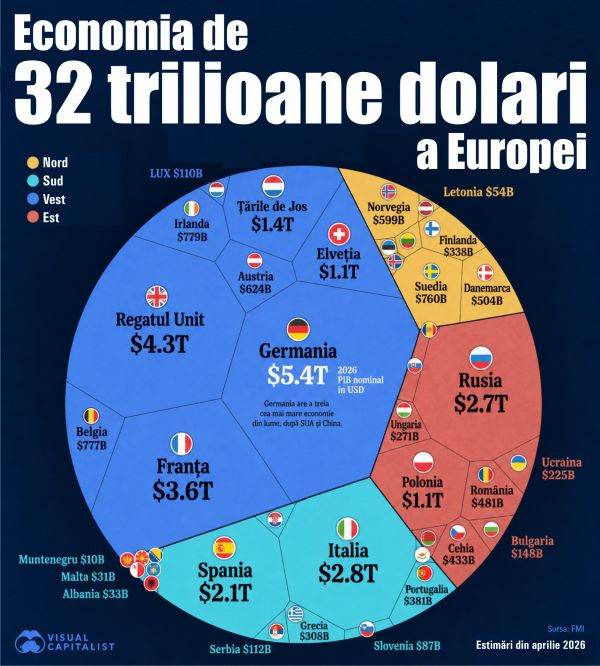
Europe's nominal GDP is expected to reach $32.3 trillion in 2026, but much of this output is concentrated in just a few countries, according to visualcapitalist.com, which ranks the continent's countries by projected nominal GDP for the current year, according to data from the International Monetary Fund (IMF).
According to data available on theglobaleconomy.com, the total government debt for the 43 European countries was, at the end of 2024, 159.24% of Europe's GDP, which meant, at the time, 40-45 trillion dollars.
It is worth noting that the public debt of EU countries is about 15 trillion dollars, equivalent to approximately 80-90% of GDP, which amounted to 16.8 trillion dollars at the end of last year.
Germany is the largest economy on the continent, followed by the United Kingdom and France, while Italy, Russia and Spain complete the group of the six largest economies in Europe. According to the cited source, the economic core of Europe remains firmly in the West, where Germany, the United Kingdom and France together generate over 13 trillion dollars. France (estimated GDP of $3.596 trillion), Germany ($5.453 trillion), and the United Kingdom ($4.265 trillion) built their economic power through early industrialization and decades of diversification into manufacturing, finance, and services. The United Kingdom's economic transformation then spread to its neighboring Western European countries, which also became industrial powers. The three Benelux countries - Belgium, Luxembourg, and the Netherlands, for example - have a combined GDP of over $2.2 trillion.
• Europe's energy giants are not from the Western core
Unlike the role played by industry in Britain and Germany or agriculture in France, energy is a major driver of Russia's economy (GDP of about $2.7 trillion). Russia is a major energy producer, with hydrocarbons such as oil and natural gas accounting for more than half of the country's exports. Although it is not a member of OPEC, Moscow is often an active participant in discussions important to oil markets.
The second-largest economy in Northern Europe is also a major player in oil and gas. Despite a population of about 5 million, Norway's economy is just under $600 billion, supported by its impressive energy reserves.
• Southern Europe on the rise
While northwestern Europe still dominates overall economic output, the momentum of growth is shifting south, where economies such as Spain and Portugal are expanding faster than the major powers. Today, Southern Europe is home to dynamic economies such as Spain ($2.1 trillion) and Portugal ($381 billion), which are each projected to grow by around 2% in 2026, more than double the pace of economies such as France and Germany.
This shift has been supported by a post-Covid tourism recovery, greater energy self-sufficiency and significant public investment.
• Europe feels the effects of the Iran war
The economic impact of the Iran war is hitting Europe, where low growth and faster inflation risk deepening industrial, fiscal and political pressures in the region, according to Bloomberg, notes Agerpres.
President Donald Trump's military campaign is causing countries to reduce their economic forecasts, while they take measures to keep under control the increase in prices, caused by the increase in gas and oil prices.
The consequences for a continent that has just managed to overcome the effects of the conflict in Ukraine (which broke out in 2022) seem to be a return to previous policies, when support is provided to households and central banks raise interest rates. For companies, already affected by the lack of qualified employees, there is a danger of expanding the negative effects, given the decrease in personal incomes.
"It is very clear that the first and most affected are the energy-intensive sectors. But the longer it takes, the more the effect will be felt in every sector,” said Christian Keller, an analyst at Barclays.
With consumer confidence falling and gas and oil prices rising, Germany and Italy are among the countries considering cutting their economic forecasts, following the European Central Bank's more gloomy outlook last month.
"The current shock is probably beyond what we imagine at the moment, and it leads to a kind of delayed assessment of the severity of the crisis,” said ECB President Christine Lagarde.
The EU economy faces the risk of stagflation as a result of rising energy prices following the Iran war, European Commissioner for the Economy Valdis Dombrovskis said at the end of March, stating: "The outlook is clouded by deep uncertainties, but it is clear that we face the risk of a stagflation shock, in other words, a situation in which slower economic growth coincides with higher inflation. This is also the case if the disruptions in energy supplies are short-lived. In such a scenario, our analyses suggest that the EU economy's growth in 2026 could be around 0.4 percentage points lower than in the autumn forecast, and inflation could be up to one percentage point higher.”
The European Commission forecast in November that EU GDP would grow by 1.4% in 2026 and 1.5% in 2027, while the eurozone would expand by 1.2% this year and 1.4% next year. Eurozone inflation is expected to be 2% in 2026, in line with the ECB's medium-term target.
The EU's public debt is around euro 13 trillion, equivalent to around 80-90% of GDP, but the differences between countries are very large, according to official data. It rose sharply after the 2008 Global Financial Crisis, then rose again during the Covid-19 pandemic, and in recent years has started to stabilise or fall slightly as a percentage of GDP. The largest European economy, Germany, has a debt of 2.5-2.7 trillion euros; the United Kingdom (a non-EU state) has over 3 trillion euros, a similar level to France.








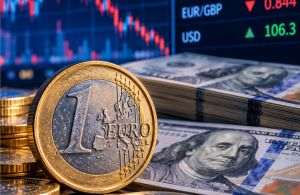










 Euro
Euro Dolar SUA
 Franc elveţian
 Liră sterlină
 Gram de aur