English
Economic activity in the eurozone recorded its fastest growth rate in three and a half years in September, with demand remaining solid despite inflation concerns linked to the conflict in the Middle East, according to an S&P Global survey published on Monday, Reuters reports via Agerpres.
Eurostat data show that the inflation rate rose to 3.8% in September-higher than anticipated-driven by rising energy prices, a trend that could prompt the ECB to raise interest rates.
The Purchasing Managers' Index (PMI) for eurozone economic activity, calculated by S&P Global, climbed to 53.1 points in September (up from 52 points the previous month), surpassing the 50-point threshold that separates economic expansion from contraction. This marks the strongest performance since the second quarter of 2022.
The services index rose to 53 points last month, reaching its highest level in ten months.
"PMI data point to 0.4% quarterly growth for the eurozone economy, with momentum accelerating into the fourth quarter. While growth drivers vary across member states, IT-related services across the eurozone as a whole are showing particularly robust expansion, supported by AI investments," noted Chris Williamson, Chief Business Economist at S&P Global Market Intelligence. • Spain - Strongest performance
Spain recorded the strongest performance, followed by Ireland, while Germany's recovery accelerated. Italy and France reported modest growth. Data also indicate intensifying inflationary pressures.
"A resurgence in price pressures, as indicated by the survey, shows inflation approaching 4%-well above the ECB's 2% target-fueling speculation about a more aggressive tightening of ECB monetary policy," Williamson added.
Markets anticipate three further interest rate hikes by the ECB through the end of June 2027.
• Greek economy set to outperform Eurozone in 2027
Greece's GDP is projected to grow faster in 2027, outperforming major European economies thanks to higher investment and robust consumer spending, according to the 2027 draft budget published yesterday by the government, as reported by Reuters.
The Greek economy is expected to grow by 2.3% next year, following a 2% expansion this year; investment is forecast to rise by 7.9% and private consumption by 1.5%.
"Despite the challenging external environment, the Greek economy is expected to continue posting growth significantly stronger than the Eurozone average for the seventh consecutive year," said Athens Finance Minister Kyriakos Pierrakakis. The government also projects a fiscal surplus of 0.3% of GDP in 2027 and a primary surplus-excluding interest payments-of 3.3% of GDP. Greece is among the few eurozone countries recording a fiscal surplus, enabling it to reduce its debt rapidly.
The debt-to-GDP ratio is expected to fall to 128.8% next year from 136.8% this year, following a cumulative decline of 67 percentage points since 2020. By the end of the year, the debt-to-GDP ratio is projected to drop below Italy's, driven by the early repayment of financial assistance packages.
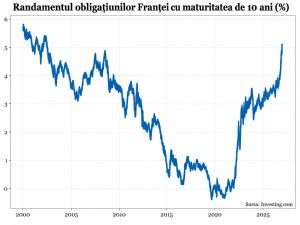
Yields on 10-year Greek government bonds stood at 4.49% yesterday, below those of France (4.90%) and Italy (4.66%).
The new budget includes subsidies and tax cuts totaling approximately euro2.2 billion to boost the income of those affected by high energy prices.
The average monthly wage, at around euro1,500, remains stagnant at 2009 levels.






















 Euro
Euro Dolar SUA
 Franc elveţian
 Liră sterlină
 Gram de aur