English
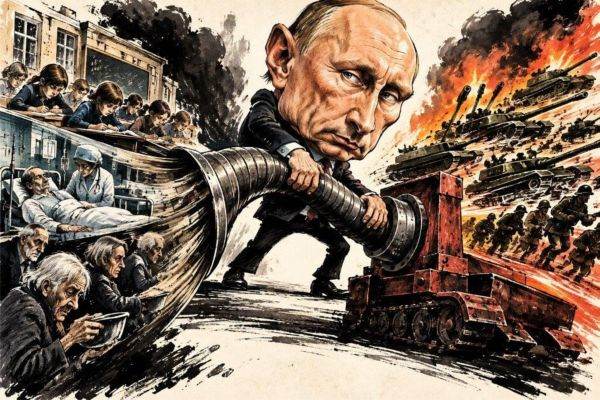
Vladimir Putin's war machine is beginning to falter due to a lack of necessary funds. Because the "Special Operation" in Ukraine-originally envisioned as a three-day affair back in February 2022-has morphed into a massive war now well into its fifth year, the initially projected funds require constant supplementation; however, Russia's fiscal room for maneuver is shrinking due to international and European sanctions imposed on the Kremlin administration. Consequently, it appears Vladimir Putin has decided to tighten the belt and implement budget cuts in education, healthcare, and social welfare for 2027 to secure funds for the armed forces deployed on the Ukrainian front. While households and businesses are being asked to shoulder additional financial strain, the defense sector is set to receive over 17.1 trillion rubles in 2027 under the draft state budget prepared by the Kremlin-details revealed in documents analyzed by the Russian news agency Interfax and news sites T-J and Fontanka, and subsequently reported by Meduza, Reuters, and the Times of India. With this new budgetary framework, the Kremlin is attempting to maintain funding for the war in Ukraine while limiting the deficit by shifting part of the burden onto the domestic economy. However, the stakes of such a budget go beyond a single year's accounting: these choices could impact the Russian Federation's standard of living, investment levels, and future development capacity.
• Healthcare and education lose funding; the population pays more
According to documents analyzed by Reuters-findings of which were reported by • The Times of India• and Meduza-social policy spending for 2027 is set to be cut by 7%, education spending by 6%, and healthcare spending by 6.8% compared to the previous plan for that year. The "national economy" category, which covers infrastructure and support for various sectors, is slated for a 7.4% reduction. This represents a scaling back of prior budgetary commitments rather than proof that every pension, school, or hospital will automatically receive exactly that percentage less than in 2026. While this distinction matters, it does not diminish the political significance: the state is curtailing civilian resources it had previously earmarked.
Regarding healthcare, data published by Interfax also indicates a decline compared to the current year's allocation. Citing the draft budget's explanatory note, Interfax reports a figure of approximately 1,818.1 billion rubles for 2027, down from the 1,877 billion projected for 2026. The difference amounts to nearly 59 billion rubles, or approximately 3.1% in nominal terms. If medical goods and services become more expensive, the loss of purchasing power could be greater. Regarding education, the agency indicates a federal allocation of approximately 1,777.4 billion rubles for next year.
Healthcare funding is not limited to the federal budget; regional budgets and the compulsory insurance fund also play a role, meaning the percentage allocated to a single line item does not reflect the entire system. Yet tensions arise here too: Interfax reports that the Federal Compulsory Medical Insurance Fund projects a deficit of 168 billion rubles in 2027, with federal transfers to the fund expected to drop from 481.4 billion in 2026 to 372.6 billion. These transfers should not simply be added to federal expenditures, as this could result in double-counting the same funding; however, they do illustrate how financial pressure is transmitted across the institutions supporting medical services.
For the general public, this budgetary adjustment will coincide with an unavoidable expense: housing maintenance. According to Interfax, the Ministry of Economic Development forecasts an average 11% increase in utility rates starting July 1, 2027-up from the previously published estimate of 8.7% for that year. While an average increase does not imply a uniform hike across all regions and households, the trend is clear: mandatory costs will consume a larger share of income unless earnings rise sufficiently. For a low-income family, the additional cost could mean foregoing a purchase, a repair, or savings. For a pensioner, a nominal increase in income can be swallowed up by mandatory expenses. For a consumer-dependent business, that same price hike can mean more cautious customers. This is the mechanism by which a seemingly sector-specific pricing measure can affect a much broader segment of the economy. The actual impact will depend on income levels, inflation, and any compensation granted to consumers.
At the same time, the state is seeking additional tax revenue. Economist Alexandra Prokopenko points out, in an analysis published by the website carnegieendowment.org on October 2, noting that the draft budget aims for higher revenue from dividends and securities-related payments. She interprets the fiscal, tariff, and financial package as a shifting of costs onto households and companies. The implication for capital is significant: if the state claims a larger share of investment income, net returns may fall precisely when the economy requires private financing.
Reduced civilian allocations, additional taxation, and higher utility costs can combine to produce a stronger impact than any single measure would on its own. Households are left with less disposable income, firms may reassess their plans, and public services must adjust their spending. While a recession does not automatically ensue, the risk increases that civilian economic activity will be stifled in order to uphold other state priorities. The adjustment may be spread across millions of taxpayers and consumers, without appearing as a single, dramatic measure.
• The Kremlin earmarks over 50 trillion rubles for defense over the next three years
In contrast, military funding is being maintained at a very high level. Citing the explanatory memorandum, Interfax confirms defense allocations of over 17.1 trillion rubles for 2027, over 16.6 trillion for 2028, and approximately 16.3 trillion for 2029. The total exceeds 50 trillion rubles over the three-year period. Fontanka reports an increase of approximately 3.6 trillion rubles-or 26.4%-for 2027 compared to the previous plan for that year. The budget thus proposes a clear reallocation of priorities in favor of defense.
This choice suggests that Moscow is marshalling resources to continue the war in Ukraine should negotiations fail to yield a solution acceptable to the Russian leadership. Three-year allocations can support industrial orders, the maintenance of capabilities, and the replenishment of stockpiles. They do not, however, guarantee results on the battlefield: inflation, component availability, productivity, and procurement efficiency all influence the purchasing power of the ruble. Nor do they rule out negotiations, as plans remain subject to revision. The signal, however, is that a swift end to the conflict is not the only scenario for which the Kremlin is making financial preparations.
Politically, the non-military side of the budget places the leadership in a position of tension between military objectives and public expectations. One segment of society may benefit from defense-related wages and contracts, while another feels the impact of rising prices and the contraction of public resources. This uneven distribution may allow the war to be funded without triggering uniform discontent, yet it risks deepening disparities between communities and sectors. By prioritizing resource allocation, Russia's budget reinforces the position of those benefiting from military demand.
• Debt and war consume resources meant for the civilian future
Debt itself is another beneficiary of budgetary resources. The Russian publication T-J projects debt service costs of approximately 4.6 trillion rubles for 2027, up from an estimated 3.7 trillion the previous year. According to the same analysis, defense accounts for approximately 35% of federal spending, and-combined with security and public order-about 44%. Interest payments and military priorities thus occupy a significant share of the budget, limiting the flexibility to fund other objectives.
Regarding investment, this structure can favor certain activities while discouraging others. State suppliers may benefit from more stable demand, yet large contracts do not guarantee high margins, dividends, or rapid capital recovery. A company might need to ramp up production while simultaneously requiring costly investments to fulfill orders. Reliance on a dominant buyer also becomes a vulnerability should priorities shift. For civilian firms, risks compound: more cautious consumer demand, higher costs, and difficult access to capital if the state absorbs a significant portion of available funding. A project that is profitable at low interest rates may become unattractive when the cost of borrowing is high. Additional taxation can extend the investment payback period. Consequently, decisions are driven by what actually remains for the company after costs and taxes, rather than by a mere increase in aggregate economic activity.
Even a potential ceasefire would not automatically yield gains for all investors. Some civilian activities might benefit from the reallocation of resources, whereas certain capacities built to meet military demand would require adaptation. Furthermore, expenditures for the restoration and maintenance of military capabilities could remain high. Investing in a war-oriented economy therefore entails both the risk of prolonging the conflict and the risk of a shift in the structure of demand.
The cost that is hardest to measure immediately is that of deferred development. Resources diverted from a civilian project can reduce the deficit or free up funds for defense, but could leave behind unimproved infrastructure and lower productivity. If such choices are repeated, the effects can compound, impacting the quality of services and the economy's capacity to generate future revenue. The Russian state can maintain war funding while simultaneously eroding the very foundation that would support its finances post-war.
The draft budget for 2027 demonstrates how the ongoing conflict can be funded without a single drastic cut: through civilian allocations falling short of promises, additional taxes, higher bills, and borrowing that shifts the cost burden to future budgets. For the Kremlin, these measures provide financial breathing room. For the public and businesses, they limit the scope of choice. Russia is buying time for the war, but it is doing so by drawing on the resources needed to build its civilian future.



















 Euro
Euro Dolar SUA
 Franc elveţian
 Liră sterlină
 Gram de aur