English
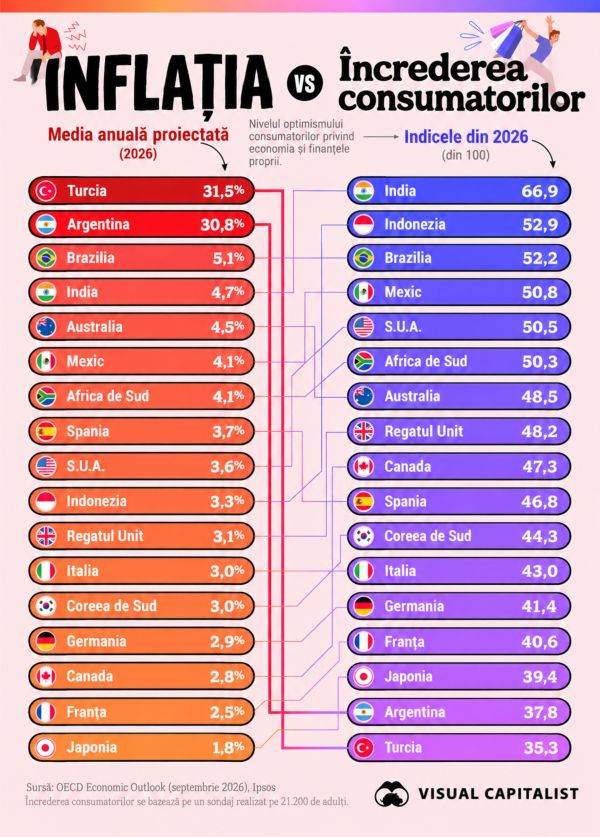
Inflation is beginning to rise again in many of the world's largest economies, following a period where it had eased from the high levels seen in recent years.
Comparing inflation with consumer confidence reveals a more complex picture, according to visualcapitalist.com; the site notes that some countries with relatively low inflation continue to face weak consumer confidence, while several emerging economies are recording considerably higher levels of confidence.
Using OECD inflation projections and Ipsos consumer confidence data, the source compares price pressures and consumer confidence across 17 major economies.
Turkey and Argentina are estimated to record an average inflation rate of over 30% in 2026, far surpassing other major economies. The projected rate is 31.5% for Turkey and 30.8% for Argentina. Excluding these two countries, the projected inflation for the nations included in the analysis ranges from 1.8% in Japan to 5.1% in Brazil. Among G7 economies, the United States ranks first at 3.6%, followed by the United Kingdom at 3.1%.
Consumer confidence follows a different pattern. India ranks first with a score of 66.9, while Germany, France, Italy, South Korea, and Japan all record scores below 45.
Japan's case illustrates this discrepancy. Although it has the lowest projected inflation rate in the ranking, its confidence score is only 39.4. Consumer sentiment reflects a broader economic picture, encompassing factors such as wages, employment, and economic outlook.
• Why inflation outlooks are shifting again
The context for these rankings is changing rapidly as tensions in the Middle East drive up energy prices. Monitored global oil inventories fell by 507 million barrels between February and August, thereby reducing the buffer available to absorb potential new supply disruptions.
Currently, more than half of G20 economies are recording inflation rates that exceed the targets set by their central banks. The OECD projects that inflation within the G20 group will rise from 3.4% in 2025 to 4.1% in 2026, before falling to 3.6% in 2027.
This situation places countries in varying positions regarding their ability to absorb another period of high prices. Real wages in Japan, South Africa, and Italy remain at or below pre-pandemic levels, which could make a further rise in the cost of essentials harder for households to bear.
The persistence of this inflationary resurgence will depend largely on energy market trends and the duration of current supply disruptions, the cited source concludes.























 Euro
Euro Dolar SUA
 Franc elveţian
 Liră sterlină
 Gram de aur