 English


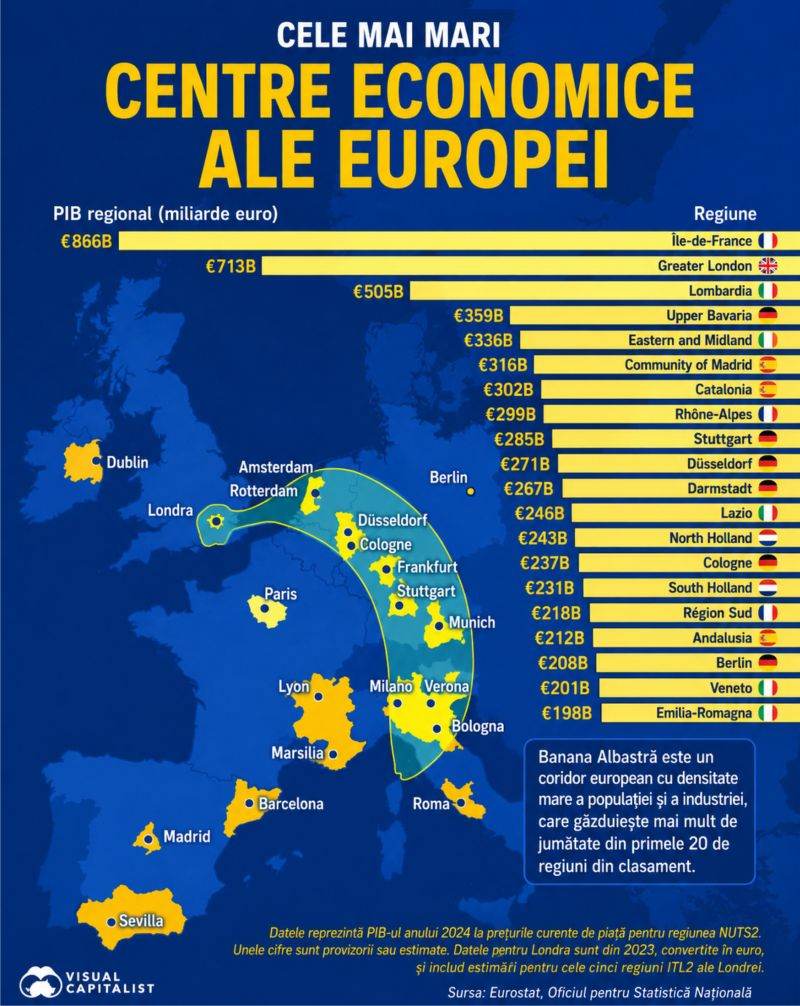
Europe's economic power is concentrated in a relatively small number of regions, anchored by globally important cities such as Paris, London, Milan, Munich and Madrid. Visualcapitalist.com presents a map and ranking of Europe's strongest economic centers, by regional GDP, using the latest data published by Eurostat and the UK's Office for National Statistics. Together, these regions serve as the continent's main centers for finance, industry, technology, trade and business services.
A clear pattern emerges from the rankings: many of Europe's largest regional economies are clustered along the Blue Banana corridor, which stretches from southern England, through the Benelux countries and western Germany, to northern Italy, and has long formed the backbone of the European economy.
• A tale of two cities
Ile-de-France is Europe's most powerful economic hub, generating a GDP of euro866 billion. Anchored by Paris, the region accounts for almost a third of France's economic output, despite being home to only around a fifth of the country's population. Its influence extends far beyond France, through its roles in finance, business services, luxury goods, tourism and governance.
The British equivalent of Ile-de-France, Greater London, ranks second in Europe, with a regional GDP equivalent of euro713 billion. Greater London encompasses the urban area around the British capital, which is a global hub for sectors such as finance, insurance and media.
London and Paris have been two of Europe's most important economic and political centres for centuries. The two cities are now anchor regions that attract more international tourists than almost any other place in the world.
• The Blue Banana - the backbone of the European economy
European industrial production has been concentrated for decades in a small, non-contiguous corridor that starts in England and extends to northern Italy. Due to its shape, this corridor has been called the Blue Banana or the Liverpool-Milan Axis. The Blue Banana serves as the backbone of the European economy. The corridor is concentrated around German industrial centres such as the regions of Cologne (euro237 billion), Stuttgart (euro285 billion) and Upper Bavaria (euro359 billion), the latter of which includes Munich.
However, the corridor also extends to the main port regions of the North (euro243 billion) and South (euro231 billion) Netherlands, as well as to productive regions in northern Italy, such as Lombardy (euro505 billion) and Veneto (euro201 billion).
• The "Economy of the Leprechaun”
Most of the regions that fuel the European economy in modern times have been centres of industrial or commercial activity for centuries, either in the North Sea or in the Western Mediterranean.
A notable exception is the Irish region of Eastern & Midland, which, at euro336 billion, has a regional GDP higher than Catalonia (Spain, euro302 billion) or Lazio (Italy, euro246 billion).
While the Eastern & Midland, where Dublin is located, is indeed a highly productive and developed area, the region's massive GDP is largely attributable to the accounting practices of large multinational companies that keep their European offices in Dublin for tax purposes. This distortion of macroeconomic indicators represents the "Leprechaun economy.”
• IMF downgrades euro zone growth forecast
The International Monetary Fund (IMF) this month downgraded its euro zone growth forecast for this year and revised up its inflation expectations due to the Middle East war, warning that the situation could worsen if high energy prices persist, Reuters reports, according to Agerpres.
In its report on the economies of the 21 countries that use the euro, the international financial institution forecasts economic growth of 0.9% this year, after in April it forecast an advance of 1.1%, while inflation is expected to stand at 2.8%, from a level of 2.6% previously estimated. Already in April, the IMF had worsened its growth forecasts for the euro area economy, compared to the estimate in January.
"After a period of growth at potential and inflation that has remained around the ECB's 2% target, the outlook for the euro area has weakened,” the IMF said, referring to the Middle East war as "a large but temporary negative supply shock.”
"An even more persistent energy shock would further increase inflation and inflation expectations, while declining confidence or financial stress could reduce demand. An escalation of the Middle East conflict or delays in repairing energy infrastructure, increased hostilities in Ukraine, and further trade policy adjustments constitute additional risks,” the report said.
• Britain's economy appears unscathed by Iran war
The British economy grew by 0.6% in the first three months of this year, marking the third year in a row of solid growth in the first quarter, the Office for National Statistics in London said in May, a sign that businesses and consumers are coping with the effects of the Iran war, although domestic turmoil is weighing on borrowing costs, according to Reuters and Bloomberg.
In the fourth quarter of 2025, growth was just 0.2%. The expansion in the first three months of this year is in line with analysts' forecasts but exceeds that of the Bank of England, which expected an increase of 0.5%.
In February, before the Iran conflict began, the United Kingdom's GDP grew by 0.4%, and in March it registered an increase of 0.3%, driven by the services sector, industrial production and construction. Economists had expected a slight decline in March.
But analysts warn that there are risks to the economy from the fallout from the Iran war. Companies reported higher energy costs in April and weaker demand, raising fears of stagflation.
Capital Economics analysts expect UK GDP to stagnate in the second and third quarters, and in the worst-case scenario, the UK could fall into recession.


















 Euro
Euro Dolar SUA
 Franc elveţian
 Liră sterlină
 Gram de aur





























