English


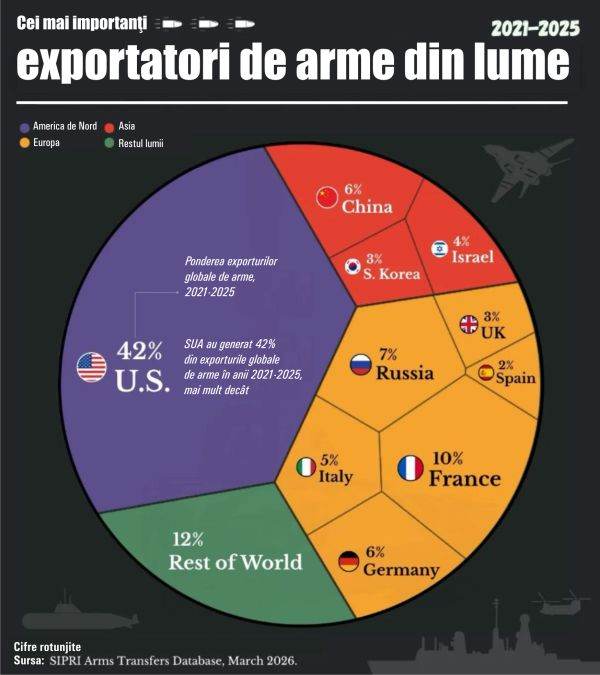
The global arms trade is highly concentrated between a few countries, with the United States of America far ahead of any other supplier, shows an analysis by visualcapitalist.com, which mentions that, between 2021 and 2025, the USA generated 42% of global arms exports, more than four times more than the second largest exporter.
The cited source shows the share of global arms exports by country, in the period 2021-2025, based on SIPRI data on arms transfers.
The largest arms exporters in the world are, according to SIPRI: USA, which is far ahead of all competitors (42% of global arms exports); France (10%); Russia (7%); Germany (6%); China (6%); Italy (5%); Israel (4%); United Kingdom (3%); South Korea (3%); Spain (2%).
• Why the US Dominates Global Arms Exports
The United States has long been the world's largest arms exporter, but its dominance has expanded in recent years, the source notes. Several factors contribute to this development, namely: technological superiority in advanced systems such as fighter jets, missile defense, and surveillance technologies; large-scale defense production capacity, supported by massive domestic military spending; and extensive networks of alliances, including NATO partners and security arrangements in Asia and the Middle East.
As geopolitical tensions rise, many countries are turning to the US for advanced weapons systems. European demand, in particular, has increased in the wake of Russia's invasion of Ukraine, contributing to a nearly 10% increase in global arms transfers.
These exports are also closely linked to broader geopolitical influence, solidifying the US position as a central supplier to allied nations.
• Germany overtakes China
A notable change in the rankings is that Germany has overtaken China as the world's fourth-largest arms exporter. Germany now accounts for about 6% of global exports, just ahead of China. The shift reflects the rise of German defense production and growing demand for European-made military equipment.
European arms suppliers have benefited from heightened security concerns on the continent, which has accelerated purchases within NATO and neighboring states.
Meanwhile, China remains a significant exporter, but tends to sell more regionally, particularly to countries in Asia, Africa and the Middle East.
• South Korea's rapid rise
One of the fastest-growing players in the global arms market is South Korea. With about 3% of global arms exports, the Asian country has been rapidly expanding its presence, focusing on competitive prices, fast production times and modern weapons systems. South Korean firms have secured major contracts for tanks, artillery systems and fighter jets, particularly in Eastern Europe and Southeast Asia. The country has made defense exports a national strategic priority, aiming to become one of the world's leading arms exporters in the coming decades, the source said.
• European defense industry wants more clarity
European politicians need to provide more clarity on who should do what to strengthen the continent's defense, otherwise there is a risk of wasting money due to slow decision-making and overlapping projects, a representative of European defense companies told Reuters, according to Agerpres.
European countries rushed to increase defense spending after Russia's invasion of Ukraine, and US President Donald Trump has made it clear that Europeans should expect less support from the United States through NATO.
Along with national governments and NATO, which have long been the main actors in developing and financing European defense policies, European Union entities such as the European Commission and the European Defense Agency have become increasingly involved in the sector in recent years. Many of their initiatives aim to fill gaps in Europe's defense, such as anti-drone systems, reduce dependence on the United States and encourage joint arms procurement.
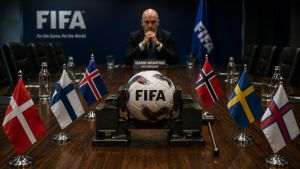
"It's a kind of mess with all sorts of organizations that have a role,” Camille Grand, secretary general of the European Aerospace, Security and Defense Industries Association, told Reuters in February. "We don't have a clear governance for all this yet, to define who does what and how decisions are made.”
The organization represents more than 4,000 companies from 21 countries.
Recent EU initiatives include the Security Action for Europe, a euro150 billion loan scheme for defense spending, the European Defense Industrial Program to boost the sector, and a Roadmap to strengthen European defense capabilities.
"It all comes down to getting a little more clarity on how we govern this collective effort that is needed to deliver capabilities faster,” Grand said, highlighting air and missile defense as an area that would benefit from more clarity, as projects and initiatives have emerged from different bodies to protect against missiles, drones and other threats.
Some European officials also see a need for increased coordination. European Defense Commissioner Andrius Kubilius has called for a European Security Council, which could include non-EU countries such as Britain in some decisions. But EU foreign policy chief Kaja Kallas has expressed skepticism about the idea, saying: "I don't think another institution will really make things easier.”
The US dominates global arms exports, accounting for 42% of the world total between 2021 and 2025.
------------
South Korea is emerging as a fast-growing defense supplier, expanding its exports of advanced weapons systems globally.


















 Euro
Euro Dolar SUA
 Franc elveţian
 Liră sterlină
 Gram de aur