English


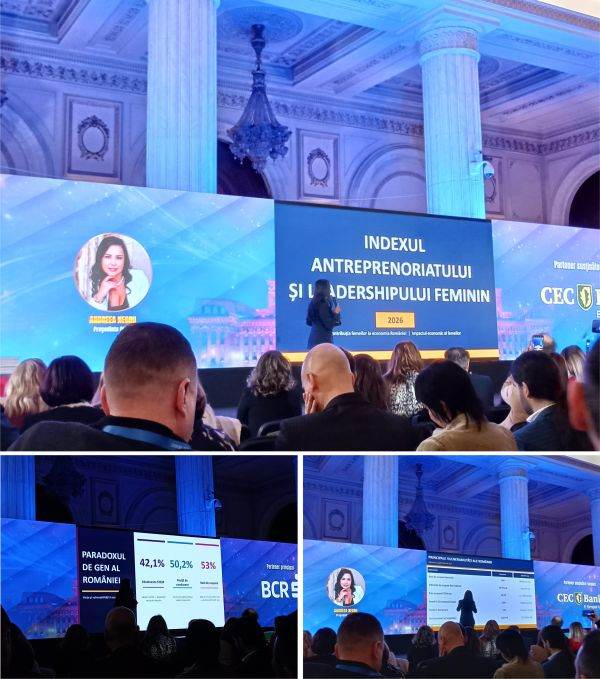
The fiscal contribution of women to the Romanian economy reached 509 billion lei in the period 2022-2024, equivalent to approximately 24.8% of the annual Gross Domestic Product, but the real potential is much higher, as almost one million women remain outside the labor market, which causes the economy an annual loss estimated at 1.6% of GDP, according to the second edition of the Women's Entrepreneurship and Leadership Index, launched by the European Businesswomen's Federation (PEFA) during the Digital Innovation Summit Bucharest 2026.
The President of PEFA, Andreea Negru, explained that the analysis carried out by the employers' organization attempts to truly quantify for the first time the economic role of women in Romania and the impact that their participation in the labor market has. "The female employment rate in Romania is 53%, while the European Union average is 65 percent. In terms of the employment gap between women and men, we are in fourth place in the European Union, and the female employment rate is 39.7 percent versus 57.8%. 10% of the members of the boards of directors of companies listed on the stock exchange are women, while the European Union average is 24%. In Parliament, women account for 19%, the average in the European Parliament being 37.3 percent. The fiscal contribution of women to the economy, in the reference period 2022-2024, is 509 billion lei. What does this mean? A share of 24.8% of the national Gross Domestic Product, annually", specified Andreea Negru.
The study conducted by PEFA highlights the fact that the Romanian economy loses billions of lei annually due to an insufficiently exploited economic potential. "We still have a potential, untapped workforce. We are talking about 998,000 women who, if integrated into the workforce, would represent an increase in Gross Domestic Product by 65.2 billion lei and a share over time of 10.1%", explained the PEFA president.
The paradox is even greater as Romania has an extremely well-prepared female human capital. Andreea Negru mentioned: "We have STEM graduates. We occupy first place in the European Union, with a huge innovation potential, 42.1%. In management positions in the central public administration we have 50.2% women, but the employment rate is 53% compared to the average of 65% in the European Union. The fact is that we have skills, but we do not have national competitiveness. (...) Basically, 1.6% of GDP is lost annually due to the exclusion of women".
• Most women entrepreneurs run a micro-enterprise
In addition to the macroeconomic analysis, the index also includes the results of a survey conducted by CURS and ESOMAR among women entrepreneurs in Romania, which indicates that female entrepreneurship is dominated by small and very small businesses, with a stable and mature structure.
First Vice President of PEFA, Lorena Stoian, stated: "The survey showed that we have solid female entrepreneurship. When asked the question of the size of the business, 88.5% of women answered that they own micro-enterprises, 9.6% small enterprises, 1.4% medium-sized and 0.5% large companies. We have an interesting percentage of over 73% in which women told us that they have at least five years of experience in entrepreneurship, so we have entrepreneurship that is built over time, built with vision and predictability."
The motivations for entering entrepreneurship are primarily related to the desire for economic independence. "In first place we observe financial independence with a percentage of 41%, followed by the desire for flexible work commitments, passion for business and innovation, lack of adequate alternatives and family tradition”, said Lorena Stoian.
At the same time, the survey shows that women entrepreneurs face a series of persistent obstacles. The First Vice-President of PEFA showed: "In first place among the challenges that women in business in Romania have is the balance between personal and professional life, followed by gender prejudices and stereotypes and limited access to financing. Another important question was whether women have experienced any form of discrimination in the last year. 74% said no, but we also see a percentage of 26% of positive answers, which means that one in four women has witnessed or experienced some form of harassment or discrimination”.
Also, according to the survey, many of the existing support programs are little known in the entrepreneurial environment, with 77% of respondents stating that they are not aware of any organizations or government programs in Romania that support businesswomen. The situation is similar regarding mentoring, where 59% of women entrepreneurs participating in the survey presented by PEFA claimed that they had never participated in a mentoring program.
However, the outlook remains optimistic. "88% of women are confident that the future belongs to female entrepreneurship and female leadership and that they will contribute to economic progress," said Lorena Stoian.
• Anca Dragu: "If women participated in the same proportion as men in the labor market, global GDP would increase by 20%"
Invited to the event, the governor of the National Bank of the Republic of Moldova, Anca Dragu, emphasized that developments in the neighboring country confirm the importance of female entrepreneurship for economic development. "We see in the Republic of Moldova that one in three private companies is led by a woman. The survival rate in the first year of companies founded by women is 88%, higher than the survival rate of companies founded by men, which is about 80%. The typical entrepreneur is between 35 and 44 years old, 70% of them have higher education and work in the food, textile or handicraft industries," said Anca Dragu.
The NBM Governor explained that the authorities in Chisinau are trying to support this sector through dedicated programs. "We have 11,800 women who have received grants, especially for digitalization and re-technologizing, and 9,400 participants in training courses. At the National Bank, we pay attention to supporting our colleagues. 64% of employees are women and, at the management level, 53% are women," said Anca Dragu, adding that "if women participated in the same proportion as men in the labor market, global GDP would increase by 20%, according to a World Bank study." Returning to the domestic level, the Secretary of State in the Ministry of Defense, Eugen Bachide, emphasized that the role of women is also becoming more visible in military institutions. "We have 23% women in the ministry and 13% women in the military. I say it is a good percentage and we are doing quite well. The partnership we have with PEFA helps us a lot and I believe that as long as there is dialogue and communication, many things will be solved”, declared the official from the MApN.
In turn, State Counselor Laszlo Borbely - coordinator of the Department for Sustainable Development - brought up the role of equal opportunities in sustainable development. "This index of female entrepreneurship is a compass, an X-ray of the stage we are in and we must be partners. At the level of the General Secretariat of the Government, we are doing quite well: at the management level we have 20 men and 30 women, and at the execution level 170 men and 322 women. At the level of dignitaries we still have work to do, but we are on the right track”, said Laszlo Borbely.
• FRF, the promoter of the female presence in a male-dominated sport
The President of the Economic and Social Council, Sterică Fudulea, underlined the essential role of women in social dialogue and in the functioning of democracy. "The importance of women in social and civic dialogue is not a secondary theme, but is an essential condition for the healthy functioning of democracy. For a balanced social dialogue we need women, because they transmit stability and a deep understanding of social vulnerabilities”, stated Mr. Fudulea.
Sterică Fudulea also showed that within the technical secretariat of the Council 67% of the staff are women, and in the CES plenary, on the employers' side 7 out of the 15 members are women, that is almost 47%, on the unions' side 20% of the representatives are women, that is 3 out of 15, and on the NGO side, 7 out of 15 members are women.
In a different vein, the president of the Romanian Football Federation, Răzvan Burleanu, spoke about the radical transformation of women's football in Romania. "Twelve years ago, all the girls and women who played football in Romania would have fit in this hall. There were 300. Today, there are over 11,000 girls and women who play football only in the Romanian Football Federation system, and in addition to them, we are talking about over 110,000 girls and girls who play in interschool competitions. If we in football manage to make this change, then we will certainly manage to normalize the role of women in society in our country," said Răzvan Burleanu. Overall, the index launched by the European Businesswomen's Confederation shows that Romania's economy is at a crossroads: women already contribute almost a quarter to the country's gross domestic product, but the real potential is much greater. Reducing structural barriers, expanding supportive public policies and increasing women's participation in the labor market could transform this potential into one of Romania's most powerful economic development engines in the next decade.
























 Euro
Euro Dolar SUA
 Franc elveţian
 Liră sterlină
 Gram de aur