English

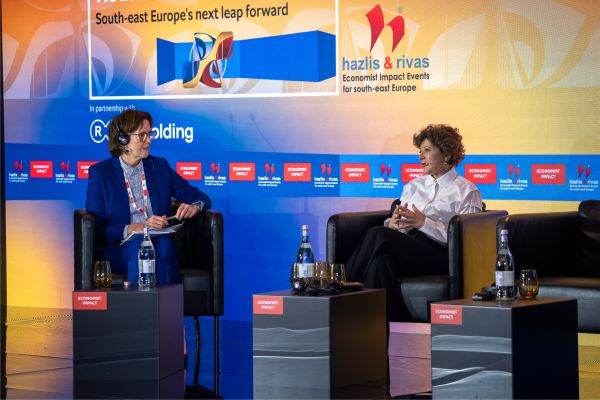
Romania's economy must change its growth model, based so far on low costs, European funds and remittances, and accelerate institutional reforms to become competitive and attractive to international capital, participants in the Romanian Government Roundtable, an event that took place in Bucharest the other day, said yesterday.
A central pillar of this transformation is the reform of state-owned companies and the improvement of corporate governance, considered essential for market stability and for transmitting a signal of confidence to investors, along with fiscal and budgetary discipline and accession to the OECD.
Opening yesterday's debates, Oana Gheorghiu, the deputy prime minister in charge of the reform of the state and public companies, declared: "Romania needs foreign capital and investments, but for this it needs to do three things: the reform of state companies, entry into the OECD and stability and financial-budgetary discipline. Foreign capital looks not only at opportunities, but also at stability and risks. Romania still has many steps to take here. I believe that the reform of state companies is an extremely important signal for foreign investors, because any disruption of the market that comes from state support in certain areas poses risks for foreign investors. And not only for foreign investors, but also for Romanian private investors. I hope once again that political decision-makers see this reform of state companies not only as a challenge, but as an opportunity for Romania's growth and that they will support the project until the end. The reform of state companies is one of the most challenging. We have over 1,500 state companies, a lot for a country like ours." ours, which have accumulated losses of over 14 billion lei. The state can no longer afford this. It is time when, regardless of the resistance in the system, the reform must be implemented”.
• Reduced interoperability, the gap in the digitalization process of state institutions
He also specified that the coherent digitalization of the administration and the simplification of procedures, correlated with investments in green and innovative technologies, are seen as key factors for reducing bureaucracy, increasing efficiency and developing a modern economic ecosystem, capable of attracting capital and supporting entrepreneurship.
Deputy Prime Minister Oana Gheorghiu showed that our country has made a lot of progress in the field of digitalization, including at ANAF and the Ministry of Finance, and companies feel this.
However, the deputy prime minister for the reform of the state and public companies stated: "Romania has digitized in many areas, but in a fragmented way. Each institution worked for itself, without interoperability. This is what we need to do: interoperability, to help citizens and the business environment. We need digitization, but we also need simplification. If we digitize complicated processes, we will have chaotic digitization."
Regarding digitalization, his Government colleague, Irineu Darău, Minister of Economy, Digitalization, Entrepreneurship and Tourism, said: "Our vision is to approach the technological transition as a unitary ecosystem, in which digital innovation, green energy, industrial policy and defense are deeply interconnected. To achieve this, we are acting in three main directions. First, the state must stop financing the past and start imposing the future. We can no longer afford to allocate public capital without demanding innovation in return. At least 40% of each funded project must be directed towards green or digital technologies, thus conditioning public support on preparing the economy for the future. Second, we cannot ask the private sector to digitize while public administration remains analog. We are constantly working to overcome the perception of the state as a bureaucratic obstacle and to rebuild it as an agile partner. We are laying the foundations for the European digital identity wallet, which will fundamentally simplify the interaction between citizens, companies and authorities. We are also developing virtual assistance solutions based on artificial intelligence, which will provide entrepreneurs with instant, non-stop support, reducing the bureaucracy that has traditionally slowed them down. Finally, we must recognize that technology is the main currency of international cooperation and geopolitical security in the current context. Digital resilience and sovereign industry are inseparable. Romania is taking steps to become a strategic pillar for the European Union”.
• Minister of Economy: Rapid digitalization of essential public services is needed
The Minister of Economy also referred to the software industry: "What concerns me, coming from the software industry, is maintaining the status quo. In Romania, from 20 years, digital transformation has been promised, but progress has been limited. First, we should be more realistic and recognize that we need to accelerate this transition. Then, it is about prioritization: identifying essential public services, the most problematic for citizens, and digitizing them quickly. We also need to analyze governance: what type of institutions are needed and which of the existing ones represent obstacles to digitization. At the same time, we need to look at the conditions necessary to attract researchers, IT specialists or venture capitalists to come and invest more in Romania. An important element would be the development of "sandboxes” on a larger scale than currently in Europe. These should involve more flexible tax rules, simplified regulations and dedicated instruments for mobilizing capital. Currently, these mechanisms are missing. IT startups and innovative companies have to go through the same bureaucratic barriers as any other type of business, which limits their development potential.”
He also spoke about developing human capital and adapting skills to new technological requirements, which are indispensable conditions for strengthening the attractiveness of the national economy.
Irineu Darău pointed out: "We are faced with the urgent societal challenge of upgrading our workforce and the economic pressure to maintain the competitiveness of small and medium-sized enterprises in an era of accelerated automation. However, I strongly believe that these challenges represent an unprecedented opportunity for our region to leap forward. If there is one lesson that Romania can offer from its recent strategic acceleration, it is that technology can no longer be treated as an isolated sector.”
• 170 million euros to finance the first job of young employees
For his part, Florin Manole, the Minister of Labor, said that the human capital program will be solved with the support of European funds. Florin Manole specified: "We have an important program, financed from European funds: an allocation of over 170 million euros to finance the first job of young employees. It is a project that responds to several problems on the labor market and which has strategic importance, especially because it will bring people to the labor market who will stay for a long time, especially since the whole of Europe, not just our country, has a problem with youth unemployment and the need to find answers to this problem. The answer that we have, in line with the EU, is to subsidize jobs for young people."
Regarding the digitalization of the economy, the Minister of Labor claims that it would have been expected that working on platforms would mean less fraud, less undeclared work.
Florin Manole pointed out: "Unfortunately, it is not like that: the biggest informal economy situations and fines were given by the Labor Inspection in Romania to platform workers. So the fraud does not take into account the degree of sophistication of the economic sector. From agriculture to platform work, we have the same problems. But the answer to this problem also has to do with legislation: we have to implement the directive that regulates platform work, we will probably do it in the next few weeks. But beyond this, we also need a strong and efficient Labor Inspection. The reality is this: we are a country that, in its capital, Bucharest, where there are most employers and most employees, has a 50% decrease in the number of labor inspectors at the Labor Inspection in the last 20 years, although the number of companies is much higher. And now we are being asked to cut another 20% of positions. This would mean that, in reality, in Bucharest, no serious company and no honest entrepreneur would have the expectation that the Labor Inspection would catch and punish those who break the law, which is very bad news for the economy”.
• Financial instruments, the best solution for financing companies
During the debate, the need to have fair growth was also discussed, through the European cohesion funds and other financial institutions.
Dragoş Pîslaru, Minister of Investments and European Projects, said that, at this moment, in terms of the speed of catching up, we are far ahead of Poland or other states in the region and pointed out that, after our country has already absorbed 9 billion euros from cohesion funds, in 2027 we will have between 7 and 8 billion euros to be spent through cohesion policy.
Dragoş Pîslaru also mentioned: "The idea is that, after entering the European Union, we relaxed a little and relied heavily on a growth model fueled by consumption. Consumption contributed significantly to economic growth. Of course, this model has not been without imbalances. But the essential point is that we are now at a crucial moment of changing the economic model. We are moving from consumption to investment. And we are currently relying mainly on public investment. This is seen in the fact that we are finally completing the highways, completing the railway system, modernizing the water and sewage networks and so on. () But looking ahead, what is very important for our ambition, especially for the period 2028-2034, is that we will move from the emphasis on public investment to a model based on stimulating private investment. (...) We will do this using financial institutions, financial instruments and leverage. The central idea is to move from a reality where you receive a euro and spend a euro, and then 80% ends up in the public sector and only 20% in the private sector, to a reality where at least a third, if not more, is achieved by the private sector, using the leverage effect. (...) We want SMEs to no longer come directly to the ministry, but to go to financial intermediaries, to banks, to investment funds. With this approach, we estimate that we will be able to mobilize between 60 and 70 billion euros through financial markets and strategic projects in the period 2024-2030”.
Regarding the increase in investments, Bogdan Chiriţoiu, President of the Competition Council, said that the public and private sectors must, together, stimulate investments, because the economy is no longer recording significant growth.
Bogdan Chiriţoiu said: "Although we have a stable banking system, I would say that it is very expensive. The system certainly does not address the needs of all companies in Romania. If we look at the assets of the banking system, we have the lowest percentage compared to GDP. So a lot of companies do not use the banking system. Maybe some do not need it, maybe multinationals can access finances from the banking systems of their own countries, but when we talk about local companies, which represent more than 50% of GDP, they do not access these resources available in the banking sector so much. I would like our financial sector to be more dynamic and to meet the needs of all Romanian companies and to have financial instruments that we do not use in the Government. It is good that, finally, we have the Investment Bank for Development. It is very good if we manage to come up with financial instruments, because we still rely heavily on grants from the Government. That is why the Competition Council is lobbying the Government to use fewer grants and more financial instruments, such as state guarantees, for example”.
Regarding the financing provided by the banking sector, Andrei Bratu, corporate executive vice president at UniCredit Bank, stated that the banking sector could be used to transform savings into productive investments faster and on a much larger scale than before.
Andrei Bratu said: "A significant leap is needed in terms of both competitiveness and investment. This should not be done incrementally, but on a large scale, and the banking sector can play a key role in this process. Otherwise, we risk finding ourselves in a weaker position in global competition, as Europe, compared to the United States and China. Costs will increase, development will slow down, and our growth objectives will be affected.”
He noted that simplifying the regulatory framework, accelerating institutional response, digitizing processes and more bankable projects will immediately lead to major growth in the national economy.













 Euro
Euro Dolar SUA
 Franc elveţian
 Liră sterlină
 Gram de aur