English

After seven episodes documenting the major blocs of the fragmented global economy, this eighth episode analyzes a unique case: the Gulf Bloc (GCC - Gulf Cooperation Council). It is a hybrid that operates efficiently at the customs and trade level but remains incomplete at the monetary and fiscal level in 2026.
The Gulf Cooperation Council brings together six states: Saudi Arabia, the United Arab Emirates, Qatar, Kuwait, Oman and Bahrain. The current economic architecture has two core components:
- Customs union (since 2003): with a common external tariff and elimination of internal duties.
- Common market (since 2008): granting citizens extended economic rights across all member states. However, unlike the European model, the critical component of the monetary union is missing.
• 1. Current situation: Active customs union, operational common market
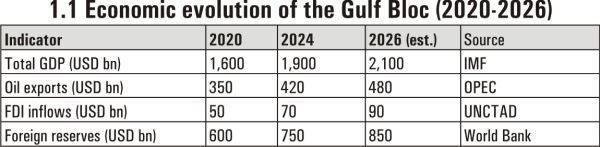
The bloc is organized through the Gulf Cooperation Council (GCC). Although the integration process has been slow, by 2026 it represents one of the most prosperous free-trade areas in the world.
- Customs union: Goods circulate between the six states without internal duties, after customs clearance at first entry into the bloc.
- Common market: Grants citizens similar rights to work, invest and own property throughout the region.
• 2. What the customs union concretely means
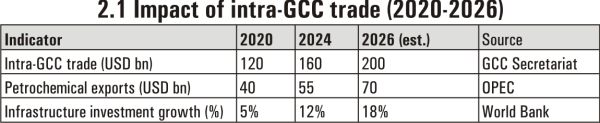
The GCC customs union rests on three technical pillars:
1.Elimination of customs duties between member states;
2.Common external tariff (generally 5%) toward non-bloc countries;
3.Coordinated customs procedures, enabling smooth logistics between Emirati ports and Saudi markets.
• 3. What the GCC common market means
The common market provides a level of mobility of production factors rarely seen outside Europe:
- Right to work and establish companies without local partners (in certain sectors);
- Equal access to financial and capital markets (regional stock exchange);
- Real estate and commercial property ownership rights for bloc citizens.
• 4. What does not exist: Monetary union
The Gulf common currency project (Khaleeji) remains stalled. Although the initiative was formally launched, by 2026 there is neither a single currency nor a unified monetary policy.
- Reason: Member states prefer to keep their currencies directly pegged to the US dollar, independently managing reserves generated by energy exports.
• 5. Convergent financial power: Sovereign Wealth Funds (SWF)
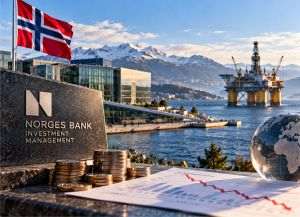
In the absence of a single currency, the "bloc effect” is generated by the raw strength of capital. GCC sovereign wealth funds manage assets exceeding USD 4 trillion, often acting in coordination.

• 6. Implications for Romania
Opportunities:
- Attracting GCC capital: Sovereign funds are seeking infrastructure and energy projects in Romania to balance their hydrocarbon portfolios;
- Energy hub: Romania can serve as a transit node for Qatari LNG toward Central Europe.
Risks:
- Regional competition: Neighboring states (Poland, Hungary) offer aggressive fiscal incentives to attract the same sovereign funds.
• 7. Case study: Hidroelectrica and the partnership with Masdar (UAE)
- Context: Romania needs massive investments to diversify its energy mix in line with EU standards.
- Challenge: Financing offshore wind projects and large solar parks.
- Solution: Hidroelectrica signed a strategic agreement with Masdar (Abu Dhabi Future Energy Company), supported by UAE sovereign funds. The partnership targets the development of renewable energy projects exceeding 1 GW.
- Result: In 2025, the first investments began increasing Romania's green production capacity, while offering Gulf partners access to the EU energy market.
- Source: Hidroelectrica Annual Reports; Qatar Investment Authority Strategic Briefs.
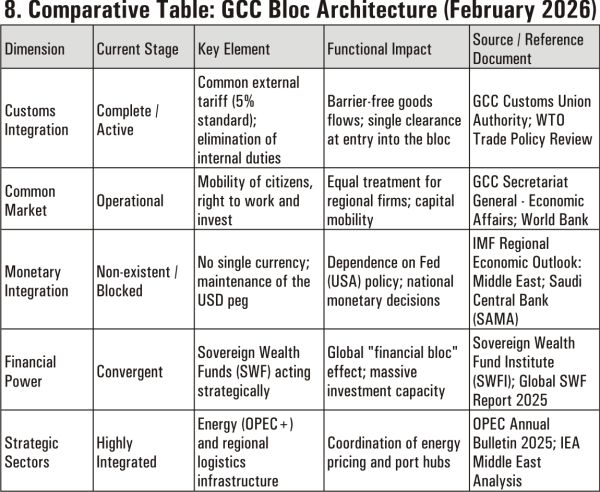
In the fragmented landscape of 2026, the Gulf Bloc represents an efficient anomaly: it functions at the customs level without massive centralized bureaucracy (like the EU) and exercises its global power through capital rather than currency. For Romania, the GCC is a vital partner for diversifying capital and energy resources.
















 Euro
Euro Dolar SUA
 Franc elveţian
 Liră sterlină
 Gram de aur