English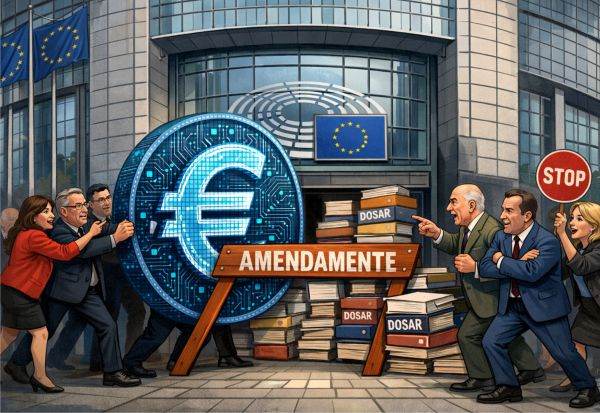
The introduction of the digital euro is blocked in the European Parliament, although such a measure would reduce dependence on the American payment infrastructure (Visa, Mastercard, PayPal), according to an article published by Euronews. The cited source states that six out of ten transactions made on the continent are processed through networks such as Visa, Mastercard or PayPal, a reality that has become for European decision-makers not only an economic problem, but one of strategic sovereignty.
In this context, the digital euro project is taking on a major political dimension. The European Union is trying to build a financial ecosystem in which the critical payment infrastructure is controlled within the community bloc. The strategy pursued by Brussels has two complementary directions. The first is the public initiative represented by the digital euro, a digital currency issued directly by the European Central Bank. The second is the development of private European alternatives to global networks, such as account-to-account payment systems and pan-European digital wallets, the most advanced of which is Wero, a project supported by the continent's major banks.
In the ECB's vision, the digital euro would represent the electronic equivalent of cash. Unlike bank deposits, it would be a direct claim on the central bank, which would offer users a level of security similar to banknotes. At the same time, the European digital currency would not operate like volatile cryptocurrencies, nor would it depend on external infrastructure, as is often the case with card payments. In addition, the digital euro would have the status of legal tender, which differentiates it from stablecoins or other private digital assets.
The ECB's institutional plan foresees the launch of a pilot project in the second half of 2027, for which European payment service providers will be invited to express their interest in 2026. The pilot would last 12 months and test the technical and operational infrastructure through controlled transactions that replicate the functioning of the final system, but without the legal status of legal tender. The actual issuance of the digital euro, however, depends on the adoption of the European legislative framework, and here the project faces a major obstacle. The European Commission presented the regulation on the digital euro in June 2023, but almost three years later the European Parliament has still not been able to adopt a formal negotiating position. The Committee on Economic and Monetary Affairs has repeatedly blocked key amendments, including those that would require the system to be fully online in parallel with the offline mode. In the European Parliament, the debate reflects the banking system's fears that a digital currency issued by the central bank could attract deposits from commercial banks, a phenomenon known as banking disintermediation. The source cited claims that, under pressure from the banking lobby, the European People's Party group supported a narrower model of a digital euro, primarily oriented towards offline use.
The source cited states that officials in Brussels want to ask the European Parliament Plenary to unblock this file, because the stakes are huge: without a parliamentary mandate, interinstitutional negotiations with the Council and the Commission cannot begin, and without a legislative agreement, the ECB Governing Council will not be able to issue a digital euro.
In parallel with the political disputes, experts consulted by Euronews warn that the European debate risks starting from an incomplete diagnosis of the problem. Judith Arnal, senior researcher at CEPS and the Real Instituto Elcano, believes that the political discourse confuses different levels of the payments ecosystem. "I'm a little worried about the current narrative I'm hearing in the European Parliament; the debate is mixing things up, basically lumping Visa, Mastercard, Apple Pay, Google Pay and Microsoft in the same category,” Judith Arnal told the source.
According to her, the retail payments system is made up of several distinct layers. Visa and Mastercard do indeed dominate the level of payment schemes, rules and transaction infrastructure, but when it comes to processing and acquiring services, the situation is different.
"In processing and acquiring, we rely exclusively on companies originating in the European Union. So there is no dependency there,” Arnal emphasizes.
In her opinion, platforms such as Apple Pay or Google Pay do not represent a real threat to European financial sovereignty, but rather raise competition issues in the technology market. "What Apple Pay creates are potential competition issues. They are different issues and we should not confuse them, because a wrong diagnosis will lead to the wrong treatment," warns Judith Arnal, who added, according to the cited source: "There is a risk of becoming captive in -anti-US corporate rhetoric, confusing the Trump administration with private companies; it is one thing to have a geopolitical dispute and quite another to simply disconnect the 27 member states from the Visa and Mastercard schemes”.
While the European institutions debate the future of the digital euro, the private sector is already moving. The pan-European digital wallet Wero, developed by the European Payments Initiative, is already operating in France, Germany and Belgium, and interoperability agreements are being extended to the rest of the continent. For the project's promoters, the goal is not to eliminate global systems, but to create a European alternative capable of balancing the market.
Ludovic Francesconi, the strategy director of the European Payments Initiative (EPI), told the cited source: "Europe is an open economy, and international schemes today represent six out of ten transactions, especially for international payments”. In his opinion, the objective of the European project is not to isolate itself from existing infrastructures, but to build a credible alternative.
Regarding the digital euro, the EPI representative takes a cautiously optimistic stance, stressing that the project needs to be integrated into a wider payments ecosystem. "We believe that cooperation is essential, although the purpose of the digital euro, beyond its monetary purpose, is still to be determined,” he says. In his view, integrating the European digital currency into existing wallets could become a natural solution: "We could discuss the best ways to include the digital euro in our wallet.”
Ludovic Francesconi argues that the future of the European payments system should be built as a public-private partnership, not as a competition between institutions and banks.
However, experts warn that the success of a European alternative is not guaranteed. For a new payment system to become relevant, merchants must consider it cheaper than card payments, consumers must benefit from an experience as simple as one-click payment, and fraud risks must be effectively managed. Judith Arnal has drawn attention to the vulnerabilities of instant payments, where the speed of transactions can magnify risks. "Once a payment is instant, it's over, period,” she says, highlighting the difficulty of recovering funds in the event of fraud.
Paradoxically, the political debate over the digital euro has already had an unexpected effect on the market. Political pressure from European institutions has accelerated initiatives by the banking sector. "I'm not sure that if the digital euro had not been on the table, the banking sector would have moved so quickly on these interoperability agreements,” says Arnal. According to her, the political momentum of the project has led European banks to move faster on projects that previously seemed too complex or too expensive.
In light of the above, as the digital euro project evolves, experts talk about a hybrid financial architecture, in which European systems like Wero would handle domestic and intra-Union transactions, global networks like Visa and Mastercard would continue to facilitate international payments, and the digital euro would function as a public safety net supported by the balance sheet of the European Central Bank.

























 Euro
Euro Dolar SUA
 Franc elveţian
 Liră sterlină
 Gram de aur